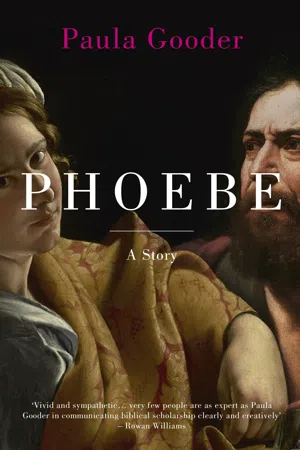
Sometime around 56 AD, the apostle Paul wrote to the church in Rome. His letter was arguably his theological masterpiece, and has continued to shape Christian faith ever since. He entrusted this letter to Phoebe, the deacon of the church at Cenchreae; in writing to the church that almost surely met in her home, Paul refers to her both as a deacon and as a helper or patron of many. But who was this remarkable woman? In this, her first novel, Biblical scholar and popular author and speaker Paula Gooder tells Phoebe's story - who she was, the life she lived and her first-century faith - and in doing so opens up Paul's theology, giving a sense of the cultural and historical pressures that shaped Paul's thinking, and the faith of the early church. Written in the gripping style of Gerd Theissen's The Shadow of the Galilean, and similarly rigorously researched, this is a novel for everyone and anyone who wants to engage more deeply and imaginatively with Paul's theology - from one of the UK's foremost New Testament scholars.
- 320 pages
- English
- ePUB (mobile friendly)
- Available on iOS & Android
eBook - ePub
About this book
Information
Part One
Phoebe: A Story
Chapter 1
‘. . . to the only wise God, through Jesus Christ, to whom be the glory forever! Amen.’
The resonant, almost melodic, voice of the reader had at last fallen silent. The final syllables of the letter seemed to hang for a few moments and then waft out into the humid air of the Roman summer evening. All around the garden a silence settled; a silence so profound that Phoebe heard, or at least thought she heard, a solitary leaf part company from the plant next to her and flutter slowly to the ground. Only then did she realise that she was holding her breath, and the odd tingling at the end of her nose suggested that it was some time since she had last remembered to breathe.
The reader hadn’t so much read the letter as performed it – his voice thundering in the opening paragraphs, thoughtful and careful in the middle, before dropping to a gentle, cheerful greeting at the end. As she awaited the Romans’ response, Phoebe’s anxiety grew and grew. In Corinth, Paul’s letters did not – to put it mildly – meet with universal acclaim. The receipt of a letter from Paul usually led to what the generous and gentle Gaius euphemistically termed a time of ‘vibrant discussion’; a ‘discussion’ that often ended when one group or another walked out and refused to return. So Phoebe had, unconsciously, held her breath as she waited to discover what form the reaction would take. She had prepared herself for almost anything, except for this: a deep silence. The quiet was such that the chirping of the cicadas felt stridently intrusive.
Phoebe exhaled. Her breath came out as a harsh sigh, and in the stillness, the sound echoed loudly, causing the people in front of her to flinch and look around in surprise. She felt her neck redden in that all too familiar blush that would soon turn her whole face into a beacon of embarrassment. In a well-used defensive movement, she tried to shrink – withdrawing into herself like the snails she used to prod in the garden as a child.
It wasn’t long before Phoebe realised the flaw in her plan. What she had never quite acknowledged, until now, was that hunching down meant spreading out; taking up less vertical space required more horizontal space. And there was none. This garden, where she was standing, was crammed with people. And not only the garden. The whole house was full of people. Every conceivable space was full. People were even hanging out of the windows that surrounded the garden, suggesting that the private family rooms inside were similarly full. Granted the house was not very big – it was much smaller, in fact, than her beautiful villa in the sea port of Cenchreae, overlooking the ever-shifting Aegean. It was exquisitely elegant, but not big, and what space it did have was currently full to bursting with human bodies.
During the reading of the letter, this press of humanity had taken on a life of its own. Ripples of irritation or agreement, of assent or outrage, had run through the crowd. As the letter neared its end, and Paul had begun to send greetings to beloved friends, passing acquaintances, and even total strangers, the ripples around the crowd had announced more clearly than words could have done where each person was to be found. The house was so full it almost felt as though the assembled company had to breathe together, just as they appeared to react together to what Paul had written.
As a result, rather than deflecting attention, Phoebe’s attempt to appear smaller was attracting it. As she shrank from what she took to be annoyed faces, she took up more room; shoving an elbow in one direction and a shoulder in another, and sending up a flurry of tuts as those around her expressed their discomfort into her burning ears. She gave up, then, and let the full heat of her embarrassment flood over her.
Up until now she had done so well in keeping her anxieties in check, though, if she was honest, since she had landed at Ostia, there had been no need for her many concerns. During the long and tedious hours aboard ship from Corinth, she had played in her mind the many possibilities of what could go wrong: being unable to work out how to get to Aristobulus’ house, getting lost, losing the precious letter, finding herself in the middle of a riot, having all her money stolen, being captured and sold as a slave in a far-flung part of the empire. No scenario – no matter how unlikely – had remained unimagined. It was only when a performing bear broke free from its chains, consumed Paul’s letter in one saliva-laden gulp before squashing the breath out of her body by sitting down on her suddenly, that she allowed herself to consider that maybe . . . just maybe . . . her imagination had run away with her.
It had come as a relief – if also a slight anticlimax – to discover that Paul’s network of messages and messengers had ensured, not only that she was expected, but that a small slave boy, with eyes as bright as a bird, had been in the port at Ostia waiting for her, and had proceeded to organise her journey to Rome with an endearing, if slightly comical, assurance far beyond his years.
A low-throated chuckle distracted her for a moment from the heat of her embarrassment. She turned and looked into a pair of sparkling eyes, brimming with life and energy. They belonged to a diminutive woman whose body seemed far too small to contain the life within. Her face was lined with age, but in such a way that hinted at adventures undertaken and challenges faced. Her clothes were well made but also well worn. It was her hands that gave the most away. These were hands of hard labour, gnarled and misshapen from years of plying a trade.
‘You’d think we’d be used to it by now.’
‘To what?’ Phoebe’s bemusement showed on her face.
‘This,’ she gestured to the crush. ‘We Romans are always crammed together no matter where we are. And you’d think we’d get used to it. But we don’t. A crowd like this makes us grumpy, and we never have time to recover our good humour before we plunge into another horde. I loved Corinth for that. It might have quite a reputation for certain things, but it felt so spacious after Rome. Aquila loved living there – and would have stayed if we hadn’t had to travel on to Ephesus with Paul – but, perversely, I pined away for the very thing I hate most when I’m here. The people, the noise, the hustle and bustle, the grumpiness . . .’
As she chattered on, it slowly dawned on Phoebe who this was. Prisca had been well known in Corinth and Phoebe had heard many stories about her. Prisca’s chatter had had two effects. One was that she had broken the deep silence in a much more natural way than Phoebe’s noisy sigh had done, causing the gentle murmur of conversation to begin rippling through the crowd. The other was that it had turned Phoebe’s attention outwards, so that her embarrassment had fallen away.
She looked up and was now able to take in the crowd of people in the house more fully than she had before. On one level, the crowd of faces was comfortingly familiar. As in Corinth, the people gathered together in this place had skin tones of various shades of brown, from the paler bronze of those who originated in Greece and Italy, through the darker shades of those from Galilee, Judea, and Egypt, to a very few faces the deep rich brown of those from Nubia. As she looked around her, she calculated that there weren’t quite as many people here as she had first assumed. There couldn’t be many more than a hundred. It was the small size of the house that made it feel as though there were more. Before a question had even half formed in her mind, Phoebe found Prisca answering it.
‘We don’t always gather like this. Have I mentioned how we hate crowds? We only come together for special occasions – like you do in Corinth. We just couldn’t agree who would get Paul’s letter first, so in the end it was fairest for us all to hear it at the same time. Not everyone could come, of course, as it’s the third day of the week and none of us Christians has a house quite big enough for everyone – not like Gaius’s beautiful home in Corinth – so we “borrowed” Aristobulus’s house for the evening.’
Phoebe’s sense of shock must have been quite evident.
Prisca chuckled. ‘No need to look quite so surprised. Blaesus, his steward . . . there,’ she pointed to a well-dressed and distinguished-looking person standing by the entrance to the garden, ‘is his favourite slave. Can’t be long now until he is due to get his freedom, though I suspect he’ll be as sad to be freed as Aristobulus will be to let him go. He has full use of the house while his master is away – and Aristobulus is away a lot. So, when we all need to come together, we often meet here, though even this isn’t big enough for everyone. We decided that the best thing to do was to hear the letter all together, then Stachys – who you heard reading the letter out – will make copies, and before you know it all the gatherings will have a copy. Then the fun will begin.’
Phoebe frowned, her confusion revealing itself in the wrinkling of her forehead.
‘I suppose it does depend on what you count as fun,’ Prisca conceded, ‘but you have to agree that Paul provokes the best conversations. Agree with him or not, it’s hard not to have an opinion on what he has to say. Once we have a copy, we can read it again, talk about it, argue if we like. Then start all over again. I’ve heard lots of Paul’s letters in my time, but never one quite like this. I wouldn’t be surprised if people are still trying to work out what it means in a few months’ time. You can’t help wondering whether even Paul knows what he means some of the time. When he’s in the flow, there’s no stopping him.’
‘Not much stopping you either,’ said a man from the other side of Prisca. ‘The real reason we parted company with Paul was so that some of the rest of us could get a word in edgeways. The two of you together left precious little time for anyone else to speak. You haven’t even introduced yourself, woman.’
Despite her embarrassment of a few moments before, suddenly, and to her great surprise, Phoebe found herself laughing. She’d heard of Prisca and Aquila from her friends in Corinth: of Prisca’s determination and Aquila’s laconic humour; of Prisca’s passion and Aquila’s compassion. Aquila was universally loved and admired. Prisca, as is the lot of strong women, evoked a more mixed response. Still, loved or not, everyone remembered her.
Prisca, so it was rumoured, had married ‘beneath her’. Aquila, originally from Pontus in Asia Minor, was a tent-maker like Paul; Prisca was from a more genteel family. That was why, they said, she was always mentioned before Aquila. Now, however, Phoebe pondered whether there might be other reasons too. Prisca’s vitality seared her powerfully into the memory. She could well imagine that when you thought of this couple, Prisca would simply come to mind first. She wondered what it might have felt like to have the twin dynamos of Paul and Prisca in Corinth at the same time.
Phoebe hadn’t been part of the community when they had been in Corinth – come to that, she hadn’t even been a Christian then either. That was a year she would never forget – the year Gallio was proconsul – and the year when her carefully constructed new life had begun to unravel. But no, she couldn’t think about that now, her emotions were unreliable enough as it was. She re-emerged into the present to hear Aquila, with a formality as gently humorous as it was sincere, declaring: ‘Phoebe, honoured deacon of the church and revered patron of many, we welcome you to Rome. May you never know loneliness here. We, your brothers and sisters in Christ, stand ready to help you in whatever you require.’
The applause that broke out all around her made Phoebe realise that Aquila’s authority, quiet though it be, was strong, and that their conversation was no longer private – if it had ever been. She looked up to see two hundred or so inquisitive eyes trained on her face. For the second time that evening, Phoebe felt her neck flush, but having learnt her lesson moments before, this time she did not try to hide.
‘What we want to know,’ a voice called out, ‘is what is the help that you need?’
‘When Phoebe is ready, she’ll tell us,’ Prisca said tartly, ‘but now we need to go home.’ And, amidst the ensuing outcry, Phoebe found herself guided skilfully through the press of people and deposited outside in the gathering gloom.
Chapter 2
Phoebe woke slowly the next morning, conscious of limbs so heavy they felt pressed into the thin mattress beneath her. The quality of the light in the room suggested that it was many hours since dawn. For an instant, caught in that delicious moment between sleep and wakefulness, she thought herself back in Cenchreae with little more to do than oversee the activity of her household slaves, and, perhaps, a few of the clients who would be lined up outside her house ready to do anything she required. With a lurch, she remembered that she was not at home, but adrift in a strange city with a task ahead of her that she could barely bring herself to acknowledge.
She remembered little of what happened after she left Aristobulus’s house. She recalled being conducted quickly and efficiently by Prisca through the dark streets until they arrived at a tenement block (which looked to Phoebe’s untrained eye very like all the other blocks they had passed on their way). Once inside, Phoebe took in a vague impression of a large room in which there was an overpowering smell of something that she couldn’t quite place. At the back of the room a simple staircase led up to another room above, separated into sections with hangings. Prisca had deposited Phoebe into one of these, and disappeared. That was the last Phoebe remembered until now.
As she emerged slowly into consciousness, she was aware both of the smell again and of a hum of conversation wafting up through the floorboards beneath her. A higher voice talking swiftly and with animation, that was Prisca; then a gentle but authoritative lower voice, clearly Aquila; but there was also a third voice, male, harsh in tone, often speaking over the other two voices and drowning them out. He seemed to be pacing around, as his voice grew fainter, then louder again as he passed under the spot where Phoebe lay.
For a while Phoebe lay still, listening more to the rhythms of what was clearly an argument than to its actual words. The words that did float upwards communicated more about the level of outrage felt by the owner of the third voice than about its cause. After a while, Phoebe could stay still no longer, and she got up swiftly and with purpose. It was only at that moment that she realised, with a gut-wrenching horror, that all her possessions – including the heavy bag of money she had brought with her to see her through her time in Rome – had been left behind at Aristobulus’s house.
When she had arrived from Ostia the house was so full of people that she had been utterly confused. She tried to remember what had happened. It was that bright-eyed slave boy who had skilfully relieved her of her travelling chest, at the same time pushing her into the press of people. As she had ...
Table of contents
- Cover
- About the Author
- Title Page
- Imprint Page
- Contents
- Part One
- Chapter 1
- Chapter 2
- Chapter 3
- Chapter 4
- Chapter 5
- Chapter 6
- Chapter 7
- Chapter 8
- Chapter 9
- Chapter 10
- Chapter 11
- Chapter 12
- Chapter 13
- Chapter 14
- Chapter 15
- Chapter 16
- Chapter 17
- Chapter 18
- Chapter 19
- Chapter 20
- Chapter 21
- Chapter 22
- Chapter 23
- Chapter 24
- Chapter 25
- Chapter 26
- Chapter 27
- Chapter 28
- Chapter 29
- Chapter 30
- Chapter 31
- Chapter 32
- Part Two
- Notes
- Select Bibliography
- Hodder Faith
Trusted by 375,005 students
Access to over 1.5 million titles for a fair monthly price.
Study more efficiently using our study tools.
Frequently asked questions
Yes, you can cancel anytime from the Subscription tab in your account settings on the Perlego website. Your subscription will stay active until the end of your current billing period. Learn how to cancel your subscription
No, books cannot be downloaded as external files, such as PDFs, for use outside of Perlego. However, you can download books within the Perlego app for offline reading on mobile or tablet. Learn how to download books offline
Perlego offers two plans: Essential and Complete
- Essential is ideal for learners and professionals who enjoy exploring a wide range of subjects. Access the Essential Library with 800,000+ trusted titles and best-sellers across business, personal growth, and the humanities. Includes unlimited reading time and Standard Read Aloud voice.
- Complete: Perfect for advanced learners and researchers needing full, unrestricted access. Unlock 1.5M+ books across hundreds of subjects, including academic and specialized titles. The Complete Plan also includes advanced features like Premium Read Aloud and Research Assistant.
We are an online textbook subscription service, where you can get access to an entire online library for less than the price of a single book per month. With over 1.5 million books across 990+ topics, we’ve got you covered! Learn about our mission
Look out for the read-aloud symbol on your next book to see if you can listen to it. The read-aloud tool reads text aloud for you, highlighting the text as it is being read. You can pause it, speed it up and slow it down. Learn more about Read Aloud
Yes! You can use the Perlego app on both iOS and Android devices to read anytime, anywhere — even offline. Perfect for commutes or when you’re on the go.
Please note we cannot support devices running on iOS 13 and Android 7 or earlier. Learn more about using the app
Please note we cannot support devices running on iOS 13 and Android 7 or earlier. Learn more about using the app
Yes, you can access Phoebe by Paula Gooder in PDF and/or ePUB format, as well as other popular books in Literature & Roman Ancient History. We have over 1.5 million books available in our catalogue for you to explore.