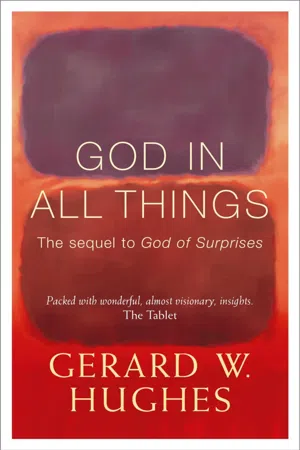
Gerard Hughes's popularity lies in the fact that he always writes directly for the individual struggling with issues of faith and life and gets right to the heart of spiritual needs and concerns. His best-seller GOD OF SURPRISES published nearly 20 years ago has sold nearly a quarter of a million copies. GOD IN ALL THINGS is a follow up to that book written for a different world and a different spiritual climate.This is a guidebook for the inner journey. It is about recognising God in the ordinary, in the joy and sadness of things, about knowing that God cannot be separated from whatever we experience. It is written for people on the fringes of Christianity, or those who are disillusioned with church structures and dogmatic theology. Hughes has written this book because he is concerned at the split between religion and life, as if religion was something apart and detached from the rest of God's creation. Apart from being a brilliant spiritual guide this book is a call to a faith in terminal decline to enlarge its concept of God and break out of the straitjacket of pious religion.
- 272 pages
- English
- ePUB (mobile friendly)
- Available on iOS & Android
eBook - ePub
God in All Things
About this book
Information
Topic
Theology & ReligionSubtopic
ChristianityCHAPTER
ONE
SPLIT SPIRITUALITY
Spirituality Popular: Churchgoing Dwindling
‘SPIRITUALITY’ HAS BECOME A fashionable word. Thirty years ago it was rarely used outside religious circles: today it appears frequently in the press and in novels, plays and films. We find the word in political manifestos and in the proposals of government, education authorities and the health service. ‘Spirituality’ has found its way into business boardrooms, and in many large bookshops there is a prominent ‘spirituality’ section on the ground floor. In the same shops, ‘religious’ books are likely to occupy a few shelves upstairs!
Today’s growing interest in spirituality is accompanied by a growing disinterest in churchgoing, with the exception of those who attend some of the black-led churches. According to the survey compiled for the BBC Soul of Britain series, church attendance fell by over 20 per cent in the years between 1989 and 1998. According to the same survey, more than 76 per cent of the national population had undergone a spiritual or religious experience that was still affecting them. These are remarkable statistics. I do not know the average age of the congregations to whom the churches minister, but in my experience of church meetings and church services, the average age of the regular churchgoer is about fifty-five and rising annually.
People are looking for spiritual guidance and the majority fail to find it in the mainstream Christian churches. Today we distinguish between being ‘spiritual’ and being ‘religious’. In this context, the word ‘religious’ implies membership of a particular church, regular attendance at its services, and adherence to its regulations. It is very often the most Christ-centred and committed people who are particularly critical of the Church, as they experience it. The ‘Church’ is accused of being hypocritical and out of touch, and more interested in self-preservation than in caring for others. The clergy are accused of being unable to listen, unable to accept criticism, and of behaving like control freaks. In such criticisms, Church/institution tends to be identified with existing clerical structures.
Pie in the Sky?
We have a very understandable movement away from ‘Church’ alongside a growing interest in spirituality: this is a clear indication of a spirituality that is seriously split. Spirituality without some visible form is like breath without a body. On the other hand, a visible form (Church) without spirituality is like a body without breath.
Spiritual movements have been springing up within Christianity since New Testament times, engendering great enthusiasm, attracting thousands of very committed people, and then splitting into separate factions before disappearing altogether. Christianity is, essentially, a down-to-earth religion. In the words of St Irenaeus writing in the second century, ‘God became a human being, so that human beings might become God.’ The word ‘spirituality’ refers to the presence of God, ‘the Spirit’ within us and among us. God is the Spirit of unity, of love and of compassion. If our life in the Spirit is genuine, it must find expression in the way we relate to one another and the way in which we organise our lives, both corporately and as individuals.
The essence of Church is the Spirit of God, and the Church is called to be the effective sign of God’s presence within us and among us. I am using the word ‘Church’ in the sense of the visible inter-relationship that must grow and develop among those who become aware of, and respond to, the Spirit rather than referring to any particular Church. A key function of Church is to point beyond itself and to make us more perceptive and responsive to the Spirit present in all peoples and all things. All church structures need to be provisional, and all are in continuous need of reform – if we divinise particular structures we are in danger of falling into idolatry. The Spirit is found through our relationships with other human beings, and in order to enable us to relate successfully we need an organisation that is pliant and adaptable because it is open to the Spirit. Spirituality that is not embodied in some kind of organisation easily becomes ‘pie in the sky’, while Church without spirituality can pose a dangerous threat to human life and freedom.
Spirituality/Church?
The Concise Oxford Dictionary defines the word ‘spiritual’ as follows:
1 of, or concerning, the spirit as opposed to matter. 2 concerned with sacred or religious things; holy; divine; inspired. 3 (of the mind etc.) refined, sensitive; not concerned with the material. 4 (of a relationship etc.) concerned with the soul or spirit etc., not with external reality.
According to this definition, the only link between the spiritual and the material is to be found in ‘sacred or religious things’. In the light of such a definition it is hardly surprising that we should have difficulty in explaining the relationship between spirituality and everyday life. Readers may well ask themselves whether, according to this definition, they rank as spiritual persons or not. How much time, attention and energy do I give to sacred things – the Church, religion, and so on – as compared with the attention I give to material things? What would be the effect upon you and your household if you became ‘spiritual’ according to the dictionary definition?
Such a definition reveals the enormous split in our spirituality. By ‘split’ I mean that God and the things of God are divided off from ordinary everyday life. God is confined to Church, religion, the sacred and the intangible. In the light of such a definition we could be forgiven for supposing that ‘spiritual’ persons must have minds and emotions of a highly refined and delicate quality – so refined that they are unconcerned with other human beings or with any created thing apart from those that qualify as ‘sacred’ or ‘religious’.
Theological Language Underpins the Split
We speak of natural and supernatural, spiritual and material, eternal and temporal, sacred and secular, grace and nature. While these can be useful distinctions, they can easily be misunderstood to indicate that there are two separate layers of reality: the natural, material layer, and the supernatural, spiritual layer. The conscientious Christian is encouraged to consider the supernatural to be of greater importance than the natural, the spiritual as more important than the material. And grace is perceived as being of infinitely greater value than nature. Such misunderstanding leads us into ‘doublethink’. Imagine that you are setting off on a long-distance flight and you find yourself praying for a safe journey. What kind of pilot would you like God to provide for you? A pilot who is spiritual according to the dictionary definition, a pilot whose mind is on God, the soul, the sacred, etc., and not on material and temporal things? Or would you prefer a good solid atheist whose primary interest during the flight is concentrated on the instrument panel and bringing the material plane with its material passengers safely back to their earthly destination?
Religious Instruction Confirms the Split
I was brought up as a Roman Catholic. From an early age I knew that God was all important, and for that I am grateful. God, in my childhood memory, was as homely and familiar as the rest of my family. Saying nightly prayers was as natural as kissing my parents goodnight, although the prayers took a bit longer. On reflection, my difficulties with God began when I was given religious instruction.
The spirituality presented to the Roman Catholic Church of my generation was divisive and split. It was divisive because we were taught that there was no salvation outside the Church, which was one, true, Catholic and apostolic. So the world was divided into Catholics and non-Catholics. As Catholics, we were forbidden to take part in the services and prayers of a ‘false’ religion, which banned us from attendance at any other Christian Church apart from the Greek and Russian Orthodox. It was divisive within our own lives, because we were taught an extremely split and dualist spirituality. The body, of which we were most immediately aware, was considered to be a threat to the spirit. One Catechism question enquired: ‘Of which must you take most care, of your body or of your soul?’ The answer was: ‘I must take most care of my soul. The body, if not corrected by self-denial, will certainly carry us to hell’! Such a spirituality was also divisive in leading us to think of God as separate and apart from us. In the words of the Catholic Catechism of my generation, God was ‘The supreme Spirit who alone exists of Himself and is infinite in all perfections’. Not the kind of God with whom one could feel at home, or want to have around on holidays. Because the spiritual was so emphasised and separated from the material, ‘worldly’ matters were not considered important. Worldly matters included our total emotional life. True faith did not seem to have much relationship to our experience of life on earth. Consequently, one could be a devout and committed Catholic without any awareness that political, social, economic and cultural questions were not only relevant to living faith in God, but integral to that faith. In 1891 Pope Leo XIII had published the first great social encyclical, which came to be known as ‘The Worker’s Charter’, but its importance and implications had still to reach most of the pews fifty years later. There was, however, a great emphasis on the ‘corporal works of mercy’, food for the hungry, drink for the thirsty, shelter for the homeless, etc. If Catholics did not necessarily tend to think globally, they generally acted locally with great generosity.
The previous paragraph is a deliberate caricature in order to show the extent to which my early religious instruction encouraged a ‘split’ spirituality. Such a caricature fails to do justice to the very attractive elements I found in Roman Catholicism, and that I still find there. It is this very attractiveness that leads me to complain constantly about the split that hides the face of God. Until we acknowledge the enormity of this split in our spirituality, we shall be unable to change; church numbers will continue to dwindle, and we shall find ourselves clinging to some Christless structure.
The Split Affects All Christian Denominations
It may be objected that the spirituality that I have been describing is no longer taught within the Roman Catholic Church. Why am I harping on about past history when today’s spirituality is far less dualistic and much more integrated?
The problem of split spirituality is wider and deeper than we realise. For the past forty years I have worked with Christians of many different denominations. The details of our spiritual upbringing may be different, but, in my experience, we all suffer from a split in our spirituality.
I worked at one time with a group of Christian psychotherapists, the majority of whose clients were Roman Catholic priests or members of religious congregations. On one occasion I asked the psychotherapists whether they ever asked clients about their prayer life. Their unanimous answer was ‘No’. When I asked the reason, I was told that it would be ‘unprofessional’ to enquire about the prayer life of clients. The reason given was that if the psychotherapist focused attention on a client’s prayer, the client might use prayer as a way of escaping from the psychological problems that had to be faced. If prayer is based upon a split spirituality it is undoubtedly true that it can be used as a way of escaping the problems that beset us, but this type of prayer tries to bypass the facts. And God is always in the facts. We cannot escape God’s reality checks for long!
It is possible to use forms of prayer that are ‘unearthed’, which bear no relation to what is, in fact, going on, as a way of escaping from our responsibilities. The psychotherapists with whom I worked were aware of this problem and their reaction was understandable, but they were wrong in assuming that their clients’ prayer was necessarily split.
A divided spirituality leads us to split the spiritual from the psychological, as though the two words referred to different parts of the person. This is a dangerous misunderstanding. It can, for example, lead us to think that the only people who are suitable for spirituality work are those who are 100 per cent psychologically sound. Such a principle would have excluded many of the greatest saints from spirituality work, not to mention the vast majority of the human race! There is no inner state in any human being that can be described as ‘purely psychological’, for God is present and at work in all our states. The distinction between psychological and spiritual does not denote two separate areas of our human psyche. It rather indicates two different ways of approaching the single psyche. As psychologists and as spiritual guides we must not create no-go areas for God – or for the psychologist. It is, however, necessary and valid to approach those areas in differing ways. It is in this context that there is a valid distinction between the spiritual and the psychological.
The Split Continues
The majority of Christians in the developed world are not opposed to a nuclear defence policy, and an even greater majority still believe in the necessity of war to preserve peace on earth. This support for nuclear defence and for war as a means of bringing peace is an indication of the divided nature of our spirituality. We all want peace, and we reckon that the possession of a nuclear arsenal, as well as conventional arms, is the best way of ensuring that peace. Most nations subscribe to the Roman aphorism ‘To preserve peace, prepare for war’, an aphorism that wins the support of the majority in most Western countries. Because of our split spirituality we can both pray for peace and at the same time support a policy of national defence that militates against peace. While our reason may convince us that the possession of nuclear arms is justified, ethical and sensible, we may experience acute discomfort if we allow God to enter into our prayer for peace. When Jesus appeared to his frightened disciples on Easter Sunday evening, he said ‘Peace be with you’ and showed them his hands and his side (John 20:20). The world’s peace is achieved through trying to become invulnerable: Christ’s peace comes through vulnerability. This truth brings us to the very uncomfortable heart of the matter.
We have become so used to a split spirituality that we no longer notice the split, which divides our hearts from our heads, our reason from our emotion. Consequently, we can produce well-reasoned arguments in favour of war and of the need for nuclear arms while, at the same time, praying to God earnestly and sincerely for peace. Without realising what we are doing, we take remarkable care not to let God interfere with our practical plans for peace. The point of the peace prayer is not to argue for pacifism, but simply to illustrate the truth that because of the split in our spirituality, we do not allow God to interfere in our practical plans for peace and war, or any other matter.
The following exercise is an imaginative one. You attend a church service on Peace Sunday and listen to this peace prayer. It has been composed by someone whose reason has convinced them of the legitimacy of nuclear defence and of just war as a means of bringing peace to the world. In the prayer, the composer, aware of the split in our spirituality, allows God to enter into the reasoning behind the prayer. The exercise is simply to notice what emotional effect this prayer has on you. Does it leave you strengthened, happy and hopeful in your attitudes, or unhappy, angry and confused? The prayer illustrates what happens when we allow God access to our feelings, when we allow our prayer to become ‘earthed’. Here is the prayer:
Dear Lord, inspire our scientists that they may invent yet more lethal weaponry (so that our deterrent may prove even more effective). Protect us from any unfortunate accident in its testing (lest it destroy us and our own cities rather than our enemies). Bless our economy that we may put these weapons into plentiful production (otherwise we cannot deter). Have a special care of the hungry, the homeless, the sick and the aged of our own land and of other lands until such time as our defence commitments allow us to contribute a little more to these worthy purposes. Strengthen our leaders in a strong defence policy. Drive out from our midst any who by thought, word or deed undermine our national security, and grant us the protection of nuclear weaponry now and forever. Amen.
This prayer is not offered as an argument against nuclear deterrence, but simply as an indication of the split nature of our spirituality. How did you feel as you read the prayer, and what did you do with those feelings? Some elements in the masculine culture still regard feelings and emotions as a sign of weakness rather than a source of wisdom. We have developed ways of praying that allow us to discount feelings. We may justify such an attitude to ourselves by claiming that we are trying to free ourselves from distractions (any activity involving the material physical world qualifies as a ‘distraction’). Such an elevated form of prayer has the great advantage of keeping God from interfering in our plans. Could the real reason for our split spirituality be the fact that it keeps God out of the way?
Another Example Illustrating the Present Split in Our Spirituality
Each reader will have a different way of carrying out the following exercise – and if you carry it out several times you may find yourself coming up with a variety of answers. The exercise introduces us to the use of the imagination, which can open up deep wells of spirituality within.
To begin the exercise, sit down and relax. Imagine there is a ring at your front doorbell. On answering it, you meet on the doorstep the Risen Lord himself. Somehow, you know beyond any shadow of doubt that it is h...
Table of contents
- Cover
- Title
- Copyright
- Contents
- Dedication
- Preface
- Acknowledgments
- 1 Split Spirituality
- 2 What Is Holiness?
- 3 Down-to-earth Holiness
- 4 Earthing Our Prayer
- 5 On Desire
- 6 Which Path to Follow?
- 7 The Path to Freedom
- 8 Pilgrimage
- 9 Reflections on Christian Unity
- 10 Reflection on Human Suffering, Death and Christian Faith
- 11 Unless You Lose Your Life . . .
- 12 Light in the Darkness
- Appendix 1
- Appendix 2
- Appendix 3
- Appendix 4
Trusted by 375,005 students
Access to over 1.5 million titles for a fair monthly price.
Study more efficiently using our study tools.
Frequently asked questions
Yes, you can cancel anytime from the Subscription tab in your account settings on the Perlego website. Your subscription will stay active until the end of your current billing period. Learn how to cancel your subscription
No, books cannot be downloaded as external files, such as PDFs, for use outside of Perlego. However, you can download books within the Perlego app for offline reading on mobile or tablet. Learn how to download books offline
Perlego offers two plans: Essential and Complete
- Essential is ideal for learners and professionals who enjoy exploring a wide range of subjects. Access the Essential Library with 800,000+ trusted titles and best-sellers across business, personal growth, and the humanities. Includes unlimited reading time and Standard Read Aloud voice.
- Complete: Perfect for advanced learners and researchers needing full, unrestricted access. Unlock 1.5M+ books across hundreds of subjects, including academic and specialized titles. The Complete Plan also includes advanced features like Premium Read Aloud and Research Assistant.
We are an online textbook subscription service, where you can get access to an entire online library for less than the price of a single book per month. With over 1.5 million books across 990+ topics, we’ve got you covered! Learn about our mission
Look out for the read-aloud symbol on your next book to see if you can listen to it. The read-aloud tool reads text aloud for you, highlighting the text as it is being read. You can pause it, speed it up and slow it down. Learn more about Read Aloud
Yes! You can use the Perlego app on both iOS and Android devices to read anytime, anywhere — even offline. Perfect for commutes or when you’re on the go.
Please note we cannot support devices running on iOS 13 and Android 7 or earlier. Learn more about using the app
Please note we cannot support devices running on iOS 13 and Android 7 or earlier. Learn more about using the app
Yes, you can access God in All Things by Gerard Hughes in PDF and/or ePUB format, as well as other popular books in Theology & Religion & Christianity. We have over 1.5 million books available in our catalogue for you to explore.