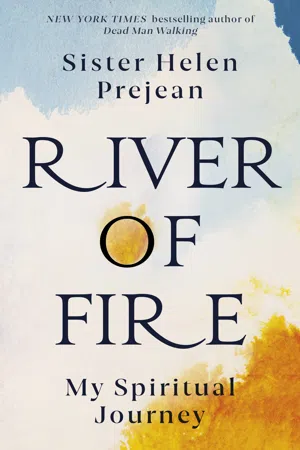
'Riveting... Providing a window into the upheaval in the church during the 1960s and 70s, Prejean's engrossing memoir also fleshes out how she rose to be an influential voice within the church before becoming a renowned proponent of abolishing the death penalty. Informing and entertaining, Prejean's exceptional memoir will be of special interest to social justice advocates. Publishers Weekly In this revelatory, intimate memoir from the author of Dead Man Walking, America's foremost leader in efforts to abolish the death penalty shares the story of her growth as a spiritual leader, speaks out about the challenges of the Catholic Church and shows that joy and religion are not mutually exclusive. Sister Helen Prejean's work as an activist nun, campaigning to educate Americans about the inhumanity of the death penalty, is known to millions worldwide. Less widely known is the evolution of her spiritual journey from praying for God to solve the world's problems to engaging full-tilt in working to transform societal injustices. Sister Helen grew up in a well-off Baton Rouge family that still employed black servants. She joined the Sisters of St Joseph at the age of eighteen and was in her forties when she had an awakening that her life's work was to immerse herself in the struggle of poor people forced to live on the margins of society. In this honest and fiercely open account, Sister Helen writes about the relationships with friends, fellow nuns and mentors who have shaped her over the years, as well as the close friendship with a priest that challenged her vocation in the 'new territory of the heart'. The final page of River of Fire ends with the opening page of Dead Man Walking, when she was first invited to correspond with a man on Louisiana's death row. River of Fire is a book for anyone interested in journeys of faith and spirituality, doubt and belief and 'catching on fire' to purpose and passion. Written in accessible, luminous prose, it is a book about how to live a spiritual life that is wide awake to the sufferings and creative opportunities of our world.
- 320 pages
- English
- ePUB (mobile friendly)
- Available on iOS & Android
eBook - ePub
About this book
Information
PART I

NOVICE
Bride of Christ
Be perfect just as your heavenly Father is perfect.
—Matthew 5:48
In the name of the Father, and of the Son, and of the Holy Ghost. Amen.
I adore Thee, O my God! I thank Thee; I offer myself to Thee without reserve. My Lord Jesus! When shall I be entirely Thine and perfectly according to Thy heart? My God and my all! I love Thee with my whole heart. In Thee do I place all my hopes.
—“Prayers on Awakening and Arising,”
Formulary of Prayers for the Use of the Sisters of Saint Joseph
At the close of the evening meal I’m performing what our Holy Rule calls a “practice of humility.” Along with a few other Sisters I’m kneeling at Mother Anthelma’s table to ask for a penance. Pinned to my veil is a placard that states my failing: “Most uncharitable,” but I have to announce my fault out loud, too: “Mother, please give me a penance for having mean and unloving thoughts about another Sister.” The idea behind the practice is that by declaring our faults publicly, we might be stirred to strive more earnestly to overcome them.
When you’re going to do a practice of humility, you go to a drawer in the dining room and select your failing from a wide selection of placards: “Unrecollected,” “Proud,” “Gossip,” “Selfish” … You pin it on and wear it during the meal. In among the placards there is also a string with a piece of broken dish tied to it. That is worn around the neck for failing in the vow of poverty by breaking something.
Among us novices, when we know a fellow novice’s failing in poverty ahead of time—like the time Sister Eugene broke a toilet seat—we’re over the top in anticipation about how she will phrase her failing to Mother. If she says “toilet” anything, the solemnity of the practice will be extinguished by hoots of laughter emanating from the novitiate side of the dining room. It doesn’t take much to set us off. With no TV or radio, we’re starved blind for entertainment. One time our table of six giggled through the entire meal, losing it every time we glanced toward Sister Anne Meridier, who’d pinned the placard “Unrecollected” upside down on her pious little head. It doesn’t help matters that meals are supposed to be eaten in solemn silence.
I have to say that the main reason I’m wearing this “Most uncharitable” placard is because of Sister Roseanne (not her real name). She has one of those bossy, pushy personalities, and in the close, constricted life of the novitiate … well, that can drive you nuts. Sister Roseanne had rushed to be the first one to arrive at the novitiate on entrance day, knowing that the “band” (class entering together) would be referred to as “Sister Roseanne’s Band.” It burned me up that she did that, which proved to be but a small harbinger of her dominating character. And now that everything in the novitiate is recoded into religious ideals, she’s doing her level best to be Number One Novice—even in holiness.
Well, to be truthful, competition gets me going, so at first sound of the 5:00 A.M. bell (the bell is the voice of God) the two of us throw on all ten pieces of the holy habit—kissing dress, veil, and rosary as we go—and race lickety-split to be first in the chapel for morning prayers. All it took to launch the race was a casual remark of our novice mistress that a really fervent novice would not only be on time for prayers but would hasten to the chapel early so she could have a few extra minutes with our blessed Lord. That was it. The race was on.
Another thing that galls me about Roseanne is that during meditation—she sits right behind me in chapel—she’s always fiddling and rustling. She can’t keep her hands still, cleaning one fingernail with another, click, click, click, and sighing deeply, one sigh after another. They reverberate seismically through the chapel—where, with everyone quietly meditating, you can hear your own breathing. So imagine click, click, sigh behind you constantly when you’re trying very, very hard to quiet your soul and enter into the depths of mystical prayer with God.
At our weekly conference, our novice mistress, Mother Noemi, talks to us about putting up with one another’s faults and foibles. Now, there’s a new nun word, foible, part of a whole new lexicon I’m learning, like edifying (good example), and modesty of the eyes (eyes lowered to avoid distractions), and religious decorum, which covers a multitude of actions: speech (demure, never raucous), walking (never swinging arms), singing (like the angels with clear notes and blending voices), politeness (answering “Yes, Mother,” “Yes, Sister”; avoiding nicknames), and even blowing your nose in nunly fashion (with men’s large white handkerchiefs).
And now foible, a quaint little word if ever there was one. I’ve seen it written but never heard it used by real people in real conversations. Well, ol’ Click may well be the Foible Queen of the World. As far as I know, I don’t have too many foibles, but you can never be sure. As Mother says, self-knowledge is hard to come by; we all have blind spots because of pride, which we’re born with as Daughters of Eve, and pride blinds, while humility opens the eyes of the soul.
Lord knows I need humility just to handle Click. I’m praying for a divine infusion of grace to overcome all the mean-spirited things I hope happen to Roseanne, the most benign of which is that Mother will move her place in chapel and foist her onto other poor souls. And it is such thoughts that now bring me to my knees at the feet of Mother Anthelma.
I’m nineteen years old, the year is 1958, and I’ve already made it through the first nine months of probation (called “postulancy”) and am now a first-year novice at St. Joseph Novitiate in New Orleans. More than anything in the world I want to be a holy nun in love with God. I want to be a saint. And, according to Catholic teaching, by joining the religious life I’m choosing the most direct route to sainthood. By my vows I will become a spouse of Jesus Christ.
Or, rather, as I am learning, I am chosen by Jesus because you can’t simply declare yourself chosen and become a nun just like that, because that might be self-will, not God’s will. Jesus said, “You have not chosen me but I have chosen you,” so you have to be invited and you have to pray long and hard, listening to your deep-down soul to hear the call. Then you have to ask admittance to the community, and merely because you’re asking doesn’t mean they’ll accept you, and I prayed and prayed and wrote and rewrote my application to Mother Mary Anthelma, the superior, asking to be admitted to the novitiate. I also had to have my parish priest, Father Marionneaux, write to Mother Anthelma to assure the community that I was a Catholic in good standing. The novitiate, where I am now, is the training ground, the place where you and the community see if there’s a “fit.”
In senior religion class at St. Joseph’s Academy, where I went to high school, Father William Borders taught us that religious life, or the Life of Perfection, is the “highest” state of life for a Christian, higher than marriage and the single life. That’s because the other states of life must be lived in the world, which is full of traps, seductions, and temptations—all lures of Satan, who is hell-bent, you better believe it, on separating souls from God.
I still have a pocket-sized New Testament given to me by my sister, Mary Ann, on my entrance day into the community. In it she inscribed:
To my favorite sister, Helen [I’m her only sister, her little joke]
I hope that you shall be very happy. You are one of God’s children who has been chosen to be in His special family. I’m very proud to tell people that I have a sister in the convent praying for me. I will need your prayers, Helen, for the way of life I have chosen is a worldly one, and I’ll have many obstacles in my way. I shall remember you always in my prayers. May you love God always and stay close to Him, as you are now.
All my love,
Mary
The highest state of life? A life of seeking perfection? Bride of Christ? I always did have high ambitions. When I was in eighth grade I announced to Sister Mark and my classmates that I intended to become either the Pope or president of the United States. A joke, of course, thrown out with a thirteen-year-old’s flippancy, and everyone laughed, but even then I harbored within my young breast a desire for greatness. After all, as president of our class had I not already exhibited solid, if not brilliant, leadership? When Maxine, our dearly loved classmate, was forced to leave us because her father was transferred away from Louisiana to the other end of the world—somewhere way up north like Detroit—had I not given a stirring speech of farewell, which moved many to tears, including Maxine herself (and almost me myself, had I not hung strenuously onto my self-control)? I reached this pinnacle of emotion in my speech simply by pointing out that Maxine’s passage from us was truly a form of death, for we, remaining in Baton Rouge, would probably never see her alive again this side of the grave. My speech stunned my classmates. It was my first intimation of the power of words.
Who knows what fame as an orator I might have achieved in the “world”?
But I’m chucking it all to embrace the hidden, prayerful life of a nun. I’m only a teenager, but I know what I want. I want to withdraw from the “world” and its temptations so I can contemplate and achieve union with God. Jesus had told Pontius Pilate, “My kingdom is not of this world,” and it is this spiritual kingdom I’m after. So, whatever happens in the “world” is of no concern to me, except I know to pray ceaselessly for sinners, especially for the conversion of atheistic, Communist Russia. I am well aware that, hands down, atheistic Communism is the single greatest threat to Catholics, who alone possess the one true faith, and to the United States of America, the unparalleled leader of the Free World.
During these two and a half years of training I will not listen to or read the news except for really big Catholic news like the election of a new pope. So I know nothing about young black men such as Emmett Till in Mississippi, beaten to death around this time for supposedly flirting with a white woman, nor do I know that in my own state of Louisiana a portable electric chair is making its way to New Orleans and other cities to kill criminals—overwhelmingly black men or boys summarily convicted of raping or murdering whites.
What do I know (or care) about that? For sixteen centuries the Catholic Church has unerringly taught (all Church teachings are free of human error, of course) that the state has the right—indeed, the duty—to keep society safe by imposing the death penalty on violent criminals. It’s clearly a question of self-defense for society, just as countries in war have a right to self-defense. Besides, if a criminal is truly remorseful and accepts death as just and rightful punishment for sin—“The last will be first,” Jesus said—that criminal can win a place in heaven along with St. Peter and the Blessed Mother and all the saints. Isn’t gaining heaven the purpose of everyone’s earthly existence?
As for poverty and injustice, when you think of it, haven’t there always been poor people in the world? Isn’t that simply the way the world is? That’s what we were taught. Kids in India starve and we in the United States have abundance. But if poor people accept their sufferings as God’s will, they can achieve an awful lot of eternal merit and win the heavenly crown, just like criminals who repent. Didn’t Jesus say to the Good Thief who died beside him on the cross, “This day you shall be with me in Paradise”? Besides, Jesus didn’t seem to think poverty was all that terrible. He even seemed to think poverty offered spiritual advantages. “Blessed are you who are poor,” he told the crowd. Maybe it was because all peasants in Galilee were poor or like himself, a craftsman, barely a notch above.
In high school, I once met some poor black families in the countryside outside of Baton Rouge when our Catholic Students Mission Crusade took them Thanksgiving baskets. Very nice baskets, packed with a lot of Christian charity: turkey, yams, corn, milk, bread—even cranberry sauce, to top off the festive meal. Three of us in a Jeep had to drive off the road and across a field to reach some shacks—tiny wooden frames with tin roofs and a front porch—and a whole bunch of kids pouring out the front door as we drove up. I asked the mama how many kids she had, so that we could hand out candy.
“Six,” she says, counting heads.
Then, out of the door comes another kid.
“Make it seven,” she says.
I loved it—told the story for months to my white friends. From my culturally superior perch I thought I had black folks all figured out. I mean, what do you expect, with all these women having litters of kids by different fathers and lending them out to kin to raise? I guess it is close to impossible to keep track. At our congregation’s health clinic in New Roads, a rural town about thirty miles out of Baton Rouge, a story circulated about Mandy, a black patient, who every year came to the clinic to have her baby. As she was leaving with number four, one of our Sisters said, “Bye, Mandy, see you next year.”
“No, you ain’t neither,” said Mandy. “We done found out what’s causin’ all dis.”
That’s black folks for you, we thought. Not a care in the world. Like the kids, squealing with delight, helping us carry the Thanksgiving goodies onto the porch. It was November and some of the kids were barefoot, and a few had runny noses, but there they all were, smiling and giggling and happy as larks that these white ladies were delivering candy and good eats for everybody.
I used to think that poor people are happier than most of us. Their minds aren’t screwed up with conflicted philosophical notions about the meaning of life. They just live. No worries about house payments or even the expense of having babies. They just collect monthly welfare checks from the government. It’s been that way forever in Louisiana, which had a huge slave population to work in the cotton and sugarcane fields, and black people still compose a hefty percentage of the state’s population. I’m not prejudiced, I’d tell myself, I’m Christian. I love all people, whatever their skin color. And I get along with “Negroes” as well as I do with anybody. I was always the one in our family who hung out in the kitchen the most, chewing the fat with the servants.
Here at the motherhouse all the servants are black—Bernice with Sister Bernard in the laundry, Lily Mae with Sister Joseph Claire in the kitchen, and Monroe with Sister Mercedes in the yard. We novices work right alongside them, cutting up vegetables and peeling potatoes or folding sheets and towels in the laundry. When I’m a professed Sister I’m looking forward to being on the “home missions” team in summer, teaching black kids their catechism in Morganza, another rural Louisiana town. After all, they’re God’s children, too. And when God looks at souls, He doesn’t see black or white. He only sees who’s in sanctifying grace and who isn’t.
One day, as the river of consciousness deepens, I will radically change my way of thinking about all of this. But not until I burst out of my cocoon of privilege. Don’t hold your breath. It’s going to take a while.
Later I’ll also realize just how much my faith is riddled with fear. So much fear that I’m even afraid of Jesus. Yes, I know he is my Savior, but he also has this no-nonsense, tough judge side. In the Gospels he makes no bones about the Last Judgment, that the saved—the sheep—will come with him into heaven, while the goats are separated out and sent to hell. It’s clearly there in the Gospel of St. Matthew, and I can just picture myself jockeying around in the final push, trying to get away from the goats and in tight with the sheep but knowing there’s no hiding, no blending in with the crowd when it comes to this final, very particular, judgment from which no human is exempt. As I’m at last approaching Jesus, getting close, I can hear him and see him point to this one and that one: You! Over here with the sheep, welcome into heaven. But terrifyingly, also: You, goat! Not you! Away from me into eternal hellfire, and I can picture the poor goat bleating pitifully, Bahhh, bahhh, I wanna be with the sheep, but off he goes, prodded and shoved with the other goats into eternal perdition. Which would I be? Sheep? Goat? All eternity, hanging in the balance, and I’m praying like mad, “Please, Jesus, please, let me be with the sheep.”
A vivid imagination can be a curse.
The morality I know I learned straig...
Table of contents
- Cover
- About the Author
- By Sister Helen Prejean
- Title Page
- Copyright
- Dedication
- Epigraph
- Contents
- Preface
- Introduction
- Part I: Novice
- Part II: Teaching and Learning
- Part III: London, Ontario
- Part IV: Becoming an Adult Church
- Part V: River Rapids
- Afterword
- Appendix: A Letter to Pope Francis
- Acknowledgments
- Footnote
Trusted by 375,005 students
Access to over 1.5 million titles for a fair monthly price.
Study more efficiently using our study tools.
Frequently asked questions
Yes, you can cancel anytime from the Subscription tab in your account settings on the Perlego website. Your subscription will stay active until the end of your current billing period. Learn how to cancel your subscription
No, books cannot be downloaded as external files, such as PDFs, for use outside of Perlego. However, you can download books within the Perlego app for offline reading on mobile or tablet. Learn how to download books offline
We are an online textbook subscription service, where you can get access to an entire online library for less than the price of a single book per month. With over 1.5 million books across 990+ topics, we’ve got you covered! Learn about our mission
Look out for the read-aloud symbol on your next book to see if you can listen to it. The read-aloud tool reads text aloud for you, highlighting the text as it is being read. You can pause it, speed it up and slow it down. Learn more about Read Aloud
Yes! You can use the Perlego app on both iOS and Android devices to read anytime, anywhere — even offline. Perfect for commutes or when you’re on the go.
Please note we cannot support devices running on iOS 13 and Android 7 or earlier. Learn more about using the app
Please note we cannot support devices running on iOS 13 and Android 7 or earlier. Learn more about using the app
Yes, you can access River of Fire by Helen Prejean in PDF and/or ePUB format, as well as other popular books in Social Sciences & Social Science Biographies. We have over 1.5 million books available in our catalogue for you to explore.