We just can't stop talking about the big questions around science and faith. They haven't gone away, as some predicted they might; in fact, we seem to talk about them more than ever. Far from being a spent force, religion continues to grow around the world. Meanwhile, Richard Dawkins and the New Atheists argue that religion is at war with science - and that we have to choose between them. It's time to consider a different way of looking at these two great cultural forces. What if science and faith might enrich each other? What if they can together give us a deep and satisfying understanding of life?Alister McGrath, one of the world's leading authorities on science and religion, engages with the big questions that Dawkins and others have raised - including origins, the burden of proof, the meaning of life, the existence of God and our place in the universe. Informed by the best and latest scholarship, Inventing the Universe is a groundbreaking new primer for the complex yet fascinating relationship between science and faith.
eBook - ePub
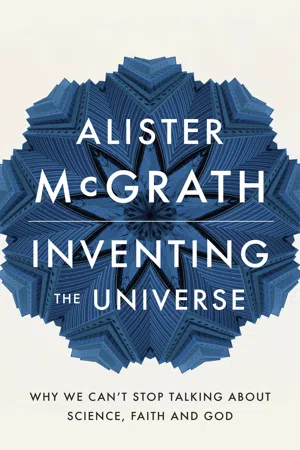
Inventing the Universe
Why we can't stop talking about science, faith and God
- 256 pages
- English
- ePUB (mobile friendly)
- Available on iOS & Android
eBook - ePub
About this book
Information
1
From Wonder to Understanding:
Beginning a Journey
Beginning a Journey
Most of us know that heart-stopping feeling of awed wonder at the beauty and majesty of nature. I remember well a journey I made across Iran in the late 1970s. I was travelling on a night bus through the vast desert between Shiraz and Kermān, when its ailing engine finally failed. It sputtered to a halt in the middle of nowhere. We all left the coach while its driver tried to fix it. I saw the stars that night as I had never seen them before – brilliant, solemn and still, in the midst of a dark and silent land. I simply cannot express in words the overwhelming feeling of awe I experienced that night – a sense of exaltation, amazement and wonder. I still feel a tingle, a shiver of pleasure, running down my spine when I recall that desert experience, all those years ago.
Rapturous Amazement: A Gateway to Understanding
For some, that sense of wonder – what Albert Einstein called ‘rapturous amazement’1 – is an end in itself. Many of the Romantic poets took this view. Towards the end of his life, the great German novelist and poet Goethe declared that a sense of astonishment or wonder was an end in itself: we should not seek anything beyond or behind this experience of wonder, but simply enjoy it for what it is.2 But for many it is not a destination, however pleasurable, but is rather a starting point for exploration and discovery.
The great Greek philosopher Aristotle also knew that sense of wonder. For him it was an invitation to explore, to set out on a journey of discovery in which our horizons are expanded, our understanding deepened and our eyes opened.3 As the great medieval philosopher Thomas Aquinas once put it, this sense of wonder elicits a desiderium sciendi, a ‘longing to know’, whose fulfilment leads to joy as much as to understanding.4
This journey of discovery involves both reason and imagination, and leads not to a new place, but rather to a new way of looking at things. There are two main outcomes of this journey of exploration. One of them is science, one of humanity’s most significant and most deeply satisfying achievements. When I was young, I wanted to study medicine. It made sense. After all, my father was a doctor and my mother a nurse. Knowing my career plans, my great-uncle – who was head of pathology at one of Ireland’s leading teaching hospitals – gave me an old microscope. It turned out to be the gateway to a new world. As I happily explored the small plants and cells I found in pond water through its lens, I developed a love of nature which remains with me to this day. It also convinced me that I wanted to know and understand nature. I would be a scientist, not a doctor.
I never regretted that decision. From the age of fifteen, I focused on physics, chemistry and mathematics. I won a major scholarship to Oxford University to study chemistry, where I specialised in quantum theory. I then went on to do doctoral research at Oxford in the laboratories of Professor Sir George Radda, working on developing new techniques for studying complex biological systems. I still have that old brass microscope on my office desk, a reminder of its pivotal role in my life.
Yet though I loved science as a young man, I had a sense that it was not complete. It helped us to understand how things worked. But what did they mean? Science gave me a neat answer to the question of how I came to be in this world. Yet it seemed unable to answer a deeper question. Why was I here? What was the point of life?
Science is wonderful at raising questions. Some can be answered immediately; some will be answerable in the future through technological advance; and some will lie beyond its capacity to answer – what my scientific hero Sir Peter Medawar (1915–87) referred to as ‘questions that science cannot answer and that no conceivable advance of science would empower it to answer’.5 What Medawar has in mind are what the philosopher Karl Popper called ‘ultimate questions’, such as the meaning of life. So does acknowledging and engaging such questions mean abandoning science? No. It simply means respecting its limits and not forcing it to become something other than science.
Why We Can’t Evade the Big Questions
The Spanish philosopher José Ortega y Gasset (1883–1955) put his finger on the point at issue here. Scientists are human beings. If we, as human beings, are to lead fulfilled lives, we need more than the partial account of reality that science offers. We need a ‘big picture’, an ‘integral idea of the universe’. As a young man, I was aware of the need for a ‘bigger narrative’, a richer vision of reality that would weave together understanding and meaning. I failed to find it. What I found to be elusive I then took to be merely illusory. Yet the idea never entirely died in either my mind or my imagination. While science had a wonderful capacity to explain, it nevertheless failed to satisfy the deeper longings and questions of humanity.
Any philosophy of life, any way of thinking about the questions that really matter, according to Ortega, will thus end up going beyond science – not because there is anything wrong with science, but precisely because its intellectual virtues are won at a price: science works so well because it is so focused and specific in its methods.
Scientific truth is characterized by its precision and the certainty of its predictions. But science achieves these admirable qualities at the cost of remaining on the level of secondary concerns, leaving ultimate and decisive questions untouched.6
For Ortega, the great intellectual virtue of science is that it knows its limits. It only answers questions that it knows it can answer on the basis of the evidence. But human curiosity wants to go further. We feel we need answers to deeper questions that we cannot avoid asking. Who are we, really? What is the point of life? As Ortega rightly observed, human beings – whether scientists or not – cannot live without answering these questions, even in a provisional way. ‘We are given no escape from ultimate questions. In one way or another they are in us, whether we like it or not. Scientific truth is exact, but it is incomplete.’ We need a richer narrative, linking understanding and meaning. That is what the American philosopher John Dewey (1859–1952) was getting at when he declared that the ‘deepest problem of modern life’ is that we have failed to integrate our ‘thoughts about the world’ with our thoughts about ‘value and purpose’.7
So we come back to that haunting and electrifying sense of wonder at the world. As we have seen, one of its outcomes is science – the attempt to understand the world around us. But there is another outcome. It is one that I initially resisted, believing that it was utterly opposed to science. The shallow materialism of my youth had no space for it. Yet I gradually came to realise that we need a richer and deeper vision of reality if we are to do justice to the complexity of the world, and live out meaningful and fulfilling lives. So just what are we talking about? The quest for God.
Like so many young people in the late 1960s, I regarded the idea of God as outdated nonsense. The 1960s were a time of intellectual and cultural change. The old certainties of the past seemed to crumble in the face of a confident expectation of a revolution that would sweep away outdated nonsense, such as belief in God. Without quite realising what I was doing, I adopted a worldview that then seemed to me to be the inevitable result of the consistent application of the scientific method. I would only believe what science could prove.
So I embraced a rather dogmatic atheism, taking delight in its intellectual minimalism and existential bleakness. So what if life had to be seen as meaningless? It was an act of intellectual bravery on my part to accept this harsh scientific truth. Religion was just a pointless relic of a credulous past, offering a spurious delusion of meaning which was easily discarded. I believed that science offered a complete, totalised explanation of the world, ruthlessly exposing its rivals as lies and delusions. Science disproved God, and all honest scientists were atheists. Science was good, and religion was evil.
It was, of course, a hopelessly simplified binary opposition. Everything was black and white, with no sense of the many shades of grey that demanded their proper recognition. But this simplistic outlook suited me just fine then. Without quite understanding what was happening, I had fallen into an ‘in-group/out-group’ mentality, which consolidates a privileged sense of belonging to a superior ‘in-group’ by ridiculing, vilifying and demonising its opponents. (It is traditionally understood to be one of the nastier features of religion, but it has now become clear that it is characteristic of any fundamentalism, whether religious or anti-religious.) Religion was intellectually wrong, and morally evil. It was a contaminant, best avoided rather than engaged.
Looking back, I now realise that the world must have seemed very simple to my sixteen-year-old mind. I lacked both the detailed knowledge of the history and philosophy of the sciences that would have shown me that things were rather more complicated than this, and the wisdom to cope with the paradoxes, ambiguity, limits and uncertainty of any serious engagement with reality.8 Yet for about three years, I was totally convinced of both the intellectual elegance of atheism and the utter stupidity of those who embraced alternative positions.
In December 1970, I learned that I had won a scholarship to study chemistry at Oxford University. Yet I could not begin my studies at Oxford until October 1971. So what was I to do in the meantime? Most of my friends left school in order to travel the world or earn some money. I decided to stay on at school and use the time to learn German and Russian, both of which would be useful for my scientific studies. Having specialised in the physical sciences for two years, I was also aware of the need to deepen my knowledge of biology, and begin to think about biochemistry. I therefore settled down to begin an extended period of reading and reflection.
After a month or so of intensive reading in the school science library in early 1971, having exhausted the works on biology, I came across a section that I had never noticed before: ‘The History and Philosophy of Science’. I had little time for this sort of material, tending to regard it as uninformed criticism of the certainties and simplicities of the natural sciences by those who felt threatened by them. Philosophy, in my view, was just pointless speculation about issues that any proper scientist could solve easily through a few well-designed experiments. What was the point? Yet in the end, I decided to read these works. If I was right, what had I to lose by doing so?
By the time I had finished reading the somewhat meagre holdings of the school in this field, I realised that I needed to do some very serious rethinking. Far from being half-witted obscurantism that placed unnecessary obstacles before the relentless pace of scientific advance, the history and philosophy of science asked all the right questions about the reliability and limits of scientific knowledge. And they were questions that I had not faced thus far – such as the under-determination of theory by data, radical theory change in the history of science, the difficulties in devising a ‘crucial experiment’, and the enormously complex issues associated with devising what was the ‘best explanation’ of a given set of observations. I was overwhelmed. It was as if a tidal wave was battering against my settled way of thinking, muddying what I had taken to be the clear, still and, above all, simple waters of scientific truth.
Things thus turned out to be rather more complicated than I had realised. My eyes had been opened and I knew there was no going back to the simplistic take on the natural sciences I had once known. I had enjoyed the beauty and innocence of a childlike attitude to the sciences, and secretly wished to remain in that secure place. Indeed, I think that part of me deeply wished that I had never picked up those books, never asked those awkward questions, and never questioned the simplicities of my scientific youth. But there could be no going back. I had stepped through a door which up to that point I did not know existed, and could not escape the new world I now began to inhabit.
I found that I could no longer hold on to what I now realise was a somewhat naïve view – that the only authentic knowledge we can possess is scientific knowledge based on empirical evidence. It became clear to me that a whole series of questions that I had dismi...
Table of contents
- Cover
- Title Page
- Imprint Page
- Dedication
- Contents
- 1 From Wonder to Understanding: Beginning a Journey
- 2 Stories, Pictures and Maps: Making Sense of Things
- 3 Theory, Evidence and Proof: How Do We Know What Is True?
- 4 Inventing the Universe: Our Strange World
- 5 Darwin and Evolution: New Questions for Science and Faith
- 6 Souls: On Being Human
- 7 The Quest for Meaning and the Limits of Science
- 8 An Empirical Ethics? Science and Morality
- 9 Science and Faith: Making Sense of the World – Making Sense of Life
- For Further Reading
- Notes
Trusted by 375,005 students
Access to over 1.5 million titles for a fair monthly price.
Study more efficiently using our study tools.
Frequently asked questions
Yes, you can cancel anytime from the Subscription tab in your account settings on the Perlego website. Your subscription will stay active until the end of your current billing period. Learn how to cancel your subscription
No, books cannot be downloaded as external files, such as PDFs, for use outside of Perlego. However, you can download books within the Perlego app for offline reading on mobile or tablet. Learn how to download books offline
Perlego offers two plans: Essential and Complete
- Essential is ideal for learners and professionals who enjoy exploring a wide range of subjects. Access the Essential Library with 800,000+ trusted titles and best-sellers across business, personal growth, and the humanities. Includes unlimited reading time and Standard Read Aloud voice.
- Complete: Perfect for advanced learners and researchers needing full, unrestricted access. Unlock 1.5M+ books across hundreds of subjects, including academic and specialized titles. The Complete Plan also includes advanced features like Premium Read Aloud and Research Assistant.
We are an online textbook subscription service, where you can get access to an entire online library for less than the price of a single book per month. With over 1.5 million books across 990+ topics, we’ve got you covered! Learn about our mission
Look out for the read-aloud symbol on your next book to see if you can listen to it. The read-aloud tool reads text aloud for you, highlighting the text as it is being read. You can pause it, speed it up and slow it down. Learn more about Read Aloud
Yes! You can use the Perlego app on both iOS and Android devices to read anytime, anywhere — even offline. Perfect for commutes or when you’re on the go.
Please note we cannot support devices running on iOS 13 and Android 7 or earlier. Learn more about using the app
Please note we cannot support devices running on iOS 13 and Android 7 or earlier. Learn more about using the app
Yes, you can access Inventing the Universe by Alister E McGrath in PDF and/or ePUB format, as well as other popular books in Biological Sciences & Christianity. We have over 1.5 million books available in our catalogue for you to explore.