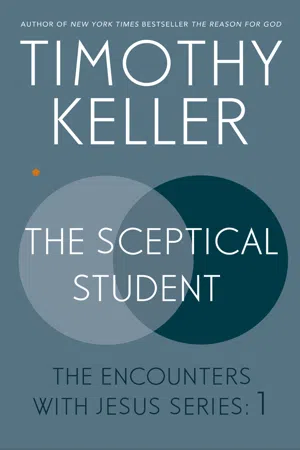
The Gospels are full of encounters that made a profound impact on those who spoke with Jesus Christ. In the first essay of his new series, Timothy Keller, pastor of New York's Redeemer Presbyterian Church and New York Times -bestselling author of The Reason for God, shows how those encounters can still have a deep effect on us today. Through a lively examination of the biblical passage where Nathanael, the sceptical student, meets with Jesus, Keller reveals how this interaction is about life's deep questions: Who are we? Why are we here? Why be a good person? Why love instead of hate? This first essay in the ten-part Encounters with Jesus series also includes an exclusive look at Timothy Keller's book on faith and work: Every Good Endeavour: Connecting Your Work to God's Work.This and the other nine in the series make up the complete Encounters With Jesus: Unexpected Answers to Life's Biggest Questions.
- 32 pages
- English
- ePUB (mobile friendly)
- Available on iOS & Android
eBook - ePub
About this book
Information
Topic
Theology & ReligionSubtopic
ChristianitySeveral years ago, I wrote a book called The Reason for God: Belief in an Age of Scepticism. Based on my twenty years of experience as a pastor in Manhattan, I chose the most persistent arguments that sceptics make against Christianity and sought to show that, in the end, they were not convincing. Then I presented what I considered to be the most compelling reasons why Christianity is the only true hope for the world and also why it makes so much sense to those who believe. I’ve always appreciated sceptics’ arguments and the invaluable role they play in defining and clarifying what is unique about Christianity. It bothers me when Christians dismiss these questions glibly or condescendingly. Taking the time and effort to answer hard questions gives believers the opportunity to deepen their own faith while creating the possibility that doubtful people may become open to the joy of Christianity.
This essay is based on the first of a series of talks I gave in Oxford Town Hall in Oxford, England in 2012. A campus group asked me to speak for five nights to students—most of them sceptics—exploring encounters that Jesus Christ had with five individuals in the Gospel of John. I could not imagine a more exciting project. First, of course, these accounts reveal the core teachings of Jesus, and in a particularly dramatic and vivid way. But the conversations Jesus had with these persons were not merely about personal sins and specific religious practices. In these encounters we see addressed the big, “meaning of life” questions: Who are we, and why are we here? Why be a good person; why love instead of hate? What’s wrong with the world? (Obviously, something is—you just have to look at the newspaper or in the mirror any given morning to be aware of that.) And what, if anything, can make it right?
Everyone has a working theory of what the answers are to these questions. If you try to live without one, you will soon be overwhelmed by how meaningless life seems. We live at a time when some insist that we don’t need any such answers, that we should admit that life is just meaningless busywork in the grand scheme of the universe, and leave it at that. When you are alive, they say, just try to enjoy yourself as much as you can, and when you are dead, you won’t be around to worry about it. So why bother about trying to find the meaning of life?
However, the French philosopher Luc Ferry, (who, by the way, is in no way a Christian himself) in his book A Brief History of Thought, says that such statements are “too brutal to be honest.” He means that people who make them cannot really believe them all the way down in their hearts. People cannot live without any hope or meaning, or without a conviction that some things are more worth doing with our lives than others. And so we know we do have to have answers to these big questions in order, as Ferry puts it, “to live well and therefore freely, capable of joy, generosity, and love.”
Ferry goes on to argue that almost all our possible answers to those big philosophical issues come from five or six major systems of thought. And today so many of the most common answers come from one system in particular. For example: Do you think it’s generally a good idea to be kind to your enemies and reach out to them rather than kill them? Ferry says this idea—that you should love your enemies—came from Christianity and nowhere else. And as we will see, there are plenty of other ideas we would consider valid, or noble, or even beautiful, that came solely from Christianity.
Therefore, if you want to be thoughtful—if you want to be sure that you are developing good answers to the fundamental questions—you need at the very least to become deeply acquainted with the teachings of Christianity and, especially, with its founder Jesus Christ. And the best way to do that is to see how he explained who he was and what he was all about to people he encountered.
One of the biggest obstacles in the way of people coming to Christianity is that they think they know all about it already. They think they already know the answers that Christianity offers to the questions of life. But based on my experience, I don’t think they usually do. So my aim in this essay, and in the subsequent ones in the Encounters with Jesus Series is to give the Christian answers to these fundamental questions by doing a close reading of several of Jesus’ encounters with various men and women. These are answers I believe we cannot live without.
The first encounter I want to look at is a subtle but powerful one with a sceptical student. It has lessons for those who are sceptical themselves about Christianity, and also for Christians who encounter scepticism from those who do not believe. To understand the encounter, we must put it in context. It comes just after what has been called the “Prologue” at the beginning of the book of John. Ferry points out that this prologue was one of the turning points in the history of thought. The Greeks believed that the universe had a rational and moral order to it, and this “order of nature” they called the Logos. For the Greeks the meaning of life was to contemplate and discern this order in the world, and they defined a well-lived life as one that conformed to it. The gospel writer John deliberately borrows the Greek philosophical term Logos and says this about Jesus:
In the beginning was the word (Logos), and the word was with God, and the word was God. He was with God in the beginning. Through Him, all things were made. Without Him, nothing was made that has been made. In Him was life, and in that life was the light of all mankind. . . . And the wo...
Table of contents
- Cover
- Contents
- Title Page
- Also by Timothy Keller
- Copyright Page
- The Sceptical Student
- Excerpt from Every Good Endeavour
- About the Author
Trusted by 375,005 students
Access to over 1.5 million titles for a fair monthly price.
Study more efficiently using our study tools.
Frequently asked questions
Yes, you can cancel anytime from the Subscription tab in your account settings on the Perlego website. Your subscription will stay active until the end of your current billing period. Learn how to cancel your subscription
No, books cannot be downloaded as external files, such as PDFs, for use outside of Perlego. However, you can download books within the Perlego app for offline reading on mobile or tablet. Learn how to download books offline
Perlego offers two plans: Essential and Complete
- Essential is ideal for learners and professionals who enjoy exploring a wide range of subjects. Access the Essential Library with 800,000+ trusted titles and best-sellers across business, personal growth, and the humanities. Includes unlimited reading time and Standard Read Aloud voice.
- Complete: Perfect for advanced learners and researchers needing full, unrestricted access. Unlock 1.5M+ books across hundreds of subjects, including academic and specialized titles. The Complete Plan also includes advanced features like Premium Read Aloud and Research Assistant.
We are an online textbook subscription service, where you can get access to an entire online library for less than the price of a single book per month. With over 1.5 million books across 990+ topics, we’ve got you covered! Learn about our mission
Look out for the read-aloud symbol on your next book to see if you can listen to it. The read-aloud tool reads text aloud for you, highlighting the text as it is being read. You can pause it, speed it up and slow it down. Learn more about Read Aloud
Yes! You can use the Perlego app on both iOS and Android devices to read anytime, anywhere — even offline. Perfect for commutes or when you’re on the go.
Please note we cannot support devices running on iOS 13 and Android 7 or earlier. Learn more about using the app
Please note we cannot support devices running on iOS 13 and Android 7 or earlier. Learn more about using the app
Yes, you can access The Sceptical Student eBook by Timothy Keller in PDF and/or ePUB format, as well as other popular books in Theology & Religion & Christianity. We have over 1.5 million books available in our catalogue for you to explore.