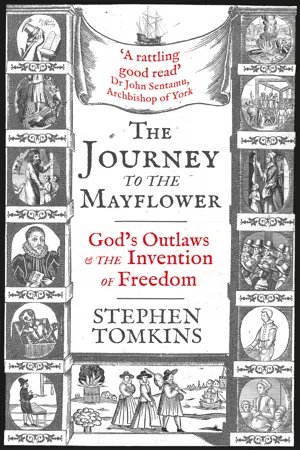
'Wonderfully learned, wonderfully written, a microscopic examination of the acorn from which a truly mighty oak would spring. I learnt a huge amount.' - Tom Holland, author of Dominion: The Making of the Western Mind 2020 sees the 400th anniversary of the sailing of the Mayflower - the ship that took the Pilgrim Fathers to the New World. It's a foundational event in American history, but it began as an English story, which pioneered the idea of religious freedom. The illegal underground movement of Protestant separatists from Elizabeth I's Church of England is a story of subterfuge and danger, arrests and interrogations, prison and executions. It starts with Queen Mary's attempts to burn Protestantism out of England, which created a Protestant underground. Later, when Elizabeth's Protestant reformation didn't go far enough, radicals recreated that underground, meeting illegally throughout England, facing prison and death for their crimes. They went into exile in the Netherlands, where they lived in poverty - and finally the New World.Stephen Tomkins tells this fascinating story - one that is rarely told as an important piece of English, as well as American, history - that is full of contemporary relevance: religious violence, the threat to national security, freedom of religion and tolerance of dangerous opinions. This is a must-read book for anyone interested in the untold story of how the Mayflower came to be launched. 'A rattling good read' - The Archbishop of York, Dr John Sentamu
- 384 pages
- English
- ePUB (mobile friendly)
- Available on iOS & Android
eBook - ePub
About this book
Trusted by 375,005 students
Access to over 1.5 million titles for a fair monthly price.
Study more efficiently using our study tools.
Information
PART ONE
The bloody beast’s gear
1
Burning sermons
In August 1553, the Bishop of Gloucester and Worcester was summoned to London. The Privy Council told him he was in trouble over a debt to the crown of £509 5s 5d in unpaid first fruits, but everyone knew the truth: the Queen wanted him burned alive.
The Catholic establishment was not in the habit of having its bishops executed, but the Protestant Reformation had changed things, in Queen Mary’s eyes. Under her half-brother Edward’s six years of Protestant rule in England, churches had been stripped, services rewritten, faithful bishops deposed, and Catholic teachings denounced and insulted from the pulpit and contradicted in the Prayer Book. Now, after Edward’s premature death, Mary embarked on a Catholic spring-clean, and those who had assaulted the Church and blasphemed its faith, even in its highest places, would be punished and purged.
The Bishop of Gloucester and Worcester, John Hooper, was high on the list. Not only had he been involved in unseating traditionalist bishops in Edward’s time – bishops who were now back in power with vengeance – but he was one of the most radical Protestants in public life, even refusing where possible to wear the traditional episcopal vestments. He was, you might say, an early puritan.
Hooper was imprisoned in the Fleet for a year and a half, and relieved of his bishopric. He paid the fee for freedom to move around inside the prison, but was kept in close confinement anyway. The cell was positioned, as he put it, between ‘the sink and filth of all the house’ and the street gutter, and he became ill, suffering sciatica and a bloated torso. Attempts were made to convert him, including exorcism, but Hooper was prepared to die for his faith. The authorities had given him the chance to flee the country, and Hooper’s friends had urged him to return to exile in Switzerland, where he had gone six years earlier to escape Henry VIII’s erratic anti-Protestant backlash. But back then he had been a mere scholar, now he was a bishop. ‘Once I did flee, and take me to my feet; but now, because I am called to this place and vocation, I am thoroughly persuaded to tarry, and to live and die with my sheep.’1
Interrogated in January 1555 in St Saviour’s Church, Southwark, by the Bishop of Winchester (whose diocese extended from Hampshire to London Bridge), Hooper was found guilty of heresy and taken by night to Newgate, the bishop’s men going ahead to dowse the costermongers’ candles so that he would not be recognised. On Monday 4 February, refusing to recant, Hooper was defrocked – a literal term in those days – and at four the following morning was woken to start his last journey back to Gloucester, hooded to avoid exciting the public.
Hooper had been loved and hated in Gloucestershire. He was perhaps the most popular preacher in England, performing (the word does justice to the entertainment value of Tudor sermons) two or three times a day to overflowing churches. He had been a driven reformer, especially after his first survey of the diocese revealed, according to one count, that fewer than half of the 311 clergy interviewed were able to list the ten commandments, thirty failed to recite the Lord’s Prayer in English, and 27 could not tell him who composed it. He even demanded a minimum religious educational standard from the laity, making one John Trigg do public penance for not knowing any of the ten commandments.
The execution of Bishop Hooper
Whether to pay loving tribute to their martyr pastor, or to enjoy a religious tyrant’s comeuppance, vast crowds gathered on the Saturday morning around St Mary’s Knapp, some perching in the great elm, to see Hooper’s gospel in the crucible. John Foxe, the chronicler of the Marian burnings, claims that 7,000 were there – an impressive head count considering the population of the city was about half that, though attractions like a market or feast would bring large numbers from the surrounding villages.
Understandably, Mary insisted the golden-tongued preacher ‘be led quietly and in silence’ and open not his mouth, but, while the sheriffs forbade him to address the crowd, they allowed him to pray aloud. Hooper in his prayer confessed to being swill, and a sink of sin, but publicly reminded the Lord that he was dying not for his offences but for his refusal to deny the gospel as he understood it, which he briefly recapitulated; the Mayor chased away two people taking notes. Hooper prayed for the patience to endure the fire, or, if it were God’s will, for the supernatural anaesthesia that ancient tradition said was granted to martyrs in their hour of death. The former request was indeed granted.
Hooper was shown a pardon from the Queen, to take effect if he would abjure his heresy even now, but he cried, ‘If you love my soul, away with it!’ He was stripped to his shirt, and the sheriffs divided up his clothes among them. Standing on a stool, he was fastened to the stake by a metal band, which the soldiers had trouble fitting around his swollen waist. The faggots and reeds were placed about his feet and lit, the wood being green to prolong his dying, but the wind was so strong that when the fire was spent, he was hurt but very much alive. The executioners kindled a second fire, which again, Foxe says, ‘burned at the nether parts, but had small power above, because of the wind, saving that it did burn his hair and scorch his skin a little’. ‘For God’s love, good people,’ Hooper cried from the unconsuming flames, ‘let me have more fire!’2
A third bundle was lit, and this finally did the job. Hooper called out repeatedly, ‘Lord Jesus, have mercy upon me! Lord Jesus receive my spirit!’ Foxe concludes:
When he was black in the mouth, and his tongue swollen, that he could not speak, yet his lips went till they were shrunk to the gums: and he knocked his breast with his hands till one of his arms fell off, and then knocked still with the other, what time the fat, water, and blood, dropped out at his fingers’ ends, until by renewing of the fire, his strength was gone, and his hand did cleave fast, in knocking, to the iron upon his breast. So immediately, bowing forwards, he yielded up his spirit.3
He had been three-quarters of an hour in the fire.
Between 280 and 300 men and women died on Mary’s bonfires in the course of four years, including bricklayers and gentlefolk, university fellows and illiterate workers, a ‘blind boy’ and an ‘aged woman’, and five bishops including the Archbishop of Canterbury. The theory behind burning heretics was that it intimidated their fellow travellers while edifying the faithful, giving both a tangible sense of the hellishness of false doctrine. But as Peter Marshall puts it, ‘the meaning of those deaths could never be entirely controlled by the oppressors’. Mary’s spectacles seemed to leave much of the audience with the disastrous impression that saints had been martyred. Foxe’s stories, compelling works of Protestant propaganda published in 1563 as the Book of Martyrs, naturally tend to present the victims as brave heroes roasting joyfully before tearful, admiring crowds, but Catholic observers painted much the same picture. Witnessing the first burning, that of John Rogers the Bible translator, in Smithfield five days before Hooper’s, the French ambassador said Rogers went to his death ‘as if he had been led to a wedding’, accompanied by his children and cheered on by the crowd. Mary’s Spanish chaplain Simon Renard reported the same event: ‘Some of the onlookers wept, others prayed to God to give him strength, perseverance, and patience to bear the pain and not to recant, others gathered the ashes and bones and wrapped them up in paper to preserve them, yet others threatening the bishops.’4
As a more recent commentator, Ted Hughes, put it, in a poem about the execution of the Bishop of St David’s the following month:
No pulpit
Of his ever held their eyes so still,
…
Out of his mouth, fire like a glory broke,
And smoke burned his sermon into the skies.5
‘The blood of Christians is seed’, exulted the second-century apologist Tertullian when the faithful were being killed by Rome fourteen centuries previously, and now once again there went out a sower to sow.
The Marian burnings
This is where the story of the Pilgrim Fathers starts, with Mary’s campaign to burn Protestantism out of England. It was this more than anything that ignited the first puritan movement and lit the pilgrims’ way into the religious underground, into exile and into the New World. Always, behind all their passions, their longings and hatreds, their dreams and sacrifices, and their wranglings over theological trivia, there is the heat of Mary’s fires. The founders of the Separatist movement that would take them to the Netherlands and North America lived and hid and prayed through this assault, and it changed their view of the world. It gave them an arch-enemy and divided the world into two bodies: of Christ and antichrist. It forced them to choose whether they would stay true, despite the danger, to the gospel they had embraced or bend the knee to another lord; and in so doing it made religion what a millennium of Christian rule over Europe had, at all costs, prevented it from being: a matter of choice. Their revolutionary, pioneering, fanatical movement was forged in these fires.
The motive that persuaded Mary, by nature the mildest of Tudor monarchs, to execute her subjects for their crimes of belief was above all a hatred of the religion that had wrecked her life. When, in her adolescence, it became clear that she would be Henry VIII and Catherine of Aragon’s only surviving child, Henry feared his failure to produce an heir would destroy the young Tudor dynasty and plunge England back into civil war. A papal dispensation overruling canon law had allowed Henry to marry Catherine in the first place, but now Pope Clement VII was controlled by the Catholic Emperor Charles V, Catherine’s nephew, and could not oblige. Thus it was, for every reason except religion, that Henry turned to Protestantism. Taking the church away from Rome solved his marital problems, and confiscating the houses and vast lands of the monks solved his financial problems for a while. He took the title ‘Supreme Head of the Church of England’ but continued to enforce Catholic worship and doctrine, executing both Protestants and Catholics who opposed him. It was a reformation unlike any other in Europe, one entirely steered by the whim of the monarch.
When Parliament declared Catherine unqueened in 1534, Mary became illegitimate and unmarriageable, was banished from court and excluded from succession to the throne (until she was eventually reconciled to Henry), and she never saw her mother again. Her Protestant stepmother Anne Boleyn humiliated her and pressed Henry to have her killed, but instead Mary was made a servant to her baby half-sister Elizabeth. She threw herself into piety and was perpetually unwell. During her brother’s Protestant reign, a diplomat reported that Mary would constantly repeat, ‘Si deus est pro nobis, quis contra nos?’ If God is for us, who can be against us?
This text was proved true when the dying Edward was persuaded to exclude Mary once again from the royal succession, this time in favour of his adviser’s daughter-in-law Jane Grey. Against the warnings of her most trusted counsellors, Mary raised an army, successfully seized the throne and received a rapturous welcome from crowds hailing the legitimate sovereign. God was for her; she was to rule by and for God.
Mary’s assault on Protestants was not a matter of political expediency then, but a crusade against evil and a war on error. Rome had condemned Protestant teachings as ‘pernicious poison’ to be purged, and she had the divine anointing to administer the purgation. Fire had been the Catholic defence against heresy for centuries, and the English laws requiring it had only been repealed under Henry and Edward. Mary’s third Parliament eventually agreed to reinstate the heresy laws, and she started immediately. Mary’s more worldly advisers, including her trusted chaplain Renard, implored her to restrain herself, fearing that public cruelty would squander the goodwill of the people and provoke an uprising, but she would not be tempted. She believed in forgiving crimes against herself wherever possible, but heresy only became a crime to be forgiven after a heretic recanted. Till then it was a disease to be cured.
The rationale for persecution
Mary had every reason to believe she could overcome faith with fire. Public judicial murder did not revolt sixteenth-century viewers or discredit the persecutor. Thousands of people were executed every year in England and Wales, to the great diversion of the public, and torture and mutilation were standard acts of justice. Mary’s heretics probably increased the annual total of executions by no more than 3 per cent. Burning was a cruel punishment to be sure, but no more so than the hanging, drawing and quartering of traitors. The burnings of Protestants in Spain were hugely popular cruelties; they burned no sermons into the skies, but successfully eradicated Spanish Protestantism, just as holy fire had destroyed earlier movements. The blood of martyrs is not always seed; sometimes it is just blood.
Neither were most viewers shocked that victims were killed for their religious beliefs. The whole of western and central Europe had been united in the one Christian faith for a millennium before Protestantism had appeared thirty-five years ago, so agreement seemed obviously possible and natural, as well as desirable. Religious dissent threatened the fabric of society and lured people into hell. It was as widely understood that the population must be united in one religion as it is, by us today, that citizens must all be subject to the same laws; and it was as vital to stamp out wrong religion as it is to stop medical malpractice.
Protestantism had in it the seeds that could in time grow to overturn such preconceptions: its fundamental innovation was to enthrone the principle that a person has the responsibility to listen to their own conscience, and the right to follow their own mind, as Martin Luther had demonstrated unforgettably at Worms. But other forces pulled the movement in the opposite direction. One was the millennium of experience in which church was a whole Christian society, making it hard to think of church in any other way. In this arrangement, religious leaders and thinkers had power over the whole population, power that they were in no hurry to throw away now. And there was the conviction that eternal souls were at stake and false beliefs would damn them, so no punishment could be crueller than allowing religious misinformation to thrive.
Protestants, while condemning Catholicism as a creed of persecution, could be as ruthless with heretics as Catholics were. Bishops that Mary burned had themselves, during Edward’s reign, approved the execution of a man who denied the deity of Christ and a woman who believed that Jesus grew in Mary’s womb without taking her flesh; other radicals had recanted when threatened with violence. The main difference between Catholics and Protestants on the issue of heresies was whether Protestantism was one. Almost the only Christians who disapproved of persecution per se were the radical Protestant spin-off the Anabaptists, who denounced the very idea of a state church – and therefore were killed, eradicated as a religious and political plague, by almost any authority, Protestant or Catholic, who found Anabaptists in their realm. The number of Anabaptists in England was minuscule, and the real extremism of the movement had been distorted into horrible proportions in the minds of others by the Anabaptist revolution in Münster in the 1530s, which had involved communism and polygamy am...
Table of contents
- Cover Page
- Title Page
- About the Author
- Also by Stephen Tomkins
- Dedication
- How to Use this eBook
- Contents
- Introduction
- Part One: The bloody beast’s gear
- Part Two: The willing sort
- Part Three: New Jordans
- Epilogue: The long run
- Notes
- Martin Luther
- Copyright
Frequently asked questions
Yes, you can cancel anytime from the Subscription tab in your account settings on the Perlego website. Your subscription will stay active until the end of your current billing period. Learn how to cancel your subscription
No, books cannot be downloaded as external files, such as PDFs, for use outside of Perlego. However, you can download books within the Perlego app for offline reading on mobile or tablet. Learn how to download books offline
Perlego offers two plans: Essential and Complete
- Essential is ideal for learners and professionals who enjoy exploring a wide range of subjects. Access the Essential Library with 800,000+ trusted titles and best-sellers across business, personal growth, and the humanities. Includes unlimited reading time and Standard Read Aloud voice.
- Complete: Perfect for advanced learners and researchers needing full, unrestricted access. Unlock 1.5M+ books across hundreds of subjects, including academic and specialized titles. The Complete Plan also includes advanced features like Premium Read Aloud and Research Assistant.
We are an online textbook subscription service, where you can get access to an entire online library for less than the price of a single book per month. With over 1.5 million books across 990+ topics, we’ve got you covered! Learn about our mission
Look out for the read-aloud symbol on your next book to see if you can listen to it. The read-aloud tool reads text aloud for you, highlighting the text as it is being read. You can pause it, speed it up and slow it down. Learn more about Read Aloud
Yes! You can use the Perlego app on both iOS and Android devices to read anytime, anywhere — even offline. Perfect for commutes or when you’re on the go.
Please note we cannot support devices running on iOS 13 and Android 7 or earlier. Learn more about using the app
Please note we cannot support devices running on iOS 13 and Android 7 or earlier. Learn more about using the app
Yes, you can access The Journey to the Mayflower by Stephen Tomkins in PDF and/or ePUB format, as well as other popular books in History & Early Modern History. We have over 1.5 million books available in our catalogue for you to explore.