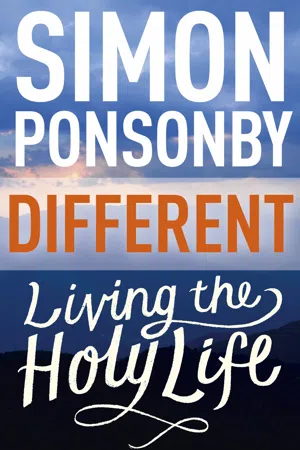
Simon Ponsonby has been called a 'preacher's preacher' on the one hand, and a 'people's theologian' on the other. He speaks and writes from a passion to see God glorified and people's lives changed - and with an increasing concern that too often, even those who are deeply committed to Christianity and church still don't seem to be much different from anyone else.In this punchy new book Simon sets out the challenge for all of us to look hard at our own lives and think about the life God is calling us to - to deal with the things that prevent us from following in spirit and in truth, and to face up to our failure to be true to the task God has set us. Tackling tough issues from porn to family life and digging deep into Bible stories from classics like Daniel and the Lion's Den to hard passages like those dealing with the Israelites' worship of Baal and Asherah, Simon takes us with him on a wide-ranging journey into the heart of what God wants for his people. Holiness is not always an easy read, but it is an important book that might just shake the church out of its current crisis if we will come together to heed its call to a deeper holiness that the world will see and take notice of.
- 224 pages
- English
- ePUB (mobile friendly)
- Available on iOS & Android
eBook - ePub
About this book
Information
Topic
Teologia e religioneSubtopic
CristianesimoChapter 1
Sindividual
. . . for all have sinned and fall short of the glory of God. (Romans 3:23)
For the wages of sin is death, but the gift of God is eternal life in Christ Jesus our Lord. (Romans 6:23)
Christianity rejects as a fiction the notion that humankind of its own devices can significantly improve itself without God. It lays the blame for the world’s ills on what it terms sin, the universally prevalent and malevolent moral virus. Sin is anything we think, say, do or don’t do that contravenes what God would have us think, say, do or not do. What God would have us say, think, do or not do is revealed to all in the conscience, in Scripture, in a general revelation in natural law, and pre-eminently in Christ. Sin is a refusal to live life God’s way.
I was leading a retreat when I met Carol. A woman in her early sixties, she was effervescent with delight in Christ. There was a transparent integrity to her joy that was infectious, as she shared how she was actively and effectively involved in mission teams and evangelism. I asked her to tell me something of her journey of faith. She began by sharing how over many years, from a young lady into middle age, her life had been shrouded in clouds of dark memories because of something she had done that left deep shame and guilt. She had no Christian background, but her husband was a nominal Catholic and he compounded her sense of guilt by saying that the things from her past that plagued her were in fact Mortal Sins from which there could be no forgiveness, and she was condemned to hell. (Some husbands can be less than helpful!) So she would sometimes pray to the unknown god in the sky to forgive her, and occasionally would go into a church to kneel at the rail and seek to cast off her angst-ridden burden of guilt. But nothing helped and she felt emotionally, existentially and spiritually ground into the ground by it.
One day as she was driving to the supermarket, into her mind as clear as a bell dropped the words ‘Romans 3 verse 23’. Having no church background, she initially had no idea where on earth these words came from or what on earth they meant. She did her shopping and returned home, but these words stayed in her mind and she wondered at last if they might be from the Bible. Rummaging around she found an old Authorised Version Family Bible, and set to searching – sure enough she soon located the verse that had echoed in her mind: ‘for all have sinned and fall short of the glory of God’.
Yes! Exactly! This Scripture verse held up the mirror to her condition, making sense of her years of shame and pain – she, like all of us, had sinned, and her existential trauma was the result of being separated from God in his glory and goodness. She read on, ‘and all are justified freely by his grace through the redemption that came by Christ Jesus’. Oh, the relief. The shame, judgement, guilt and dread of the years fell away as she drank in great draughts of grace. She saw it all so clearly: she was a sinner, no question about that, and so was everybody, but her sin was not the end of the matter. God, knowing her sins full well, had acted in Jesus’ death to deal with her sins, to forgive her and to free her. Jesus had done what she could not do: he had purchased her forgiveness. Peace and joy flooded her – the weight of years was shed as she wept and fell into God’s forgiving welcoming arms. When I met her, this revelation and liberation still seemed fresh to her and was evident to us – no wonder she was so filled with life: she knew God, she knew her sins were forgiven, she knew her glory restored.
Things can only get better . . . or maybe worse
I was invited to be part of a small panel in a public debate on the theme of ‘Sin and Society’ – taking part were an ordained psychologist, a university academic theologian and me, introduced as a priest practitioner. One of the panellists suggested optimistically that the world was, objectively, getting better. In some senses, of course, it certainly is. I had that week read a Grimsby synagogue Jewish burial register from the late nineteenth century (I know, I know, my reading is bizarrely eclectic). On one page, almost every entry recorded the death of a child in infancy – thankfully, things have changed and today more than a third of babies born in the West are expected to live to a hundred. Perusing statistics about numbers of deaths in war, from hunger, overall quality of life, access to education, real wealth, we can see that many things that might frame how we judge life’s goodness are indeed improving. However, fresh in my mind was the last time I had been in that church, a couple of years before. Walking by one evening, a crowd had gathered and the church had been cordoned off. The policeman on duty told me that a man was at the top of the tower preparing to jump off. He seemed rather shaken and told me that it was his first day back to work after a colleague’s suicide. He was disgusted that the crowd outside were cynically holding up their phones to record the event and shouting, ‘Jump, jump, jump.’ By the time I got to the top of the tower, two policewomen there had already succeeded in talking down the potential suicide. But I asked the debaters whether people – intrinsically, in their natures – are actually improving? My answer was no.
The same day as that debate on sin, I attended a seminar on pornography. In 1998 there were 28,000 X-rated porn sites on the Internet; one generation later there are upwards of 30 million. Years ago porn was for sad men tall enough to reach up to the top shelf. But we have witnessed an exponential rise in immorality as porn becomes the norm, with an estimated 68 per cent of young men and 18 per cent of young women using it weekly.1 More worrying is the abuse and sex trafficking that walk hand in hand with the porn industry,2 not to mention the psychological and social effects that are disastrous for everyone involved. Brave new world? More like depraved new world.
Morally we are confused: there was an international outcry a few years ago when a cat was thrown in a bin, and more recently when a big-game hunter killed a lion, yet there is silence and apparent indifference about the 200,000 unborn babies aborted each year in England. There has been a serious reattribution in our morality and of our values when cats, whether domestic or wild, are worth more than defenceless humans made in God’s image; surely we have lost perspective?
The prophet Isaiah foresaw that the day would come when evil was called good and good evil. That day, I fear, has come. Professor Christina Hoff Sommers, the notable US philosopher and ethicist, claims ‘We have been thrown back into a moral stone age’ and illustrates this by noting that when she asks modern university students about categories of right and wrong, most react by becoming visibly ‘insecure’, because ‘they don’t believe there is such a thing, they believe each person must decide for themselves’.3 Dostoyevsky posited – and Nietzsche et al. have built on his statement – that ‘Where there is no God, everything is permissible.’ When you abandon God, you abandon the only authoritative basis for defining right from wrong. Without an absolute moral reference point, a divine lawgiver, a moral arbiter, then right and wrong are merely pragmatic social constructs that blow where the wind takes them. But if there is a God, and if he indeed establishes moral commands on the basis of his moral integrity, then failure to comply is at best foolish and at worst blasphemous.
This is what we call sin. I want to explore four characteristics of sin and our relationship with it.
1. We are all sindividuals
The Bible says that ‘sindividualism’ is a universal problem: as Romans 3:23 says, ‘all have sinned and fall short . . .’ The psychiatrist Dr Karl Menninger wrote a bestseller called Whatever Became of Sin?4 He recalled a sunny day in September 1972. A stern-faced, plainly dressed man stood still on a busy street corner in Chicago. As pedestrians rushed on their way to lunch or a business meeting or work, this stranger would theatrically raise his right arm, and point at a person near him and declare loudly just one word: ‘GUILTY!’ The effect on the passers-by was extraordinary. They would stop in their tracks, stare at him, hesitate, look away, look at each other, and then rush away. One gentleman turned to another and exclaimed: ‘But how did he know?’ How did he know that all were guilty of something? Well, because it isn’t rocket science that all are guilty of something. All have sinned, and not just superficially and occasionally – according to the Bible, we are all ‘sindividuals’ – not simply individuals who sin, but people who are sinners: sin is who we have become, not simply what we do.
Sir Arthur Conan Doyle, the well-known detective novelist and an astute student of human nature, was also a practical joker. In a (possibly apocryphal) story, he sent twelve pals, all establishment figures, a telegram stating succinctly: ‘Flee immediately, all is discovered.’ Apparently, ten of the twelve left the country that weekend. I am so curious about what it was they each feared disclosure of.
Mind you, people don’t need telling that they are sinful. Their consciences tell them so. I have only met one person who claimed he had never sinned – and he was a nut job. Some, it’s true, try to justify their sin as not really ‘that’ sinful; some try to pass the buck, or blame their environment, poor education, even their DNA. Some, while recognising sin in themselves, try to suppress it by the exercise of their will-power; while many religious types attempt to atone for their own sin, to balance the scales in their favour by doing ‘good works’. Mostly, people compare themselves against others – the worst they can think of: sexual offenders, or Nazi criminals – and take comfort that by contrast they are really rather good people. Of course, by comparison to Hitler everyone comes off well, but the correct comparison is not with the worst but the best: Jesus Christ. Paul says we sin and fall short of God’s glory – the beauty of his glory is moral perfection, and that is the standard. As German theologian W. Günther writes, ‘Yahweh is the yardstick.’5
Many times when folk hear I’m a priest I’ve received the response, ‘I’m not religious, but I keep the commandments.’ My reply is generally to ask, ‘Which ones?’ Which commandments of God do you keep? All 613 precepts of the Torah? The Ten Commandments? Really?
What about Jesus’ summary of the law into just two rules: ‘Love the Lord your God with all your heart and with all your soul and with all your mind and with all your strength’, and ‘Love your neighbour as yourself’ (Mark 12:30, 31). When I ask that question it generally receives a frown – but it’s not intended to win a cheap point: we need to see the seriousness of our condition of sin. And yes, while some of us may keep some of God’s commandments, his laws are not a multiple-choice test inviting us to attempt three questions out of ten. The fact is, all of us fail most of God’s moral law, most of the time.
2. Sindividuals are miserable
The tragic irony of sin is that the little slips that may appear insignificant – or at times downright appealing – are so very costly. At creation we were clothed and crowned with glory – God’s own glory, God’s life-giving goodness, his radiance and divine effulgence. This was the atmosphere in which we lived and moved and had our being. But sin is a disaster, as our first parents experienced; their sin unleashed a universal apocalypse, but all of us have a personal responsibility in that all have sinned. Sin separates us from a Holy God – no wonder he seems like a ‘pie in the sky’ idea to our earthbound perception. Sin separates us from the Holy God who is the source of all life and so we forfeit life eternal and the life intended. Without God, life begins to escape from our every pore the moment we take breath. In sin we fade away: we are the grey ones, wraiths, shadows of the image of God we were destined to be. In falling away from the Holy God, the God of all glory, we forfeit our glory – everything about us is tarnished. The Danish philosopher Kierkegaard understood this, writing, ‘sin alone is man’s ruin’. Truly, sin is an assassin, a life-taker – nothing good ever came of it. Malcolm Muggeridge quotes St Teresa of Avila as saying ‘life in this world is like a night in a second-class hotel’6 – for some, I’d say, it is a little better than that, for some considerably worse. A few seem so numbed as to have no residue of longing for lost glory or lost God; but most of us marred God-image-bearers have a deep-down inchoate nostalgia, Pascal’s ‘God-shaped void’, that cannot be satisfied by anything else. This is the restless heart’s eternal quest for a home of which St Augustine spoke so powerfully.
Billy Graham’s final sermon, a video presentation of the cross,7 features two extraordinary testimonies of transformation, by a rapper known as Lecrae and a folk-rock singer, Lacey Sturm. They are open and honest about their lives, their pain, their failings, and their emotions before they met Jesus. Lacey recalls how ‘I couldn’t get away from my own depression’ – searching for light and liberty she explored various therapies and philosophies but came away empty: ‘a lot of nice ideas, but there wasn’t any tangible healing . . . I remember thinking, “I’m tired of the pain in my heart – I’m tired of going to bed that way, I’m tired of feeling a burden, I’m tired of not knowing why I am alive.”’ Such was this existential wilderness, with no pain-killing palliate, that she lost all hope of ever seeing a change and spiralled into despair, firmly resolved to end it all.
The rapper, Lecrae, who tell us his nickname was ‘crazy’, had lost all bearings – caught up with guns, gangs, drugs, sex, he was on a trajectory that would have seen him either incarcerated for his crimes or lying dead in the street through gang violence. He recalls how he felt at that time: ‘I was really hurting and I did not understand the source of all my pain and problems . . . I spent my whole life burdened for something, hungering, thirsting, chasing after this thing I could not put my finger on.’ Both Lacey and Lecrae referred independently to their pain, and that’s where sin and separation l...
Table of contents
- Cover
- Title Page
- Imprint Page
- Dedication
- Contents
- Introduction
- 1 Sindividual
- 2 New
- 3 Thy Will – My Will
- 4 Take Off Your Shoes
- 5 Religion is Nuts
- 6 Even Tigger Needs a Hug
- 7 Baal and Asherah
- 8 Porn Free
- 9 Idols or Bibles
- 10 The Lion in Daniel
- 11 Drift and Drown
- 12 Turnings
- Epilogue – Christ Formed in You
- End Notes and Bibliography
- Acknowledgements
Trusted by 375,005 students
Access to over 1.5 million titles for a fair monthly price.
Study more efficiently using our study tools.
Frequently asked questions
Yes, you can cancel anytime from the Subscription tab in your account settings on the Perlego website. Your subscription will stay active until the end of your current billing period. Learn how to cancel your subscription
No, books cannot be downloaded as external files, such as PDFs, for use outside of Perlego. However, you can download books within the Perlego app for offline reading on mobile or tablet. Learn how to download books offline
Perlego offers two plans: Essential and Complete
- Essential is ideal for learners and professionals who enjoy exploring a wide range of subjects. Access the Essential Library with 800,000+ trusted titles and best-sellers across business, personal growth, and the humanities. Includes unlimited reading time and Standard Read Aloud voice.
- Complete: Perfect for advanced learners and researchers needing full, unrestricted access. Unlock 1.5M+ books across hundreds of subjects, including academic and specialized titles. The Complete Plan also includes advanced features like Premium Read Aloud and Research Assistant.
We are an online textbook subscription service, where you can get access to an entire online library for less than the price of a single book per month. With over 1.5 million books across 990+ topics, we’ve got you covered! Learn about our mission
Look out for the read-aloud symbol on your next book to see if you can listen to it. The read-aloud tool reads text aloud for you, highlighting the text as it is being read. You can pause it, speed it up and slow it down. Learn more about Read Aloud
Yes! You can use the Perlego app on both iOS and Android devices to read anytime, anywhere — even offline. Perfect for commutes or when you’re on the go.
Please note we cannot support devices running on iOS 13 and Android 7 or earlier. Learn more about using the app
Please note we cannot support devices running on iOS 13 and Android 7 or earlier. Learn more about using the app
Yes, you can access Different by Simon Ponsonby in PDF and/or ePUB format, as well as other popular books in Teologia e religione & Cristianesimo. We have over 1.5 million books available in our catalogue for you to explore.