'a fiercely intelligent theologian and historian' - The Independent ' Miranda gives us the confidence to sit and taste the Bible's profound and life-changing goodness.' - Stephen Cottrell, Archbishop of York As a vicar, Miranda Threlfall-Holmes is used to being asked to recommend a book on how and why to read the Bible. Filling the gap between popular Bible reading notes and more academic books, How to Eat Bread is the book she'd give to anyone wanting to explore the Bible as part of their faith. Its three main sections delve into the rich heritage of how Christians have read the Bible down the ages: From the Larder - ways that scripture itself uses other parts of scripture, or models and demonstrates different ways of reading
Grandma's Recipe Book - historical methods of biblical interpretation
Molecular Gastronomy - the insights and methods of modern theological hermeneuticsEncouraging readers to try out a variety of tried and tested ways of Bible reading, experiment with different ingredients and sample the results, How to Eat Bread is a refreshingly hands-on approach to understanding this ancient library of texts. 'exhilarating and hands-on... Miranda Threlfall-Holmes provides a fantastic guide' - Fergus Butler-Gallie
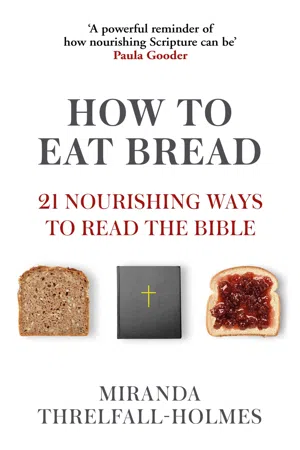
- 208 pages
- English
- ePUB (mobile friendly)
- Available on iOS & Android
eBook - ePub
About this book
Information
Topic
Theology & ReligionSubtopic
BiblesPART ONE
From the store cupboard: Scripture
1
Arguing with God
Read: Genesis 18:20–33
Then the LORD said, ‘How great is the outcry against Sodom and Gomorrah and how very grave their sin! I must go down and see whether they have done altogether according to the outcry that has come to me; and if not, I will know.’ So the men turned from there, and went towards Sodom, while Abraham remained standing before the LORD. Then Abraham came near and said, ‘Will you indeed sweep away the righteous with the wicked? Suppose there are fifty righteous within the city; will you then sweep away the place and not forgive it for the fifty righteous who are in it? Far be it from you to do such a thing, to slay the righteous with the wicked, so that the righteous fare as the wicked! Far be that from you! Shall not the Judge of all the earth do what is just?’ And the LORD said, ‘If I find at Sodom fifty righteous in the city, I will forgive the whole place for their sake.’ Abraham answered, ‘Let me take it upon myself to speak to the Lord, I who am but dust and ashes. Suppose five of the fifty righteous are lacking? Will you destroy the whole city for lack of five?’ And he said, ‘I will not destroy it if I find forty-five there.’ Again he spoke to him, ‘Suppose forty are found there.’ He answered, ‘For the sake of forty I will not do it.’ Then he said, ‘Oh do not let the Lord be angry if I speak. Suppose thirty are found there.’ He answered, ‘I will not do it, if I find thirty there.’ He said, ‘Let me take it upon myself to speak to the Lord. Suppose twenty are found there.’ He answered, ‘For the sake of twenty I will not destroy it.’ Then he said, ‘Oh do not let the Lord be angry if I speak just once more. Suppose ten are found there.’ He answered, ‘For the sake of ten I will not destroy it.’ And the LORD went his way, when he had finished speaking to Abraham; and Abraham returned to his place.
The book of Genesis is the first, and earliest, part of the Bible. It contains stories that go back well before the earliest written texts of the Bible were composed, stories that have been told and retold for thousands of years. For most of this section, we will be looking at how parts of the Bible use other, earlier parts of the scriptural tradition – but here there are no ‘earlier’ written texts. What we see in the opening chapters of the Bible is the final written form of debates that went on for hundreds or thousands of years before they were written down: debates about who God is, what the world is, and why things are as they are, told in the form of story and counter-story, and finally combined in the written narrative that we read today. We can see in these early chapters that, where various different strands of oral tradition didn’t combine neatly, they were sometimes kept side by side – for example, in the two creation stories preserved in Genesis 1 and 2. And most importantly for our purposes here, we can see the development of distinctively biblical ways of thinking about how humans can interact with words revealed by God.
Words – both God’s words, and what they can accomplish, and how human beings use, misuse and react to words – are a major theme of the early chapters of Genesis. In Genesis 1, it is God speaking that calls the world into being. Genesis 2 introduces the idea of God commanding humans not to do something (in this case, not to eat the fruit from a particular tree). In Genesis 3, for the first time, other characters besides God speak in the narrative – the snake, the woman and the man – and as soon as they take on speaking parts, God’s commandment of Genesis 2 is debated and outvoted. Genesis 4 introduces the first argument, resulting in both the first murder and the first lie.
The existence of good and evil is another major theme of these opening chapters. The fundamental assertion of Genesis is that God created the world and created it well. Genesis 1 repeats over and over again the refrain that ‘God saw that it was good’. But this begs the question: Then what went wrong? It is observable fact, and always has been, that there is suffering, pain and death in this world. Human beings are capable both of supreme good and appalling evil, and natural disasters or ‘acts of God’ can seem indiscriminate in who they hurt and what they destroy. The first part of Genesis considers various answers to these age-old questions.
Abraham’s negotiation with God in Genesis 18 is the culmination of both of these themes. This story became foundational for the developing biblical understanding of how humans can and should interact with God’s word(s) – in dialogue and argument, both directly with a conversation partner, and indirectly with the scriptural tradition so far.
Argument is an important strand in the Jewish rabbinic tradition of reading Scripture. It is what Jesus grew up with. When he stayed behind as a child in the temple (Luke 3:41–9), after a family trip to Jerusalem, and was found ‘in the temple courts, sitting among the teachers, listening to them and asking questions’, this is the tradition that he was drawn to. He continued with it throughout his adult ministry, debating with ‘scribes and pharisees’ – though he stayed silent before the outsider, Pilate, who was not trained to appreciate this kind of debate. It was what rabbis and their disciples did; they wrestled with God, wrestled with the meaning of the Scriptures, in dialogue and debate.
In this rabbinic tradition, still living today, the purpose of argument was and is not so much to arrive at a correct answer as to encounter God in, and let ourselves be formed and changed by, the process of the argument itself. This can be a strange idea to our modern minds. We have mostly been formed by a scientific, post-Enlightenment tradition in which the point of experiments, arguments and debates is to arrive at the truth. We tend to assume that if one reading of the evidence is right, another must be wrong. The quasi-scientific concept of truth that we learn from school is that there is an objective truth to be discovered – even though contemporary science knows things are much more complicated than that.
And so we’ve tended to approach modern theology and the reading of the Bible in the same way: the point of reading and thinking about it must be to find out the right answers. You may well have heard the Bible referred to as, for example, the ‘manufacturer’s instruction manual’ for human beings. But the Bible isn’t organised like an instruction manual, and many of the stories it contains seem to be the opposite of instructions for how to live.
Abraham’s negotiation with God in Genesis suggests another way of approaching the Scriptures: as something to be engaged with, wrestled with and argued with. This involves approaching them with reverence, but a very different kind of reverence from what we often mean in the Western cultural tradition. Many of us have been trained from childhood to equate reverence with keeping quiet. A ‘reverent silence’ was expected in museums, concert halls and churches. We are taught that to show reverence we should look, not touch and listen, not speak. Reverence to a teacher is shown by ‘listening respectfully’ and not arguing. Even though modern education trends expect more engagement in dialogue, children are still told off in schools for ‘arguing back’, and authority figures in so many settings – from the Church to politics – react defensively to disagreement. We may find it difficult to think of a robust, experiential approach as ‘reverent’.
But the reverence expressed here is the awed expectancy that God might actually listen to us and engage with us in argument - and that both we, and the world, might be permanently changed by the encounter. If you’ve been brought up in real fear of God’s power, the idea of arguing with God might seem terrifying. This story doesn’t shy away from that: Abraham is clearly nervous of trying God’s patience too far. Another foundational story for the rabbinic tradition is of Jacob wrestling with God in Genesis 32:24–32 – Jacob is left with a permanent limp as a result. Both these stories have a clear message within them that we will survive arguing with God; but also, that we can’t expect arguing with God to be a purely academic exercise. Arguing with God, wrestling with the Scriptures, means getting deeply involved. It means taking them, and God, seriously enough to invest time and energy in risking the debate.
These ancient stories also help us to see that many of the biblical texts, which we so often read simply as stand-alone stories, are themselves part of this process of debate. The canon of Scripture preserves these debates for us, so that we can learn not just from the stories themselves and from our reflection on them, but also from reflecting on and debating the relationship between different stories. The fact that the Bible doesn’t always agree with itself on everything (unlike that idea of an instruction book) doesn’t mean it’s not inspired; it means that the process of debate and argument is a (perhaps the) place where inspiration happens.
So, for example, one strand of Jewish tradition about the story of Abraham arguing with God over the fate of Sodom and Gomorrah is to understand it as an argument against the idea that natural disasters must be God’s will. This stands in dialogue with the story of Noah and the flood (Genesis 6–8), where the whole population of the world is destroyed apart from the eight people in the ark. It is also in dialogue with the story of Adam and Eve, and strands of tradition that interpret all that has gone wrong in the world as God’s punishment for their disobedience in eating the apple. Or the story of Cain and Abel in Genesis 4, where jealousy and sibling rivalry is the cause of the first murder. In other words, this whole opening section of Genesis invites us to contemplate various answers to the question of why evil and suffering exist.
In this context, the story of Abraham’s lengthy negotiation with God serves to conclude this section with a debate about the morality of punishing the good alongside the wicked. Could God do that? Would God do that? And if not, then natural disasters that destroy whole communities or large swathes of the population should not be blamed on God’s anger. It is interesting to compare this story with the book of Jonah, and his mission to tell the wicked inhabitants of the city of Nineveh of God’s imminent destruction. Or with the persistence into our own time of the human tendency to claim that illnesses or natural disasters might be God’s judgement. ‘What have I done to deserve this?’ is a perennial human question in the face of suffering. The Bible doesn’t give a simple answer. Instead, it tells stories, and invites us to argue with them, to argue even with God, and to find meaning in the very experience of that argument.
So don’t hesitate to argue back with God when you read something in the Bible, or encounter a situation in life, that seems to you unjust, unfair or indefensible. What on earth is God doing? Why is this in the Bible at all? How on earth are we meant to make sense of this? Surely God – who’s meant to be Love – isn’t really like this? These are all perfectly good, healthy and indeed biblical questions to ask. But asking them involves genuinely grappling with God – so don’t expect to have your worldview, lifestyle or opinions unchanged as a result.
2
Stories to grab your attention
Read: 2 Samuel 12:1–10
And the LORD sent Nathan to David. He came to him, and said to him, ‘There were two men in a certain city, one rich and the other poor. The rich man had very many flocks and herds; but the poor man had nothing but one little ewe lamb, which he had bought. He brought it up, and it grew up with him and with his children; it used to eat of his meagre fare, and drink from his cup, and lie in his bosom, and it was like a daughter to him. Now there came a traveller to the rich man, and he was loath to take one of his own flock or herd to prepare for the wayfarer who had come to him, but he took the poor man’s lamb, and prepared that for the guest who had come to him.’ Then David’s anger was greatly kindled against the man. He said to Nathan, ‘As the LORD lives, the man who has done this deserves to die; he shall restore the lamb fourfold, because he did this thing, and because he had no pity.’
Nathan said to David, ‘You are the man! Thus says the LORD, the God of Israel: I anointed you king over Israel, and I rescued you from the hand of Saul; I gave you your master’s house, and your master’s wives into your bosom, and gave you the house of Israel and of Judah; and if that had been too little, I would have added as much more. Why have you despised the word of the LORD, to do what is evil in his sight? You have struck down Uriah the Hittite with the sword, and have taken his wife to be your wife, and have killed him with the sword of the Ammonites. Now therefore the sword shall never depart from your house, for you have despised me, and have taken the wife of Uriah the Hittite to be your wife.
There are several parts of the Bible that make us wince when we read them. Often these are bracketed out in reading plans and lectionaries – few churches will include in their reading of the psalms, for example, the line ‘Blessed are those who take your children and dash them against the rocks’. Such blatant examples of religious and racial hatred are often used against Christianity as one reason not to take the Bible seriously. But if we read the whole Bible, and do take it seriously, what are we to make of such passages?
This story from 2 Samuel sees the prophet Nathan challenge King David’s appalling behaviour. David has raped or seduced Bathsheba, and then, when she becomes pregnant, he first tries to cover up by getting her husband to come back and sleep with her himself, and when that plan fails, he gives orders for her husband to be killed. In response, God sends the prophet Nathan to challenge David. It is, on the face of it, a rather uninspiring story of privileged male entitlement on the part of someone who is meant to be God’s chosen and anointed king, a hero of the tradition.
Nathan’s method is not to condemn David outright, but to tell him a story. He tells the story as if he were recounting an actual incident to the king, only later revealing that this is a fictional story that he has composed to make his point. David clearly understands the story to be a factual account of an injustice and reacts as any right-thinking person would be expected to: he is angry at the injustice, greed and misuse of power that the story recounts. And then, because he is the king, that is to say he knows he is in a position of power and is expected to enforce justice when a complaint is brought before him, he demands to know who the wrongdoer is and vows to bring him to account.
This episode, when the prophet Nathan tells David the story and then springs the trap on him, is a key passage when dealing with the parts of the Bible that appal us. Here, the prophet Nathan gives us a model of handling and using story that suggests that what matters about how we respond to these stories is precisely that we are appalled.
It does not matter that the story is not, in fact, literally true – that no sheep were harmed in the making of this story. Nathan’s purpose in telling the tale is not to get justice for a fictional sheep farmer, but to evoke the reaction that he did in his hearer: to make him angry at the injustice and determined to do something about it. Only then does he point out that it is David’s own behaviour that he has just described.
At one level – within the story itself – this is simply a clever way of trapping David into condemning himself. But it is also an example to us of what God might be doing for us, through the inclusion of some really problematic incidents and stories in the canon of Scripture.
There has been a tendency historically to read violent, sexist, racist and otherwise hard texts as if they were both literally descriptive of God’s will for humanity and prescriptive for righteousness. So, for example, passages that tell of genocide as a punishment for unrighteousness have often been read on these two levels. They have been read as if they describe incidents that really happened in history and prescribe that it is God’s will that unrighteousness be destroyed. Such texts have then all too often been used to justify taking destructive action on God’s behalf. And, let’s be honest, some of them were almost certainly written with exactly that in mind. The biblical texts record the full range of human emotions and desires, including a whole variety of ways in which greed, fear, envy or even the simple desire for security can lead to violence, cruelty and destruction. In many cases it appears that the authors felt they were describing justified, God-given actions, whereas reading their accounts now we recoil from seeing it that way. This is explored further in part 3, particularly in chapters 16-18 exploring aspects of liberation theology.
But Nathan’s use of story here suggests an alternative way of reading such episodes, focusing not (for the moment) on the historical and ethical questions they raise, but on the emotions they evoke in us. The parts of the Bible that seem appalling to us might be read as functioning just as Nathan’s story did for David. If Nathan had simply described and condemned David’s behaviour, then his message would have had much less emotional power. David may well have reacted defensively. He may have attempted to justify himself. He may even have persuaded himself that his own justification was correct, and become more entrenched in his belief that he had a right to act as he did. By telling a story, Nathan first evoked in David something of God’s passion for justice and righteousness, so that he was then able to recognise how his own behaviour had violated those ideals.
So when a passage enrages us, this story suggests that the first question to ask is not ‘Is it true?’ but ‘Why am I so angry?’ What is it about the behaviour described – whether of people, or of God – that is so appalling to you?
Then consider: how does it change your reading of that passage if ...
Table of contents
- Cover Page
- Title Page
- Dedication
- Contents
- INTRODUCTION
- PART ONE: From the store cupboard – Scripture
- PART TWO: Grandmother’s recipe book – tradition
- PART THREE: Molecular gastronomy – reason
- Afterword by Paula Gooder
- Appendix 1: A note on Bible translations
- Appendix 2: Using this book in a group
- Appendix 3: Some suggestions for further reading
- More from Hodder
- Copyright
Trusted by 375,005 students
Access to over 1.5 million titles for a fair monthly price.
Study more efficiently using our study tools.
Frequently asked questions
Yes, you can cancel anytime from the Subscription tab in your account settings on the Perlego website. Your subscription will stay active until the end of your current billing period. Learn how to cancel your subscription
No, books cannot be downloaded as external files, such as PDFs, for use outside of Perlego. However, you can download books within the Perlego app for offline reading on mobile or tablet. Learn how to download books offline
We are an online textbook subscription service, where you can get access to an entire online library for less than the price of a single book per month. With over 1.5 million books across 990+ topics, we’ve got you covered! Learn about our mission
Look out for the read-aloud symbol on your next book to see if you can listen to it. The read-aloud tool reads text aloud for you, highlighting the text as it is being read. You can pause it, speed it up and slow it down. Learn more about Read Aloud
Yes! You can use the Perlego app on both iOS and Android devices to read anytime, anywhere — even offline. Perfect for commutes or when you’re on the go.
Please note we cannot support devices running on iOS 13 and Android 7 or earlier. Learn more about using the app
Please note we cannot support devices running on iOS 13 and Android 7 or earlier. Learn more about using the app
Yes, you can access How to Eat Bread by Miranda Threlfall-Holmes in PDF and/or ePUB format, as well as other popular books in Theology & Religion & Bibles. We have over 1.5 million books available in our catalogue for you to explore.