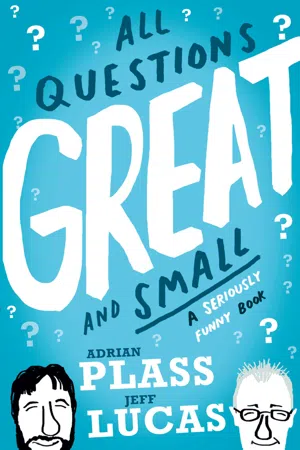
The whole idea of the SERIOUSLY FUNNY tour was for Adrian Plass and Jeff Lucas to let people in on their conversations about God, life and the universe - and it went pretty well. After all, that's pretty much what they've been doing in their separate writing and speaking careers all these years.
All told, people seemed to like the way their trademark styles came together and shed light on even the most difficult subjects, in a way that perhaps made those burdens a little easier to bear.
However, as they toured around the country, Adrian and Jeff realised that other people's questions were at least as interesting as their own - possible more so. Eventually they decided they'd better have a go at some answers. This book is the result.
They may not have got the answers right, but they have certainly had a good time along the way - and they hope you will, too.
- 208 pages
- English
- ePUB (mobile friendly)
- Available on iOS & Android
eBook - ePub
About this book
Information
Topic
Theology & ReligionSubtopic
Christianity

Are there stories in the Bible that you really don’t like? Do you have a least favourite Bible story?
I knew my answer on this one immediately – the Bible story in question is not so much disagreeable as downright horrifying. I hate it.
But then, I have a whole list of least favourite Bible stories. Sit tight – there’s some nasty stuff coming.
It includes Abraham being told to take a knife and kill and burn his son Isaac. I can hardly stand to read it. I’m nauseated by Israel being commanded to create carnage as they took swords to the entire city of Jericho. Then there’s the episode of Paul being less than gracious with errant John Mark and refusing to allow him to continue on his apostolic team. While there’s not even a sniff of the violence that bleeds from the Abraham/Isaac and Jericho stories, this one makes me angry because Paul had received so much grace, what with him being the former chief persecutor of the Church and murderer of Christians (think ISIS with a fanatical Jewish face), and yet he seemed incapable of passing grace along and giving a young leader a second chance. It’s a decision that disgusts me and, more importantly, disgusted his teammate Barnabas – their team split up that day and never reunited. Sad.
But my all-time least favourite episode is the vile story of Lot and his daughters. This awful incident includes incest and gang rape. Living in the moral cesspool that was Sodom, Lot is visited by some hunky angels. These celestial chaps are obviously rather handsome, because soon a group of men surround the house wanting to commit homosexual gang rape on them. If that isn’t nasty enough – the picture of a mob of baying blokes crazed with violent lust is obscene – Lot’s response to them is unspeakably worse.
He offers them his virgin daughters. I’ll type that again, in case you missed the horror of it at first reading.
His bright idea was to throw his young, innocent daughters out to the wannabe rapists, and he even said that they could do whatever they liked with them.
What?
Commentators rush to talk about the cultural demands of hospitality – since they had come under his roof, Lot was honour-bound to protect the angels, at whatever price. Lot was under huge pressure, but there is absolutely no excuse for his shameless willingness to sacrifice his own family in this way. He was living in Sodom, but clearly, Sodom had taken up residence in him. Thankfully, his offer was not taken up.
But there’s worse to come. This nasty, grubby, odious little man is mentioned in the New Testament, and when I read the description of him there, my mind revolts. Lot is described as ‘righteous’.
Eh? A father who would surrender his own kith and kin to a hideous gang that would almost certainly not only have deflowered them, but killed them in the process?
But then that points to something remarkable about the gracious character of God.
Lot was righteous – in comparison to the amoral, oppressive, abusive people he lived alongside.
Samson was a bloodthirsty, headstrong womaniser, but he still ends up in the hallowed list of faith heroes in Hebrews 11.
Abraham twice pretended that his wife Sarah was not his wife, which led to all kinds of confusion and trouble. But in the New Testament, he is tagged repeatedly as the friend of God.
It seems that God does not define us by our worst moments or our most shameful thoughts, which is an enormous relief, considering the depths to which we can all sink without too much effort.
And so I really don’t like the sickening story of Lot and his daughters at all. But when I look at God’s verdict on that wimpish, cowardly, tormented man, I find strange relief from a terrible tale.
To return to one of the other stories that I mentioned – when God commanded Abraham to take a knife to Isaac – I’ve been pondering it over the last few days, and I am definitely warming to it. And that’s because I’m thinking that it’s actually an unfolding mini-drama about God showing Abraham what he didn’t want.
Let me explain. I know that, at the heart of this gut-wrenching episode, there is a test of faith and obedience. God wanted to know if Abraham was serious about doing what he was told. Even though, as I said earlier, the New Testament constantly celebrates Abe as a man of faith and the friend of God (and barely mentions his failures), the Old Testament makes it clear that Abraham’s walk of faith was a frankly unsteady amble with some major detours and lash-ups along the way. He struggled to live in the gap between God’s promise and its fulfilment, and I sympathise with him. He had to wait twenty-five years between being told that he’d be the father of a nation and celebrating the birth of Isaac, who didn’t show up until Abraham was a hundred years old.
Along the way, he stumbled, agreeing to sleep with a servant girl to produce a child. That was a decision that brought about sixteen years of domestic tension and then a painful parting as he had to disinherit Ishmael. And then he lied about his wife Sarah being his wife, twice, which meant that she was taken by other men, again with bad results all round.
So now he’s told to kill the boy he loves, the son and heir he’s waited decades for. He has to juggle this totally contradictory command with something else God has said: the nations will be blessed through Isaac. So what on earth is going on?
And then, when you dig around in the Bible, it’s clear that God always hated human sacrifice. He judged his people when they fell into doing it, and sobs through the prophet Jeremiah, ‘I did not command or mention [human sacrifice], nor did it enter my mind.’2
2 Jeremiah 19:5
So what’s the deal? God repeatedly railed against the horrific practice of people sacrificing children in worship. But now he commands Abraham to do just that. Why?
Abraham came from Ur, where people sacrificed children. He was heading for Canaan, where the same terrible rituals were used. So now God needed Abraham to know, once and for all, this is not what I want, ever.
God could have just barked a command, a stern prohibition. But instead, he called Abraham to journey through the awful, conflicting agony of trekking up that mountain with his son and ultimately preparing him for death. Abraham now knew what excruciating emotional pain this hideous practice brought for both parent and child.
I think we need to talk a little more, not just about what God wants from us, but what he doesn’t want. Some of my angst as a teenage Christian came from my desperate determination to do the will of God, which created an unhealthy obsessiveness, edging towards fanaticism. I was willing and ready to take the knife (figuratively speaking) to some very beautiful things in my life, just because I loved them so much. One of them was Kay, now my wife of thirty-six years. I agonised over loving her, because I loved her, and nearly lost her as I struggled.
Abraham was discovering that God calls us to trust him, not appease him. Back then, I was living in appeasement mode, thinking that God would love me more if I discarded what I loved the most, bringing my sacrifices to him. And I frequently still slip back into appeasement-thinking, wanting to buy God, to pay him off. But his love is not for sale. In a way that you and I can never fully understand (especially in the light of what we’ve just been thinking about), the price has been paid in full by Jesus.
Dennis Kinlaw preached a series of renewal services at a Wesleyan church here in Colorado, where I now live and work part of the time, back in 1982. He imagined God the Father and Jesus the Son watchi...
Table of contents
- Cover
- Also by Jeff Lucas
- Also by Adrian Plass
- Title Page
- Imprint Page
- Dedication
- Contents
- FOREWORD
- INTRODUCTION
- NOW THAT REMINDS ME OF A TIME WHEN ...
- WHERE'S MY SOAPBOX?!
- TELLING IT LIKE IT REALLY IS . . .
- THAT'S A TRICKY ONE!
- WELL, I SEE WHY YOU'D ASK THAT . . .
- DO YOU WANT THE ‘OFFICIAL ANSWER' OR THE TRUTH?
- WHAT KIND OF QUESTION IS THAT?!
- NOW THERE'S SOMETHING TO GET OUR TEETH INTO!
Trusted by 375,005 students
Access to over 1.5 million titles for a fair monthly price.
Study more efficiently using our study tools.
Frequently asked questions
Yes, you can cancel anytime from the Subscription tab in your account settings on the Perlego website. Your subscription will stay active until the end of your current billing period. Learn how to cancel your subscription
No, books cannot be downloaded as external files, such as PDFs, for use outside of Perlego. However, you can download books within the Perlego app for offline reading on mobile or tablet. Learn how to download books offline
Perlego offers two plans: Essential and Complete
- Essential is ideal for learners and professionals who enjoy exploring a wide range of subjects. Access the Essential Library with 800,000+ trusted titles and best-sellers across business, personal growth, and the humanities. Includes unlimited reading time and Standard Read Aloud voice.
- Complete: Perfect for advanced learners and researchers needing full, unrestricted access. Unlock 1.5M+ books across hundreds of subjects, including academic and specialized titles. The Complete Plan also includes advanced features like Premium Read Aloud and Research Assistant.
We are an online textbook subscription service, where you can get access to an entire online library for less than the price of a single book per month. With over 1.5 million books across 990+ topics, we’ve got you covered! Learn about our mission
Look out for the read-aloud symbol on your next book to see if you can listen to it. The read-aloud tool reads text aloud for you, highlighting the text as it is being read. You can pause it, speed it up and slow it down. Learn more about Read Aloud
Yes! You can use the Perlego app on both iOS and Android devices to read anytime, anywhere — even offline. Perfect for commutes or when you’re on the go.
Please note we cannot support devices running on iOS 13 and Android 7 or earlier. Learn more about using the app
Please note we cannot support devices running on iOS 13 and Android 7 or earlier. Learn more about using the app
Yes, you can access All Questions Great and Small by Adrian Plass,Jeff Lucas in PDF and/or ePUB format, as well as other popular books in Theology & Religion & Christianity. We have over 1.5 million books available in our catalogue for you to explore.