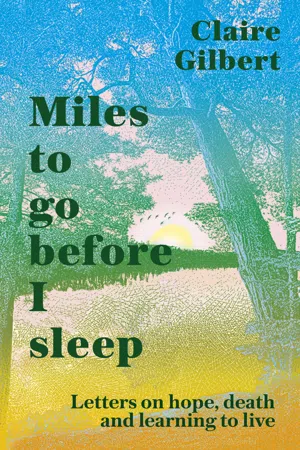
'Claire's honest, raw, authentic diaries will be a source of comfort to many'- Miranda Hart At the age of 54 Claire Gilbert was diagnosed with myeloma, an incurable cancer of the blood. The prognoses ranged from surviving only a few months to living for several decades, with no guarantee of which outcome was to be hers. It was a shocking diagnosis into uncertainty, or rather, into only one certainty: death. But Claire discovered that facing her own mortality was liberating. She discovered this through writing letters. Claire asked her siblings and a small group of friends if they would let her write to them with total honesty about what she was going through, as she was going through it. These letters turned out to be a great solace, and gradually her group of 'dear readers' has grown; what she had to say wasn't just of value to herself, but to others, too. The letters chart Claire's journey through diagnosis, chemotherapy and a brutal round of stem cell treatment, and end with the rest of the UK joining her in her immuno-compromised isolation in March 2020, when the coronavirus pandemic hit. Unflinchingly honest and wide-ranging, Claire writes about the restorative role of nature, politics, poetry, humour - and a restless exploration of the spiritual dimension of death and dying. This is an honest, luminous account of what Claire has gone through and what keeps her going, a deeply spiritual meditation on life and suffering, and an exploration of how faith is no simple solace but provides a whole new plane of meaning during these liminal moments. 'Claire Gilbert's account of the progress of her fatal illness, from diagnosis through various traumatic treatments, is in turn candid, painful, funny, tender, fierce and philosophical. But most of all it is a marvellously enjoyable read depicting the human spirit at its finest: defiant, exuberant, joyous. An example to us all that we can triumph over the cruellest adversity'- Salley Vickers
- 288 pages
- English
- ePUB (mobile friendly)
- Available on iOS & Android
eBook - ePub
About this book
Information
Twenty-ninth Letter
Dear Readers
Monday, 28 October
I walk towards my fear.
Today is the fifteenth anniversary of my father’s death from cancer and it is the day of my own little death from Melphalan, the chemotherapy that will kill my bone marrow. It is based on the mustard gas used in the First World War.
The taxi driver takes a complex route, distracting me with side streets I’d not seen before. It is 8.00am when we arrive, so I take my luggage to the Cotton Rooms: an embarrassingly vast case, packed with day clothes and night clothes in anticipation of weeks away, and a lot of books.
And I walk empty handed to the Cancer Centre, to ‘ambulatory care’ − where the Cotton Room patients and other outpatients are treated. I see the registrar, who tells me I will feel all right for the next couple of days. He is beautiful.
I am sent to the basement to have my PICC line inserted. ‘PICC’ stands for ‘peripherally inserted central catheter’. The nurse-surgeon is beautifully made up under her face visor. She runs a very fine tube into a vein through my upper left arm, all the way to the other side of my heart. She is in training, so I get to hear the explanation and directions of the senior nurse, and watch, fascinated, a living cross section of my pumping vein on the screen as the line is fed through it. Afterwards two exit valves dangle from my arm so blood can be taken and substances infused without having to puncture my skin and damage my veins with cannulas every time. A clever invention, great not to have cannulas, and I can’t feel it, but it is strange to have inside me. I don’t like it.
I meet M, a fellow myeloma sufferer. M’s myeloma is ‘galloping’ and this is his second stem cell transplant after only ten weeks since his first. Ten weeks! He lives in Broadstairs and is a magician. He wears a pork pie hat and answers all my questions about the procedure kindly and reassuringly, but his eyes are scared: he knows what is coming.
Then I meet the consultant, Dr Neil. Because I have compromised kidney function my body won’t tolerate the Melphalan so well (but what would ‘tolerating it well’ look like?) and the issue for me, he says, will be nausea. Straightaway, not in two days. Cold dread seizes me.
We have until 2.30pm. Seán has arrived and we check in to the Cotton Rooms. We choose a quiet room looking over the back of the Cancer Centre, not such an interesting view but Tottenham Court Road is noisy. I don’t know how long we will be here. It is lovely to have the comfort of a room we can share. But as soon as my temperature goes up to thirty-eight degrees I have to go into hospital because it means I have an infection, and since this happens to ninety-five per cent of people having a stem cell transplant it is likely to happen to me. Once the Melphalan has killed off the bone marrow I am neutropenic, with no immunity at all. Even bacteria in my own body which I would normally tolerate can cause infection, and infection will kill if not treated.
But I feel a challenge: I want to be one of the five per cent who don’t have to leave the comfort of the Cotton Rooms during the whole procedure.
I return to ambulatory care for the Melphalan. I sit in one of the squishy chemotherapy chairs, just like those at Guy’s but in sicklier colours. Nurse Lydia solemnly hands me a tray of five orange-flavoured popsicles and I’m told to start sucking them. This is to counter the Melphalan side effect of destroying the bacteria lining my digestive system from my mouth all the way down to my bottom. I am hooked up to the drip and given a flush of saline, then the Melphalan starts. I sit and suck as the Melphalan infuses. I look and feel ridiculous, which makes me laugh, even as I receive the poison. It only takes half an hour, but it is a killer. I suck my popsicles and meditate on maranatha.
Then it is finished and we are free to go. I am given three kinds of anti-emetic as well as stomach protector, anti-viral drugs and vitamin D3 for my bones. A huge bag of drugs.
I feel strange. I have some mouth ulcers (already) and a slightly queasy stomach.
I do gentle Pilates and my head stops feeling like cotton wool.
I do not feel sick. I do not feel sick.
We spend the evening in our room, Seán on the phone for a long time to neighbours in Hastings because our house alarm has gone off.
Tuesday, 29 October
I have hardly slept and feel shivery, queasy, sniffly. It occurs to me that the one thing that cannot happen now is that I do not receive my stem cell transplant, scheduled for tomorrow. I have had the killer Melphalan; if I don’t have my stem cells I will die.
I throw up.
I am in a kind of anticipatory Easter − today is anticipatory Saturday, yesterday was Good Friday, tomorrow will be my resurrection; only the effects are all delayed so my actual Easter Saturday will start at the weekend when my bone marrow dies and who knows when resurrection will dawn with the stem cells grafting?
I am wondering what happens to the dead bone marrow. Is it absorbed into the bone ‘wall’ surrounding it? Like humus from dead leaves into the ground?
Over the day I eat a little cheese and biscuits, stale pain au raisin, wafer biscuits, bean salad, cornflakes . . . I didn’t realise when Dr Neil said ‘Nausea will be an issue for you’ he meant it will be an issue because I will lose my appetite and stop eating before I really lose my appetite when the Melphalan starts killing my bone marrow. I can’t lose strength now. So I eat exactly what I fancy, when I fancy it.
A feeling of positivity and well-being rises in me, despite how odd I feel physically. A positive attitude makes the stem cell transplant work, said the nurse who gave me the popsicles.
Wednesday, 30 October
I won’t be sick. I won’t.
I am.
It is such a relief to be sick because it takes the nausea away, but it also takes away the banana I have just eaten, with great difficulty, and all the drugs I have just swallowed through my sore and swelling throat.
Everyone in the Cotton Rooms is sensitive to each other’s need to be apart and careful, as well as sociable. Only one too-hearty greeting and interrogation, but they are couched in kindness and love.
I return to ambulatory care for my stem cell transplant. I am in a separate room, on a bed. I am cannulated for this; for some reason the PICC line won’t do. Nurse Lydia brings in two frozen bags of what looks like gloopy blood, the stem cells I last saw hooked up to Rosie. She thaws them in a bath of warm water in the room. First one, then the other bag is infused into me. It is straightforward apart from the moment when the stem cells congregate in the vein around the cannula and get stuck, and Lydia has to push them onwards and into my body with a flush. That hurts a lot. I lie and listen to my Dear Reader playlist, which brings me joy. The procedure takes about two hours.
At the end, one of the hospital chaplains appears and gives me Communion. We are left alone for the little service, which is inexpressibly comforting, even though she drops things and emphasises the word ‘hope’ in a pleading, needy way that would normally have irritated me. Now I am simply grateful and tearful. My blood pressure has come right down, having been high after the transplant. Lydia says it is because I have had Communion. She wears a tiny gold cross on a necklace.
I am overcome with emotion.
Thursday, 31 October
I vomit during the night.
It is my birthday.
A huge card lit by fairy lights from Seán in the worst possible taste makes me laugh. He gives me a horse shoe for my birthday present.
We stroll slowly to Gordon Square and Woburn Square and relish the trees, their leaves turning orange and tawny and yellow and old gold.
I manage to eat some yoghurt and some stale croissant, a pear and some biscuits and cheese.
I am very low. The thought of going back to the Cancer Centre and being among the drips and the chemotherapy and the needles and the calm, accepting patients fills me with dread and nausea.
I don’t ask for prayers to change the course of history but oh, dear Lord, I pray that this cup is taken from me soon, and that I go into such a deep remission that I never have to cross the threshold of any cancer centre ever again.
I feel sick, tired, dopey, sad, useless, bloated, hot, and the Melphalan side effects, apart from nausea, haven’t even begun yet.
I will forget how bad this is once it is over; a mercy perhaps but I never want to have to go through it again.
Oh Julian, you fixed your mind on God and you were not troubled by earthly things. Help me to be the same. Help me.
I realise, as I cry and pace the room, that I can ask you, my Dear Readers, for help. This is strange and hard: I don’t like asking for myself and I am unable to imagine an interventionist God. But I remember how I prayed so desperately and sincerely for Seán’s health to be restored and feel I can, this time, ask for myself.
I wri...
Table of contents
- Cover
- About the Author
- Title Page
- Imprint Page
- Dedication
- Contents
- Prologue
- I Diagnosis
- First Letter
- Second Letter
- Third Letter
- Fourth Letter
- II First Part of the Treatment
- Fifth Letter
- Sixth Letter
- Seventh Letter
- Eighth Letter
- Ninth Letter
- Tenth Letter
- Eleventh Letter
- Twelfth Letter
- Thirteenth Letter
- Fourteenth Letter
- Fifteenth Letter
- Sixteenth Letter
- Seventeenth Letter
- Eighteenth Letter
- Nineteenth Letter
- Twentieth Letter
- Twenty-first Letter
- III Second Part of the Treatment
- Twenty-second Letter
- Twenty-third Letter
- Twenty-fourth Letter
- Twenty-fifth Letter
- Twenty-sixth Letter
- IV Third Part of the Treatment
- Twenty-seventh Letter
- Twenty-eighth Letter
- Twenty-ninth Letter
- Thirtieth Letter
- Thirty-first Letter
- Thirty-second Letter
- Thirty-third Letter
- Thirty-fourth Letter
- Thirty-fifth Letter
- Thirty-sixth Letter
- Thirty-seventh Letter
- Thirty-eighth Letter
- V Maintenance Chemotherapy and Covid-19
- Thirty-ninth Letter
- Fortieth Letter
- Forty-first Letter
- Forty-second Letter
- Forty-third Letter
- Forty-fourth Letter
- Dear Readers’ Playlist
- Acknowledgements
- Notes
Trusted by 375,005 students
Access to over 1.5 million titles for a fair monthly price.
Study more efficiently using our study tools.
Frequently asked questions
Yes, you can cancel anytime from the Subscription tab in your account settings on the Perlego website. Your subscription will stay active until the end of your current billing period. Learn how to cancel your subscription
No, books cannot be downloaded as external files, such as PDFs, for use outside of Perlego. However, you can download books within the Perlego app for offline reading on mobile or tablet. Learn how to download books offline
Perlego offers two plans: Essential and Complete
- Essential is ideal for learners and professionals who enjoy exploring a wide range of subjects. Access the Essential Library with 800,000+ trusted titles and best-sellers across business, personal growth, and the humanities. Includes unlimited reading time and Standard Read Aloud voice.
- Complete: Perfect for advanced learners and researchers needing full, unrestricted access. Unlock 1.5M+ books across hundreds of subjects, including academic and specialized titles. The Complete Plan also includes advanced features like Premium Read Aloud and Research Assistant.
We are an online textbook subscription service, where you can get access to an entire online library for less than the price of a single book per month. With over 1.5 million books across 990+ topics, we’ve got you covered! Learn about our mission
Look out for the read-aloud symbol on your next book to see if you can listen to it. The read-aloud tool reads text aloud for you, highlighting the text as it is being read. You can pause it, speed it up and slow it down. Learn more about Read Aloud
Yes! You can use the Perlego app on both iOS and Android devices to read anytime, anywhere — even offline. Perfect for commutes or when you’re on the go.
Please note we cannot support devices running on iOS 13 and Android 7 or earlier. Learn more about using the app
Please note we cannot support devices running on iOS 13 and Android 7 or earlier. Learn more about using the app
Yes, you can access Miles To Go Before I Sleep by Claire Gilbert in PDF and/or ePUB format, as well as other popular books in Social Sciences & Social Science Biographies. We have over 1.5 million books available in our catalogue for you to explore.