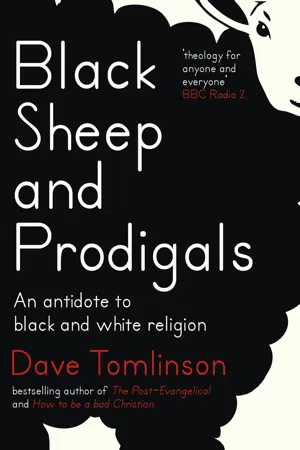
'Very interesting, it's all about not alienating people before they even think about crossing the threshold of where you worship.' Chris Evans, BBC Radio 2 Do you feel more at home on the edges of faith than at the centre? Would you call yourself a bit of a black sheep? Too often Christian spirituality has been associated with conformity, or a subculture where people don't feel able to ask questions. But Dave Tomlinson, author of How to be a bad Christian, doesn't think it has to be like this; instead, our spiritual communities can be 'laboratories of the Spirit' - places where we can explore issues of faith and spirit with openness, imagination and creativity. Welcome to black sheep spirituality - where doubts and questions are an essential part of faith; where difference of opinion is a sign of a secure community; where divine revelation is embraced wherever it is found - in the arts, science and the natural world as well as religious tradition; and where faith is something that is lived and practised rather than embalmed in beliefs or ritual. 'Theology for anyone and everyone' BBC Radio 2
- 256 pages
- English
- ePUB (mobile friendly)
- Available on iOS & Android
eBook - ePub
About this book
Information
Topic
Theology & ReligionSubtopic
Christianity
1. I believe in being true to yourself
find your inner black sheep
To go wrong in one’s own way is better than to go right in someone else’s.
Fyodor Dostoyevsky
Having barely darkened a church doorway for twenty years, Nina never imagined joining one – much less loving it. She still shuns the label ‘Christian’, admits to struggling with the version of God she finds in the Bible, and most of the time can’t stand Jesus – at least, not the Jesus she has often heard talked about in church. Yet she has found a home in our church community.
She tried being a Christian when she was younger, even got confirmed (or was it ‘conformed’?) at thirteen. But in the end she was turned off by the judgementalism she detected in the Church: ‘This obsession with personal morality. Everyone convinced of their rightness and everyone else’s wrongness.’
By her late teens Nina was exploring Buddhism and stopped calling herself a Christian. Friends at university persuaded her to accompany them to church a couple of times, but her heart wasn’t in it. And it would just wind her up.
Now a single mum, Nina says a big part of the explanation for being part of a church lies with Isaac, her son. She always wanted him raised in a community with strong values, ‘where people asked questions about right and wrong, about the purpose of life – where you could think about bigger things than the latest Nike trainers or TV show’.
Before finding St Luke’s she went on a bit of a quest, visiting the Unitarians, the Quakers, the Buddhists, but despite feeling at home with some of them, they weren’t really set up for children. Then Jonathan and Denise, a couple she met when she was pregnant, and members of St Luke’s, invited her to join them. She wondered what the church would think of her coming – even though she didn’t believe in God or the Bible, and didn’t like Jesus. Jonathan said it was fine; they’d take anyone.
As a penance for her ‘bad thoughts about Jesus’, Nina signed up to the coffee rota. And now, ten years on, she’s the ‘unofficial Director of After-Church Beverages’!
‘It’s the community I was looking for,’ she says: ‘relaxed, open, accepting. I even find the talks inspiring. It’s a place where I try to embody my own spiritual practice, which is Buddhist.’
If she had a creed, Nina says the key words would be ‘kindness’ and ‘forgiveness’, ‘compassion’, ‘courage’ and ‘patience’; with ‘community’ and ‘family’ also near the top.
But words like this are useless in isolation, she stresses: ‘You have to embody your faith. There’s nothing wrong with sitting in a cave meditating, but you only find out what it means when you leave the cave behind. When you engage with the real world.’
The Buddhist emphasis on practice rather than belief really makes sense to Nina. ‘It underlines how every day we try to walk the talk,’ she says. ‘We don’t always get it right, but we reflect and we go again. Our practice includes our mistakes. We’re never qualified, we’re always practising.’
And after ten years at St Luke’s, Nina has even come to think differently about Jesus. Although she sees two Jesuses. ‘The one you often find talked about in church – judgemental, separating people, focused on the good and the bad’ – she still finds that Jesus hard to take. But then there’s another Jesus for whom she has a lot of time – who she says was ‘probably a Buddhist. Like me.’1
Nina isn’t the average church member. She practises Buddhism, questions the Bible and holds less than conventional thoughts about God and Jesus. On which basis, many churches definitely wouldn’t accept her as a member. At the very least she would be perceived as spiritually prodigal, a wandering black sheep needing to find the fold of true faith. Maybe she would be invited onto an Alpha course or the like to get ‘converted’, to discover the true way.
Nina is a black sheep, I agree. But in a good sense. She is her own person, not just one of the crowd. Her spirituality arises from experience. There is nothing pre-packaged about her. She has her own values, beliefs and practices that she has thought about and internalised. She is a woman of considerable spiritual intelligence.
Actually, we all have an inner black sheep, a wayward independent side, and our spiritual development depends on finding it and learning to integrate it into our daily lives. It’s the instinct to question the status quo, to swim against the tide, to explore a different path, to be authentic. Our more controlling, fearful self tells us not to listen to our questioning self; to step back in line, keep the rules and fit in, play things safe. But until we begin to accept and engage this spiritual shadow side to us we cannot really grow in faith, or even as individuals.
The Quaker Parker Palmer writes, ‘I want to learn how to hold the paradoxical poles of my identity together, to embrace the profoundly opposite truths that my sense of self is deeply dependent on others dancing with me and that I still have a sense of self when no one wants to dance.’2 Black sheep spirituality focuses on this tension. It is not about being a loner or spurning community, but about learning to value our own instincts at least as much as we do those of others, and having the courage to stand by them.
The natural assumption is that churches and other religious groups will be obvious settings to grow our spiritual intelligence. And sometimes they are. However, emails and messages I receive most days of my life say something different. Even as I write, a woman from New Zealand tells me that she feels her church is more of a religious kindergarten than the ‘university of the spirit’ that she hoped for. ‘There is no room for me to live, breathe, be my own person,’ she writes. ‘If I am going to be accepted, I’ll need to fit in, to be a virtual carbon copy of everyone else. But I won’t be that.’
The Church haemorrhages people like this all the time. They are the black sheep, the prodigals prone to wandering from the well-worn path, who ask the ‘wrong’ questions, struggle to fit in. Yet often they are the ones who are the most perceptive and spiritually switched on. Conformity is not a fruit of the Spirit. Quite the reverse: it is a product of fear and intimidation.
For twenty-five years, these kinds of people have been the main focus of my life and work – people on the edges of the religious ghetto, or completely outside of it, yet whose spiritual journeys are often more authentic than those of many insiders.
This very week, in a pub after a wedding I conducted, I had umpteen conversations with people of considerable spiritual nous who had long ago stopped going to church because they were frustrated by the unquestioning conformity they felt was required of them. ‘Of course, that’s not how people in the Church would see it,’ one man told me. ‘They’d say that they welcome you asking questions. But once you make it clear that you aren’t going to tow the line, that you hold a different point of view about God or Jesus or something, you’re looked at with suspicion. You’re not a kosher Christian unless you believe the “right” things.’
Another man spoke with some concern about his two grown-up children who no longer went to church or believed the same things as him and his wife. ‘But look at them,’ I replied. ‘They are fine human beings, clearly driven by spiritual values, even if they no longer find church and conventional faith attractive or helpful. If I were you, I’d be proud of them.’
‘You’re right,’ he said. ‘The truth is, they’ve had the courage to ask the questions I have always pushed to the back of my mind. We’re not so different really; it’s just the way we’ve handled our doubts.’
For ten years in the 1990s, I led a ‘church’ in a pub, known self-disparagingly as ‘Holy Joes’, especially designed for church prodigals. Nowadays I am the vicar of a more conventional-looking church, yet which is virtually a flock of black sheep: people who want to have their own opinions, who dislike being told what to believe and often question things; who want to be authentic. These are my people. This is where I feel at home: at the edges of faith.
Christian spirituality is too often understood and couched in passive terms like ‘obedience’ and ‘submission’, as if we were meant to be compliant infants instead of grown adults with questions and healthy scepticism and a voice to speak back. So we end up with a religious subculture of conformity, where fear inhibits any sense of real faith and adventure.
In many churches, especially those of the more conservative ilk, the culture of conformity is intentionally nurtured in the name of ‘holiness’ or ‘discipleship’. God may be perceived as a father, but definitely an authority figure with a plan for people’s lives that must be known and obeyed. So being a ‘good’ Christian involves becoming weak and dependent in some way – certainly dependent on the Almighty, but maybe also on the church leaders as God’s representatives. And phrases like ‘only believe’, ‘trust and obey’ and ‘lean not on your own understanding’ become mantras that cultivate a mentality of learned helplessness, a psychology of compliance.
Ron grew up in this kind of church culture, and up until his mid-twenties looked like the perfect model of a ‘good’ Christian. He ‘gave his heart to Jesus’ when he was thirteen, was baptised as an adult two years later, and by the time he was nineteen was helping to lead an Alpha group in the church, with no awareness of any serious questions or queries about his faith. ‘I was like a perfect sheep,’ he told me, ‘heading in the same direction as everyone else, never questioning whether it was the right direction, never doubting what I was told, never allowing myself any stray thoughts.’
Then life at university brought Ron a raft of doubts and questions. Perhaps it was living away from home and not going to his church regularly, or maybe issues raised by his coursework, or just beginning to see Christianity through the eyes of his non-churchgoing friends, but his faith began to unravel. ‘It was as if I was suddenly outside the bubble of certainty and unquestioning com...
Table of contents
- Cover
- About the Author
- Title Page
- Imprint Page
- Dedication
- Contents
- Prelude: Not for the spiritually certain
- 1. I believe in being true to yourself
- 2. I believe beliefs are overrated
- 3. I believe ‘God’ is just a word
- 4. I believe in poetry, art and rock’n’roll
- 5. I believe in evolution, and the Big Bang
- 6. I believe in original goodness
- 7. I don’t believe in an interventionist God
- 8. I believe in Jesus and the three wise women
- 9. I believe someone who punishes his son for other people’s shortcomings needs counselling
- 10. I believe the ‘empty tomb’ is a distraction
- 11. I believe truth is stranger than fact
- 12. I believe in life before death
- 13. I believe God is human
- 14. I believe in Hobnobs, beer and round tables
- Postscript: Liberal evangelism
- Acknowledgements
- Notes
Trusted by 375,005 students
Access to over 1.5 million titles for a fair monthly price.
Study more efficiently using our study tools.
Frequently asked questions
Yes, you can cancel anytime from the Subscription tab in your account settings on the Perlego website. Your subscription will stay active until the end of your current billing period. Learn how to cancel your subscription
No, books cannot be downloaded as external files, such as PDFs, for use outside of Perlego. However, you can download books within the Perlego app for offline reading on mobile or tablet. Learn how to download books offline
Perlego offers two plans: Essential and Complete
- Essential is ideal for learners and professionals who enjoy exploring a wide range of subjects. Access the Essential Library with 800,000+ trusted titles and best-sellers across business, personal growth, and the humanities. Includes unlimited reading time and Standard Read Aloud voice.
- Complete: Perfect for advanced learners and researchers needing full, unrestricted access. Unlock 1.5M+ books across hundreds of subjects, including academic and specialized titles. The Complete Plan also includes advanced features like Premium Read Aloud and Research Assistant.
We are an online textbook subscription service, where you can get access to an entire online library for less than the price of a single book per month. With over 1.5 million books across 990+ topics, we’ve got you covered! Learn about our mission
Look out for the read-aloud symbol on your next book to see if you can listen to it. The read-aloud tool reads text aloud for you, highlighting the text as it is being read. You can pause it, speed it up and slow it down. Learn more about Read Aloud
Yes! You can use the Perlego app on both iOS and Android devices to read anytime, anywhere — even offline. Perfect for commutes or when you’re on the go.
Please note we cannot support devices running on iOS 13 and Android 7 or earlier. Learn more about using the app
Please note we cannot support devices running on iOS 13 and Android 7 or earlier. Learn more about using the app
Yes, you can access Black Sheep and Prodigals by Dave Tomlinson in PDF and/or ePUB format, as well as other popular books in Theology & Religion & Christianity. We have over 1.5 million books available in our catalogue for you to explore.