'As informative as it is entertaining - read it, you won't regret it' Paula Gooder Beards have had cultural and religious significance for thousands of years. A fascinating story is to be told of the religious significance of beards from the ancient civilisations to today. This book will survey beard theology from ancient Egypt, Greece, Rome and Mesopotamia, to the Jews of Jesus's day and through to the early Church fathers who strongly promoted the beard, the Latin church which outlawed it leading up to and after the Great Schism of 1054. We will pursue the story of the protestant reformers and leaders of the evangelical revival of the 19th century all had plenty to say about the beard.This largely untold and intriguing story of the religious significance of beards and will contain a series of entertaining true historical stories, such as the cardinal who lost the papacy due to his beard, the female pharaoh who wore the fake beard and how beards were cited in the papal bull of excommunication that formalised the split of the Eastern and Western churches in the great schism.As well as providing a unique historical narrative, it also provides a subtle basis for reflection on current theological disputes and debates, gently inviting you to consider what parallels there are to the historical theological disputes which today seem trivial but caused heated passions in their day. It will entertain and inform in equal measure.'A profound exploration of the way beliefs turn to rules... smart, funny and absolutely fascinating' Cole Moreton
Any discussion of the religious history of beards must surely begin with Jesus. For the world’s 2.4 billion or so Christians, the example of Christ is the ultimate authority. His life is a guide for all to follow. Jesus lived a sinless life, the purpose of which was to save us from our sins. So, if you want to know whether beards are pleasing to God, we could start by considering the beard of our Lord.
We probably all believe that Jesus was a bearded man. But why, when there are no contemporary descriptions or images of him? What does the Bible have to say about beards and how did that influence the theology of the early church? The great fathers of the early church had a surprising amount to say on the subject of facial hair. The approach they took to the imitation of Christ and to the creation of their theology is part of the foundation of the theology of the modern Church. It can help us reflect on the foundations of our own theology.
The beard of our Lord
Christ’s face is one of the most recognisable images in the world. Whether it appears in an exquisitely painted fresco, a cartoon on a T-shirt or the burnt crust of our toast, we are still able to make it out distinctly as the face of Jesus. And that face has a beard. We all know what Jesus looked like. Our image of Jesus has a beard because the historical Jesus had a beard.
There are no written descriptions of Jesus from anyone who could have met him, however. Nothing in the Bible describes his physical appearance. Most confusingly, the earliest surviving images of Christ depict him as clean shaven. It was not until the fourth century that the first bearded Jesus was depicted in art and it was another century before this became the dominant image. The familiar picture of the pale-skinned, blue-eyed, long-haired Jesus with a flowing beard cannot be an authentic representation of a first-century Palestinian Jew. Well, certainly not the pale skin and blue eyes bit. But what about the beard? Why have we decided that Jesus had a beard, in the absence of any primary evidence?
Let us set off on our journey to discover the holy history of hairy faces with the holiest and hairiest of them all, and work out how Jesus got his beard.
The saviour formerly known as
The earliest picture of Jesus that the world’s archaeologists have uncovered dates from around ad 250. To our best guess, that would be a little more than two hundred years after Jesus was crucified by the Romans just outside Jerusalem. The earliest Christians did not make images of Christ. This was for two very good reasons, the first being that the Bible told them not to. One of the Ten Commandments says, ‘You shall not make for yourself an image in the form of anything in heaven above or on the earth beneath or in the waters below’ (Exodus 20:4), which seemed pretty clear in the traditional Jewish and early Christian interpretation.
The second reason was equally compelling. Painting a Christian image was likely to get you killed. After the Great Fire of Rome in ad 64 the Emperor Nero blamed the Christians and they became a group to which it was dangerous to belong. For around two hundred years, varying degrees of persecution acted as an effective deterrent to those who may have wished to own and enjoy Christian images, as well as to those who might have been employed to create them.
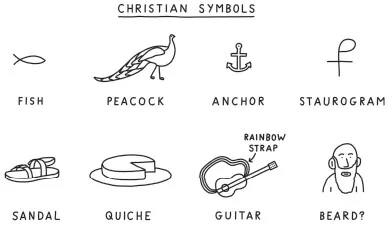
As a result, the earliest representations of Jesus were symbolic and ambiguous. They included:
A FISH – the Greek word ‘ichthus’ forms an acronym for ‘Jesus Christ, Son of God, Saviour’. It quickly became one of the most widely used Christian symbols and survives in the form of badges, wristbands, car stickers and hipster Christian tattoos to this day;
A PEACOCK – this one has not survived. It was based on the ancient Greek belief that the flesh of the peacock did not decay after death. The peacock was associated with immortality and was adopted by early Christians as a figurative illustration of Jesus;
THE ANCHOR – this one survives in popular worship songs that ask God to be our anchor, but its meaning is widely misunderstood. In ancient times the anchor was a symbol of safety and was adopted by Christians as a sign of hope;
THE STAUROGRAM (which looks a bit like a cross with a long P forming the upright). It is a combination of the Greek letters T and P and was simply an abbreviation of the word ‘stauros’, the Greek word for cross. It is used in a number of early copies of the New Testament.
After a couple of hundred years, however, images depicting Jesus himself started to appear.
The early Jesus
One place where we find some of the earliest Christian art is the catacombs of Rome. The catacombs were originally a burial place for Christians lower down the social scale. Later, they became the last resting place for Christians of all stripes, from the lowest to the very highest. The remains of popes from the third century are buried there and are still visited today by pilgrims seeking a connection to the early saints.
As the social, and therefore financial, status of those buried there rose, so did the level of luxury in which their earthly remains were laid to rest. The catacombs became decorated with fine frescos which formed an artistic commentary on the character of the souls upon whom they looked down.
On the many miles of underground tombs around Rome, the image of Christ as the Good Shepherd appears more than a hundred times, including the earliest known depiction of Jesus in the catacombs of San Callisto on the Appian Way. The wall painting there is well preserved for its age and shows Jesus as a young man with a lamb around his shoulders and carrying a pot to feed the other lambs, which gather around his feet. He is wearing white robes, and there can be no mistake at all that there is not a single hair upon his divine chin. His upper lip is unquestionably bare.
To understand how the image of Jesus that we know came about, we need to understand a fundamental truth about how Jesus has been perceived by people throughout the ages: we see Jesus as we expect him to be. We see him through the lens of our own cultural norms and expectations. The reason the Good Shepherd on the wall of the San Callisto catacomb has no beard is because he was painted by a Roman who depicted Christ as he imagined him to be, with all the cultural reference points of Roman society and mythology intact.
The most obvious giveaway that the Jesus in the catacombs is not a historically accurate portrayal is those white robes he is wearing: a Roman tunic. The Hebrew carpenter in occupied Palestine would never have worn traditional Roman dress. He is also shown with olive skin and short hair – an idealised Roman youth, according to the traditional artistic style of the period.
We might imagine the commission given to this Roman painter to have been something like this:
Patron: Hi there, are you good at painting frescos in catacombs?
Painter: Me? Seriously? I’m the best catacomb fresco painter this side of Hadrian’s Wall, mate!
Patron: Very well, my good fellow. Could you paint Jesus as the Good Shepherd for me in the San Callisto catacomb on the Appian Way?
Painter: You want me to paint who? As the good what, now?
Patron: Jesus. As the Good Shepherd.
Painter: OK, I’m fine with the shepherd bit, but who is this Jesus chap? Friend of yours, was he?
Patron: Sort of. He is the Son of God. Our risen Lord and Saviour. He died then rose to new life and is now reigning at the right hand of God in heaven, until he comes again to judge the living and the dead.
Painter: Right. I’ll take your word for that. Can you just tell me what he looks like?
Patron: Ah, no, not really. No idea, to be honest. You’ll be the first person ever to paint him. Or at least in the future your painting will be the earliest one to survive.
Painter: Not a problem. Nil problemum, as they say in the forum. You tell me what he was like and I’ll paint someone who I think might look like that character.
Patron: Good idea. He was fully divine and fully human at the same time. He lived a sinless life and brought good news of the coming of the kingdom of God. He was then betrayed and crucified in shame. He was the Lamb of God and a Good Shepherd to his people.
Painter: Well, why didn’t you just say he was a demigod! I’ve been painting them for years. I tell you what, I’ll just do you a Hermes, but take off the winged shoes and helmet. OK? I often do him carrying a lamb anyway, so that works as a good shepherd. Hermes brought messages from the gods to humans – you say your chap brought good news from God. He was a handsome lad, too.
Patron: Sounds perfect! When can you start? You’d better hurry, I’m starting to feel a little poorly.
The Roman painter attempting to paint a man who was the Son of God had plenty of reference points from his own culture to borrow from. While the resulting image would not be historically accurate, it would at least mean that those viewing the pictures would understand the language of the painting. Good skin, firm calf muscles and white robes were all part of the normal artistic interpretation of the plethora of half-human, half-divine figures in Roman mythology. They were naturally borrowed to represent the Jesus whose real image had already been lost to posterity, but whose divinity was to be expressed.
Hermes and Dionysus were commonly borrowed images. Dionysus had a strong link as the god of wine, as Jesus said he was the vine and his followers were the branches. Sol Invictus, the Invincible Sun, was also commonly used. Worship of Sol Invictus was formally instituted by the Emperor Aurelian in ad 228, around the time when images of Jesus started to appear. The obvious links between the Light of the World and the Invincible Sun were so strong that this image was even used as the basis of a mosaic in the Vatican in the third century.
In the Basilica di San Pietro, a grotto under the Vatican, a wonderful ceiling painting shows Christ as the sun god. He is riding a Roman chariot and has rays of light emanating from his head. The painting is decorated with the vines of Dionysus around it, making it a classic example of Roman art bringing its own language and history into Christian art.
So the Jesus seen by early Christians in Rome was one who looked an awful lot like Roman gods and heroes. And they never had beards.
Symbolic Jesus
When looking back at these images, it is easy to see them as a kind of corrupted art form – taking non-Christian images and pretending that Jesus looked like a kind of Roman god. However, that is a very modern interpretation. At the time, the artists would not have seen their ...
Table of contents
Cover
Title Page
Imprint Page
Epigraph
Contents
Preface
Introduction
PART I: FOR GOD SO LOVED THE BEARD
1. Christ and the Beard of Life
2. A Multitude of Chins: Holy Beards
PART II: SHAVING FOR THE GODS
3. In the Beginning was the Beard
4. Smooth Classics: Beards in Ancient Greece and Rome
PART III: SHAVED FROM SIN: SAINTS WITH RAZORS
5. The Close Latin Shave
6. Hairy Non-Christians
7. Beards in Heaven and Hell
PART IV: THE BIG RELIGIOUS BEARD COMEBACK
8. History’s Holiest Beards
PART V: BEARD SCIENCE
9. Beard Sexism, Racism and Semen on the Brain
PART VI: BEARDS ARE BACK
10. Shaving Revival
11. Modern Beard Rebels and Pioneers
CONCLUSION
Trusted by 375,005 students
Access to over 1.5 million titles for a fair monthly price.
Study more efficiently using our study tools.
Frequently asked questions
Yes, you can cancel anytime from the Subscription tab in your account settings on the Perlego website. Your subscription will stay active until the end of your current billing period. Learn how to cancel your subscription
No, books cannot be downloaded as external files, such as PDFs, for use outside of Perlego. However, you can download books within the Perlego app for offline reading on mobile or tablet. Learn how to download books offline
Perlego offers two plans: Essential and Complete
Essential is ideal for learners and professionals who enjoy exploring a wide range of subjects. Access the Essential Library with 800,000+ trusted titles and best-sellers across business, personal growth, and the humanities. Includes unlimited reading time and Standard Read Aloud voice.
Complete: Perfect for advanced learners and researchers needing full, unrestricted access. Unlock 1.5M+ books across hundreds of subjects, including academic and specialized titles. The Complete Plan also includes advanced features like Premium Read Aloud and Research Assistant.
Both plans are available with monthly, semester, or annual billing cycles.
We are an online textbook subscription service, where you can get access to an entire online library for less than the price of a single book per month. With over 1.5 million books across 990+ topics, we’ve got you covered! Learn about our mission
Look out for the read-aloud symbol on your next book to see if you can listen to it. The read-aloud tool reads text aloud for you, highlighting the text as it is being read. You can pause it, speed it up and slow it down. Learn more about Read Aloud
Yes! You can use the Perlego app on both iOS and Android devices to read anytime, anywhere — even offline. Perfect for commutes or when you’re on the go. Please note we cannot support devices running on iOS 13 and Android 7 or earlier. Learn more about using the app
Yes, you can access Beard Theology by The Church Mouse,Dave Walker in PDF and/or ePUB format, as well as other popular books in Theology & Religion & Christian Theology. We have over 1.5 million books available in our catalogue for you to explore.