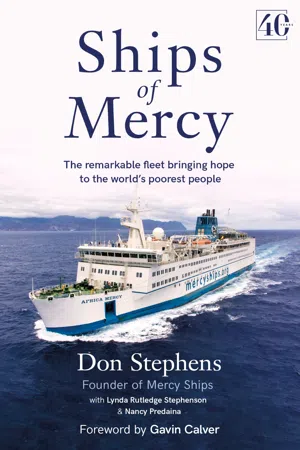
Ships of Mercy tells the riveting true story of Mercy Ships, the astonishing fleet of hospital ships that sail the globe, bringing dramatic change to the lives of hundreds of thousands of people in the most impoverished and disease-stricken corners of the world.
Ships of Mercy is a page-turner of the highest quality, an inspiring testimony both to the essence of the human spirit and God's amazing providence.
It tells the story of a teenager's extraordinary vision brought to reality in the form of a multi-million dollar life-saving mission. It also tells the story of a family of people from diverse backgrounds who have sacrificed their comfort and security in order to perform remarkable acts of grace and kindness.
eBook - ePub
Ships of Mercy
The remarkable fleet bringing hope to the world's poorest people
- 240 pages
- English
- ePUB (mobile friendly)
- Available on iOS & Android
eBook - ePub
About this book
Information
Topic
Theology & ReligionSubtopic
Religion
CHAPTER 1
THE BIRTH OF A DREAM
The most pathetic person in the world is someone who has sight but has no vision.
—Helen Keller
I could say it all started with a hurricane, or reading a book about the famous SS Hope. I could say it started with meeting Mother Teresa, or with the birth of our special-needs son, John Paul. Or I could say it began with my parents’ simple way with grace and mercy and dignity with their small-town helping hand. I could say all those things about the very beginning of the idea that became Mercy Ships, and they’d all be true.
Certain ideas and opportunities fall into place in providential ways in almost every life. As I look back at my own, I can see the patterns of things happening when they did, and why, and I find myself shaking my head at the wonder, the sheer improbability, of it all.
I had been imagining the idea of a hospital ship since I was nineteen, and considering I grew up in landlocked Colorado, that was rather odd, to say the least. Growing up in the fifties and sixties, I was part of a generation who wanted to change the world and believed it was possible. President Kennedy’s Peace Corps was a popular and inspiring organization. By the time I left home, I was already primed to think in terms of spending a life in some sort of humanitarian effort, just through watching my nononsense parents. My mother and father were the perfect blend for the western Colorado farming and ranching town of Olathe where I grew up.
With my mother, it was care and compassion; with my father, practicality and integrity. My mother believed the best of everyone, and my father could spot a phony a hundred yards away. My mother had a remarkable heart for helping needy families in our town and a talent for treating them with dignity and respect that I quickly noticed as a child. “You never know when I might be in that situation and you can help me,” was one of the phrases she used to put everyone at ease.
My father, on the other hand, a farmer, rancher, and a grocery-store owner, was a pure, plainspoken Western man. What you saw was what you got. You never had to worry about what my dad thought, because he would tell you. And he told us a lot. “Words come too easily for some people,” he’d say. “I am far more interested in what you do, the deeds of your life, than any words you will ever say.”
That came home to me in a big way at his funeral. After the service, one of my parents’ longtime friends asked if I knew why so many Mexican-Americans were there. Many of those attending the memorial service were Hispanic, some people I’d never met.
“They were migrant workers,” she said. “They tried to stay through the entire year, after harvest, and their families were in challenging circumstances. Your father extended them credit when no other store owner would.” What was not being said was the obvious fact that they were people of integrity who paid him back, and, something better, they had passed on the story of his actions through their family life, honoring his good deed by making it part of their family lore. When you offer something life-affirming to someone who has nothing, the purest way that person can honor the deed is to pass the story from one generation to the next. That fact echoed through my heart and soul years later when I heard how Mercy Ship stories became family legends too.
So in 1964, at nineteen, I was raring to change the world, like so many others in my generation. I tagged along on a trip to the Caribbean, organized by a group that has been described as a faith-based Peace Corps—an organization called Youth With A Mission (YWAM)—that corralled a lot of us teenagers to be part of a program called SOS, a Summer of Service. What we didn’t know was that we were walking right into a hurricane.
Back then there was no way to know when a hurricane was brewing—no warning and no way to call anyone. All phones lines were down. Before I knew it, I was huddled with others in an aircraft hangar, riding out the worst of Hurricane Cleo as it roared around us. In the streets of Nassau, palm trees were being blown down, roofs blown off, and streets flooded. We were gathered in different venues for safety.
I was with a group in an old British World War II aircraft hangar that had withstood several storms. I remember cracking open those big hangar doors and staring at the sight. As you might imagine, we were all praying and praying hard. We were worried about ourselves and about our worried parents, and as the wind rattled and shook that hangar until it almost blew away itself, we couldn’t help but think about the Bahamians losing their houses and livelihoods—and, for some, their very lives. During that long day, I remember hearing about something a girl had said that day: “Wouldn’t it be wonderful if there was a ship with doctors and nurses that could come in after such a disaster?”
The idea stuck; I have no idea why. I remember how logical it had sounded to me. But I was as landlocked as a Colorado mountain boy could get. Young and all but clueless, I just stowed it away with all the other ideas that can fill a nineteen-year-old’s head.
Soon afterward, I recall hearing about the SS Hope, the world’s first peacetime floating hospital. During the 1960s, the logical idea had come to life—and it captivated the world. A doctor named William Walsh was appalled by the poor health conditions he saw during his South Pacific World War II service. Dr. Walsh persuaded President Eisenhower to donate a U.S. Navy hospital ship that he transformed with the help of donations into the SS HOPE (“Health Opportunities for People Everywhere”).
The ship made voyages throughout the Far East, South America, and parts of Africa. I remember its simple philosophy: “Go only where invited, and help people help themselves.” And I also remember the idealistic way it began, by asking for volunteers—drug companies to donate medicines; and doctors, nurses, and technicians willing to share and teach their skills to those developing countries.
But it was not until years later, as I read Walsh’s book, A Ship Called Hope, that memory and imagination rolled together.
By that time, in the late 1970s, the SS Hope had been grounded after eleven successful voyages. Project Hope transformed into a land-based, developmental program and still is working today, doing a marvelous job. At that time, there were no other nongovernmental sailing hospitals. The ocean was wide open for the Mercy Ships dream.
By the time I read Walsh’s book, I was married and living in Switzerland with my wife, Deyon, a nurse trained in the new field of coronary medicine. Deyon and I were young; we wanted to travel and be involved in something to make a difference with our lives. We had reconnected with Youth With A Mission, the group that had taken both of us through that hurricane, and had moved to Europe to undergo intensive language training and ultimately to direct the organization’s growing European, Middle East, and African office. But I had never forgotten my fascination with floating hospital ships. The idea still seemed incredibly viable. It had worked once; I knew it could still work. By all that is right, a citizen of the twenty-first century should have access to the very basics of twenty-first-century medical care, and I knew this could be the best and quickest way to do it.
A ship manned by experts and self-contained with its own water, power, accommodations, and medical supplies could go anywhere and do amazing things. The problems of the developing world—lack of dependable utilities or reliable ways to deliver supplies—had always been the catch-22 of offering aid to the developing world. A ship surely could do what the best land-based or governmental organization could do, and do it easier, quicker, and cheaper.
For months after reading Walsh’s book, I couldn’t stop talking about Project Hope’s original floating hospital concept. In truth, though, I had been intrigued with ships ever since moving to Europe. Every chance we had to go to the Baltic port area and the Mediterranean, we would go by ferry. Living in the middle of Europe, we were surrounded by centuries of ship-going cultures. Each time we sailed somewhere, I found a way to get onto the bridge and sneak a peek into the engine room. I was fascinated with ship engines and the sheer intelligence and breadth of knowledge required to run them. A modern ship engineer has to have an understanding of petroleum, electricity generation, electronics, diesel propulsion, and sanitation and waste disposal.
I was also fascinated with the command structure. There is something about life and work onboard a ship that is sheer clarity. In the maritime world, the first rule of operation is a clear understanding of processes, systems, and structure. As a ship nears a port, a certified local pilot climbs a rope ladder and boards the ship. The pilot, who knows the local currents, shoals, and conditions, then gives orders to the captain. The pilot calls out the orders to the captain:
“Five degrees starboard!” he quietly commands.
The captain relays the command verbatim to the helmsman.
The helmsman hears the order and repeats it verbatim to make sure that the captain and the pilot know he understood correctly. And when he has brought the helm around five degrees, the helmsman repeats it again just to let the captain and pilot know he has accomplished it: “Five degrees starboard, sir!”
That says clarity to me. Clear, crisp, and softly spoken commands bring immediate clarity and response, bring ships into port, and keep people safe. Ambiguity is dangerous—on ships or in organizations. I saw the effectiveness of clear command communication on the bridge, and it formed my future concept of the kind of “command” structure needed for a hospital-ship effort.
Wherever we went during those years, I was drawn to the docks and to the big ships, always with a sense of wonder about why, considering I was just a Colorado farm boy. Not until years later would I find out, with delight, that my Norwegian forefathers quite likely helped to build a ship called the Eliezer in Norway, which sailed for Sierra Leone where Mercy Ships was destined to go. Does a love for ships soak into the genes? Perhaps it does.
All I know is that while I lived in Europe, only hours from my great-grandfather’s homeland, I was mesmerized with anything and everything to do with ships. At the same time I was already in a career with an established international group of volunteers who raised their own financial support for their nonprofit work. As I worked with the organization’s European, Middle East, and African issues, I kept pondering new answers to old developing-world problems, hearing all the obstacles that existed for each one.
Youth has its advantages. I was naive and persistent (or stubborn, as some might say) enough to keep pondering the big questions about the developing world’s problems. I truly believed there had to be streamlined, graceful answers we just weren’t seeing. I was convinced that one of them had to do with the hospital-ship concept. I stored it all away, though, and went on with the work at hand.
Then our son J. P. was born.
By this time, we had two children, Heidi and Luke, both healthy and normal. But an unknown, autism-like syndrome left John Paul severely challenged, mentally and physically. What we could not know then was that he would never be able to speak, dress, or feed himself. We loved him from the outset, but because he couldn’t respond in the normal ways, we would have to learn to show our love for him through the hard work of caring for him through the years ahead.
As Deyon and I coped with the round of doctor visits and tests for our new, struggling baby, I began to wonder what we would need to provide for him. Support groups, health care, medicine, day care, and education, all exist in the developed world to help the handicapped. Even our streets and buildings reflect the sensitivity for these members of our society. But that wasn’t true in the rest of the world.
Even as I coped with my own emotions about my new little boy’s reality, I was well aware of the enormous segments of the world’s population suffering with handicaps even more severe than J. P.’s. After all, what would it be like to live in a village in Africa, or Indonesia, or Guatemala, and face a similar situation? The question now had a personal dimension. And as our fears were realized for our third child, I came face-to-face with the fundamental question about the value of a life.
And that was the moment I met Mother Teresa.
John Paul was a little over a year old when a doctor friend in India arranged for a colleague and me to see Mother Teresa’s world-renowned work with the destitute in Calcutta. I would have a chance to see how her order, the Sisters of Charity, cared for the severely handicapped and the dying in the midst of one of the world’s most impoverished cities. Her work should have been little noticed by the world, really. Yet everyone, from the most powerful leaders to everyday citizens, knew about her service to the world’s forgotten, inspired by the capacity for divine mercy she embodied. She had become a shining example of a person who, through dignity, honor, and respect, put words into action, “doing” the gospel, as she so famously expressed it. Action and words—integrity—it was the same dynamic my father had expressed.
The city of Calcutta was a shock to the senses that no description can prepare you to handle. Each night, I stepped over families living on the streets, where they were born, lived, and died. I saw one water standpipe where people lined up twenty-four hours a day to pump their families’ supply. Yet despite the overwhelming needy masses in Calcutta, I’d heard that Mother Teresa had instilled in her followers a gift for focusing on each individual as if he or she were the only person in the world receiving such attention and concern. And that, I was about to discover, included me.
Somehow she had learned that my young son was handicapped. I hadn’t told many. I had barely begun to talk about it; I was still finding my way. But somehow she knew—it was one of the first things discussed. Only moments after we were introduced, Mother Teresa said something that charted the course of the rest of my life. I can hear the echoes of her words even now: “Your son will help you on your journey to becoming the eyes, ears, mouth, and hands for the poor.”
I was just thirty-two years old at the time. I could not have heard a more profound message. She had framed some very basic questions of life: Why were you born? What is your purpose in life? Why did God put you on Earth? What is your dream? What has caused pain in your life?
To visit Mother Teresa was a wonderful opportunity. For me, my take-away was the gift of clarity. She helped crystallize my purpose in life, my role in life and what I was to do. The dreams and realities of my life came together in meaningful focus, shining like a beacon—a ship’s beacon. Hence, we have Mercy Ships.
All the reasons against the f...
Table of contents
- Cover
- Title Page
- Copyright
- Dedication
- Contents
- Foreword by Gavin Calver
- Preface: Ship of Hope
- Introduction: A Tale to Tell
- Chapter 1 The Birth of a Dream
- Chapter 2 The Perfect Ship
- Chapter 3 Stranded in Greece
- Chapter 4 Launched!
- Chapter 5 On Trial in Greece
- Chapter 6 A True Hospital Ship
- Chapter 7 Finally to Africa
- Chapter 8 Bringing Hope and Healing
- Chapter 9 Heart of Africa
- Chapter 10 To the Ends of the Earth
- Chapter 11 Headlines Tell the Story
- Chapter 12 Mercy Ships on Land and Sea
- Chapter 13 The Africa Mercy Makes Its Debut
- Chapter 14 New Ship, New President, New Hope
- Chapter 15 Leaving Footprints of Mercy
- Chapter 16 Capacity Building and New Power
- Afterword: As Wide as the Sea
- Appendices
- About the Authors
- Photographs
Trusted by 375,005 students
Access to over 1.5 million titles for a fair monthly price.
Study more efficiently using our study tools.
Frequently asked questions
Yes, you can cancel anytime from the Subscription tab in your account settings on the Perlego website. Your subscription will stay active until the end of your current billing period. Learn how to cancel your subscription
No, books cannot be downloaded as external files, such as PDFs, for use outside of Perlego. However, you can download books within the Perlego app for offline reading on mobile or tablet. Learn how to download books offline
Perlego offers two plans: Essential and Complete
- Essential is ideal for learners and professionals who enjoy exploring a wide range of subjects. Access the Essential Library with 800,000+ trusted titles and best-sellers across business, personal growth, and the humanities. Includes unlimited reading time and Standard Read Aloud voice.
- Complete: Perfect for advanced learners and researchers needing full, unrestricted access. Unlock 1.5M+ books across hundreds of subjects, including academic and specialized titles. The Complete Plan also includes advanced features like Premium Read Aloud and Research Assistant.
We are an online textbook subscription service, where you can get access to an entire online library for less than the price of a single book per month. With over 1.5 million books across 990+ topics, we’ve got you covered! Learn about our mission
Look out for the read-aloud symbol on your next book to see if you can listen to it. The read-aloud tool reads text aloud for you, highlighting the text as it is being read. You can pause it, speed it up and slow it down. Learn more about Read Aloud
Yes! You can use the Perlego app on both iOS and Android devices to read anytime, anywhere — even offline. Perfect for commutes or when you’re on the go.
Please note we cannot support devices running on iOS 13 and Android 7 or earlier. Learn more about using the app
Please note we cannot support devices running on iOS 13 and Android 7 or earlier. Learn more about using the app
Yes, you can access Ships of Mercy by Don Stephens in PDF and/or ePUB format, as well as other popular books in Theology & Religion & Religion. We have over 1.5 million books available in our catalogue for you to explore.