How is constructive cultural exchange possible when traditions hold such contradictory views? Jingjing Li brings Edmund Husserl's phenomenology and Chinese Yogacara Buddhism into dialogue to explore the concept of essence in this open access book.
While phenomenology and Yogacara Buddhism are both known for their investigations of consciousness, there exists a core tension between them: phenomenology affirms the existence of essence, whereas Yogacara Buddhism argues that everything is empty of essence (svabhava). Answering this question and positioning both philosophical traditions in their respective intellectual and linguistic contexts, Li argues that what Husserl means by essence differs from what Chinese Yogacarins mean by svabhava. We see how Husserl problematises the substantialist understanding of essence in European philosophy.
Detailing the process of finding a middle ground between the two traditions, Li's rich study demonstrates how both can thrive together in order to overcome Orientalism. She reveals that Chinese Yogacara has developed a distinct account of self-transformation, ethics and social ontology that renders it much more than simply a Buddhist version of Husserlian phenomenology.
The ebook editions of this book are available open access under a CC BY-NC-ND 4.0 licence on bloomsburycollections.com. Open access was funded by the Dutch Research Council (NWO).
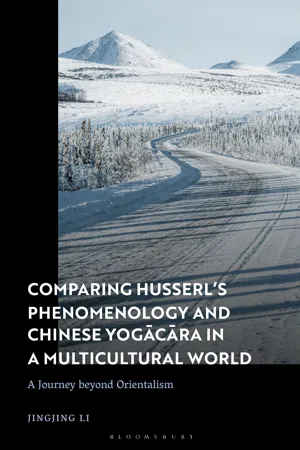
eBook - PDF
Comparing Husserl’s Phenomenology and Chinese Yogacara in a Multicultural World
A Journey Beyond Orientalism
- 273 pages
- English
- PDF
- Available on iOS & Android
eBook - PDF
Comparing Husserl’s Phenomenology and Chinese Yogacara in a Multicultural World
A Journey Beyond Orientalism
About this book
Trusted by 375,005 students
Access to over 1.5 million titles for a fair monthly price.
Study more efficiently using our study tools.
Information
Table of contents
- Cover
- Halftitle page
- Series page
- Title page
- Copyright page
- Contents
- Tables
- Acknowledgments
- Abbreviations
- Note on Usage and Convention
- Prologue
- Part One The Journey
- Part Two The Road
- Part Three The Tracks
- Part Four The Destination
- Epilogue
- Notes
- Bibliography
- Index
Frequently asked questions
Yes, you can cancel anytime from the Subscription tab in your account settings on the Perlego website. Your subscription will stay active until the end of your current billing period. Learn how to cancel your subscription
No, books cannot be downloaded as external files, such as PDFs, for use outside of Perlego. However, you can download books within the Perlego app for offline reading on mobile or tablet. Learn how to download books offline
Perlego offers two plans: Essential and Complete
- Essential is ideal for learners and professionals who enjoy exploring a wide range of subjects. Access the Essential Library with 800,000+ trusted titles and best-sellers across business, personal growth, and the humanities. Includes unlimited reading time and Standard Read Aloud voice.
- Complete: Perfect for advanced learners and researchers needing full, unrestricted access. Unlock 1.5M+ books across hundreds of subjects, including academic and specialized titles. The Complete Plan also includes advanced features like Premium Read Aloud and Research Assistant.
We are an online textbook subscription service, where you can get access to an entire online library for less than the price of a single book per month. With over 1.5 million books across 990+ topics, we’ve got you covered! Learn about our mission
Look out for the read-aloud symbol on your next book to see if you can listen to it. The read-aloud tool reads text aloud for you, highlighting the text as it is being read. You can pause it, speed it up and slow it down. Learn more about Read Aloud
Yes! You can use the Perlego app on both iOS and Android devices to read anytime, anywhere — even offline. Perfect for commutes or when you’re on the go.
Please note we cannot support devices running on iOS 13 and Android 7 or earlier. Learn more about using the app
Please note we cannot support devices running on iOS 13 and Android 7 or earlier. Learn more about using the app
Yes, you can access Comparing Husserl’s Phenomenology and Chinese Yogacara in a Multicultural World by Jingjing Li in PDF and/or ePUB format, as well as other popular books in Philosophy & Eastern Philosophy. We have over 1.5 million books available in our catalogue for you to explore.