How did Nietzsche and Sartre come to represent alternative modes of philosophy as antithetical thinkers? What exactly is their philosophical connection and how far does it extend?
Tracing the connections between the existentialist philosophies of Nietzsche and Sartre, Nik Farrell Fox provides new readings attuned to questions of the self, politics and ethics. From their earliest to final writings, Fox brings into critical view the full trajectory of their lives and philosophy to reveal the underexplored parallels that connect them. Through engaging with new Nietzsche and Sartre studies as authoritative strands of interpretation, this book identifies both philosophers as twin thinkers of a deconstructive and paradoxical logic. Fox further re-examines their work in light of contemporary debates concerning posthumanism, vibrant materialism, quantum theory and speculative realism.
The Parallel Philosophies of Sartre and Nietzsche presents two iconic existentialists as thoroughly contemporary thinkers whose complex, rich, and sometimes-ambiguous philosophy, can illuminate our present posthuman reality.
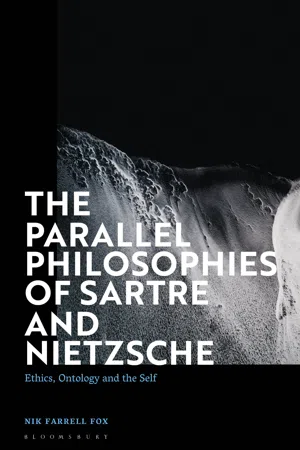
eBook - ePub
The Parallel Philosophies of Sartre and Nietzsche
Ethics, Ontology and the Self
- 272 pages
- English
- ePUB (mobile friendly)
- Available on iOS & Android
eBook - ePub
About this book
Information
1
Reading Nietzsche and Sartre
When I imagine a perfect reader, I always think of a monster of courage and curiosity who is always supple, cunning, cautious, a born adventurer and discoverer.(Nietzsche, Ecce Homo 3.3)
Literary phenomenology
Writing was an obsession to Nietzsche and Sartre, a daily necessity, as Nietzsche remarked, like relieving oneself (GS 93). What perhaps characterizes their shared style most of all is the magical fusion of philosophy and literature in their writing. Sartre’s Nausea is a tableau vivant of conceptual imagery and literary description bound together in a lived dynamic of ‘literary phenomenology’ (Inkpin 2017: 16), while Nietzsche’s Zarathustra articulates philosophical ideas through the literary medium of ‘a phantasmatic and hallucinatory landscape poem’ (Shapiro 2016: 84). Nausea expresses Sartre’s wish ‘to be both Spinoza and Stendhal’1 and takes the form of a ‘phenomenological novel’, exhibiting osmosis between the literary and the philosophical by virtue of the status of consciousness it establishes in Roquentin. In the words of Contat and Rybalka,
by the dissolution of the subject that it effects; by its refusal of psychology: Roquentin has no ‘character’, no substantial ego; he is pure consciousness of the world; his experience is not a voyage into the depths of interiority; on the contrary, it is a bursting out toward things. Everything is outside: Nausea is not in Roquentin; he’s the one who is dissolved in it. (1981: 1664)
As Sartre remarked, a writer has to be a philosopher: ‘From the moment that I knew what philosophy was, it seemed normal to require it of a writer. . . . I preferred that the philosophy I believed in, the truths that I relied on, be expressed in my novel’ (Beauvoir 1981: 178, 184).2
Replacing ‘proposition by demonstration’ (as Beauvoir (1983: 50) described Sartre’s literary writing) doubtlessly brought to life their ideas in a literary form of glorious Technicolor, but it also contributes to the proliferating play of interpretation in understanding them. In their autobiographies, they blur the lines between fact and fiction, embarking on what Nietzsche called mnemotechnics – the retrospective investment of past material by later experience in which the future shapes the past. Sartre discovered, when recalling his own childhood, that the nature of autobiographical reflection is a dynamic selective process in which past experiences are appropriated to current needs, interests and projects to produce a narrative which is simultaneously fictional and true.3 Sartre ambiguously classifies his autobiography in this manner as ‘a true work of fiction’ and, in equal measure, his biography of Flaubert as ‘a work of fiction that I believe’ (1977: 10:146).
Despite their fine writing style, the ambiguity that runs through the core of their works means that Nietzsche and Sartre are difficult thinkers to understand comprehensively without cliché or simplification. Wandering along the complex and winding highways and byways that comprise their philosophy, a feeling of disorientation soon strikes with a confusion of signposts that seem to point discrepantly in opposite directions. As Katsafanas (2018: 93) observes of Nietzsche, there is a distinct lack of systematicity in his work in which he rarely presents clear defences of his central concepts and arguments: ‘Some of his claims seem mutually contradictory, to the extent that readers . . . present his texts as “booby trapped” against articulation of philosophical theory.’ Caws (1984: 1) identifies a similar trait in Sartre: ‘If by “argument” is understood a sequence of propositions, beginning from premises laid down with some plausible warrant and proceeding by way of intermediate steps, each accompanied by a justifying reason, to a conclusion firmly established, the discovery of arguments in Sartre’s work is not easy.’ His ‘dual allegiance’ to philosophy and literature means that although he starts out in his works to be ‘lucid’ and ‘rigorous’ like a philosopher, the writer gradually takes over with the result that ‘the distance from conception to expression is progressively reduced, critical restraint yields to enthusiasm and the whole enterprise gathers momentum’ (1984: 3).
‘The characters an artist creates’, Nietzsche wrote, ‘are not the artist himself, but obviously the series of characters to which he devotes himself with innermost love does indeed say something about the artist himself’ (UM 4.2). We must thus be wary in unproblematically taking Sartre’s fiction as his definitive philosophical view without weighing the ambiguity in his thinking. Just as it is simplistic to take Garcin’s proclamation of ‘hell is other people’ in Huis Clos as Sartre’s settled philosophical view of intersubjectivity, it is also hasty to directly assimilate Roquentin to Sartre.4 Sartre’s fulfilment of his original project to be a writer gives him a level of productivity and a cheerful disposition absent in Roquentin. As he writes, for instance, ‘[t]he essential difference between Antoine Roquentin and me is that, for my part, I write the story of Antoine Roquentin’ (WD 338). He also alludes to the gloominess of Roquentin that is contrary to his own disposition – like himself but ‘stripped of the living principle’ (WD 338). In his novels, by his own admission, structures such as sadness and melancholia begin to take on a life of their own: ‘That’s what I did: I stripped my characters of my obsessive passion for writing, my pride, my faith in my destiny, my metaphysical optimism – and thereby provoked in them a gloomy pullulation. They are myself beheaded’ (WD 339). Like Hilbert in ‘Erostrate’ and other characters that populate Sartre’s fictional universe, Roquentin is not a double of Sartre but more ‘a nightmarish deformation’ of him in which only certain traits remain: ‘I fool people . . . I haven’t felt Nausea, I’m not authentic’ (WD 62).
To pin down these two freewheeling philosophers is thus no straightforward task. Their freedom from institution and place as itinerant philosophers offers a biographical parallel to the freedom that characterized their thinking. As Hayman (1982, 1986) remarks, what exemplifies them is their continual process of ‘writing against’ themselves, always evolving their perspective and resisting philosophical stasis. In the 1886 preface to the second part of Human, All Too Human, Nietzsche, for instance, declares how, after his turn from Wagner and Schopenhauer, ‘I now took sides against myself and for everything that would hurt me – me especially – and come hard to me’. It is impossible, in this respect, as Foucault (1988: 32) commented, to identify a single authoritative ‘Nietzscheanism’ since Nietzsche was a self-declared anarchist who held no regard for textual fidelity. Ambiguity can be found in the very question of whether or not there is even a Nietzschean system to speak of. In Daybreak, for instance, Nietzsche warns passionately against system builders – ‘Beware of systematizers!’ (D 318) – and roundly condemns the ‘will to a system’ in Twilight of the Idols: ‘I distrust all systematizers and avoid them. The will to a system is a lack of integrity’ (TI 1.26). Many of his interpreters, however, view him as a thoroughly systematic thinker including, among others, Heidegger, Kaufmann, Danto and Deleuze. The notes of the Nachlass are commonly seen as Nietzsche’s own will to a system in which his main philosophical concepts – the will to power, eternal return and the Übermensch – receive their fullest articulation. As I present them, Nietzsche and Sartre are twin thinkers of contradiction and ambiguity who bequeath us a number of interpretative puzzles, but it is within the productive play of contradiction and ambiguity that, I hope to show, the wellspring of their ‘sublimated thinking’ most readily flows and a greater logic of deconstruction unravels.
Good reading/bad reading
Hear me! For I am such and such a person. Above all, do not mistake me for someone else.(Nietzsche, Ecce Homo P1)
Nietzsche has firm expectations of his readers who must acknowledge the temporal quality of ‘the art of reading’ (GM P8). It is essential to slowly digest his texts: ‘read slowly, deeply, looking cautiously before and aft, with reservations, with doors left open, with delicate eyes and figures . . . My patient friends, this book desires for itself only perfect readers and philologists: learn to read me well!’ (D P5). Philology, he tells us, is to be understood as ‘the art of reading well’ – to be able to read off a fact ‘without falsifying it by interpretation, without losing caution, patience, subtlety in the desire for understanding’ (A 52). But how should we read the writings of Nietzsche and Sartre? As texts with a life and meaning of their own or as texts imprinted with the ‘existential signatures’ of their authors?
There appears to be a paradox in Nietzsche’s recommendations on how we should understand him. The philosopher who stamps personality onto his writings warns against any Cult of Personality in discerning the true meaning of the text. In his debates over the ‘Homer Question’, for instance, he argues that it doesn’t matter who or how many wrote the work since ‘the composer of the Iliad and the Odyssey is an “aesthetic judgment”’ (KGW 2.1.263). Once the text has been written, it acquires a life of its own independent of the author’s subjective meaning and intention (HH 208). Elsewhere, however, the novel and powerful method of critical inquiry that Nietzsche develops is irreducibly ad hominem. This ad hominem approach involves the interlacing of bios and mind and points back to the author, as well as the meaning, profundity and effect of an argument, and is consistent with his own idea of the importance of perspective.5 He wonders, for instance, if his own and other philosophies are no more than ‘intellectual detours for . . . personal drives?’ (D 553), and writes of the ‘great love’ he has for conveying his truthfulness to his readers through which he ‘has a personal relationship to his problems, and finds in them his destiny, his distress, and his greatest happiness’ (GS 345). In the preface to the second edition of The Gay Science, Nietzsche makes an indissoluble link between his own autobiographical situation and the themes of ‘convalescence’, ‘health’ and ‘sickness’ in his philosophy. The great pain he suffered ‘compels us philosophers to descend into our ultimate depths and to put aside all trust, everything good-natured, everything that would interpose a veil, that is mild, that is medium – things in which formerly we have found our humanity. I doubt that such pain makes us “better”, but I know that it makes us more profound’ (GS P3). Conscious of ‘the advantages that my fickle health gives me over all robust squares’ (GS P3), there is, he emphasizes, a direct relation between psychology and philosophy:
In some it is their deprivations that philosophize; in others, their riches and strengths – those who philosophize through their deprivations need their philosophy, whether it be as a prop, a sedative, medicine, redemption, elevation, or self-alienation. (GS P2)
Nietzsche strongly reiterates this linkage in Beyond Good and Evil, declaring that there is ‘absolutely nothing impersonal about the philosopher’; every philosophy is ‘a confession on the part of its author and a kind of involuntary and unconscious memoir’. A philosopher’s psychological dispositions and drives are, he maintains, ‘the real germ of life out of which the entire plant has grown’ (BGE 6). Thus, in every philosophy there is always ‘a point at which the philosopher’s “conviction” appears on the scene’ (BGE 8).
As Salomé (1988) first suggested, the trajectory of Nietzsche’s thinking correlates closely to the material circumstances of his life. His aphoristic style of writing, for instance, was a consequence largely of his nomadic lifestyle and the fact that he had short periods to write in between his chronic troughs of bad health. Because of this, he purposely approaches deep problems like cold baths: ‘quickly into them and quickly out again’ (GS 381). His aphorisms require exegesis in order to decipher them and a higher level of engagement to be understood (GM P8). They are necessarily incomplete (HH 178, 207) and serve as tests for the reader (Z 1.7). This gives Nietzsche’s philosophy, as Deleuze (1983: 31) argued, a kind of magnetic and interactive quality. The use of aphorisms, along with the use of paradox, wordplay, metaphor and masks, invites evaluation and interpretation through its very form and constitution. One has no choice but to interpret and evaluate what Nietzsche actually means.6
Sartre’s writings similarly bear the trace of environment and his unique circumstance. One cannot ignore, for instance, the narcotic influence on the Critique. On reading its long meandering paragraphs and interweaving interminable sentences one is struck by a certain imposition of rhythm, a kind of fuelled effort to render its writing as rapid as the movement of thinking. It was not a case of writing in the ordinary sense, as Beauvoir (1977: 385) recounted, in the way of pausing to think, making corrections and rewriting certain sentences or passages: ‘for hours at a stretch he raced across sheet after sheet without rereading them, as though absorbed by ideas that his pen, even at that speed, couldn’t keep up with.’ Cohen-Solal (1991: 374) records,
This is how he wrote The Critique of Dialectical Reason: a wild rush of words and juxtaposed ideas, pouring forth during crises of hyper-excitement, under the effect of contradictory drugs, that would zing him up, knock him down, or halt him in between . . . Heavy doses for a tough man, hyperlucid and nearly impervious to pain, who, however, would occasionally lapse into moments of absence, from which he then promptly re-emerged, ready to assume control, with vivacity and pride.
Just like Nietzsche’s, Sartre’s philological recommendations of ‘good reading’ are polysemous, often balancing on a tightrope of humanist and anti-humanist equivocation. In reference to his biographies of Baudelaire, Genet and Flaubert, Ireland (2020: 451) observes how ‘Sartre is both a humanist and an anti-humanist’, his analysis residing in the ambiguous space between the two. While stating in an interview, for instance, that ‘the life of people who write is projected in the writing in one way or another’ (1979b: 26), Sartre maintains elsewhere that ‘the text towers above its author’ (WL 34). Mueller (2019: 36) echoes Ireland on this point of tergiversation, showing how, as we move from What Is Literature? to The Family Idiot, Sartre’s literary theory ‘accords more and more importance to the figure of the reader and seeks to elucidate the possibility of the reader’s freedom with increasing precision’. The implicit association of Sartre with an unqualified adherence to ‘a conception of the author as a coherent, indivisible, and authoritative entity’ is as false as is ‘the assumption of a supposedly unproblematic and “whole” Sartrean subject’. What Is Literature? is often associated with the notion of the committed author but views the writer in a dual reality with the reader: ‘It is the joint effort of author and reader which brings upon the scene that concrete and imaginary object which is the work of the mind. There is no art except for and by others’ (WL 50). Sartre questions Kant’s notion of disinterested pleasure on the grounds that it does not explain the relationship between the work of art and its viewer (WL 42). The collaboration between author and reader in an undertaking of collective freedom elicits the feeling of ‘aesthetic joy’ attained through the reader’s contribution through which the work ‘undergoes an increase in being’ (WL 29). Reading is not the simple reception of a message in an act of communication but an active creation characterized by freedom. Without the reader the text would ‘remain only a collection of signs’ (WL 52). In The Family Idiot, as Mueller (2019: 44) notes, Sartre moves further still towards a more decentred reading of the author and how, in a rather ‘Foucauldian move’, Sartre reduces the author to a specific function in the process of reading. Where the writer leads the reader through the text in What Is Literature?, the reader now takes over completely.7
As Nietzsche and Sartre move in their analysis to a more decentred view of the subject, they very much anticipate Derrida’s critique of the ‘metaphysics of presence’. Derrida follows Nietzsche in decentring the subject as a privileged centre by dispersing it within the system of textual relations that is writing: ‘The “subject” of writing does not exist if we mean by that some sovereign solitude of the author. The subject of writing is a system of relations between strata: the Mystic Pad, the psyche, society, the world’ (1978: 226–7). For Derrida (1978: 292), it is Nietzsche’s ‘joyous affirmation of the play of the world’ that points the way to an affirmation of the decentred play of writing that disrupts the metaphysics of presence which guides the logocentric tradition. ‘Nietzsche’ himself as a proper name must be placed in quotation marks and the question of the ‘truth of Nietzsche’ or the ‘totality of Nietzsche’s text’ must be suspended for he writes in the various masks of Zarathustra, the free spirit, the disciple of Dionysus, the new philosopher and the Antichrist.8
Although my approach is highly sympathetic to the ‘French Nietzsche’ and to the Derridean play of interpretation, the attempt to erase Nietzsche altogether from his work – to ‘write with no face’ (1972: 17) as Foucault professed to – is itself, to my mind, a false move towards metaphysical closure. Although Nietzsche stresses the ‘masks’ a...
Table of contents
- Cover
- Half-Title
- Series
- Dedication
- Title
- Contents
- Preface
- Acknowledgements
- Abbreviations
- Introduction: The Nietzsche–Sartre connection
- 1 Reading Nietzsche and Sartre
- 2 Heidegger, Derrida and the metaphysical charge
- 3 The decentred self
- 4 Smooth ontology
- 5 A creative ethics and agonistic politics
- 6 Posthuman progenitors
- 7 Lebensphilosophie
- Conclusion: Twin ternary thinkers
- Notes
- Bibliography
- Index
- Copyright
Trusted by 375,005 students
Access to over 1.5 million titles for a fair monthly price.
Study more efficiently using our study tools.
Frequently asked questions
Yes, you can cancel anytime from the Subscription tab in your account settings on the Perlego website. Your subscription will stay active until the end of your current billing period. Learn how to cancel your subscription
No, books cannot be downloaded as external files, such as PDFs, for use outside of Perlego. However, you can download books within the Perlego app for offline reading on mobile or tablet. Learn how to download books offline
Perlego offers two plans: Essential and Complete
- Essential is ideal for learners and professionals who enjoy exploring a wide range of subjects. Access the Essential Library with 800,000+ trusted titles and best-sellers across business, personal growth, and the humanities. Includes unlimited reading time and Standard Read Aloud voice.
- Complete: Perfect for advanced learners and researchers needing full, unrestricted access. Unlock 1.5M+ books across hundreds of subjects, including academic and specialized titles. The Complete Plan also includes advanced features like Premium Read Aloud and Research Assistant.
We are an online textbook subscription service, where you can get access to an entire online library for less than the price of a single book per month. With over 1.5 million books across 990+ topics, we’ve got you covered! Learn about our mission
Look out for the read-aloud symbol on your next book to see if you can listen to it. The read-aloud tool reads text aloud for you, highlighting the text as it is being read. You can pause it, speed it up and slow it down. Learn more about Read Aloud
Yes! You can use the Perlego app on both iOS and Android devices to read anytime, anywhere — even offline. Perfect for commutes or when you’re on the go.
Please note we cannot support devices running on iOS 13 and Android 7 or earlier. Learn more about using the app
Please note we cannot support devices running on iOS 13 and Android 7 or earlier. Learn more about using the app
Yes, you can access The Parallel Philosophies of Sartre and Nietzsche by Nik Farrell Fox in PDF and/or ePUB format, as well as other popular books in Philosophy & Ethics & Moral Philosophy. We have over 1.5 million books available in our catalogue for you to explore.