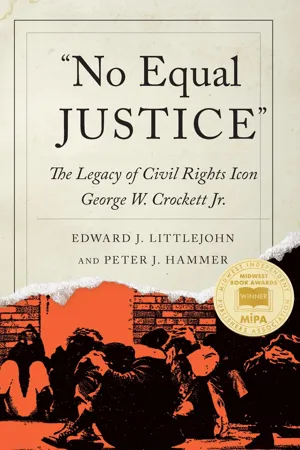
Winner of a Michigan State History Award! Gold Medal Winner in the Independent Publisher Book Awards!Gold Medal Winner in the Midwest Independent Publisher Awards!Silver Medal Winner in the Foreword Indie Awards!Finalist in the Next Generation Indie Book Awards!"There is no equal justice for Black people today; there never has been. To our everlasting shame, the quality of justice in America has always been and is now directly related to the color of one's skin as well as to the size of one's pocketbook." This quote comes from George W. Crockett Jr.'s essay, "A Black Judge Speaks" (Judicature, 1970). The stories of Black lawyers and judges are rarely told. By sharing Crockett's life of principled courage, "No Equal Justice" breaks this silence. The book begins by tracing the Crockett family history from slavery to George's admission into the University of Michigan Law School. He became one of the most senior Black lawyers in President Franklin Roosevelt's New Deal administration. Later, he played a central role fighting discrimination in the United Auto Workers union. In 1949, he became the only Black lawyer, in a team of five attorneys, defending the constitutional rights of the leaders of the U.S. Communist Party in United States v. Dennis, the longest and most dramatic political trial in American history. At the close of the case, Crockett and his defense colleagues were summarily sentenced to prison for zealously representing their clients. He headed the National Lawyers Guild office in Jackson, Mississippi, during 1964's Freedom Summer. In 1966, he was elected to Detroit's Recorder's Court—the court hearing all criminal cases in the city. For the first time, Detroit had a courtroom where Black litigants knew they would be treated fairly. In 1969, the New Bethel Church Incident was Crockett's most famous case. He held court proceeding in the police station itself, freeing members of a Black nationalist group who had been illegally arrested. In 1980, he was elected to the United States Congress where he spent a decade fighting President Reagan's agenda, as well as working to end Apartheid in South Africa and championing the cause to free Nelson Mandela.Crockett spent his life fighting racism and defending the constitutional rights of the oppressed. This book introduces him to a new generation of readers, historians, and social justice activists.
eBook - ePub
"No Equal Justice"
The Legacy of Civil Rights Icon George W. Crockett Jr.
- 448 pages
- English
- ePUB (mobile friendly)
- Available on iOS & Android
eBook - ePub
"No Equal Justice"
The Legacy of Civil Rights Icon George W. Crockett Jr.
About this book
Information
Topic
Ciencias socialesSubtopic
Biografías históricas1
The Early Years
Influences and Michigan Law
The story of George W. Crockett Jr. is a true American story, beginning in slavery and ending in an ongoing struggle for freedom. He was shaped and nurtured by a critical range of segregated Black institutions: his family, the church, and a budding Black civil society. The importance of family is illustrated by the care Crockett devoted to researching, writing, and preserving the family history. The Crockett family history includes this dedication: “This Family History is dedicated to all who came before us, whose courage and experiences we celebrate.” Acknowledging the many ways that racism erases personal identities and individual identities, the history begins, “As far as we have been able to ascertain . . .”1
This is the Crockett family story. Sidney Weatherly (Crockett’s great-great-grandfather) was brought to the United States as a slave in about 1778 to the city of Salisbury, on the Eastern Shore of Maryland. Sadly, many details are simply unknown. No one knows the place or date of Sidney’s birth or death, the name of his wife, or the number of children they had. It is known that Weatherly was the name of his slave master.2
Charles (Weatherly) Crockett (Crockett’s great-grandfather), son of Sidney Weatherly, was born a slave in or around Salisbury in 1803. He lived 105 years, passing in Laurel, Delaware, in 1908 or 1909.3 How Charles got from Salisbury to Laurel is a matter of some mystery. The Crockett family history reports, “After the Emancipation Proclamation following the Civil War, Charles crossed over from Maryland into Delaware, dropping his slave name Weatherly, and took the name Crockett. He settled on a farm in the vicinity of Spring Hill Church near Laurel, Delaware.”4 The history also states that “John Crockett [Crockett’s grandfather], the son of Charles and Anna Wales Crockett, was born on February 12, 1863 at Laurel, Delaware.”5
The Emancipation Proclamation did not apply to Maryland or Delaware. Slavery did not legally end in these states until 1865. In what the historian Barbara Jeanne Fields terms the “middle ground” of Maryland, such technicalities made little difference. “Neither the preliminary Proclamation nor the final one on January 1 embraced Maryland. But to the slaves, who cared nothing for the reasons of state that exempted their owners from the edict of freedom, that hardly mattered.”6 Fields notes, however, what a weighty and dangerous decision self-emancipation was. It appears that Charles escaped from Maryland to Delaware (also a slave state) with his pregnant wife sometime after the Emancipation Proclamation was announced on September 22, 1862, and the birth of their son, John, on the twelfth of February. In other words, John was apparently born free through an act of self-emancipation. The mystery only deepens when one realizes that Laurel is only fifteen miles north of Salisbury. They did not escape very far.
One wonders why the act of escaping from slavery during the Civil War is not stated more directly or even celebrated in Crockett family lore. As we will see, George Crockett Jr. was meticulous about details. He did not make mistakes or tolerate omissions. Interestingly, he drops a hint as to the likely truth in the family history. The history reproduces an article from the Washington Post Magazine titled “Maryland’s Eastern Shore: Tracing the Underground Railroad.” In 1860, Maryland had eighty-four thousand free Blacks and a slave population of eighty-seven thousand persons. The article asserts that there were many opportunities for slaves to escape: “The town of Easton (Maryland) harbored a sizable community of Quakers, the white linchpins of the Underground Railroad, and Quakers operated a string of safe houses in Delaware, along the Railroad’s route to Philadelphia.”7 Whether via the Underground Railroad or through a series of personal contacts and relationships spanning the fifteen miles, the Crockett family made it to Laurel, Delaware, which became and remains the family’s spiritual home.8
There is something fitting about Maryland being the place of the Crockett family origin, the same state that birthed Frederick Douglass. Douglass was a fierce advocate for racial justice and the power that a properly interpreted antislavery Constitution could deploy. These are values George Jr. would embrace his whole life.
John Crockett, George’s grandfather, married Minnie Conway of nearby Bethel, Delaware. John and Minnie had seven children; all died in infancy save two—George William Crockett (George Jr.’s father) and Elizabeth Crockett Thorgood (George Jr.’s aunt).9 George Sr. was born March 20, 1883, in Seaford, Delaware. His sister Elizabeth was born February 17, 1892. The Crockett family’s sojourn from slavery continued farther and farther north. John moved his family to Camden, New Jersey, to perfect the trade of cement layer and to provide a better education for his children.10
Unfortunately, fate intervened: “George Sr. terminated his public schooling at the high school level when his father’s broken leg made it necessary that he go to work in a garment factory to support the family.”11 He was so employed when he met Minnie Amelia Jenkins in 1904, his future wife and George Jr.’s mother.
Minnie Amelia Jenkins’s father, Moses Frazier Jenkins, was born a slave in 1861. “It is believed that his birthplace was located between the towns of Starke and Waldo, some 60 miles southwest of Jacksonville [Florida].”12 The details of George Sr. and Minnie’s courtship, marriage, and early years are told in their own words in a news article commemorating their fiftieth wedding anniversary.13 Minnie was born in Georgetown, South Carolina, in 1883. “When she was about 14, her mother died and she was adopted by her cousins Dr. and Mrs. H. T. Johnson and went to live with them in Camden, N.J.”14 This is where the couple met in 1904.
What is meant by Minnie being “adopted” is unclear because sometime later her father, Moses Jenkins, traveled to Camden to take her back with him to South Carolina. George Sr. told Moses that he and Minnie wanted to be married. Moses told George that he would have to come to South Carolina for her when they were ready.15 In the meantime, Minnie taught high school in Georgetown for about two years, when, true to his word, George Sr. “traveled to Georgetown to find this young lady,” and the couple were married.16
A serious question for the couple was where they would live. Escaping slavery, the Crockett family, starting in Maryland, traveled north for relatively more safety and better educational opportunities. Now, George Sr.’s heart had taken him to South Carolina and was about to lead him even farther south. Around the time of the wedding, Moses Jenkins sold his two farms in South Carolina and bought two other farms in Waldo, Florida, near where he had been born. The newlyweds moved with him in 1906, but the rural farm town proved more than George Sr. could handle. “After arriving there I didn’t like the conditions, so we came to Jacksonville.”17
George William Crockett Jr. was born in 1909, in Jacksonville, Florida. Not surprisingly, George Jr. was greatly influenced by his parents. “My mother was small in stature, but she was strong-willed and pugnacious; she never took anything lying down. My father, who was six feet tall, was a community leader. He was the head of the Black Elks in Florida, a leader in the Black Masons, as well as the Baptist church.”18 George Sr. subsequently became an ordained minister. During his later years, he was the pastor of Jacksonville’s Harmony Baptist Church.
By standards in the Black community, the Crockett family would have been considered middle, if not upper-middle, class. The Crockett household was full of activity, including the union and civil rights work that would become so important to George Jr. George Sr. was employed, full-time, by the Atlantic Coast Railroad as a skilled carpenter, repairing and building railroad boxcars. He was also a member of the Black Carpenters Union.19 Prior to the marriage in 1906, Minnie Crockett was a licensed public school teacher in South Carolina. Described as vivacious and bright, she, like her husband, was an active leader in their church and in Jacksonville’s Black community.20 She remained committed to education and civil rights. Minnie Crockett was a personal friend of Mary McLeod Bethune and was president of the Jacksonville Bethune-Cookman Circle.21 She was well known for poetry recitals, which were described as dramatic. Her love of family and her devotion to church are shown in excerpts from her poem “Our Children”:
They are dear to us, our children three; all loving, kind and free
The eldest one, a gentle girl, who to us is a precious pearl
The next, a noble boy who is his parents’ hope and joy
Bearing his father’s name as thus he travels on to fame
’Tis of John F. that we speak with gentle disposition sweet
He is called the “Mother’s Child,” for he is ever ready with a smile
Dear God, bless these children three, and may they ever cling to thee
’Til this fleeting life is o’er, then live with Thee for ever more.22
George Jr. had an older sister and a younger brother. Alzeda Crockett, two years his elder, was born on October 9, 1907. Demonstrating the family’s unusual commitment to education, she went on to graduate from Fisk University, the first college graduate in the Crockett family, and studied at the Juilliard School of Music. Later she would become dean of women at Bethune-Cookman College in Daytona Beach, Florida.23 John Frazier Crockett was born on January 8, 1912. He would graduate from the Tuskegee Institute and work in Jacksonville as a railroad and shipyard worker, staying close to home to support his parents.24
Family support was accompanied by some level of family pressure to succeed and to make a difference in society. Moreover, there were basic norms of behavior enforced by family elders, like grandfather Moses Jenkins. George Jr. recalled that his grandfather “was a stickler on children showing respect to their elders.” When George Jr. was about eight, he addressed his Uncle Rufin by his first name within hearing range of his grandfather. Moses Jenkins quickly admonished young George to “‘put a handle on it,’ which meant using either ‘Uncle’ or ‘Mister’ as appropriate adult titles.”25 Sadly, George Jr. would lose both of his paternal grandparents relatively early in his life. Grandfather John Crockett moved back to Laurel, Delaware, from Camden, New Jersey, by July 1910. He died in the nationwide influenza epidemic of 1917.26 Grandmother Minnie Conway Crockett died two years later in June 1919, also in Laurel.27
George Sr. and Minnie Crockett had high expectations for their children. Minnie would often state, “My philosophy is that children should be ahead of their parents, should climb a step higher and make a contribution to the family and to society.”28 Similar inspiration came from George Sr. Even after receiving a call to the ministry, he continued working with the railroad, conducting his pastoral duties evenings and Sundays. “It was an example to the children that their daddy could do all this.”29
George Jr. recalled that the Blacks who were considered upper class in Jacksonville during his youth were doctors, teachers, and mail carriers. These careers had their attractions for George, but he also enjoyed working with his hands, like his father. He became a skilled carpenter, and carpentry became a lifelong hobby. At one point, when he became disillusioned with practicing law, he seriously considered carpentry as a new career.
Growing up in the Deep South, Crockett was well aware of the Jim Crow laws that segregated the races. “Before I could read, I knew what it meant. . . . Every black kid was told by his parents at a very early age . . . what discrimination was all about.”30 Nevertheless, he did not share these experiences with his own children. His youngest daughter, Ethelene, reflected, “I never once heard my father mention anything about experiences with segregation, discrimination, intimidation as a child growing up in Jacksonville.”31 That said, she recalled that even during her childhood when her family visited her grandparents in Jacksonville in the very house her father had grown up in, they “never saw white people.”32 Ethelene characterized her grandfather George Sr. as a “strong disciplinarian” who was extremely protective of the family. She recounted, “He told me to go with the girl who lived across the street that was about my age and to stick with her and don’t go anywhere she didn’t go and listen to everything she told me to do.”33
Ethelene described her grandmother in very different terms: “From the way my father talked about his mother, I think she shaped him more than anybody else. She was all about ‘do the right thing’ and ‘look out for your fellow man.’ My grandfather was all about protecting yourself and protecting your family. But my grandmother was about taking care of community, taking care of family, not going with the crowd, but being true to yourself.”34
Crockett’s first experiences in the North came through his father’s work with the railroad as travel passes were provided for the family. In the summer, they would go to Philadel...
Table of contents
- Cover
- Title Page
- Copyright Page
- Dedication
- Contents
- Acknowledgments
- Introduction
- 1. The Early Years: Influences and Michigan Law
- 2. Toward a Radical Law Practice
- 3. The Great Communist Conspiracy Trial: Battle of Foley Square
- 4. Aftermath of United States v. Dennis
- 5. “I Wasn’t Alone”: From Prison to Fighting Disbarment
- 6. Early 1960s: Crockett, the Guild, and Civil Rights in the South
- 7. Election to Detroit Recorder’s Court, the 1967 Rebellion, and the L. K. Tyler Case
- 8. The New Bethel Baptist Church Incident
- 9. The Struggles in Recorder’s Court, 1970–78
- 10. Crockett in Congress: A Tall Tree Falls
- Notes
- Index
Trusted by 375,005 students
Access to over 1.5 million titles for a fair monthly price.
Study more efficiently using our study tools.
Frequently asked questions
Yes, you can cancel anytime from the Subscription tab in your account settings on the Perlego website. Your subscription will stay active until the end of your current billing period. Learn how to cancel your subscription
No, books cannot be downloaded as external files, such as PDFs, for use outside of Perlego. However, you can download books within the Perlego app for offline reading on mobile or tablet. Learn how to download books offline
Perlego offers two plans: Essential and Complete
- Essential is ideal for learners and professionals who enjoy exploring a wide range of subjects. Access the Essential Library with 800,000+ trusted titles and best-sellers across business, personal growth, and the humanities. Includes unlimited reading time and Standard Read Aloud voice.
- Complete: Perfect for advanced learners and researchers needing full, unrestricted access. Unlock 1.5M+ books across hundreds of subjects, including academic and specialized titles. The Complete Plan also includes advanced features like Premium Read Aloud and Research Assistant.
We are an online textbook subscription service, where you can get access to an entire online library for less than the price of a single book per month. With over 1.5 million books across 990+ topics, we’ve got you covered! Learn about our mission
Look out for the read-aloud symbol on your next book to see if you can listen to it. The read-aloud tool reads text aloud for you, highlighting the text as it is being read. You can pause it, speed it up and slow it down. Learn more about Read Aloud
Yes! You can use the Perlego app on both iOS and Android devices to read anytime, anywhere — even offline. Perfect for commutes or when you’re on the go.
Please note we cannot support devices running on iOS 13 and Android 7 or earlier. Learn more about using the app
Please note we cannot support devices running on iOS 13 and Android 7 or earlier. Learn more about using the app
Yes, you can access "No Equal Justice" by Edward J. Littlejohn,Peter J. Hammer in PDF and/or ePUB format, as well as other popular books in Ciencias sociales & Biografías históricas. We have over 1.5 million books available in our catalogue for you to explore.