Unlock the power of the SOLIDWORKS 3D CAD Sheet Metal module by learning essential tools such as Lofted Bends and Hems, and discover real-world manufacturing tipsKey Features• Understand what Sheet Metal is and how you can use it with SOLIDWORKS software• Explore all of the Sheet Metal tools step by step, from simple edge flanges to complex forming tools• Learn the real-world manufacturing factors that can affect your designsBook DescriptionSOLIDWORKS© is the premier software choice for 3D engineering and product design applications across a wide range of industries, and the Sheet Metal module forms an important part of this powerful program.This book will help you to understand exactly what Sheet Metal is, why it is used, and how you can make the most of this fundamental design feature. You'll start by understanding the basic tools, including Base Flanges and Sketched Bends, before moving on to more complex features such as Custom Forming Tools and Lofted Bends. The book covers all the necessary tools in a step-by-step manner and shares practical manufacturing tips and tricks that will allow you to apply the skills that you learn to real-world situations.By the end of this SOLIDWORKS book, you'll have understood how to make the best use of SOLIDWORKS Sheet Metal tools and be able to create a whole range of 3D models and designs confidently.What you will learn• Discover what Sheet Metal can be used for and how you can benefit from this skillset• Create Sheet Metal parts, both from scratch and by converting existing 3D parts• Select different Sheet Metal tools to be used in different situations• Produce advanced shapes using Lofted Bends• Relate the Sheet Metal techniques in the book to real-world manufacturing and design, including material selection and manufacturing limitations• Practice Sheet Metal techniques using real-world examplesWho this book is forThis book is for existing SOLIDWORKS software users looking to expand their skillset and specialize in Sheet Metal design, including engineers who want to upskill or modeling enthusiasts looking to improve their skills and knowledge. The book will be especially useful for junior engineers and designers who are already familiar with general Solid modeling and want to learn extra computer-aided design (CAD) skills to advance their careers and open up exciting new design opportunities. Basic knowledge of SOLIDWORKS and experience using a Windows PC are all you need to get started.
- 300 pages
- English
- ePUB (mobile friendly)
- Available on iOS & Android
eBook - ePub
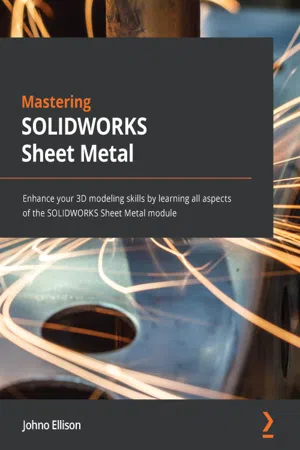
Mastering SOLIDWORKS Sheet Metal
About this book
Information
Subtopic
CAD/CAMSection 1: Getting Started with the Sheet Metal Module
Each journey starts with a first step. Our first goal will be to introduce what SolidWorks Sheet Metal is and how we can use it. We'll then explore the basics of creating and using simple Sheet Metal models and drawings.
This section contains the following chapters:
- Chapter 1, Sheet Metal Basics – Exploring Sheet Metal Properties and Material Selection
- Chapter 2, Adding Bends Using Edge Flanges
- Chapter 3, Getting Familiar with Basic Tools in Sheet Metal
- Chapter 4, Creating Sheet Metal Drawings and Exporting Files
Chapter 1: Sheet Metal Basics – Exploring Sheet Metal Properties and Material Selection
SolidWorks is one of the world's premier three-dimensional (3D) computer-aided design (CAD) modeling software, with millions of users. However, while many people use SolidWorks for 3D solid modeling, there are also a number of more specialist modules for creating other types of models. The SolidWorks Sheet Metal module is one of the most important of these because it unlocks the massive potential of sheet metal manufacturing and production.
In this chapter, we'll explore what sheet metal is and why it is important. We'll learn how to create a Sheet Metal model using a Base Flange and how to edit the model's Sheet Metal properties.
We'll also cover Flattening parts and have a brief look at which materials are most commonly used for sheet metal.
By the end of this chapter, you'll understand how to start Sheet Metal parts and how to adjust their basic parameters, as well as having some wider knowledge of sheet metal manufacturing and use.
In this chapter, we're going to cover the following main topics:
- Introducing Sheet Metal
- Creating a Base Flange
- Sheet Metal properties
- Other Base Flange options and flattening parts
- Considerations when selecting sheet metal materials
Technical requirements
To complete this section and all following sections, you will require a copy of the SolidWorks software program, along with basic working knowledge. This includes how to carry out operations such as starting new parts, creating and editing sketches and features, and using common tools. For readers who are completely new to SolidWorks, it is advisable to gain a firm foundation of solid modeling first, before undertaking the Sheet Metal module covered in this book.
During the course of the book, if a certain tutorial or tool is causing problems, then try double-checking all of the previous steps, or even try closing the part and starting again from the beginning.
Error messages in SolidWorks can be quite descriptive and often tell the user exactly what the issue is. So, if presented with an error, then try to avoid the temptation to click OK without reading it properly, and attempt to carry out the action suggested in the message.
If the problems persist, then feel free to contact me online via Twitter at www.twitter.com/johnoellison.
SolidWorks versions
The examples and demonstrations in this book were made using SolidWorks 2021. Other versions of SolidWorks may have very minor differences in things such as the interface and how certain options are labeled, but in general, the workflow should be very similar. If you do get stuck on any of these differences, then please contact me using the details previously provided.
Units of measurement
Throughout this book, millimeters (mm) are used as the unit of measurement, but this can be adjusted according to the reader's preference by setting the model's units to inches ("), for example, and then typing the millimeter numerical value followed by mm into the Smart Dimension tool when adding dimensions. This will automatically convert the millimeter values into inches (or your selected unit type).
Terminology
Throughout this book, "sheet metal" (lowercase) refers to the general industry and manufacturing methods used in the real world, whereas "Sheet Metal" (capitalized) refers specifically to the SolidWorks Sheet Metal module.
The term "part" refers to a real-life component or item, whereas part (italicized) refers specifically to a SolidWorks part document.
Introducing Sheet Metal
Sheet metal parts are those that are—as the name suggests—created from flat sheets of metal. Numerous different manufacturing techniques such as bending, cutting, and forming allow these simple flat sheets to be transformed into complex 3D parts. The popularity of sheet metal has exploded in modern times because it allows designers and engineers to take a widely available material type—the flat sheets—and use relatively low-cost tools and processes to create complex products, at an industrial scale.
The chances are that a quick look around your home, garage, or workplace will reveal d...
Table of contents
- Mastering SOLIDWORKS Sheet Metal
- Contributors
- Preface
- Section 1: Getting Started with the Sheet Metal Module
- Chapter 1: Sheet Metal Basics – Exploring Sheet Metal Properties and Material Selection
- Chapter 2: Adding Bends Using Edge Flanges
- Chapter 3: Getting Familiar with Basic Tools in Sheet Metal
- Chapter 4: Creating Sheet Metal Drawings and Exporting Files
- Section 2: Advanced Sheet Metal Tools
- Chapter 5: Creating Complex Parts Using Swept Flanges and the Fold/Unfold Tools
- Chapter 6: Utilizing Gussets, Cross Breaks, and Vents to Add Part Details
- Chapter 7: Producing Advanced Shapes Using Lofted Bends
- Chapter 8: Joining Multi-Sheet Parts Using Tab and Slot Features
- Chapter 9: Finishing Off Models Using Corner Details
- Chapter 10: Adding 3D Details to Models with Forming Tools
- Section 3: Converting 3D Parts to Sheet Metal and Creating a Sheet Metal Enclosure
- Chapter 11: Converting to Sheet Metal Using the Insert Bends Tool
- Chapter 12: Building Sheet Metal Parts Using the Convert to Sheet Metal Tool
- Chapter 13: Practical Example: The Sheet Metal Enclosure
- Other Books You May Enjoy
Trusted by 375,005 students
Access to over 1.5 million titles for a fair monthly price.
Study more efficiently using our study tools.
Frequently asked questions
Yes, you can cancel anytime from the Subscription tab in your account settings on the Perlego website. Your subscription will stay active until the end of your current billing period. Learn how to cancel your subscription
No, books cannot be downloaded as external files, such as PDFs, for use outside of Perlego. However, you can download books within the Perlego app for offline reading on mobile or tablet. Learn how to download books offline
Perlego offers two plans: Essential and Complete
- Essential is ideal for learners and professionals who enjoy exploring a wide range of subjects. Access the Essential Library with 800,000+ trusted titles and best-sellers across business, personal growth, and the humanities. Includes unlimited reading time and Standard Read Aloud voice.
- Complete: Perfect for advanced learners and researchers needing full, unrestricted access. Unlock 1.5M+ books across hundreds of subjects, including academic and specialized titles. The Complete Plan also includes advanced features like Premium Read Aloud and Research Assistant.
We are an online textbook subscription service, where you can get access to an entire online library for less than the price of a single book per month. With over 1.5 million books across 990+ topics, we’ve got you covered! Learn about our mission
Look out for the read-aloud symbol on your next book to see if you can listen to it. The read-aloud tool reads text aloud for you, highlighting the text as it is being read. You can pause it, speed it up and slow it down. Learn more about Read Aloud
Yes! You can use the Perlego app on both iOS and Android devices to read anytime, anywhere — even offline. Perfect for commutes or when you’re on the go.
Please note we cannot support devices running on iOS 13 and Android 7 or earlier. Learn more about using the app
Please note we cannot support devices running on iOS 13 and Android 7 or earlier. Learn more about using the app
Yes, you can access Mastering SOLIDWORKS Sheet Metal by Johno Ellison in PDF and/or ePUB format, as well as other popular books in Ciencia de la computación & CAD/CAM. We have over 1.5 million books available in our catalogue for you to explore.