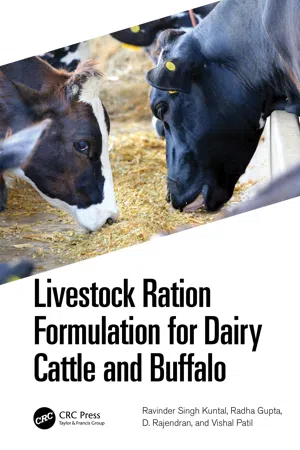
Livestock Ration Formulation for Dairy Cattle and Buffalo
eBook - ePub

Livestock Ration Formulation for Dairy Cattle and Buffalo

  1. 114 pages
  2. English
  3. ePUB (mobile friendly)
  4. Available on iOS & Android
eBook - ePub

Livestock Ration Formulation for Dairy Cattle and Buffalo

About this book

Livestock Ration Formulation for Dairy Cattle and Buffalo provides an interdisciplinary, integrative perspective and optimization on dairy cattle feed formulation problem solving. It helps dairy farmers by introducing them the right frequency and right amount of balanced diet to be fed to cattle's and buffaloes at different body condition so that their feeding cost should be decreased and there should be increase in income for dairy farmers, as they don't have enough knowledge of feeding practice. It helps animal nutritionist to work for dairy farmers which have very limited feed resources to fulfil nutrients requirement in terms of crude protein (CP), total digestible nutrient (TDN), calcium (Ca) and phosphorus (P) by developing a software programme to plan a balanced low budget diet.

It includes the Linear and Goal programming model for non-pregnant dairy buffalo is been solved using Hybrid Real Coded Genetic Algorithm and the results are compared with Real Coded Genetic Algorithm (RGA) considering different versions like RGA without crossover, RGA without Mutation, RGA with crossover and mutation. These models can also be applied with other nutritional models like CNCPS, INRA.

This book is a step forward in that direction to provide least cost diet formulation based on nutrient requirement of the cattle and buffalo, which is been calculated according to Indian Council of Agricultural Research (ICAR, 2013) and NRC (2001) on dry matter basis, provides a clear and precise platform for other researcher in Animal Nutrition field which also give initial platform to build a software and android application to formulate least cost ration Based on data and algorithm used in this book, which helps Dairy farmers directly to feed balanced diet at cheap rate.

Features:

  • It is a good reference to local dairy farmers by introducing them to the right frequency and right amount of balanced diet to be fed to cattle and buffaloes at different production cycles.

  • It will provide basic platform and some solutions to built-up software about cattle nutrition development and least cost formulation for end-user.

  • It has several techniques for optimizing animal diet formulation but a good balance between coding/programming and animal nutrition is incorporated towards application of soft computing technique to improve the quality of the solution due to rigidity of the constraints.

Frequently asked questions

Yes, you can cancel anytime from the Subscription tab in your account settings on the Perlego website. Your subscription will stay active until the end of your current billing period. Learn how to cancel your subscription.
No, books cannot be downloaded as external files, such as PDFs, for use outside of Perlego. However, you can download books within the Perlego app for offline reading on mobile or tablet. Learn more here.
Perlego offers two plans: Essential and Complete
  • Essential is ideal for learners and professionals who enjoy exploring a wide range of subjects. Access the Essential Library with 800,000+ trusted titles and best-sellers across business, personal growth, and the humanities. Includes unlimited reading time and Standard Read Aloud voice.
  • Complete: Perfect for advanced learners and researchers needing full, unrestricted access. Unlock 1.4M+ books across hundreds of subjects, including academic and specialized titles. The Complete Plan also includes advanced features like Premium Read Aloud and Research Assistant.
Both plans are available with monthly, semester, or annual billing cycles.
We are an online textbook subscription service, where you can get access to an entire online library for less than the price of a single book per month. With over 1 million books across 1000+ topics, we’ve got you covered! Learn more here.
Look out for the read-aloud symbol on your next book to see if you can listen to it. The read-aloud tool reads text aloud for you, highlighting the text as it is being read. You can pause it, speed it up and slow it down. Learn more here.
Yes! You can use the Perlego app on both iOS or Android devices to read anytime, anywhere — even offline. Perfect for commutes or when you’re on the go.
Please note we cannot support devices running on iOS 13 and Android 7 or earlier. Learn more about using the app.
Yes, you can access Livestock Ration Formulation for Dairy Cattle and Buffalo by Ravinder Singh Kuntal,Radha Gupta,D. Rajendran,Vishal Patil in PDF and/or ePUB format, as well as other popular books in Medicine & Medical Theory, Practice & Reference. We have over one million books available in our catalogue for you to explore.

Information

1 Introduction to Animal Nutrition

DOI: 10.1201/9781003231714-1

CONTENTS

1.1 Operational Research
1.2 Animal Nutrition
1.3 Essential Nutrients
1.3.1 Energy
1.3.2 Protein
1.3.3 Minerals
1.4 Classification of Feedstuffs
1.5 Application Area

1.1 Operational Research

Operational research is a subject field that comprehends a wide range of applications in logical methods to make effective decision-making. Further, operational or operations research emerged while providing the solution to plan efficient military operations during World War II. Operational research is used not only in military operations but also in industry, government, agriculture and animal production. Today’s operations research has overlap with many disciplines such as industrial engineering, dairy etc., with the motto of maximizing the profit, performance or yield as well as minimizing the loss, risk or cost of some real-world problems. We cannot give any standard definition to operations research, as its boundaries are not fixed, but as per the Institute for Operations Research and the Management Sciences (INFORMS):
Operations Research and the Management Sciences are the professional disciplines that deal with the application of information technology for informed decision-making.
Yet this explicit definition is not sufficient, as it is different from a related field. However, operations research is a subfield of applied mathematics. We are using techniques from mathematics such as mathematical modeling, statistical analysis and mathematical optimization to arrive at optimal or near-optimal solutions to complex problems. Therefore, instead of following the INFORMS definition, we use operations research with the help of mathematical optimization to specify techniques and solutions for specific real-time problems. This method includes linear programming, nonlinear programming, integer programming, optimization, the Markov process, queuing theory, goal programming and heuristic algorithms. These techniques would be accepted because they give optimal solutions for specific problems except for the fact that in linear programming, if the problem is not defined in linear equations (equalities or inequalities) or continuous domain, then we cannot apply linear programming algorithms. There are many techniques in operations research which have proven to be very useful in practice. For many real-world optimization problems, operations research provides the method of choice, in particular for those problems that are complex in nature.

1.2 Animal Nutrition

India has the largest livestock population in the world. Livestock is one of the most important economic activities as it plays an important role in growth of Indian agriculture, the growth of Indian economy (it contributes about 4% of national gross domestic product – GDP – and 25% on agricultural GDP) and in livelihood, especially in the rural areas of the country, providing income for most of the family. In dairy farming, feeding cost accounts for about 70% of total operation cost. As per the Government of India Ministry of Agriculture Department of Animal Husbandry, Dairying, and Fisheries, Krishi Bhavan, in the 19th livestock census-2012 all India report, the total milch animals population (cows and buffaloes) has increased to 118.59 million (2012), an increase of 6.75%. The female buffalo population has increased by 7.99% over the previous census, and the total number of female buffaloes was 92.5 million in 2012. The buffalo population increased from 105.3 million to 108.7 million, showing a growth of 3.19%. The population of cows increased by 6.52%, and the total number of cows estimated in 2012 was 122.9 million. As per the Basic Husbandry & Fisheries statistics 2017, the per capita availability of average milk in Karnataka was 291 grams per day during 2016–17, which is less than the 12 top milk-producing states in India, such as Uttar Pradesh. Karnataka has only a 4% share in milk production in year 2016–17. From 2012 to 2016, the cattle population increased from 1.14 million to 1.37 million, with estimated milk production of 5718.22 to 6562.15 (in thousands) in which the average yield per in-milk animal of nondescript/indigenous cows during 2012–13 to 2016–17 in Karnataka was 2.32–2.43 kg/day. Area under fodder crops is increased from 35000 hectares in 2006–07 to 36000 hectares, and permanent pastures and other grazing lands decreased from 930000 hectares to 906000 hectares from 2006–07 to 2013–14 (Basic Animal Husbandry & Fisheries Statistics, 2017). According to Basic Animal Husbandry & Fisheries Statistics 2017 there was a decrease of the cattle population (190 million vs. 199 million) but an increase in buffalo (108 million vs. 105 million) population from the previous census (2012 vs. 2007). These animals contribute about 165.4 million tons of milk production annually (2016–17), in which the major contribution was from buffalo, greater than 49%. Per capita availability of milk in 2010–11 increased from 281 g/d to 355 g/d in 2016–17. In addition, during 2016–17, the share of milk production from cross-breed cows, indigenous cows, nondescript cows and buffaloes was 25.4%, 11.3%, 9.5% and 49.2%, respectively, of total milk production. The increase in population of exotic/cross-breed cattle and indigenous cattle was 34.8 % and 0.17%, respectively, whereas the population of milk animals (cows and buffaloes) has increased from 77.04 million to 80.52 million. Increasing the productivity of animals is one of the major issues in our country, which can be overcome by developing proper feeding systems to provide balanced nutrients to fulfill their requirements. By looking at increasing demands of animal products such as milk and dairy products, we can see a growth in a new entrepreneurship area with a commercial outlook for which scientific management and sustainability are important components. Nutrients are very important to dairy animals to maintain their body conditions, for milk production with an adequate amount of fat percentage and for maintaining pregnancy at third trimester. These nutrients are provided through feed, and the nutrient requirements are measured in terms of energy, protein, minerals and vitamins. In many developed countries, the standard feeding practice has come through various continuous experiments, evaluation and refinement for decades. But in India, the first published document on scientific feeding for Indian cattle appeared in ICAR bulletin No 25, titled “Nutritive Values of Indian Cattle Feeds and the Feeding of Animals” by Sen (1957). This was later modified by Sen and Ray (1964), and these feeding practices was revised by Sen, Ray and Ranjhan (1978) with some research on Indian breeds. Kearl in 1982 compiled data on nutritional requirements of different livestock species and values of different feedstuffs from various developing countries in a systematic manner. After reviewing these facts, India compiled these standards, and as a result, nutritional requirements of cattle and buffalo were published by ICAR in 1985 and 1998. After this publication, a change in productivity of Indian livestock and nutritive values were...

Table of contents

  1. Cover
  2. Half Title
  3. Title
  4. Copyright
  5. Dedication
  6. Contents
  7. List of Tables
  8. List of Figures
  9. Preface
  10. Acknowledgments
  11. Authors
  12. List of Abbreviations
  13. 1. Introduction to Animal Nutrition
  14. 2. Review of Literature
  15. 3. Tools and Techniques
  16. 4. Binary Coded Genetic Algorithm to Solve Ration Formulation Problem
  17. 5. Least Cost Feed Formulation for Dairy Cattle During Pregnancy by Using Real Coded Genetic Algorithm: An Application
  18. 6. Study of Real Coded Hybrid Genetic Algorithm to Find Least Cost Ration for Non-Pregnant Dairy Buffaloes
  19. 7. Conclusion
  20. References
  21. Index