Focusing on the experiences of foreign employees working in Japanese firms, this book identifies the trends and realities facing both expatriates and firms in the current landscape of the Japanese labour market.
By utilising interview data from both expatriates and Japanese HR staff, this study identifies the fact that self-initiated expatriates often do not remain in Japanese firms for long and highlights the main factors that influence their decisions to leave; including difficulty adjusting to Japan's lifetime employment system, seniority-based pay, and the prevalence of unpaid overtime. The book reveals that whilst Japanese firms are adjusting to improve the retention of foreign employees, there remains a clear expectation gap between the two sides. Moreover, it outlines further potential adjustments that could be implemented to reduce the turnover rate of expatriates and create a more harmonious workplace both for expatriates and for local employees. This is an urgent challenge for Japan as it faces labour shortages.
Featuring an in-depth exploration of first-hand experiences from direct testimonies of expatriates in Japanese firms, this book will be a valuable resource for academics and students of Japanese studies, human resource management, and organisation studies.
1 IntroductionForeign labour in Japan and the circumstances surrounding it
DOI: 10.4324/9781003180845-1
Introduction
This chapter introduces the current situation of foreign labour in Japan. In order to understand the importance of the theme of the book, this introduction will detail how many foreign labourers have worked in Japan so far, why their number has increased hugely, and which foreign nationals are most highly represented. Related to past studies, cross-cultural adjustment and the Japanese traditional HRM system will be briefly explained, since these are the main focus of this book, and both will be further described in later chapters. The research methods, including the case study interview method, will also be introduced.
Foreign labour in Japan
People move from developing countries to developed countries to work,1 yet when it comes to working with self-initiated expatriates (those who move of their own volition, not through a company transfer from their own country), Japan is still a developing country. How much are Japanese firms ready to welcome such expatriates and how willing are they to change the existing institutional norms, rules, and regulations around the labour environment? At the same time, how easily does foreign labour fit in to the modern Japanese workplace? It can be envisaged that foreign labour has difficulty in managing to adjust to local working rules.
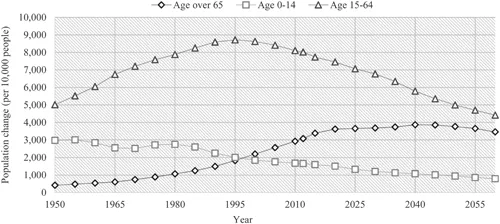
The Japanese labour market is currently faced with a severe labour shortage problem due to the recent declining birth rate in Japan, resulting in an ageing society. Figure 1.1 shows the trend of the Japanese population, based on actual data between 1950 and 2020 and estimated data between 2021 and 2060 (Cabinet Office, 2013; Portal Site of Official Statistics of Japan, 2015; Statistics Bureau of Japan, 2021).
Figure 1.1 Japanese population change (per 10,000 people) during 1950–2060 (created by the author). Sources: Cabinet Office (2013), Portal Site of Official Statistics of Japan (2015), and Statistics Bureau of Japan (2021).
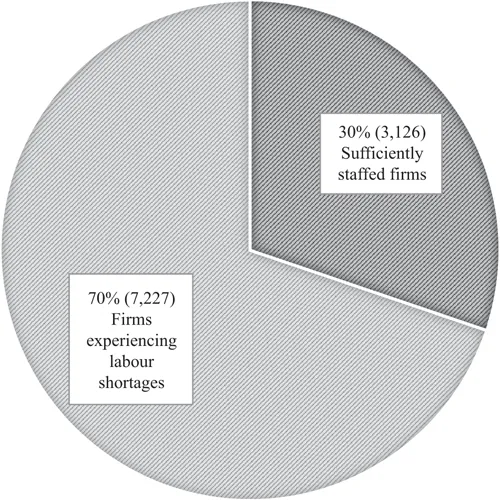
The highest population of productive ages (15–64 years old) was 87.16 million in 1995, and this number has been declining since then (Figure 1.1). The highest child population (0–14 years old) was 27.51 million in 1980, and this number has also been declining since then (Statistics Bureau of Japan, 2021). On the other hand, the aged population group is increasing (over 65 years old) (ibid.), especially since 1975. The decline of the productive population and the growth of the aged population are estimated to continue for the next 50 years (Cabinet Office, 2013). TOKYO SHOKO RESEARCH (2018) conducted a survey with 10,353 Japanese firms regarding whether or not they had had enough labour; 70% of them said that they had a labour shortage (Figure 1.2). Although the total number of bankruptcies has decreased since 2013, the number of bankruptcies due to labour shortages has been increasing (TEIKOKU DATABANK, 2019) (Table 1.1). This number increased by 20.9% in 2019 compared to the previous year.
Figure 1.2 Percentage of Japanese Firms facing labour shortages as of 2018 (created by the author). Source: TOKYO SHOKO RESEARCH (2018).
Table 1.1 Number of bankruptcies in Japan, 2013–2019 (created by the author). Source: TEIKOKU DATABANK (2019).
No. of bankruptcies due to labour shortage
Total no. of bankruptcies
2013
34
10,536
2014
70
9,543
2015
65
8,684
2016
72
8,381
2017
106
8,367
2018
153
8,110
2019
185
8,383
Around 80% of Japanese firms said that they were short of workers as of 2019. Of these, 30% of them lacked any aged groups and 46% lacked young and middle-aged workers (Japan Research Institute, 2019).2 The government has revised a part of the law concerning senior labour and their stable employment; senior labour, even after retirement age, are now able to continue working if they wish. This new law was introduced in 2013 and asks Japanese firms to choose from: (1) ending the retirement system, (2) raising the retirement age, and (3) a continued employment system such as reemployment (explanation below) (Ministry of Health, Labour and Welfare, 2021a). The ratio of the Japanese firms who have adopted one of these three is as follows; (1) 2.7%, (2) 20.9%, and (3) 76.4%, as of June 2020 (ibid.). Thus, the vast majority of firms have chosen to follow the reemployment option since the new law came into being in 2013. Of these, 74.5% have already set up the reappointment employment system, which allows employees who would like to work longer to continue working even after the retirement age of 65 years old (ibid.). The remainder, 25.5 % of firms, have allowed only a limited number of their employees to work after 65. The number of Japanese firms who have chosen option 2, raising the retirement age, is much lower than those choosing option 3, reemployment, yet some leading Japanese firms have currently extended the retirement age or plan to do so. For example, Toyota Motor and the Japanese government currently plan to extend their retirement age from 60 to 65 years old.3 Other large Japanese firms, including Honda Motor, Yamato Transport Co., YKK AP, Nomura securities, Aeon Co., Suntory Holdings,4 Taiyo Life Insurance Company,5 etc., have also extended the retirement age to 65 or 70.6 The firms who now allow staff to work until 70 have said that the new retirement age is 65, with the reemployment system applied from 65 to 70 for those staff who wish to continue working. All three options are, in part, designed to bridge the gap between the time when labourers retire, at 60 years old, and the time when their welfare pensions start, at 65 years old. For these five ‘gap’ years, senior labourers now have the option to work in order to survive. The new laws are also designed to compensate for the lack of labour, and a deficit in the welfare pension fund due to an ageing society. Japan has...
Table of contents
Cover
Half-Title
Series
Title
Copyright
Contents
List of illustrations
Acknowledgement
Author biography
List of abbreviations
1 Introduction: Foreign labour in Japan and the circumstances surrounding it
2 Cross-cultural adjustment of expatriates: Contexts of Japan and overseas
3 The Japanese traditional HRM system: The current system in Japanese firms and their overseas subsidiaries
4 Expectations of Japanese firms and Chinese/Vietnamese expatriates: The traditional Japanese HRM system
5 Experiences of Chinese and Vietnamese expatriates: Work cultural adjustment
6 Expectation gaps and hardship in Japanese firms
7 Conclusion: Lessons from the current phenomena and future implications
Appendix
Index
Trusted by 375,005 students
Access to over 1.5 million titles for a fair monthly price.
Study more efficiently using our study tools.
Frequently asked questions
Yes, you can cancel anytime from the Subscription tab in your account settings on the Perlego website. Your subscription will stay active until the end of your current billing period. Learn how to cancel your subscription
No, books cannot be downloaded as external files, such as PDFs, for use outside of Perlego. However, you can download books within the Perlego app for offline reading on mobile or tablet. Learn how to download books offline
Perlego offers two plans: Essential and Complete
Essential is ideal for learners and professionals who enjoy exploring a wide range of subjects. Access the Essential Library with 800,000+ trusted titles and best-sellers across business, personal growth, and the humanities. Includes unlimited reading time and Standard Read Aloud voice.
Complete: Perfect for advanced learners and researchers needing full, unrestricted access. Unlock 1.5M+ books across hundreds of subjects, including academic and specialized titles. The Complete Plan also includes advanced features like Premium Read Aloud and Research Assistant.
Both plans are available with monthly, semester, or annual billing cycles.
We are an online textbook subscription service, where you can get access to an entire online library for less than the price of a single book per month. With over 1.5 million books across 990+ topics, we’ve got you covered! Learn about our mission
Look out for the read-aloud symbol on your next book to see if you can listen to it. The read-aloud tool reads text aloud for you, highlighting the text as it is being read. You can pause it, speed it up and slow it down. Learn more about Read Aloud
Yes! You can use the Perlego app on both iOS and Android devices to read anytime, anywhere — even offline. Perfect for commutes or when you’re on the go. Please note we cannot support devices running on iOS 13 and Android 7 or earlier. Learn more about using the app
Yes, you can access Expatriates in Japanese Firms by Chie Yorozu in PDF and/or ePUB format, as well as other popular books in Business & Business General. We have over 1.5 million books available in our catalogue for you to explore.