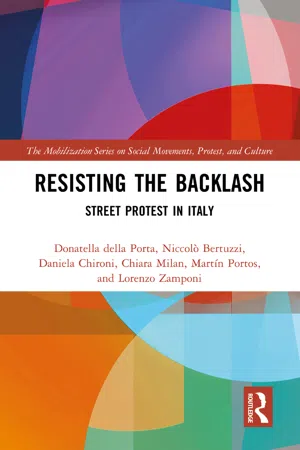
Drawing interview material, together with extensive data from the authors' original social movement database, this book examines the development of social movements in resistance to perceived political "regression" and a growing right-wing backlash. With a focus on Italy and the reaction to increasing inequalities and welfare state retrenchment policies, it examines opposition to the government and state authorities on a number of issues. Triangulating different types of data, it sheds light on the ability of citizens to organise in the streets and addresses crucial matters in social movement research, including the significance to political mobilization of grievances, class, gender and generational differences, as well as considering the network dynamics of micro-mobilization, visions of Europe, and the role of interactions with major political institutions. As such, it will appeal to scholars of sociology and politics with interests in social movements and political mobilization.
eBook - ePub
Resisting the Backlash
Street Protest in Italy
- 192 pages
- English
- ePUB (mobile friendly)
- Available on iOS & Android
eBook - ePub
Resisting the Backlash
Street Protest in Italy
About this book
Information
1 Resisting the backlash in the streets: An introduction
DOI: 10.4324/9781003262558-1
1.1 The theoretical focus: bringing activists back in
To date, research on social movements has tended to address the meso-level of mobilisations especially, looking at how social movement organisations allocate their resources, how they strategically frame their messages, and how they protest in the streets. This focus has been combined with attention to the macro-level, as analyses have investigated how political opportunities affect organisational strategies and their outcomes. What has been less reflected upon, however, is mobilisation at the micro-level: how individual activists perceive the world, how they choose between different forms of action, what motivates them to act collectively, or stops them from doing so.
While studies on electoral behaviour have, for instance, employed voter data to a massive degree in order to understand how the socio-demographic characteristics and beliefs of individuals influence their decision to turn out to vote or even their choice of a political party, attention to the individual level has only been paid to a qualified extent when it comes to other forms of political behaviour, such as protest. There may be several reasons for this limited attention to the individual level in social movement studies. Certainly, from the point of view of the availability of reliable data, social movements usually involve minority groups, which are themselves not sufficiently represented in polls that encompass the entire population to allow for in-depth analysis. What is more, the theoretical models that have dominated the field have not considered the micro-dimension to be particularly relevant. Indeed, both rational choice and socio-psychological approaches have been marginal in a field of study that has instead been more interested in broad contextual transformations (as in the “new social movements” approach) or in the organisational dimension of collective action (in the resource mobilisation approach). In fact, at the origins of social movement studies was a rejection of the consideration of the use of unconventional forms of action as motivated by frustration or, even worse, by psychopathologies, but also by the assumption that protesters are selfish individuals who mobilise on the basis of narrowly defined personal interests and incentives.
At the turn of the millennium, however, the development of specific methods for surveying people “caught in the act of protest” allowed for the collection of information on a large number of participants at various protest events, improving our knowledge of the rank-and-file participants in social movements (see, e.g., della Porta et al. 2006; della Porta 2009; Walgrave and Rucht 2010). This body of research has pushed social movement scholars to address some fundamental questions, more commonly analysed in the study of political participation. Initially, a series of research projects on the Global Justice Movement and the anti-war movement as well as, subsequently, on various other types of social movements have in fact looked, often from a comparative vantage point, at the social bases of protest, the ways in which protesters mobilise, their experiences in terms of collective actions and their political values and beliefs.1 If analysis at the meso-level have addressed organisations, including their leaders, on-the-spot questioning of demonstrators reveals what Marco Giugni and Maria Grasso have called the “normalisation of protesters”, noting that there is “a broader spectrum of protestors coming to reflect more closely the features of the average citizens” (2019: 3). As protest—once the domain of workers and students—spread to all social groups, the observation that “on the street we are all equal” emerged (Van Aelst and Walgrave 2001: 480).
This does not mean, however, that the propensity to protest is equally spread throughout the population. Indeed, social movement scholars have analysed the determinants of “differential recruitment” to activism, looking at what makes some individuals engage in action while others remain inactive (McAdam 1986). According to Lavizzari and Portos (2021), research on the individual drivers of protest participation can be divided into three broad lines of inquiry: (1) biographical availability, meaning all those individual attributes and resources that affect the costs of participation, such as marital and family status, employment conditions, income, age, education and gender (McAdam 1986); (2) political engagement, which includes an individual's capital in terms of political interest, knowledge, values, and access to information (Dalton, van Sickle and Weldon 2010; Norris 2011); (3) structural availability, namely interpersonal networks, organisational membership, and the development of human capital, civic and socio-political skills (see Verba, Schlozman and Brady 1995; Dalton and Van Sickle, 2004; Schussman and Soule 2005).
Specifically, research has consistently identified education, income, political interest, and organisational membership as being among the most significant predictors of protest involvement (Schussman and Soule 2005; Norris, Walgrave and van Aelst 2005). Younger people are more likely to use unconventional forms of political participation, as are left-wing voters and progressive citizens (Hutter and Kriesi 2013; Torcal, Rodon and Hierro 2015; Earl, Maher and Elliott 2017). In addition, empirical studies have repeatedly pointed to the role of participation in different networks, multiple membership, and degree of connectedness in general as important levers of participation in contentious politics. We can add that the latter, in fact, develops relationally through the process of socialisation, building upon prior traditions but also presenting innovative components and features (della Porta et al. 2006). As Russell Dalton and co-authors (2010) remind us, nation-specific contexts also influence protest behaviour in advanced industrial democracies, with economic and political development leading to higher protest rates. In fact, some countries still see more protests than others, and cities are much more contentious spaces than the countryside. Furthermore, individual determinants of protest often interact with the opening of political opportunity structures at the contextual level to prompt political participation (Vráblíková 2014; Quaranta 2015; Grasso and Giugni 2016).
To paraphrase the words of van Aelst and Walgrave (2001), the question of “who is that (wo)man in the street?” remains relevant, as the answer to it advances our knowledge of the drivers of participation in different times and spaces. Researchers have in fact comparatively studied protests in different countries, but also protesters at different types of events (e.g. parades versus more traditional marches), at times comparing the events organised by ‘old social movements’ with those organised by ‘new social movements’ (see Eggert and Giugni 2015; Peterson et al. 2015). With a particular focus on protest marches, attention has been paid to the comparison of participants by, e.g., age (especially on the micro-mobilisation of young activists through social media) or degree of commitment (in the analysis of first-timers versus more experienced activists) (see Anduiza et al. 2014; Verhulst and Walgrave 2009).
The analyses of data on protesters have been contextualised by looking at some specific historical periods in which protests occur. In particular, participants at demonstrations during the peak of the Global Justice Movement in the early 2000s have been compared with those who mobilised in the most intense phase of the anti-austerity movements a decade later (della Porta 2015). The analysis of protesters has, therefore, become part of a broader picture, connecting the micro-, meso- and macro-levels of analysis in order to understand social movements in different historical periods and faced with different socio-economic and political conditions. The involvement of the middle classes or precarious workers, the participation of young generations, the degree of radicalism in the activists’ views of political institutions and capitalist structures and their experiences in terms of political participation are, therefore, expected to vary in time and space. In sum, micro-mobilisation has emerged as context-dependent (van Stekelenburg et al. 2012), being linked to forms of capitalism, degrees of political opportunities, and also to the various stages of mobilisation and demobilisation during cycles of protests and the transformations in protest cultures.
It is considering these variations that we have decided to analyse participants at several protest events that occurred in Italy towards the end of the 2010s. While not seeing massive waves of protest, this period was characterised by fast political changes linked to the crisis of mainstream political parties and the rise of challengers, particularly the Five Star Movement and the League, which scholars have often described as populist parties (Taggart and Pirro 2021; Rooduijn et al., 2019). As in other European countries and in the US, anti-modernist frames in Italy have been linked to exclusionary forms of nationalism and authoritarian positions. At times combined with some “neo-con” concerns, anti-modernist frames signalled what some scholars defined as a backlash against the moral revolution launched by new social movements, with the development of particular aggressive forms of racism, attacks on gender and women's rights, and constraints on civil liberties in general (della Porta 2020a). Developed within religious institutions and promoted by right-wing milieus, anti-gender ideas have been connected to the defence of traditional values and identities. In this discursive strategy, supported by right-wing parties with Eurosceptic traits, such as the League and Brothers of Italy, and their partners at the societal level, the rhetorical toolkit also includes the spreading of fear against migrants and other minority groups who are portrayed as threats to the integrity and wealth of the nation (Kuhar and Paternotte 2017). In this context, while centre-left Italian parties were not able to come up with real alternatives to such a paradigm, radical left-wing parties were weaker in terms of visibility and electoral success than their counterparts in other Southern European countries. To sum up, our analysis will try to understand the determinants of Italian street protests for social justice and democracy in a period of perceived political and cultural backlash, with the public debate dominated by anti-immigrant and anti-gender discourses, and lacking left-wing alternatives in the institutional sphere.
1.2 The prologue: Italy under the great recession
The analysis carried out in this book addresses a specific juncture, in which Italy faced the long-lasting effects of the 2008 economic downturn and political backlash. Together with Greece, Spain, Portugal, Ireland, and Cyprus, Italy is part of the group of European countries that have been most heavily impacted by the Great Recession and austerity policies (della Porta et al. 2017). Economic indicators confirm this interpretation: the gross domestic product followed, albeit with some fluctuations, a negative trend; the constant growth of the Gini coefficient shows a steady increase of inequalities in income distribution; the public debt, notwithstanding austerity policies, continued to grow. The increase in rates of unemployment (from 5.8% to 13.1% between 2007 and 2015)2 and in the percentage of the population at risk of poverty and...
Table of contents
- Cover
- Half Title
- Series Page
- Title Page
- Copyright Page
- Contents
- List of Figures
- List of Tables
- Acknowledgement
- 1 Resisting the backlash in the streets: An introduction
- 2 Bringing grievances back in? Socio-economic inequalities and the political participation of protesters
- 3 Generations and gender in the mobilisation against the backlash
- 4 The dynamics of micro-mobilisation
- 5 Social movements and institutional politics
- 6 Politicising Europe in the streets
- 7 Conclusion
- Index
Trusted by 375,005 students
Access to over 1.5 million titles for a fair monthly price.
Study more efficiently using our study tools.
Frequently asked questions
Yes, you can cancel anytime from the Subscription tab in your account settings on the Perlego website. Your subscription will stay active until the end of your current billing period. Learn how to cancel your subscription
No, books cannot be downloaded as external files, such as PDFs, for use outside of Perlego. However, you can download books within the Perlego app for offline reading on mobile or tablet. Learn how to download books offline
Perlego offers two plans: Essential and Complete
- Essential is ideal for learners and professionals who enjoy exploring a wide range of subjects. Access the Essential Library with 800,000+ trusted titles and best-sellers across business, personal growth, and the humanities. Includes unlimited reading time and Standard Read Aloud voice.
- Complete: Perfect for advanced learners and researchers needing full, unrestricted access. Unlock 1.5M+ books across hundreds of subjects, including academic and specialized titles. The Complete Plan also includes advanced features like Premium Read Aloud and Research Assistant.
We are an online textbook subscription service, where you can get access to an entire online library for less than the price of a single book per month. With over 1.5 million books across 990+ topics, we’ve got you covered! Learn about our mission
Look out for the read-aloud symbol on your next book to see if you can listen to it. The read-aloud tool reads text aloud for you, highlighting the text as it is being read. You can pause it, speed it up and slow it down. Learn more about Read Aloud
Yes! You can use the Perlego app on both iOS and Android devices to read anytime, anywhere — even offline. Perfect for commutes or when you’re on the go.
Please note we cannot support devices running on iOS 13 and Android 7 or earlier. Learn more about using the app
Please note we cannot support devices running on iOS 13 and Android 7 or earlier. Learn more about using the app
Yes, you can access Resisting the Backlash by Donatella della Porta,Niccolò Bertuzzi,Daniela Chironi,Chiara Milan,Martín Portos,Lorenzo Zamponi in PDF and/or ePUB format, as well as other popular books in Ciencias sociales & Sociología. We have over 1.5 million books available in our catalogue for you to explore.