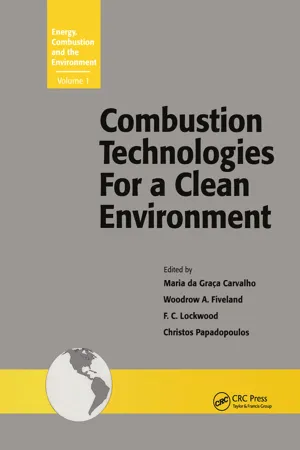
Selected Papers from the Proceedings of the First International Conference Vilamoura, Portugal, September 3-6, 1991. The 54 papers in this volume establish the first in a series of biannual benchmarks for technologies that maximize energy conversion while minimizing undesirable emissions. Covering the entire range of industrial and transport combustion as well as strategies for energy R&D, these contributions will be useful to mechanical and chemical engineers in academia and industry, and technical personnel in military, energy and environmental agencies of government. Among topics covered in the book are: strategies: now and in the future; pulverised coal combustion; oil combustion; gas combustion; gas fired systems, biomass combustion; fluidized bed combustion; incinerators; internal combustion; engines and reaction kinetics.
eBook - ePub
Combustion Technologies for a Clean Environment
- 830 pages
- English
- ePUB (mobile friendly)
- Available on iOS & Android
eBook - ePub
Combustion Technologies for a Clean Environment
About this book
Information
1. STRATEGIES: NOW AND IN THE FUTURE
DOI: 10.1201/9780367810597-1
Strategies for Future R & D in Combustion Processes
Invited lecture by P.F. SENS Commission of the European Communities, DG XII
DOI: 10.1201/9780367810597-2
INTRODUCTION
Designing an energy R & D strategy is a very speculative and, risky matter. The development of a new technology to a commercial product apparently takes some 30 years and another 20 years may be required to implement the technology on a large scale. An example of this can be found in the development of the jet engine which was invented in 1929, but it has lasted until the end of the fifties, with several interruptions in the development, explosions of test engines and bankruptcy, that jet aircraft was introduced in regular air traffic. It has also taken about thirty years between the discovery of uranium fission and the first civilian application of nuclear energy, but further introduction of nuclear power suffers now from lack of public support in many countries.
The prototype fast breeder reactor in Kalkar (D) will not be taken into operation and will be dismantled after more than 25 years of development. It is to be hoped that the development of fusion technology can obtain timely assurance of continued public support in order to avoid a fate similar to the Kalkar reactor.
Because of the long lead times, today’s decision makers will very likely no longer be around by the time the full effect of their decision, or lack of decision, becomes apparent. Their decision will affect their children much more, but it is difficult to predict in which way.
The conditions under which a specific technology may have to compete with others may change drastically during the development period. The last two decades have given examples of significant changes, caused not only by market forces but also by geopolitical factors and public acceptance. The fluctuations in oil price have caused fluctuations in coal price as well. The upward instabilities have stimulated developments from offshore technology to renewable energy while the downward instabilities have made their economy doubtful.
Uncertainties of this kind will remain and require a flexible R & D planning. On the one hand one should be careful not to drag on R & D activities on a new energy technology which has reached the phase of demonstration but whose application is postponed due to a change in the economic environment. Such a technology should be mothballed and kept in reserve as an option for “better” times.
On the other hand, a decision not to develop an energy option because it will never become economic under the present conditions may, in retrospect, appear to be unjustified if looked at under the circumstances of the year 2010 or beyond, when oil prices, according to present scenarios, have increased considerably due to exhausting resources.
CRITERIA
It may be evident from the above that energy R & D strategy has to be directed to long term targets and that economic prospects should not be the only guiding principle. In judging potential energy sources one should apply criteria such as:
- — contribution to the energy supply;
- — contribution to supply security and diversification;
- — R & D requirement;
- — environmental impact;
- — economic prospects;
- — societal acceptance.
As indicated above, the last two criteria imply such large uncertainties, that they can hardly be applied for long term R & D strategy. Another question is: is long term equally long for all the actors in the field?
For the R & D programmes, supported by the European Communities there are a number of specific criteria such as:
- — industry oriented;
- — multinational and multipartner;
- — innovative;
- — positive for the environment;
- — precompetitive;
- — subsidiary;
- — in support of SME’s;
- — reflecting the European dimension.
It must be evident from these criteria that, although the EC may recognize the need for R & D in a specific area, it does not necessarily have to be supported by the EC. The subject may already be too close to competition or no longer suited for a multipartner arrangement.
Subsidiary means that the EC should pref...
Table of contents
- Cover
- Half Title
- Series
- Title
- Copyright
- Contents
- Introduction to the Series
- Preface
- Scientific Committee
- Sponsors
- PART 1 — STRATEGIES: NOW AND IN THE FUTURE
- PART 2 — PULVERIZED COAL COMBUSTION
- PART 3 — OIL COMBUSTION
- PART 4 — GAS COMBUSTION
- PART 5 — GAS FIRED SYSTEMS
- PART 6 — BIOMASS COMBUSTION
- PART 7 — FLUIDISED BED COMBUSTION
- PART 8 — INCINERATORS
- PART 9 — INTERNAL COMBUSTION ENGINES
- PART 10 — REACTION KINETICS
Trusted by 375,005 students
Access to over 1.5 million titles for a fair monthly price.
Study more efficiently using our study tools.
Frequently asked questions
Yes, you can cancel anytime from the Subscription tab in your account settings on the Perlego website. Your subscription will stay active until the end of your current billing period. Learn how to cancel your subscription
No, books cannot be downloaded as external files, such as PDFs, for use outside of Perlego. However, you can download books within the Perlego app for offline reading on mobile or tablet. Learn how to download books offline
Perlego offers two plans: Essential and Complete
- Essential is ideal for learners and professionals who enjoy exploring a wide range of subjects. Access the Essential Library with 800,000+ trusted titles and best-sellers across business, personal growth, and the humanities. Includes unlimited reading time and Standard Read Aloud voice.
- Complete: Perfect for advanced learners and researchers needing full, unrestricted access. Unlock 1.5M+ books across hundreds of subjects, including academic and specialized titles. The Complete Plan also includes advanced features like Premium Read Aloud and Research Assistant.
We are an online textbook subscription service, where you can get access to an entire online library for less than the price of a single book per month. With over 1.5 million books across 990+ topics, we’ve got you covered! Learn about our mission
Look out for the read-aloud symbol on your next book to see if you can listen to it. The read-aloud tool reads text aloud for you, highlighting the text as it is being read. You can pause it, speed it up and slow it down. Learn more about Read Aloud
Yes! You can use the Perlego app on both iOS and Android devices to read anytime, anywhere — even offline. Perfect for commutes or when you’re on the go.
Please note we cannot support devices running on iOS 13 and Android 7 or earlier. Learn more about using the app
Please note we cannot support devices running on iOS 13 and Android 7 or earlier. Learn more about using the app
Yes, you can access Combustion Technologies for a Clean Environment by Maria G. da Graca Carvalho,Woodrow A. Fiveland,F. C. Lockwood,Christos Papadopoulos,Carvalhoc in PDF and/or ePUB format, as well as other popular books in Technology & Engineering & Environmental Management. We have over 1.5 million books available in our catalogue for you to explore.