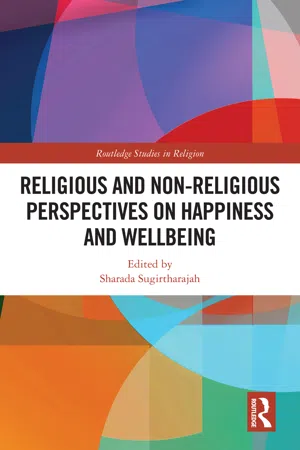
This book explores the theme of happiness and well-being from religious, spiritual, philosophical, psychological, humanistic, and health perspectives. Taking a non-binary approach, it considers how happiness in particular has been understood and appropriated in religious and non-religious strands of thought. The chapters offer incisive insight from a variety of perspectives, including humanism, atheism and major religions such as Christianity, Islam, Buddhism, Hinduism, and Judaism. Together they demonstrate that although worldviews might vary substantially, there are concurrences across religious and non-religious perspectives on happiness that provide a common ground for further cross-cultural and interreligious exploration. What the book makes clear is that happiness is not a static or monolithic category. It is an ongoing process of being and becoming, striving and seeking, living ethically and meaningfully, as well as arriving at a tranquil state of being. This multifaceted volume makes a fresh contribution to the contemporary study of happiness and is valuable reading for scholars and students from religious studies and theology, including those interested in interreligious dialogue and the psychology of religion, as well as positive psychology.
eBook - ePub
Religious and Non-Religious Perspectives on Happiness and Wellbeing
- 208 pages
- English
- ePUB (mobile friendly)
- Available on iOS & Android
eBook - ePub
Religious and Non-Religious Perspectives on Happiness and Wellbeing
About this book
Information
1 Humanism and the pursuit of happiness
DOI: 10.4324/9781003045540-1
Andrew Copson
Humanism and the humanist tradition
The first two appearances of the noun ‘humanism’ in English in print were in the nineteenth century and were both translations of the recent German coinage humanismus. In English the new noun acquired two meanings. In historical works like The Civilisation of the Renaissance in Italy by Jacob Burckhardt in 1860, it was applied retrospectively to the revival of classical learning in the European Renaissance and the tradition of thought ignited by that revival. But it was also used to describe a more contemporary attitude of mind, referring generically to a range of attitudes to life that were non-religious, non-theistic, or non-Christian.
By the start of the twentieth century, the words ‘humanism’ and ‘humanist’ were being used primarily to denote approaches to life – and the takers of those approaches – that were distinguished by (i) the valuing of human beings and human culture in contrast with the valuing of gods and religion, and (ii) affirmations of the effectiveness of human reason applied to evidence in contrast with theism, theological speculation, and revelation (e.g. Schiller 1903, Lippmann 1929). At this time the meaning of humanism, though clarified as non-theistic and non-religious, was still broad. It was only in the mid-twentieth century that people began deliberately systematising and giving form to a more specific ‘humanism’ in books, journals, speeches, and in the publications and agendas of what became humanist organisations. In the UK, H. J. Blackham (1903–2009) was by far the most productive and influential such person, active from the 1930s onwards and still publishing in the 1990s. The Plain View, a humanist journal published from 1944 until the early 1960s, which Blackham edited, counted Julian Huxley, Bertrand Russell, Gilbert Murray, and E. M. Forster among its most engaged contributors and associates – a stellar cast by any standards. The Rationalist Annual in the following decade performed a similar function and was on the desk of Albert Einstein at the time of his death.
In the course of their work of systematising humanism, its proponents drew attention to the fact that the beliefs and values captured by the noun were not merely the novel products of Europe (although in the UK they drew heavily on both the ideas of the European enlightenment and of the nineteenth-century historiographical, scientific, and ethical revolutions) but had antecedents and analogues in cultures all over the world and throughout history. Blackham, Hector Hawton (e.g. Hawton 1963), and Margaret Knight (e.g. Knight 1961) in particular dwelled at length on ancient China and India as well as ancient Europe in their works on humanism.
It was the thinkers and activists of this time who gave humanism the meaning it has today, that of a post-hoc coinage: a label intended to capture a certain attitude, which the first user of the word did not invent but merely identified. Formal definitions today all reflect this:
an appeal to reason in contrast to revelation or religious authority as a means of finding out about the natural world and destiny of man, and also giving a grounding for morality … Humanist ethics is also distinguished by placing the end of moral action in the welfare of humanity rather than in fulfilling the will of God.(Honderich 1995)any position which stresses the importance of persons, typically in contrast with something else, such as God, inanimate nature, or totalitarian societies.(Crystal 1990)a commitment to the perspective, interests and centrality of human persons; a belief in reason and autonomy as foundational aspects of human existence; a belief that reason, scepticism and the scientific method are the only appropriate instruments for discovering truth and structuring the human community; a belief that the foundations for ethics and society are to be found in autonomy and moral equality.(Craig 2000)Believing that it is possible to live confidently without metaphysical or religious certainty and that all opinions are open to revision and correction, [Humanists] see human flourishing as dependent on open communication, discussion, criticism and unforced consensus.(Audi 1995)
In this sense, ‘humanism’ and ‘humanist’ are akin to an analyst’s categories. The word ‘humanist’ applies to people who may not know it, but they are humanists no less than a human being is a Homo sapiens whether they know this is the technical binomial nomenclature for their species or not. In this way, humanism is quite different from religions and a great many non-religious philosophies, which begin at a particular point in time and whose names originate at or soon after the genesis of the ideology itself. Humanism today is the implicit worldview of many millions of people, ‘openly avowed by only a small minority of individuals … but tacitly accepted by a wide spectrum of educated people’ (Gregory 1987).
So, humanism is a certain set of linked and inter-related beliefs and values that together make up a coherent non-religious worldview, and many people have had these beliefs and values all over the world and for thousands of years. These beliefs and values do not constitute a dogma, since their basis is in free and open inquiry. But they do recur throughout history in combination as a permanent alternative to belief systems that place the source of value outside of humanity and posit supernatural forces and principles. In spite of this recurrence, they do not constitute a tradition in the sense of an unbroken handing on of these ideas down the generations – humanism arises in human societies quite separate from each other in time and space, and the basic ideas that comprise humanism can be discerned in China and India from ancient times as much as in the ancient Mediterranean and the modern West. Nonetheless, there is a long history of those ideas, within societies or through cultural encounters, inspiring and taking root in the minds of others, and in that sense, a humanist tradition can be discerned.
The necessity of happiness
The primary concern of humanists, as a result of their this-worldliness, has always been the question of how to live. Humanism is an approach to life. It is, in the words of one preeminent humanist thinker,
an attitude towards the task of thinking about how to live a life worth living, both for the person living it and for its impact on others. And the attitude is: do this thinking on the basis of the best, most sympathetic, most generous and realistic understanding of human nature and the human condition that we can muster.(Grayling 2015)
In the twentieth century, the essayist George Orwell went so far as to make this the principal difference between humanists and religious believers:
Often there is a seeming truce between the humanist and the religious believer, but in fact their attitudes cannot be reconciled: one must choose between this world and the next. And the enormous majority of human beings, if they understood the issue, would choose this world. They do make that choice when they continue working, breeding and dying instead of crippling their faculties in the hope of obtaining a new lease of existence elsewhere.(Orwell 1947)
Happiness in particular, for humanists, is the point of life. As one recent anthropologist observed after a year of fieldwork with British humanists, ‘Happiness is part and parcel of humanism’ (Engelke 2015) and is something achieved through activity in this life. It is cast by humanists not only as the point of life in general, but as the measure of good across a wide range of specific domains of human life. John Stuart Mill, a nineteenth-century philosopher routinely cited by contemporary humanists, made it the measure of morality in his work Utilitarianism when he said, ‘Actions are right in proportion as they tend to promote happiness, wrong as they tend to produce the reverse of happiness’ (Stafford 1998: 79). Harriet Martineau, the nineteenth-century social activist, made it the measure of social organisation, when she said, ‘To test the morals and manners of a nation by a reference to the essentials of human happiness, is to strike at once to the centre, and to see things as they are’ (Martineau 1838). William Beveridge, the twentieth-century architect of the British welfare state, made it the measure of political success when he said, ‘The object of government in peace and in war is not the glory of rulers or of races, but the happiness of the common man’ (Beveridge 1942).
Historically, as can in part be seen from these examples, a striking innovation of humanist thought is not only to see happiness in this life as valuable but as something that should be enjoyed by all. ‘All human beings, not a favoured few, have an equal claim to happiness’ (Hawton 1963) is the sentiment that informs Mill, Martineau, and Beveridge. They not only see happiness as the good, they see the achievement of happiness for everyone as good. This is because happiness performs a meaning-making function for humanists, analogous to how others may speak of an external and objective ‘meaning of life’. Karl Popper, writing in The Humanist Outlook, a collection edited by A. J. Ayer, as part of the systematisation of humanism, drew this comparison explicitly:
[The phrase ‘the meaning of life’] is sometimes used in the sense of a deeper, hidden meaning – something like the hidden meaning of an epigram, or of a poem … but the wisdom of some poets and perhaps also of some philosophers has taught us that the phrase ‘the meaning of life’ can be understood in a different way; that the meaning of life may not be something hidden and perhaps discoverable but, rather, something with which we ourselves can endow our lives. We can bestow a meaning upon our lives through our work, through our active conduct, through our whole way of life, and through the attitude we adopt towards our friends and our fellow men and towards the world.(Popper 1968)
The words of Orwell illustrate a contrast between what he saw as the concerns of religious believers – to pursue reward and fulfilment in a life to come – and the concern of humanists – fulfilment now. Orwell’s ‘religious believer’ was a believer in one of the monotheistic religions of his day. Today, this contrast is not so easy to draw. Many adherents, even of the religions he had in mind, although still identifying as religious, have today largely adopted humanist values, including a humanistic approach to happiness. There are also many more religions than those with which Orwell was familiar, not all of which posit a life to come at all. Nonetheless, the idea that this life is the only life, and that any fulfilment that can ever be ob...
Table of contents
- Cover
- Half-Title
- Series
- Title
- Copyright
- Dedication
- Contents
- Acknowledgements
- List of Contributors
- Introduction
- 1 Humanism and the pursuit of happiness
- 2 Happiness and well-being in positive psychology: An evaluation and examination with a focus on the virtues of gratitude and hope
- 3 Why I’m happy to feel sad
- 4 Happiness and health
- 5 Happiness and Judaism
- 6 Happiness and well-being in Christianity
- 7 Happiness and well-being in Muslim Scripture
- 8 Buddhism and human flourishing – key ideas and motifs
- 9 Happiness and well-being from a Daoist perspective
- 10 Understanding happiness: A Hindu perspective
- 11 Religiosity and happiness: much ado about nothing
- Conclusion
- Index
Trusted by 375,005 students
Access to over 1.5 million titles for a fair monthly price.
Study more efficiently using our study tools.
Frequently asked questions
Yes, you can cancel anytime from the Subscription tab in your account settings on the Perlego website. Your subscription will stay active until the end of your current billing period. Learn how to cancel your subscription
No, books cannot be downloaded as external files, such as PDFs, for use outside of Perlego. However, you can download books within the Perlego app for offline reading on mobile or tablet. Learn how to download books offline
Perlego offers two plans: Essential and Complete
- Essential is ideal for learners and professionals who enjoy exploring a wide range of subjects. Access the Essential Library with 800,000+ trusted titles and best-sellers across business, personal growth, and the humanities. Includes unlimited reading time and Standard Read Aloud voice.
- Complete: Perfect for advanced learners and researchers needing full, unrestricted access. Unlock 1.5M+ books across hundreds of subjects, including academic and specialized titles. The Complete Plan also includes advanced features like Premium Read Aloud and Research Assistant.
We are an online textbook subscription service, where you can get access to an entire online library for less than the price of a single book per month. With over 1.5 million books across 990+ topics, we’ve got you covered! Learn about our mission
Look out for the read-aloud symbol on your next book to see if you can listen to it. The read-aloud tool reads text aloud for you, highlighting the text as it is being read. You can pause it, speed it up and slow it down. Learn more about Read Aloud
Yes! You can use the Perlego app on both iOS and Android devices to read anytime, anywhere — even offline. Perfect for commutes or when you’re on the go.
Please note we cannot support devices running on iOS 13 and Android 7 or earlier. Learn more about using the app
Please note we cannot support devices running on iOS 13 and Android 7 or earlier. Learn more about using the app
Yes, you can access Religious and Non-Religious Perspectives on Happiness and Wellbeing by Sharada Sugirtharajah in PDF and/or ePUB format, as well as other popular books in Theology & Religion & Emotions in Psychology. We have over 1.5 million books available in our catalogue for you to explore.