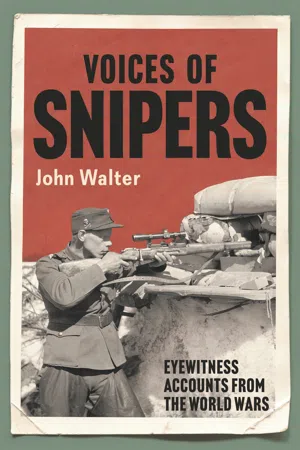
Based on an incredible breadth of first-hand testimony, this is a unique collection of eyewitness accounts from World War I and II. John Walter draws on meticulous research and the reminiscences of more than fifty snipers, tracing their journeys from recruitment and selection through training, combat and its aftermath to reveal a surprising commonality of experience, even across nationalities. Laying bare the triumphs and brutalities of sniping, the personalities and psychologies of those who found themselves doing it and considering the immediate implications on both the sniper and the wider theatre of war, this is a fascinating, detailed insight into frontline combat and the experience of sharpshooting in its historical context. The book is appended with the complete diary of Russian sniper Roza Shanina, who is still celebrated today for her remarkable shooting accuracy and astonishing bravery. Her diary offers a rare insight into the complexities of what it was to be both a sniper and a woman on the frontline.
- 224 pages
- English
- ePUB (mobile friendly)
- Available on iOS & Android
eBook - ePub
About this book
Information
Subtopic
World War IIndex
HistoryAPPENDIX 1
A TYPICAL SNIPING COURSE
Hesketh-Prichard’s course was based on specific requirements, expanded when necessary to provide skills necessary to enable snipers to act as observers and intelligence-gatherers.
On Day 1, a general lecture on the objects of the course and discipline was followed by examination of rifles brought by students – many of which proved to be defective. Then came a lecture about the care of arms, shooting to obtain groups, and observation on a German trench.
Day 2 began with a lecture on the use and care of the stalking telescope. Then came a repetition of grouping practice at 200–300 yards, paying particular attention to bullet strikes on target. The afternoon was given over to practical observation of German trenches and in open country.
Day 3 began with a lecture on the P/14 Enfield, followed by how to judge distance up to 600 yards, snap-shooting at 100–200 yards with a four-second target exposure, application at 200 yards, and consideration of shooting positions. Map-reading and long-distance observation with reports took care of the afternoon.
A lecture on map-reading occupied the morning of Day 4, followed by shooting at 400–500 yards and then at unknown ranges up to 400 yards. The afternoon was devoted to use of ground and cover, selecting and constructing hasty observation posts for open warfare, and selection of cover from view rather than cover from fire.
Day 5 began with a lecture on patrolling and scouting, followed by shooting at 300 yards and then snap-shooting at 100 and 200 yards with a three-second target exposure. A demonstration of camouflage and its uses took up the afternoon, snipers being given an area in which to disguise themselves using local material. The efficacy of this would be checked by observers, who watched while the traineees fired blanks from their concealed positions and would provide map references to expose any snipers they had detected.
The principles of elevation and windage were explained during the morning of Day 6. Spotting enemy snipers was practised, followed by ‘snap-shooting and movement’ in which the students were expected to advance unseen from 500 to 100 yards while shooting at ‘enemy head’ targets which appeared at intervals in the butts. The afternoon was spent building and using night-firing boxes, then investigating how observation of enemy trenches could be compromised by moving materials around.
Day 7, customarily a Sunday, was one largely of rest. The range was opened so that volunteers could shoot under the supervision of an instructor. Students could take the day off if they chose to do so, but experience showed that most of them were keener to improve their marksmanship.
Day 8 started with demonstrations of the construction of forward and sniping posts, patrolling using night goggles, use of cover, and keeping in touch with colleagues. Shooting practice was undertaken at ranges unknown to the firers so that the accuracy of their estimations could be checked. A march involving the use of compass bearings, and using the box respirator from time to time to protect against gas attack, filled the afternoon.
Day 9 was given over to lectures on the use of optically sighted rifles, including practising ‘zeroing’ the sights and the values of long-distance observation.
On Day 10, the duties of scouts, observers and snipers in attack and defence were discussed in detail. Grouping at 100 yards with telescope-sighted rifles was undertaken on the shooting range, followed by scouting in open country, and practical demonstrations of using scouts and snipers securing not only open country but also woods.
A lecture on front-line observation and reporting occupied the morning of Day 11, firing telescope-sighted rifles at 200 yards. Snap-shooting was practised at 100–200 yards with three-second target exposure. The afternoon allowed a directional march, with trainees put into four platoons and given map co-ordinates at which they must concentrate at a given time. Gas alarms were to be given and box respirators worn when necessary.
On Day 12, the duties of a battalion intelligence officer were explained in detail. Then came shooting at 300–400 yards and a period of German trench observation. The afternoon brought a demonstration of the use of scouts and snipers as a protective screen for the infantry in open warfare.
Understanding aerial photographs, assisted by lantern slides, was the key feature of the Day 13’s morning, including, where appropriate, study of the actual ground depicted on the photographs. Examinations in long-distance and front-line observation filled the afternoon.
Day 14 was ‘open range day’, while Days 15 and 16 were devoted to scrutiny of students’ notebooks, oral and written examinations, and shooting proficiency competitions.
Day 17, the last day, brought the course to an end, with the award of certificates to those who had made the grade.
APPENDIX 2
ROZA’S DIARY
Though not among the highest scorers, Roza Egorovna Shanina (‘Roza Georgievna Shanina’ on some documents owing to confusion about her father’s forename) remains one of the best known of all Russian female snipers.
Born on 3 April 1924 on a collective farm in the Bogdanovskoy commune in the Arkhangelsk oblast, elder daughter of Egor Mikhailovich Shanin and Anna Aleksandrovna Shanina, Roza and her family moved to Edma when the commune collapsed c. 1933. She seems to have had a difficult early life. After undergoing basic education, but denied the chance she craved to study literature at secondary school, Roza left home at 14 – walking more than 200km westwards through trackless taiga forests to Konosha, on the railway line from Yaroslavl to Archangelsk.
Precisely why she undertook such a feat of endurance is contested. Her free-spirited approach to life may have been the catalyst, but there is a suspicion that her father may have blocked her progress: unlike her mothers and brothers, he merits not a single mention in Roza’s diary.
Once in Arkhangelsk, she was able to attend secondary school and then, from 11 September 1941, worked at a kindergarten. War had begun by this time, and her eldest brother Mikhail was killed in December 1941 during the battle for Leningrad. Roza, a member of Komsomol since 1938, duly enlisted on 22 June 1943 after completing Vsevobuch marksmanship training, and graduated from the Central Women’s Sniper School in the Spring of 1944 to serve on the Third Belorussian Front with the 707th Rifle Regiment of the 1138th Rifle Division of Fifth Army.
The snipers were noticed almost as soon as they had reached the front, a report that they had killed eight Germans being published as early as 7 April 1944. Roza was almost immediately exploited, no doubt at least partly because of her looks and self-proclaimed desire to be at the heart of battle, and her picture graced periodicals such as Unichtozhim vraga (‘We shall destroy the enemy’).
Aleksandr Stanovov, responsible for some of the earliest photographs, recollected that Roza initially refused to comply unless her fellow snipers were included, but the Soviet propaganda machine soon latched on to her, the writer and propagandist Ilya Erenburg doing much to raise her profile. Tall, athletic, blue-eyed and with cascading light-brown hair (sometimes described as blonde), Roza presented an ideal image.
Such celebrity inevitably caused resentment among other snipers in her unit, and even some of her friends were less than impressed. According to
V. Mamonov and N. Poroshina, Ona zaveshchala nam pesni i rosy (‘She Bequeathed to Us Songs and Dew’, 2001), Kaleriya Petrova recalled that Roza ‘walked a bit like a sailor, rolling here shoulders from side to side. She was well able to stand up for herself, she would be silent … but if you then went too far she would square up … and tell you precisely what she thought of you!’ Others bemoaned her unpredictability, or belittled her rural upbringing.
Precisely how Roza came to prominence is uncertain, though she had struck a friendship with journalist Pyotr Molchanov, editor of Unichtozhim vraga, which may even have pre-dated her arrival at the front. It has been suggested that there was more to the relationship than mere acquaintanceship, and, if a list contained in the diary is believable, many men were involved in Roza’s life. But the levels of this involvement – platonic or intimate – have been disputed.
Many have been quick to condemn Roza as a ‘front-line whore’, and it is fair to say that internet coverage is often prurient. However, there is no evidence in the diary to suggest that she was easy with her favours; indeed, certain passages can be read to suggest the opposite.
Roza Shanina is also often seen as an inheritor of the ‘warrior woman’ traditions of the Amazons, Nike (Goddess of Victory) and the many individuals who entered combat disguised as men. The journal Rabotnitsa (‘Woman worker’) depicted her as the female warrior of all ages: ethnic clothing and ancient armour paired with binoculars and a submachine gun.
Roza herself had no qualms about the sniper’s role. She is said to have had 17 kills by 5 May 1944, her performance being recognised on 18 June with the Order of Glory third class and then on 22 September 1944 with the second-class award.
A total of 59 kills was entered on Roza’s Nagradnoy List (official award record) late in December 1944. However, many more could have been registered by the time she was fatally wounded by shrapnel, dying on 28 January 1945. A ‘final score’ of 75 or 76 is plausible.
Roza Shanina was part of what she christened the Ubegayutsaya troyka, ‘Runaway Troika’, with Aleksandra ‘Sasha’ Yekimova (killed in February 1945) and Kaleriya ‘Kalya’ Petrova. The Russian word troyka, now commonly associated with a sleigh, can also mean a threesome. Serafima ‘Sima’ Anashkina, Evdokiya ‘Dusya’ Krasnoborova and Lidiya ‘Lida’ Vdovina, said Roza, also formed a Troika.
Memories Fade …
Though Roza Shanina and others such as Lyudmila Pavlichenko enjoyed wartime fame, their prominence soon faded. Owing to a widespread perception of female combatants as ‘front-line whores’, many were destined to die in obscurity.
The acronym coined to describe them, PPZh, Pokhodno Polevye Zheny, ‘marching field [or campaign] wives’, a play on the designation of the Shpagin or PPSh submachine gun, had become common currency by 1945; and Marshal Vasily Ivanovich Chuikov could still write in Nachalo puti, (‘Beginning of the Way’, published in 1959), that the mobilisation of women on an unprecedented scale ‘is still weakly covered in military literature, and at times unjustly forgotten … Equally with men, they bore all the burdens of combat life and, together with us men, they went all the way to Berlin.’
Publication of Roza’s diary in Russian in 1965, albeit in abbreviated form, inspired not only her own rehabilitation but also the rise of interest in other Soviet snipers at a time when Khruschchev’s successors made Victory Day, 9 May, a public holiday in Russia. However, the view that women should not have killed men – even in circumstances as extreme as the USSR had faced during the Great Patriotic War – held sway for some time.
Though many reunions had been undertaken, Yuliya Zhukova recalling in her memoirs that 350–400 graduates of the women’s sniper school had attended one such event held in 1975 in Moscow’s Red Square, only when concerted efforts were made in the 1980s by Svetlana Aleksandrovna Alekseyevich and others to record female veterans’ reminiscences did the situation change appreciably.
Lyudmila Pavlichenko’s memoirs, incomplete on her death in 1974, were published in Russian in 2015 as Ya – Snayper: v boyakh za Sevastopol i Odessu (‘I [am the] – Sniper: In Battles for Sevastopol and Odessa’) and in 2018 in English as Lady Death: The Memoirs of Stalin’s Sniper. Yuliya Zhukova’s fascinating recollections appeared in English in 2019 as Girl with a Sniper Rifle.
Honouring her Words
Three notebooks that Roza kept from September 1944 to January 1945 – an earlier diary is said to have been lost – reveal a complex personality, balancing fluctuating feelings of inadequacy, and attention sought by all-but-reckless and sometimes insubordinate performance in battle, with the sensitivity that could manifest itself in poetry and song.
Roza’s diary is presented here in a fre...
Table of contents
- Cover
- Title
- Copyright
- Content
- Foreword by Martin Pegler
- Preface
- Our Chroniclers
- Rise of the Sniper
- What Makes a Sniper?
- Recruiting the Sniper
- Training the Sniper
- Take your Weapons!
- Shoot If You Can!
- Snipers in Combat
- After the Fight
- Appendix 1: A Typical Sniping Course
- Appendix 2: Roza’s Diary
- Bibliography
- Plate section
Trusted by 375,005 students
Access to over 1.5 million titles for a fair monthly price.
Study more efficiently using our study tools.
Frequently asked questions
Yes, you can cancel anytime from the Subscription tab in your account settings on the Perlego website. Your subscription will stay active until the end of your current billing period. Learn how to cancel your subscription
No, books cannot be downloaded as external files, such as PDFs, for use outside of Perlego. However, you can download books within the Perlego app for offline reading on mobile or tablet. Learn how to download books offline
Perlego offers two plans: Essential and Complete
- Essential is ideal for learners and professionals who enjoy exploring a wide range of subjects. Access the Essential Library with 800,000+ trusted titles and best-sellers across business, personal growth, and the humanities. Includes unlimited reading time and Standard Read Aloud voice.
- Complete: Perfect for advanced learners and researchers needing full, unrestricted access. Unlock 1.5M+ books across hundreds of subjects, including academic and specialized titles. The Complete Plan also includes advanced features like Premium Read Aloud and Research Assistant.
We are an online textbook subscription service, where you can get access to an entire online library for less than the price of a single book per month. With over 1.5 million books across 990+ topics, we’ve got you covered! Learn about our mission
Look out for the read-aloud symbol on your next book to see if you can listen to it. The read-aloud tool reads text aloud for you, highlighting the text as it is being read. You can pause it, speed it up and slow it down. Learn more about Read Aloud
Yes! You can use the Perlego app on both iOS and Android devices to read anytime, anywhere — even offline. Perfect for commutes or when you’re on the go.
Please note we cannot support devices running on iOS 13 and Android 7 or earlier. Learn more about using the app
Please note we cannot support devices running on iOS 13 and Android 7 or earlier. Learn more about using the app
Yes, you can access Voices of Snipers by John Walter in PDF and/or ePUB format, as well as other popular books in History & World War I. We have over 1.5 million books available in our catalogue for you to explore.