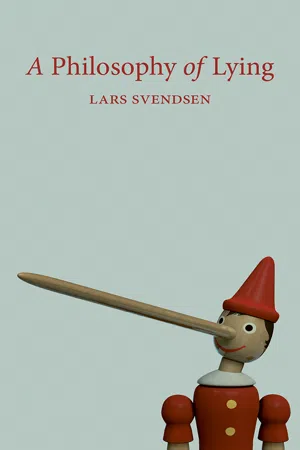
This book is a comprehensive investigation of lying in everyday life. What exactly is a lie, and how does lying differ from related phenomena such as 'bullshit' or being truthful? Lars Svendsen also investigates the ethics of lying – why is lying almost always morally wrong, and why is lying to one's friends especially bad? The book concludes by looking at lying in politics, from Plato's theory of the 'noble lie' to Donald Trump.
Svendsen's conclusion is that, even though we all occasionally lie, we are for the most part trustworthy. Trusting others makes you vulnerable, and you will be duped from time to time, but that is – all things considered – preferable to living in a constant state of distrust.
- English
- ePUB (mobile friendly)
- Available on iOS & Android
eBook - ePub
A Philosophy of Lying
About this book
Information
Topic
PhilosophySubtopic
Ethics & Moral PhilosophyReferences
Introduction
1 Timothy R. Levine, Duped: TruthDefault Theory and the Social Science of Lying and Deception, Tuscaloosa: The University of Alabama Press 2020, ch. 9.
2 For a good overview of the research, see Jörg Meibauer, ed., The Oxford Handbook of Lying, Oxford: Oxford University Press 2018.
3 For a short overview, see Bella M. Depaulo, ‘Lying in Social Psychology’, in Jörg Meibauer, ed., The Oxford Handbook of Lying, Oxford: Oxford University Press 2018.
ONE What Is Lying?
1 Arne Næss, ‘Truth’ as Conceived by Those Who Are Not Professional Philosophers, texts published by Det Norske Videnskaps-Akademi i Oslo Il. Hist.-Filos. Klass 1938 No. 4, Oslo: Jacob Dybwad 1938.
2 Aristotle, Metaphysics, trans. W. D. Ross, in The Complete Works of Aristotle II, Princeton, Princeton University Press 1985, 1011b25.
3 Bernard Williams, Truth and Truthfulness: An Essay in Genealogy, Princeton: Princeton University Press 2002.
4 Immanuel Kant, ‘An Answer to the Question: “What is Enlightenment?”’, in Kant: Political Writings, trans. H. B. Nisbet, Cambridge: Cambridge University Press 1991, p. 54.
5 Augustine, ‘Enchiridion’ and ‘De Mendacio’, in Kevin DeLapp and Jeremy Henkel, ed., Lying and Truthfulness, Indianapolis/Cambridge: Hackett Publishing Company 2016, pp. 4–35.
6 Immanuel Kant, Critique of the Power of Judgement, trans. Paul Guyer and Eric Matthews, Cambridge: Cambridge University Press 2002, §53.
7 Ludwig Wittgenstein, Philosophical Investigations, trans. G.E.M. Anscombe, Oxford: Blackwell: 1963, §249.
8 Ibid., §580.
9 George Orwell, ‘Politics and the English Language’, Horizon, 76/1946.
10 George Orwell, Nineteen EightyFour: A Novel, London: Secker & Warburg 1949.
11 Harry Frankfurt, ‘On Bullshit’, in The Importance of What We Care About, Cambridge: Cambridge University Press 1988, p. 130.
TWO The Ethics of Lying
1 Sissela Bok, Lying: Moral Choice in Public and Private Life, New York: Vintage Books 1979.
2 Aristotle, Nicomachean Ethics, trans. W. D. Ross, The Complete Works of Aristotle II, Princeton, Princeton University Press 1985, 1011b25, 1127a30.
3 Ibid., 1127a27.
4 Ibid., 1127b4–8.
5 Aristotle, Rhetoric, trans. W. Rhys Roberts, in The Complete Works of Aristotle II, Princeton, Princeton University Press 1985, 1417b36–1418a1.
6 Hugo Grotius, The Law of War and Peace, trans. Francis W. Kelsey, in Kevin DeLapp and Jeremy Henkel, ed., Lying and Truthfulness, Indianapolis/Cambridge: Hackett Publishing Company 2016, pp. 38–52.
7 Blaise Pascal, The Provincial Letters, trans. A. J. Krailsheimer, London: Penguin Books 1988, 9th letter, p. 140f.
8 Augustine, Enchiridion and De mendacio, pp. 4–35.
9 Thomas Aquinas, Summa theologiae, in Kevin DeLapp and Jeremy Henkel, ed., Lying and Truthfulness, Indianapolis/Cambridge: Hackett Publishing Company 2016, pp. 158–84.
10 Immanuel Kant, Groundwork of the Metaphysics of Morals, trans. Mary Gregor, Cambridge: Cambridge University Press 2011, p. 402.
11 Immanuel Kant, Anthropology From a Pragmatic Point of View, trans. Mary J. Gregor, The Hague: Martinus Nijhoff 1974, §14. Immanuel Kant, The Metaphysics of Morals, trans. Mary Gregor, Cambridge: Cambridge University Press 1991, p. 431.
12 Immanuel Kant, Lectures on Ethics, trans. Peter Heath, Cambridge: Cambridge University Press 1997, p. 700.
13 Kant, Lectures on Ethics, p. 62.
14 Kant, Anthropology From a Pragmatic Point of View, p. 332.
15 Kant, Lectures on Ethics, p. 446ff.
16 Kant, The Metaphysics of Morals, p. 429. Kant, Lectures on Ethics, pp. 604f., 700.
17 Kant, The Metaphysics of Morals, p. 429.
18 Ibid., p. 426.
19 Immanuel Kant, ‘Über ein vermeintes Recht aus Menschenliebe zu lügen’, in Kants gesammelte Schriften, vol. viii, Preußischen Akademie der Wissenschaften, ed. de Gruyter, Berlin/New York 1902–, p. 426.
20 Kant, Groundwork of the Metaphysics of Morals, p. 421.
21 Ibid., p. 429.
22 Baruch Spinoza, The Ethics and Selected Letters, trans. Seymour Feldman, Indianapolis: Hackett 1982, E4p72, p. 195.
23 Kant, ‘Über ein vermeintes Recht ...
Table of contents
- Front Cover
- Half Title
- Title Page
- Copyright
- Contents
- Introduction
- ONE: What Is Lying?
- TWO: The Ethics of Lying
- THREE: Lying to Yourself
- FOUR: Lies and Friendship
- FIVE: The Politics of Lying
- SIX: Living with Lying
- REFERENCES
- ACKNOWLEDGEMENTS
- INDEX
Trusted by 375,005 students
Access to over 1.5 million titles for a fair monthly price.
Study more efficiently using our study tools.
Frequently asked questions
Yes, you can cancel anytime from the Subscription tab in your account settings on the Perlego website. Your subscription will stay active until the end of your current billing period. Learn how to cancel your subscription
No, books cannot be downloaded as external files, such as PDFs, for use outside of Perlego. However, you can download books within the Perlego app for offline reading on mobile or tablet. Learn how to download books offline
Perlego offers two plans: Essential and Complete
- Essential is ideal for learners and professionals who enjoy exploring a wide range of subjects. Access the Essential Library with 800,000+ trusted titles and best-sellers across business, personal growth, and the humanities. Includes unlimited reading time and Standard Read Aloud voice.
- Complete: Perfect for advanced learners and researchers needing full, unrestricted access. Unlock 1.5M+ books across hundreds of subjects, including academic and specialized titles. The Complete Plan also includes advanced features like Premium Read Aloud and Research Assistant.
We are an online textbook subscription service, where you can get access to an entire online library for less than the price of a single book per month. With over 1.5 million books across 990+ topics, we’ve got you covered! Learn about our mission
Look out for the read-aloud symbol on your next book to see if you can listen to it. The read-aloud tool reads text aloud for you, highlighting the text as it is being read. You can pause it, speed it up and slow it down. Learn more about Read Aloud
Yes! You can use the Perlego app on both iOS and Android devices to read anytime, anywhere — even offline. Perfect for commutes or when you’re on the go.
Please note we cannot support devices running on iOS 13 and Android 7 or earlier. Learn more about using the app
Please note we cannot support devices running on iOS 13 and Android 7 or earlier. Learn more about using the app
Yes, you can access A Philosophy of Lying by Lars Svendsen, Matt Bagguley in PDF and/or ePUB format, as well as other popular books in Philosophy & Ethics & Moral Philosophy. We have over 1.5 million books available in our catalogue for you to explore.