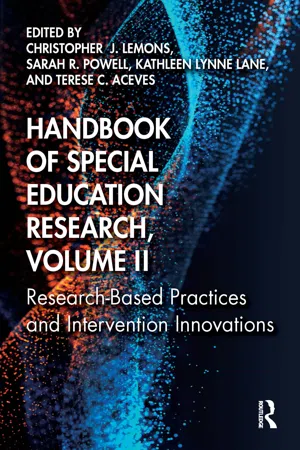
Divided into two volumes, the Handbook of Special Education Research provides a comprehensive overview of critical issues in special education research. Volume II addresses research-based practices, offering a deep dive into tiered systems of support and advances in interventions and assessments, as well as socially, emotionally, culturally, and linguistically relevant practices. Each chapter features considerations for future research and implications for fostering continuous improvement and innovation. Essential reading for researchers and students of special education, this handbook brings together diverse and complementary perspectives to help move the field forward.
eBook - ePub
Handbook of Special Education Research, Volume II
Research-Based Practices and Intervention Innovations
- 298 pages
- English
- ePUB (mobile friendly)
- Available on iOS & Android
eBook - ePub
Handbook of Special Education Research, Volume II
Research-Based Practices and Intervention Innovations
About this book
Information
1 RESEARCH-BASED PRACTICES AND INTERVENTION INNOVATIONS
DOI: 10.4324/9781003156888-1
“Necessity is the mother of invention” is an oft-quoted proverb—in this volume, we aim to shift that proverb slightly and say that “Necessity is the mother of intervention.” Special education researchers are devoted to designing, evaluating, and scaling effective interventions to improve academic, behavioral, and social outcomes for children and adolescents with disabilities, their family members, and the educators who support them. In Volume II of this Handbook of Special Education Research, authors highlight critical areas of special education research and outline what we currently know about effective interventions and where special education researchers should go next to enhance the effectiveness of our interventions. Our hope is that this volume will inspire the next generation of special education researchers to be innovative in terms of methodology, intervention design, and intervention focus to ensure that special educators and family members are well prepared to support children and adolescents with disabilities from early childhood through transition so they enter the postsecondary world on the firmest foundation for success.
Overview
Authors of chapters in this volume focus on a diverse set of issues that are critical to enhancing outcomes for students with or at risk of disability. Lane and colleagues (Chapter 2) provide an overview, explaining how Ci3T models are a broadening of Multitiered System of Supports (MTSS) to address the integration of academic, behavioral, and social-emotional domains for all learners—including students receiving special education services. Buckman and colleagues (Chapter 3) identify how the measurement and use of treatment integrity and social validity data are foundational to the implementation of tiered systems, describe how extant research has addressed these concepts, and provide recommendations to the field for advancing the collection and use of these data within tiered systems.
Al Otaiba and colleagues (Chapter 4) highlight the current state of research regarding relations between mindset-related constructs and reading achievement and describe the effects of interventions on mindset and reading achievement for students with reading difficulties and disabilities.
Oakes and colleagues (Chapter 5) examine the theoretical and empirical support for the well-being of educators working within tiered systems and provide an overview of the research on the well-being of teachers who work in tiered systems and implications for treatment integrity and teacher efficacy.
Cumming and colleagues (Chapter 6) describe mechanisms by which working conditions affect the capacity of the special education teacher workforce, discuss how working conditions contribute to special education teachers’ experiences and outcomes, and consider how working conditions affect the capacity of educational systems to meet their obligations to students.
Clemens and colleagues (Chapter 7) focus on the two most common forms of reading difficulties: word-level reading and reading comprehension. They review best practices in reading interventions, identify shortcomings in the knowledge base, and review contemporary research. Petscher and colleagues (Chapter 8) describe five core considerations one should minimally look at when choosing a screener and five core considerations expressed as questions for using a screener.
Fluhler and colleagues (Chapter 9) highlight the current state of research focused on supporting paraprofessionals and highlight a study conducted to explore paras’ perceptions of job-related supports, challenges, and their experiences and effectiveness after participating in a professional development study.
FitzPatrick and colleagues (Chapter 10) highlight the current state of research focused on writing instruction for students receiving intervention supports through MTSS or special education, and they provide implications for practitioners.
Powell and Bos (Chapter 11) review recent mathematics intervention research, discuss the evidence base of practices for design and delivery of mathematics intervention for students who are experiencing mathematics difficulty, and present pathways for improving mathematics intervention research and practice. Lembke and colleagues (Chapter 12) share information about best practices in mathematics assessment for students with the most intensive needs. The authors describe best practices for screening and progress monitoring, share information on using and creating high-quality diagnostic materials in mathematics, and provide an overview of data-based decision making centered on using mathematics assessment data to make better instructional decisions.
Richards-Tutor and Solari (Chapter 13) focus on reading interventions for students who are English learners with reading difficulties. The authors provide data on the current state of achievement and practices used for English learners, review evidence-based practices for English learners, and discuss tenets of culturally responsive and sustaining practices, focusing on how these can be used in tandem with effective interventions practices to potentially positively affect outcomes for English learners.
Belfiore (Chapter 14) focuses on students enrolled in our largest urban school districts who continue to underperform same grade-level peers and who are therefore more likely to face disciplinary sanctions. The author provides strategies rooted in applied behavior analysis to help reconstruct and maintain an equitable public education playing field for this group of learners.
Smith and colleagues (Chapter 15) highlight the current state of research focused on using technology and online learning to improve outcomes for students with disabilities and provide implications for practitioners and parents, and outline goals for the next decade of research, focusing using technology to support students with disabilities.
Carter and colleagues (Chapter 16) address six primary outcome areas that can be addressed within social-focused interventions in schools, review ten research-based interventions that can contribute to noticeable changes in the social outcomes of students, and offer recommendations for practice and research related to the social dimensions of schooling.
Common and colleagues (Chapter 17) examine theoretical and empirical support for two intensive interventions to support students’ behavioral and social needs: functional assessment-based interventions and individualized de-escalation plans. The authors examine the development of and theoretical and empirical support for each practice and discuss the breadth and scope of rigorous research undergirding each intervention’s foundation.
Farmer and colleagues (Chapter 18) focus on the social inclusion of students with disabilities from a dynamic-ecological systems perspective in which the whole child is viewed in context. The authors present the Behavioral, Academic, and Social Engagement model as a classroom management framework aimed at aligning the strengths and needs of specific students with social opportunities and experiences that promote their social adaptation and inclusion in the classroom society and provide considerations for integrating individual and peer support interventions within the model.
Esparza Brown and Aceves (Chapter 19) focus on the fair assessment of multilingual learners with an aim at ensuring equitable and effective instruction and decision making for students often from marginalized communities. The authors highlight current research, identifying the continuum of assessment practices used in schools and the key considerations when assessing multilingual students, describe formative assessments and their use by collaborative teams, and examine the use of summative assessments with diverse populations.
Barton and Lane (Chapter 20) focus on play—a critical, early milestone that contributes to the learning and development of young children in multiple ways. The authors provide a description of play in young children, a rationale for teaching play to all children and particularly children with disabilities, and an overview of evidence-based practices for teaching play to all children.
Jolivette and colleagues (Chapter 21) focus on systems-involved youth who are more likely to present with multiple and complex social, emotional, behavioral, and educational needs than their peers in public education settings. They review interventions that focus on equity and equality through the delivery of social-emotional, mental health, educational, behavioral, and trauma-informed programming, which can increase with intensity to meet each youth’s needs.
McCree and colleagues (Chapter 22) focus on the critical issue of bullying involvement, which disproportionately affects students with disabilities. The authors outline the intersection of social-emotional learning (SEL) and bully prevention, provide guidance on embedding SEL within an MTSS framework to address school-based bullying, address data collection and evaluation of school-based bully prevention systems, and highlight interventions that are promising for all youth, with a direct emphasis on students with disabilities.
In Closing
In 2021, Adam Grant, an organizational psychologist at The Wharton School, published a book titled Think Again. In the text, he argues that one key to success is having the ability to question previously held assumptions and to embrace an approach of mental flexibility. He argues that approaching problems like a scientist—being objective, data based, and curious—leads to more effective solutions to challenges. It is in this spirit that we have pulled together the contributions to this volume. We as special education researchers are scientists at heart. Our hope is that as you read the chapters, you will embrace the suggestions provided by the authors to evaluate your current thinking and to consider whether thinking again about the content, design, measurement, delivery, and ways of supporting special educators could lead to the next breakthroughs in special education research and improve the ability of schools to meet the individualized needs of students with disabilities.
Reference
- Grant, A. (2021). Think again: The power of knowing what you don’t know. Viking.
2COMPREHENSIVE, INTEGRATED, THREE-TIERED (Ci3T) MODELS OF PREVENTIONPrioritizing Integrated Systems
DOI: 10.4324/9781003156888-2
Reflecting on the past 30 years, we have had the privilege of serving as paraprofessionals, general education teachers, special education teachers, behavior specialists, and administrators in the K-12 educational system from California to New York and several states in between (Lane, Buckman, et al., 2020). Some of us experienced firsthand several reforms devoted to improving students’ educational outcomes. In the 1980s, the refer–test–place model of meeting students...
Table of contents
- Cover
- Half Title
- Title
- Copyright
- Dedication
- Contents
- 1 Research-Based Practices and Intervention Innovations
- 2 Comprehensive, Integrated, Three-Tiered (Ci3T) Models of Prevention: Prioritizing Integrated Systems
- 3 Treatment Integrity and Social Validity in Tiered Systems: Using Data to Inform Implementation Efforts
- 4 Reading Achievement and Growth Mindset of Students With Reading Difficulties or Reading Disabilities: Contemporary Research and Implications for Research and Practice
- 5 Well-Being of Educators Working in Tiered Systems
- 6 Leveraging Working Conditions to Improve the Quality and Effectiveness of the Special Education Teacher Workforce
- 7 Advances in Interventions for Students With Reading Difficulties
- 8 Considerations for Choosing and Using Screeners for Students With Disabilities
- 9 Paraprofessionals’ Perceptions of Job-Related Supports, Challenges, and Effectiveness
- 10 Writing Instruction for Students With Disabilities (and Other Struggling Writers): Current Research and Implications for Research and Practice
- 11 Mathematics Interventions for Students Experiencing Mathematics Difficulty
- 12 Mathematics Assessments for Students Experiencing Mathematics Difficulty
- 13 Evidence-Based, Culturally Responsive Interventions to Improve Academic Outcomes for English Learners With Reading Difficulties
- 14 Academic Strategies for At-Risk Students in Urban Schools
- 15 Advances in the Use of Technology and Online Learning to Improve Outcomes for Students With Disabilities
- 16 Enhancing the Social Lives of Students With Disabilities: Effective Practices and Improved Outcomes
- 17 Theoretically and Empirically Supported Intensive Interventions for Students’ Social-Emotional and Behavior Needs
- 18 The Behavioral, Academic, and Social Engagement (BASE) Model of Social Inclusion
- 19 Multilingual Learners: Testing, Assessment, and Evaluation
- 20 Teaching Children How to Play: More Than Just a Context
- 21 Addressing the Whole Youth: Characteristics and Evidence-Based Practices and Programs for Systems-Involved Youth
- 22 Bully Prevention and Social and Emotional Learning: Impact on Youth With Disabilities
- Index
Trusted by 375,005 students
Access to over 1.5 million titles for a fair monthly price.
Study more efficiently using our study tools.
Frequently asked questions
Yes, you can cancel anytime from the Subscription tab in your account settings on the Perlego website. Your subscription will stay active until the end of your current billing period. Learn how to cancel your subscription
No, books cannot be downloaded as external files, such as PDFs, for use outside of Perlego. However, you can download books within the Perlego app for offline reading on mobile or tablet. Learn how to download books offline
Perlego offers two plans: Essential and Complete
- Essential is ideal for learners and professionals who enjoy exploring a wide range of subjects. Access the Essential Library with 800,000+ trusted titles and best-sellers across business, personal growth, and the humanities. Includes unlimited reading time and Standard Read Aloud voice.
- Complete: Perfect for advanced learners and researchers needing full, unrestricted access. Unlock 1.5M+ books across hundreds of subjects, including academic and specialized titles. The Complete Plan also includes advanced features like Premium Read Aloud and Research Assistant.
We are an online textbook subscription service, where you can get access to an entire online library for less than the price of a single book per month. With over 1.5 million books across 990+ topics, we’ve got you covered! Learn about our mission
Look out for the read-aloud symbol on your next book to see if you can listen to it. The read-aloud tool reads text aloud for you, highlighting the text as it is being read. You can pause it, speed it up and slow it down. Learn more about Read Aloud
Yes! You can use the Perlego app on both iOS and Android devices to read anytime, anywhere — even offline. Perfect for commutes or when you’re on the go.
Please note we cannot support devices running on iOS 13 and Android 7 or earlier. Learn more about using the app
Please note we cannot support devices running on iOS 13 and Android 7 or earlier. Learn more about using the app
Yes, you can access Handbook of Special Education Research, Volume II by Christopher J. Lemons, Sarah R. Powell, Kathleen Lynne Lane, Terese C. Aceves, Christopher J. Lemons,Sarah R. Powell,Kathleen Lynne Lane,Terese C. Aceves in PDF and/or ePUB format, as well as other popular books in Education & Education General. We have over 1.5 million books available in our catalogue for you to explore.