This book guides process-industry professionals from the implementation of the basic foundations of Continuous Improvement (CI) through to an organization where CI is a "way of life" and a defining feature of the culture of the organization.
The readers of this book are seeking solutions to such pressing issues as:
• Eliminating accidents and near misses.
• Reducing customer complaints.
• Improving customer delivery performance.
• Elimination of accidents and near misses.
• Reducing customer complaints.
• Improving customer delivery performance.
• Introducing new products.
• Improving staff productivity.
• Removing costs to meet the budget.
• Dealing with absence and poor morale.
• Improving staff retention.
This book provides them with guidance on how to address issues in these areas in a way that enables improvements to be realized quickly but not at the expense of a long-term goal of a sustainable Continuous Improvement culture.
In addition, this book presents the implementation of CI as a cyclical journey with no endpoint. The stages are ordered in a sequence that enables the reader to get started in their area of the company and build up the elements without the need for an overall organizational strategy at the beginning.
Continuous Improvement is a vast subject with many takes on principles, approaches, and tools. This book is about how all the fundamentals of these areas fit together and, as such, covers only some of them. However, within the bibliography, I have signposted the books that have guided me during my career and which go into the principles, approaches, and tools further.
If you’re going to do something, go start. Life’s simpler than we sometimes can admit.
Robert De Niro
If you are looking for a practical, straight to the point guide on how to start and get better at Continuous Improvement (CI), then this manual will be useful. Specifically, it is a Continuous Improvement fundamental ‘how to guide’ primarily aimed at people who work within processing industries such as food and drink, consumer-packaged goods, ingredients, packaging and pharmaceuticals.
It will be of particular interest to those working in or aspiring to work in the following disciplines:
General Management
Production
Continuous Improvement Practitioner/Consultant
Technical/Quality Assurance
Engineering
Supply Chain (Purchasing, Planning and Logistics)
New Product Development
Health, Safety and Environment
Within the manual, ‘Operations’ is mentioned – please note this is a collective term for all the above.
For those of you in positions of senior leadership, whose sponsorship of Continuous Improvement is a vital factor in its success and sustainability, it is important to state, from the outset, that this manual’s approach is unashamedly ‘bottom up’ as opposed to ‘top down,’ i.e. starting small and developing the approach from there. The last chapter of the manual is Skills and Culture Development, a fundamental enabler of each stage of the Continuous Improvement Journey. Please read it first if you would like guidance on how to create the right environment and facilitate CI cultural development. The chapters are sequenced in a ‘bottom-up’ order however, as the Continuous Improvement Journey is a cycle, it is possible to start at any point.
The manual is structured in a way that you can use it to guide you by implementing the basic foundations of CI through to an organisation where Continuous Improvement is a ‘way of life’ and a defining feature of the culture of the organisation.
In your role, you may have many pressing concerns such as:
Elimination of accidents and near misses
Reducing customer complaints
Improving customer delivery performance
Introducing new products
Improving staff productivity
Removing costs to meet budget
Dealing with absence and poor morale
Improving staff retention
This manual will provide you with guidance on how to address issues in these areas in a way that enables improvements to be realised quickly but not at the expense of a long-term goal of a sustainable Continuous Improvement culture.
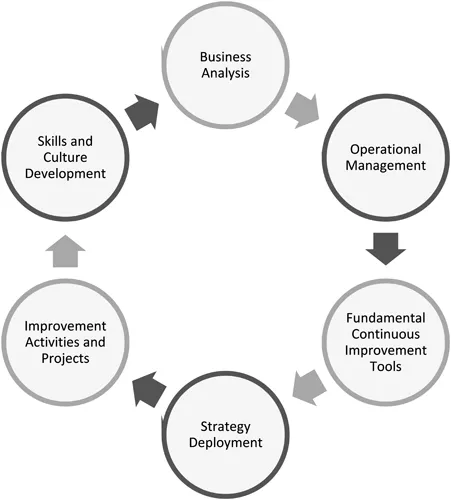
What this guide will not do is provide you with an end point. As represented in Figure 1.1, the very nature of Continuous Improvement is that it is never ending as we are always journeying towards but never achieving perfection. Toyota, arguably the world’s greatest manufacturer and exponent of Continuous Improvement, has been on its journey for well over 75 years and is still striving to increase the value to its customers and improve the way it does things.
Continuous Improvement is a vast subject with many takes on principles, approaches and tools. This manual is about how all the fundamentals of these areas fit together and, as such, covers only some of them. However, within the bibliography, I have signposted the books that have guided me during my career and which go into the principles, approaches and tools in more detail.
Figure 1.1 The never-ending Continuous Improvement Journey.
You may have come across terms such as Lean Manufacturing and Six Sigma and the various merits of each. Within this manual, I refer to both and pick out what I think works.
Sometimes people who undertake Continuous Improvement have a job title that includes one of the following terms: ‘Operational Excellence,’ ‘Business Improvement,’ ‘Black Belt,’ ‘Transformation,’ ‘Scrum,’ ‘Agile,’ etc.
Is any job title better than another? Who knows? In my opinion, there is one overriding ‘job title’ that Continuous Improvement applies to and that is ‘human being.’
I have spent over 35 years working in the processing industries in engineering, operations management and consultancy roles. This manual is essentially a letter to my younger self advising how to go about things and, hopefully, not make as many mistakes as I did!
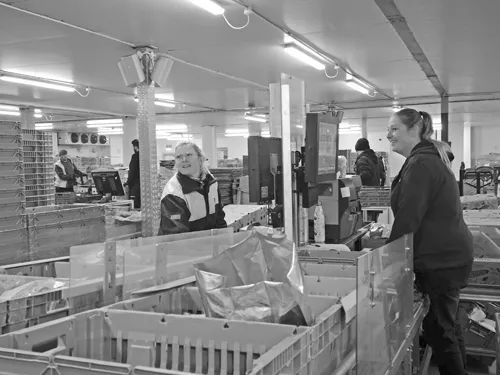
Figure 1.2 Order packing at Riverford Organic Farmers.
As it is about my experiences and relating what I think works, I have kept it as simple as possible with an emphasis on how all the pieces fit together. My style has been described as personable and pragmatic and I have tried to come across as ‘me.’ Consequently, I have written a lot of it in the first person and tried to reduce the amount of jargon. My motto is ‘don’t let perfect get in the way of better.’ This manual, I hope, conveys this and the spirit of ‘Always Making Progress.’
Continuous Improvement is fascinating as there is always something new to learn on the journey.
Enjoy the ride!
Be curious, not judgmental
Walt Whitman
Chapter 2 How This Manual Is Structured
DOI: 10.4324/9781003244707-2
I keep six honest serving men
(They taught me all I knew);
Their names are What and Why and When
And How and Where and Who.
Rudyard Kipling
2.1 Always Making Progress
Put simply, Continuous Improvement is about changing how things are done to achieve better outcomes and to keep doing this. We could describe it in more everyday terms as ‘Always Making Progress.’ This may be for yourself, your family, your community, your team, your company, your country, the planet etc.
Making progress is similar to going on a journey; you are at place A; you need or want to go to place B and you have the means and opportunity to make the journey. The ‘checklist’ for a successful journey is provided in Table 2.1.
Table 2.1 Continuous Improvement Checklist
Item
Comm...
Table of contents
Cover
Half-Title
Title
Copyright
Dedication
Contents
List of Figures
List of Tables
Foreword
Acknowledgements
Author Biography: Who Is Ian Madden?
1 Introduction
2 How This Manual Is Structured
3 Business Analysis
4 Operational Management Facilitation
5 Fundamental Continuous Improvement Tools
6 Strategy Deployment
7 Improvement Activities and Projects
8 Skills and Culture Development
Bibliography
Index
Trusted by 375,005 students
Access to over 1.5 million titles for a fair monthly price.
Study more efficiently using our study tools.
Frequently asked questions
Yes, you can cancel anytime from the Subscription tab in your account settings on the Perlego website. Your subscription will stay active until the end of your current billing period. Learn how to cancel your subscription
No, books cannot be downloaded as external files, such as PDFs, for use outside of Perlego. However, you can download books within the Perlego app for offline reading on mobile or tablet. Learn how to download books offline
Perlego offers two plans: Essential and Complete
Essential is ideal for learners and professionals who enjoy exploring a wide range of subjects. Access the Essential Library with 800,000+ trusted titles and best-sellers across business, personal growth, and the humanities. Includes unlimited reading time and Standard Read Aloud voice.
Complete: Perfect for advanced learners and researchers needing full, unrestricted access. Unlock 1.5M+ books across hundreds of subjects, including academic and specialized titles. The Complete Plan also includes advanced features like Premium Read Aloud and Research Assistant.
Both plans are available with monthly, semester, or annual billing cycles.
We are an online textbook subscription service, where you can get access to an entire online library for less than the price of a single book per month. With over 1.5 million books across 990+ topics, we’ve got you covered! Learn about our mission
Look out for the read-aloud symbol on your next book to see if you can listen to it. The read-aloud tool reads text aloud for you, highlighting the text as it is being read. You can pause it, speed it up and slow it down. Learn more about Read Aloud
Yes! You can use the Perlego app on both iOS and Android devices to read anytime, anywhere — even offline. Perfect for commutes or when you’re on the go. Please note we cannot support devices running on iOS 13 and Android 7 or earlier. Learn more about using the app
Yes, you can access Always Making Progress by Ian Madden in PDF and/or ePUB format, as well as other popular books in Business & Business General. We have over 1.5 million books available in our catalogue for you to explore.