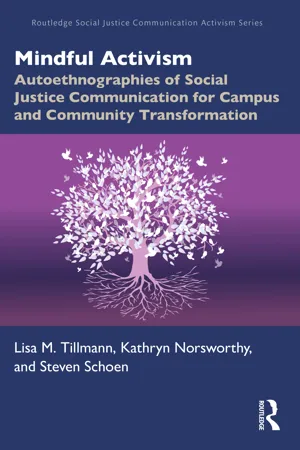
Mindful Activism
eBook - ePub

Mindful Activism

Autoethnographies of Social Justice Communication for Campus and Community Transformation

  1. 181 pages
  2. English
  3. ePUB (mobile friendly)
  4. Available on iOS & Android
eBook - ePub

Mindful Activism

Autoethnographies of Social Justice Communication for Campus and Community Transformation

About this book

This collection immerses scholars of communication and related disciplines in narratives of and conversations about social-justice-focused activism.

Through autoethnographic essays, Mindful Activism chronicles the authors' experiences as activist academics challenging and seeking to remedy injustices on campus and in local and global communities. Those experiences range from engaging in a single activist act to collaborating over many years with oppressed communities and social change groups. Building upon communication activism research and following a liberation-based transformative learning model, the book shows both activism in action and deep reflection on that activism. The authors re-experience activist experiences, draw out lessons, and invite readers to apply those to their own social justice endeavors. Mindful Activism also demonstrates how mindfulness supports activists in deepening their awareness and understanding of themselves, others, and social systems. This orientation increases the likelihood that activists will remain grounded enough to respond to injustice mindfully/effectively.

The book will enrich courses on activism, social justice, dialogue, narrative inquiry, qualitative methods, autoethnography, and general graduate studies, and will resonate with scholars committed to building a more equitable and just world.

Trusted by 375,005 students

Access to over 1.5 million titles for a fair monthly price.

Study more efficiently using our study tools.

Information

Publisher
Routledge
Year
2022
eBook ISBN
9781000563481

1 SITTING OUT "THE STAR-SPANGLED BANNER"1

DOI: 10.4324/9781003214441-2
1 The Orlando Sentinel published an earlier version of the chapter’s (auto)ethnographic narrative (Tillmann, 2016, used with permission).
Lisa M. Tillmann, Kathryn Norsworthy, and Steven Schoen

Coauthors Arrive at the Chapter Debrief2

2 Chapters 1–5 of Mindful Activism contain both (auto)ethnographic narrative composed by the lead author and a meta-narrative in the form of a dialogic debrief involving all authors. We structure the debrief according to a transformative learning model (adapted from Kolb, 1984): Experience (In relation to the events themselves, the text’s portrayal of those events, and/or the reading/hearing of the text: What happened?), Reflection (What stood out? What feelings arose?), and Generalization (What might we learn, particularly about activism, from what happened?). A fourth stage, Application, invites readers to ask: How can we apply learnings to new contexts within our own activist, civic, personal, academic, and professional lives?
August 16, 2019: Kathryn, Lisa, and Steve spend a few minutes rearranging the classroom they have reserved for today’s meeting, at which they will discuss Lisa’s draft of their book’s first chapter. Kathryn pushes the rolling whiteboard toward the east wall, saying, “I confess I read the wrong chapter!”
“I brought a copy,” reports Lisa. “How about I read it aloud?”
“Perfect!” says Kathryn, taking a seat next to Steve. She requests that he record a voice memo on his phone.3
3 We recorded and transcribed each dialogic debrief represented in Mindful Activism. The chapter’s lead author used the transcript as the basis of a creative reconstruction of the meeting.
Lisa moves her chair to face her colleagues. She clears her throat and begins.

(Auto)ethnographic4 Narrative

4 We use (auto)ethnographic to signify that we employ both ethnographic and autoethnographic practices and modes of representation; the “auto” of autoethnography refers to self, “ethnos” to culture, and “graph” to creative composition. See, e.g., Adams et al. (2021), Bochner (2014), Bochner and Ellis (2016), and Tillmann (2015).
September 13, 2016. In 56 days, Hillary Clinton will receive nearly 2.9 million more votes than Donald Trump. Tonight, Garrison Keillor performs at Rollins College,5 where I have taught since 1999. I long have regarded as an American treasure this prairie home companion.6
5 Winter Park Institute (2016).
6 Prairie Home Companion is the title of the radio show Garrison Keillor hosted from 1974 to 2016.
White, Christian, and middle-class, I grew up in small-town Minnesota, Lake City, a place resonant of Lake Wobegon,7 “where all the women are strong, all the men are good-looking, and all the children are above average.”
7 Lake Wobegon is the fictional setting of Prairie Home Companion.
Keillor opens with a sing-along: “My Country, ’Tis of Thee,”8 “America the Beautiful,”9 “Swing Low, Sweet Chariot.”10
8 Smith (1831).
9 Ward and Bates (1883, 1895).
10 Willis (1865).
Our guest then improvises a melody: “No matter what you may hear, we are one country.” Given Keillor’s reputation as “a stalwart political leftist,”11 I wonder if he has in mind the “great white snapping turtle,”12 his moniker for U.S. presidential candidate Donald Trump.
11 Rigsb y (2016).
12 K eillor (2016).
In less than two months, the turtle will take the presidency via the Electoral College, a vestige of slavery. To entice Southern states into ratifying the U.S. Constitution, the Electoral College added to states’ population totals three-fifths a person for each unable-to-vote slave. The more slaves a state had, the more electoral votes it received.
Keillor continues, “We all know the words to roughly the same songs.” I look around the gymnasium of my college, whose 2021–2022 tuition will run $54,740 ($15,000 more for room and board).13 I note the baby-boomer-skewed and overwhelmingly White crowd, some of whom paid (for “exclusive” seating) $50-nearly a full day’s work at minimum wage.
13 Rollins College of Liberal Arts (2021).
Who is the “we,” I wonder, who “all know the words to roughly the same songs”? Arun Gandhi, grandson of Mahatma and on campus to discuss “nonviolence in a violent world,” sits behind me. I don’t hear him belt out: “Sweet land of liberty, of thee I sing!”
Intones Keillor, “No matter what differences may exist between us—which I’m not going to bring up tonight, . . . we are one people.” Classic Keillor: a folksy reminder of our shared humanity.
Still, I sense that by directing attention away from differences, Keillor might be chorusing about national-anthem-sitting Colin Kaepernick14 as much as the “snapping turtle.” The snapper likely has more fans in the Rollins College gymnasium than does the sitter.
14 See Sandritter (2017).
Flash forward: Kaepernick, who shined as the San Francisco 49ers’ quarterback in Super Bowl XLVII, will play his last National Football League (NFL) game in January 2017—almost certainly a blackballing in retaliation for his protests. Assessing the next season’s 32 starting quarterbacks, D. J. Gallo will deem 11 to be “objectively worse” than Kaepernick.15
15 Gallo (2017).
Two days before Keillor’s performance at Rollins, my partner John and I discussed the 2016 NFL season, including Kaepernick’s protests, which had continued and spread to other players, teams, and sports. We commiserated about vitriol vomited by Whites more incensed by protests against racism than by systemic and lethal racism itself. I lamented the lack of White accomplices sitting or kneeling alongside teammates of color.
To be fair, I also had to reflect on my athletic “career,” which ended—due to lack of further talent—after high school. During my sport-playing years, I had neither the consciousness nor courage to sit or kneel during “The Star-Spangled Banner.” Indeed, once, as a member of the Marquette University choir, I sang the anthem at a Milwaukee Brewers’ baseball game.
What must it take for Kaepernick to risk his livelihood and the brand of contempt that still drives the lynching of Black and Brown men? I am someone with multiple layers of unearned advantage; thus, I cannot answer this question in a first-person, embodied way. However, for many years, I have learned with and from students, colleagues, friends, and dating partners of color; I’ve done enough homework to regard Kaepernick’s protests with reverence.
To (White) friends and family who cannot imagine what would lead someone to sit, kneel, or offer a Black power salute during the national anthem, I wish that I could assign Almukhtar et al.’s collection of videos showing police injuring and killing persons of color and books like Alexander’s The New Jim Crow: Mass Incarceration in the Age of Colorblindness, Wilkerson’s The Warmth of Other Suns: The Epic Story of America’s Great Migration, and Taylor’s From #Black-LivesMatter to Black Liberation.16
16 See also Taibbi (2014), Coates (2015), and Wilkerson (2020).
Keillor’s sing-along syllabus features different works: The Beatles’ “I Saw Her Standing There,”17 released in 1963, four years before the U.S. Supreme Court struck down laws barring interracial marriage in 16 states; “Amazing Grace,” published in 1779 by former slave trader John Newton; “I’ve Been Working on the Railroad,”18 whose 1894 version included a verse in minstrel dialect; and “America the Beautiful”—again! “O beautiful for pilgrim feet/Whose stern, impassioned stress/A thoroughfare of freedom beat/Across the wilderness!” I guess those lines sound more exuberant than “An economy built on genocide/Land grabs and slavery!”
17 McCartney and Lennon (1963).
18 Anonymous (1894).
After the sing-along, Keillor transitions to quirky humor. We hear bits about sadistic dentistry and death by refrigerator mishap.
Toward the end of the performance, Keillor observes, “Life is good. You learn this when you’re old and you’re done with all of your complaints. It’s an amazing world . . . no matter what anybody says. It’s a beautiful world. We live on this little well-protected island in a world of trouble, and grief, and suffering, so we should be grateful.”
For me, too, life can be quite good. Then again, I don’t live in fear that the (White) boys of my family will be assassinated the way that Cleveland Police Officer Timothy Loehmann cut down 12-year-old Tamir Rice.19 And I hope that Keillor was thinking more of the “snapping tu...

Table of contents

  1. Cover
  2. Half Title
  3. Series
  4. Title
  5. Copyright
  6. Dedication
  7. Contents
  8. List of Contributors
  9. Preface
  10. Acknowledgements
  11. Introduction: Birthing the Book
  12. 1 Sitting Out "The Star-Spangled Banner"
  13. 2 Of All Days: Critical Pedagogy Outside the Classroom
  14. 3 Queer Border Crossings
  15. 4 Wind and Winding Roads: Friendship amid Indefinite Confinement
  16. 5 "Say It Ain't So": Protecting a Nondiscrimination Policy from Appropriated Diversity
  17. Conclusion: Mindful Activists Debrief Mindful Activism
  18. Index

Frequently asked questions

Yes, you can cancel anytime from the Subscription tab in your account settings on the Perlego website. Your subscription will stay active until the end of your current billing period. Learn how to cancel your subscription
No, books cannot be downloaded as external files, such as PDFs, for use outside of Perlego. However, you can download books within the Perlego app for offline reading on mobile or tablet. Learn how to download books offline
Perlego offers two plans: Essential and Complete
  • Essential is ideal for learners and professionals who enjoy exploring a wide range of subjects. Access the Essential Library with 800,000+ trusted titles and best-sellers across business, personal growth, and the humanities. Includes unlimited reading time and Standard Read Aloud voice.
  • Complete: Perfect for advanced learners and researchers needing full, unrestricted access. Unlock 1.5M+ books across hundreds of subjects, including academic and specialized titles. The Complete Plan also includes advanced features like Premium Read Aloud and Research Assistant.
Both plans are available with monthly, semester, or annual billing cycles.
We are an online textbook subscription service, where you can get access to an entire online library for less than the price of a single book per month. With over 1.5 million books across 990+ topics, we’ve got you covered! Learn about our mission
Look out for the read-aloud symbol on your next book to see if you can listen to it. The read-aloud tool reads text aloud for you, highlighting the text as it is being read. You can pause it, speed it up and slow it down. Learn more about Read Aloud
Yes! You can use the Perlego app on both iOS and Android devices to read anytime, anywhere — even offline. Perfect for commutes or when you’re on the go.
Please note we cannot support devices running on iOS 13 and Android 7 or earlier. Learn more about using the app
Yes, you can access Mindful Activism by Lisa M. Tillmann,Kathryn Norsworthy,Steven Schoen in PDF and/or ePUB format, as well as other popular books in Education & Higher Education. We have over 1.5 million books available in our catalogue for you to explore.