Got a half hour? Use it to paint something beautiful with these ten quick projects.
The 30 Minute Artist series is for beginners and busy artists who want to achieve great paintings in just half an hour. Here, expert artist and teacher Fiona Peart helps you build skills and confidence, and loosen up your style, by producing spontaneous, lively flower paintings in thirty minutes flat.
Discover quick exercises to get you started—and then try the ten fantastic step-by-step projects, from a jug of daffodils to sunflowers to spring violas—for a delightful creative break in your day.
- 98 pages
- English
- ePUB (mobile friendly)
- Available on iOS & Android
eBook - ePub
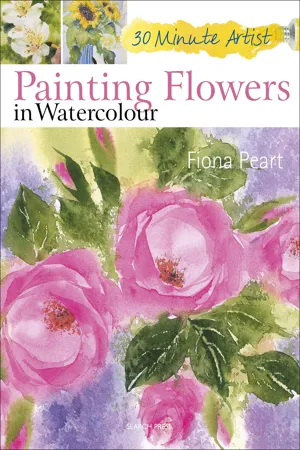
Painting Flowers in Watercolour
About this book
Information
Topic
ArtSubtopic
Art GeneralProjects

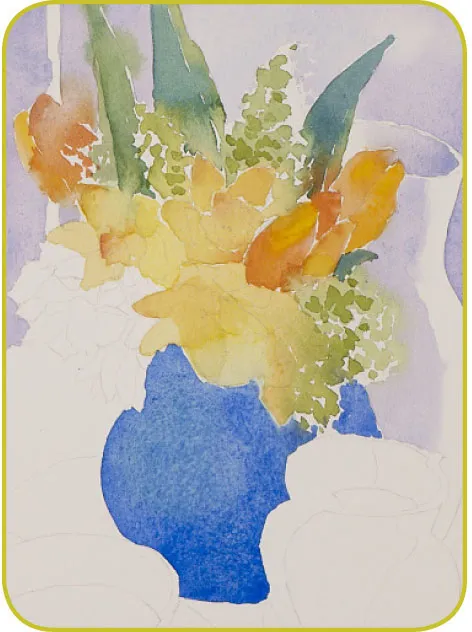
Jug of Daffodils
The vibrant complementary colours drew me to this springtime subject, which is based on the painting on the first page of this book. Small sections of colour are placed adjacent to each other and invited to touch and merge in places.
You will need
Saunders Waterford HP paper Brushes: classic round Paints: cadmium yellow, cadmium scarlet, country olive, Winsor blue (green shade), bluebell, French ultramarine, cobalt turquoise Low-tack masking tape

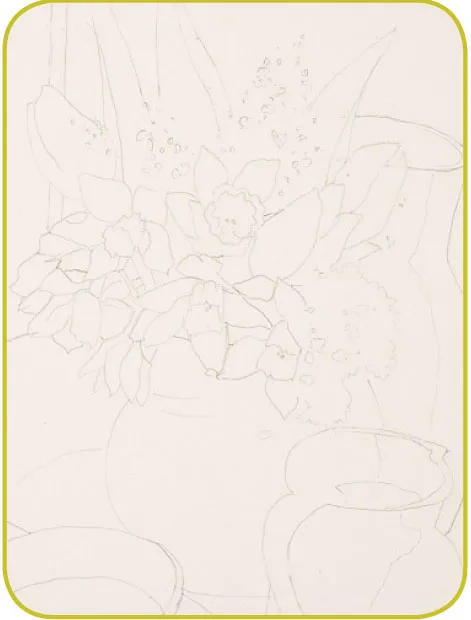
1 Use a 2B propelling pencil to sketch your initial lines on the paper, then border the edges with low-tack masking tape.
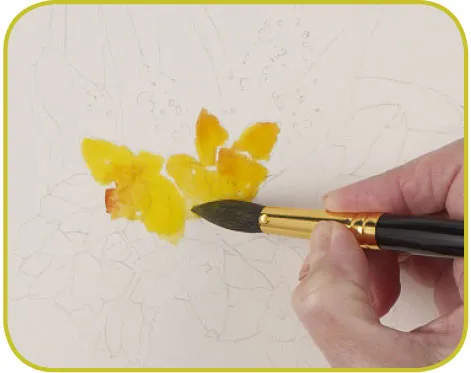
2 Double load the classic round brush with cadmium yellow in the body and cadmium scarlet on the tip, and use it to paint the two central daffodils, leaving a few gaps for light.
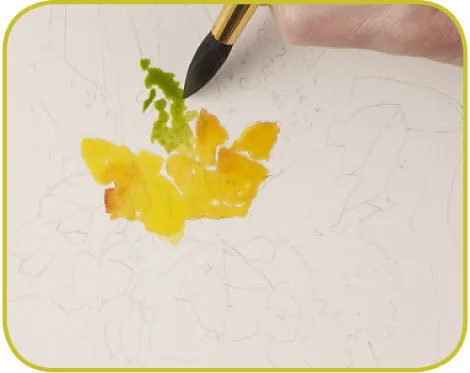
3 Rinse your brush and pick up a light green mix of country olive and a little cadmium yellow. Use this to make some small foliage marks above the flowers.
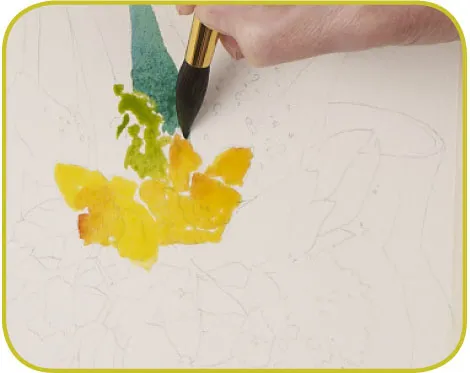
4 Pick up Winsor blue (green shade) to paint the darker part of the leaf above the centre.
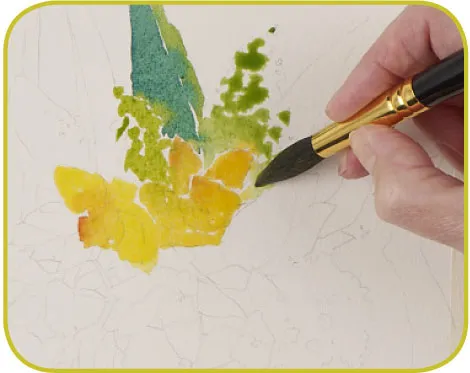
5 Rinse the brush and pick up country olive and a little cadmium yellow. Paint the lighter part of the leaf and allow a little of the darker colour to bleed across. Use the same colour to develop some more small marks around the daffodil flowers.
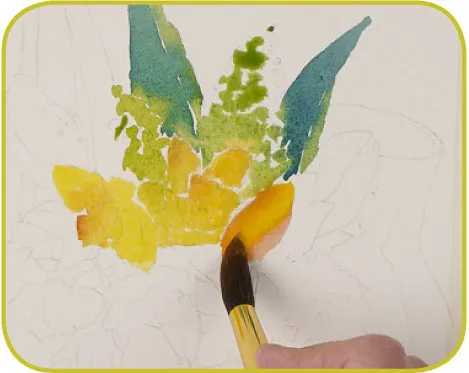
6 Paint a second large leaf as before. Rinse the brush and double load it with cadium scarlet in the body and cadmium yellow on the tip. Use this to paint the first tulip petal.
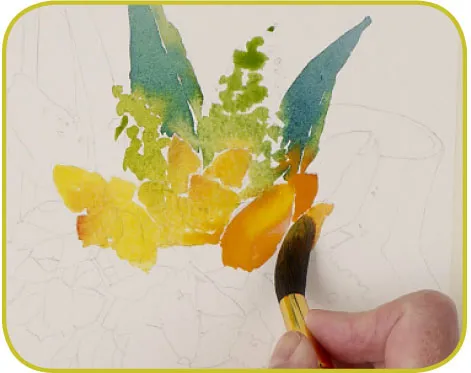
7 Paint the other tulip petals, touching the brush to the bottom of the wet leaf to let the orangey-red bleed across.
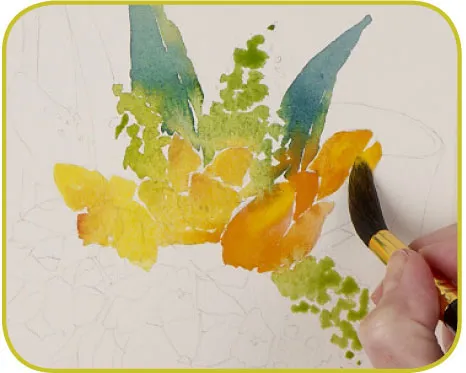
8 Add more of the light green mix in stippled touches to the right of the tulip. While wet, double load a clean brush with cadmium yellow in the body and cadmium scarlet in the tip and use this to paint the tulip petals behind the first.
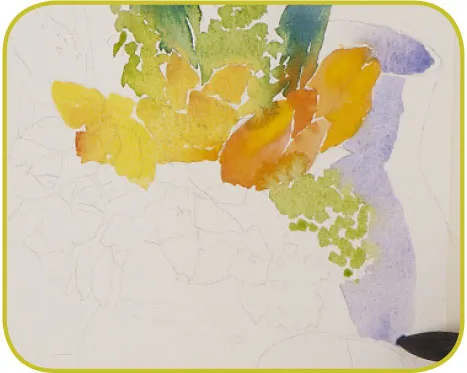
9 Rinse the brush and paint the shadow in the jug with bluebell, allowing it to touch the tulip and bleed across.
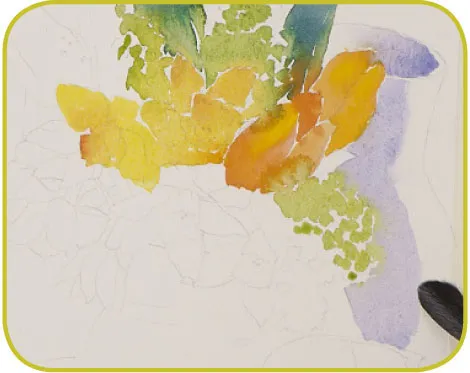
10 Rinse the brush and use clean water to draw the mix across the remainder of the inside of the jug, creating a smooth blended transition. Paint the shadow on the body of the jug with dilute bluebell, allowing the colour of the right-hand foliage to bleed a little across.
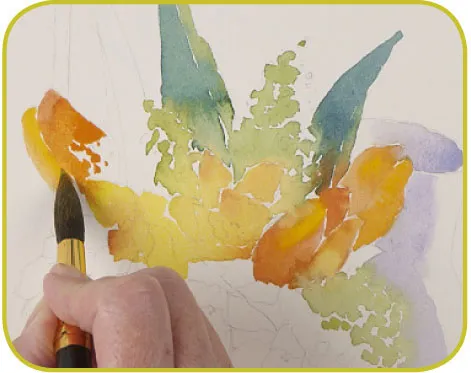
11 Paint the tulip on the left-hand side with the same colours as before, but leave a few gaps in the petal as shown above.
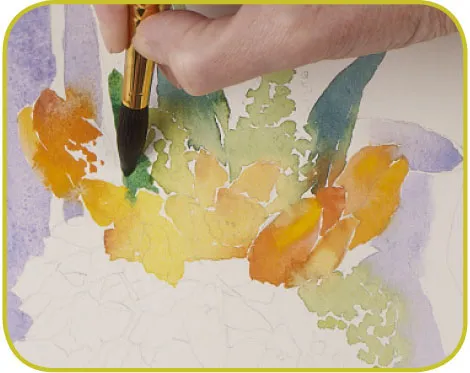
12 Use bluebell to lay in the background on the left-hand side. While wet, paint the leaf here with a mix of country olive and Winsor blue (green shade).
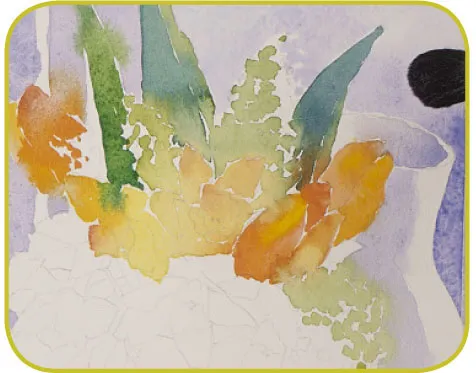
13 Paint the background on the right-hand side with bluebell, stippling around the broken foliage and being careful to leave white highlights around that area. Use the same colour to add a sharp edge to the jug.
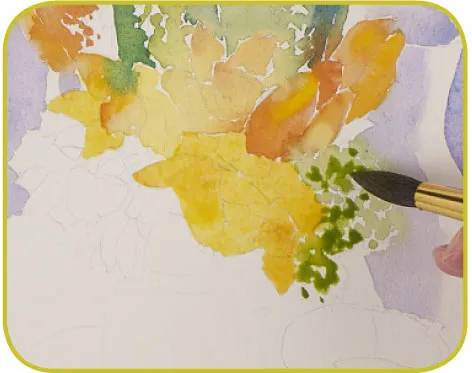
14 Paint the lower central daffodils with the same colours as before, then pick up country olive without rinsing the brush. Stipple the foliage near the flowers, and overlay the existing foliage with more of the same colour to add depth.
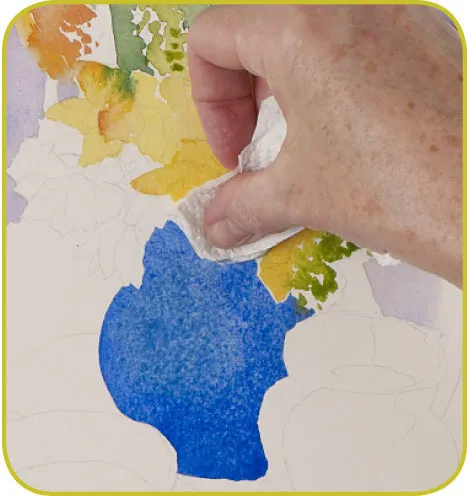
15 Paint the pot with French ultramarine and drop in cobalt turquoise for highlights. If the blue rushes into the yellow daffodil petals, use the lifting out technique to stop it and draw out any excess.
16 Add a little more blue around the foliage on the right-hand side, then us...
Table of contents
- Cover
- About the Author
- Title
- Copyright
- Dedication
- Acknowledgements
- Contents
- Introduction
- How to use this book
- Materials
- Colour
- Using a round brush
- Using an angled brush
- Using a stippling brush
- Using salt
- Using masking fluid
- Backgrounds
- PROJECTS
- Index
- Backcover
Trusted by 375,005 students
Access to over 1.5 million titles for a fair monthly price.
Study more efficiently using our study tools.
Frequently asked questions
Yes, you can cancel anytime from the Subscription tab in your account settings on the Perlego website. Your subscription will stay active until the end of your current billing period. Learn how to cancel your subscription
No, books cannot be downloaded as external files, such as PDFs, for use outside of Perlego. However, you can download books within the Perlego app for offline reading on mobile or tablet. Learn how to download books offline
Perlego offers two plans: Essential and Complete
- Essential is ideal for learners and professionals who enjoy exploring a wide range of subjects. Access the Essential Library with 800,000+ trusted titles and best-sellers across business, personal growth, and the humanities. Includes unlimited reading time and Standard Read Aloud voice.
- Complete: Perfect for advanced learners and researchers needing full, unrestricted access. Unlock 1.5M+ books across hundreds of subjects, including academic and specialized titles. The Complete Plan also includes advanced features like Premium Read Aloud and Research Assistant.
We are an online textbook subscription service, where you can get access to an entire online library for less than the price of a single book per month. With over 1.5 million books across 990+ topics, we’ve got you covered! Learn about our mission
Look out for the read-aloud symbol on your next book to see if you can listen to it. The read-aloud tool reads text aloud for you, highlighting the text as it is being read. You can pause it, speed it up and slow it down. Learn more about Read Aloud
Yes! You can use the Perlego app on both iOS and Android devices to read anytime, anywhere — even offline. Perfect for commutes or when you’re on the go.
Please note we cannot support devices running on iOS 13 and Android 7 or earlier. Learn more about using the app
Please note we cannot support devices running on iOS 13 and Android 7 or earlier. Learn more about using the app
Yes, you can access Painting Flowers in Watercolour by Fiona Peart in PDF and/or ePUB format, as well as other popular books in Art & Art General. We have over 1.5 million books available in our catalogue for you to explore.