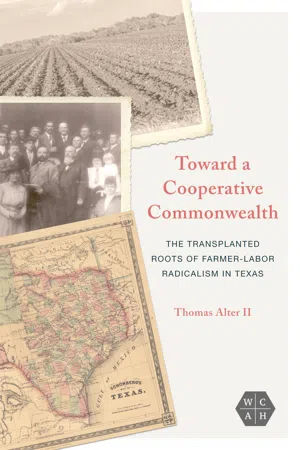
A rare look at the German roots of radicalism in Texas, Toward a Cooperative Commonwealth illuminates the labor movements and populist ideas that changed the nation's course at a pivotal time in its history.
eBook - ePub
Toward a Cooperative Commonwealth
The Transplanted Roots of Farmer-Labor Radicalism in Texas
- English
- ePUB (mobile friendly)
- Available on iOS & Android
eBook - ePub
Toward a Cooperative Commonwealth
The Transplanted Roots of Farmer-Labor Radicalism in Texas
About this book
Agrarian radicalism's challenge to capitalism played a central role in working-class ideology while making third parties and protest movements a potent force in politics. Thomas Alter II follows three generations of German immigrants in Texas to examine the evolution of agrarian radicalism and the American and transnational ideas that influenced it. Otto Meitzen left Prussia for Texas in the wake of the failed 1848 Revolution. His son and grandson took part in decades-long activism with organizations from the Greenback Labor Party and the Grange to the Populist movement and Texas Socialist Party. As Alter tells their stories, he analyzes the southern wing of the era's farmer-labor bloc and the parallel history of African American political struggle in Texas. Alliances with Mexican revolutionaries, Irish militants, and others shaped an international legacy of working-class radicalism that moved U.S. politics to the left. That legacy, in turn, pushed forward economic reform during the Progressive and New Deal eras.
Information
Publisher
University of Illinois PressYear
2022Print ISBN
9780252086366
9780252044281
eBook ISBN
9780252053276
1What Was Lost in Germany Might, in Texas, Be Won
In January 1850 Otto Meitzen stood on the deck of the brig Herschel off the Texas coast near Galveston. With him was his wife of eleven years, Jennie, and their three young children. After sailing for nearly six weeks from the port of Bremen across the Atlantic Ocean and through the Gulf of Mexico, their destination was in sight. A blue norther, however, blew them back into the gulf and delayed their landing by a week.
Much more had to be on Otto’s mind, though, than the cold. The Prussian king still ruled. Otto would have to achieve his dream of economic and political freedom in Texas, not in a united Germany. He had embraced the revolutionary tide that swept Europe in 1848 and actively participated in the attempts to forge a democratic republic in opposition to the despotism of Prussian king Friedrich Wilhelm IV. During the revolution, some of the more radical working-class demands emanated from the Meitzens’ home province of Silesia. When the revolution failed and the counterrevolution ensued, the Meitzens, according to family lore, made “their escape to the sailing vessel one jump ahead of the emperor’s bayonets.” They were not alone; other Silesians also chose exile in Texas. These Silesian immigrants and their fellow Achtundvierziegers influenced working-class Texas politics in the decades to follow.1
A powerful connection exists between the Silesian region of Central Europe and central Texas, ultimately linking the radical working-class demands of the Revolutions of 1848, Texas Populism, the Socialist Party of the early twentieth century, and attempts to create a labor party in the United States after World War I. During the Revolutions of 1848, Silesia was the only region in Europe that developed a provincewide organization, the Rustic Alliance, whose membership was composed of and fought for the demands of the agrarian working class. The Rustic Alliance’s origins began in the Democratic Club of Liegnitz (present-day Legnica), Silesia, when the club’s members ventured into the countryside with the intent of linking the radical democratic and economic demands of workers with those of rural peasants. The Rustic Alliance and Democratic Clubs of Silesia served as politically left pulls on the overall course of the 1848 German Revolution.
The farmer-labor alliance in Silesia during the Revolutions of 1848 was remarkably similar to alliances seen in Texas Populist and socialist movements. The similarity was due in part to the significant number of Silesian and other 48er political exiles and their descendants who chose to continue the fight for their political beliefs in Texas, after fleeing the counterrevolution in Europe. The Texas sections of the People’s and Socialist Parties were among the largest of their movements in the United States. Just as the Silesian radical farmer-labor movement acted as a left pull on the 1848 German Revolution, the Populist and socialist movements exerted left pressure on US politics. One bright red thread linking these momentous movements together is the German Texan Meitzen family.
Silesia, currently a part of southwestern Poland, sits at one of the not-altogether-unique convergence points of peoples and empires in Europe. The first state to control the area was Greater Moravia in the late ninth century, followed briefly by Bohemia. In the late tenth century, the Piast dynasty brought much of Silesia into the Polish state. After a series of conflicts, Poland surrendered rule of Silesia to the Kingdom of Bohemia in 1335. From Bohemia, the region passed into the realm of the Hapsburg Empire. As a result of eventual Hapsburg rule, Silesia had a strong Germanic presence to go along with its Bohemians and Poles. German power and influence ascended with the Prussian conquest of Silesia in 1741 and remained strong until the end of World War II. The ethnic cleansing terror during Nazi rule, cession of Silesia to Poland after the defeat of Nazi Germany, and the forced removal of millions of ethnic Germans from Silesia and nearby areas ended much of the region’s centuries-long multicultural identity.2
While the horrors of the twentieth century waited in the future, Silesia, like much of Europe, was embroiled in political turmoil when Otto Meitzen was born in the provincial capital of Breslau on February 12, 1811. The American and French revolutions of the late eighteenth century inspired Europe’s laboring masses and liberal intellectuals with the ideas of liberty, fraternity, and equality. The French Revolution also produced the Napoleonic armies that, though it destroyed the reactionary and obsolete Germanic Holy Roman Empire, brought war and foreign military occupation. After Napoleon’s retreat from Moscow in 1812, Breslau became the center of German resistance against the French. The French defeat in 1813 at the Battle of Leipzig did not usher in a new era of liberty but instead the formation of the Austria-dominated German Confederation and the consolidation of a bureaucratic, aristocratic-minded government.3
Concurrent with the redrawing of Europe’s political geography, the economic transition from feudalism to capitalism was underway as well. The process of German industrialization began in the Rhineland and Silesia toward the end of the eighteenth century. In Silesia, the center of the German textile industry, the number of looms went from 19,800 in 1748 to 28,700 in 1790. Most of the looms were not steam-powered modern looms, but the numbers demonstrate a transition from subsistence agriculture to modern industry and wage labor. Though undergoing industrialization, Silesia still had a large agricultural sector, which created a unique convergence of farm and labor demands in 1848.4
The Meitzen family was emblematic of the historical shifts of this period. The earliest known Meitzens were from Pomerania, a northeastern Prussian province. Most likely they were farmers. Well into the twentieth century, the family held significant political ties to farmers and the land. Otto Meitzen’s father, Melchior, was born in Berlin in 1772 and later moved with his brother August to Breslau. We know little about his position in society other than that he married a noblewoman of the Kalckreuth family. The Kalckreuths were an old and wealthy Silesian family who traced their nobility back to the beginning of the thirteenth century.5
Nevertheless, a life within the Prussian aristocracy did not last long for the Meitzens. Melchior divorced the Kalckreuth noblewoman and married her maid. He had one child with the noblewoman, a son, August, who stayed connected to his mother. With his new wife, Melchior had three children—Otto, Marie born in 1816, and William in 1818. From Melchior’s divorce and new marriage, the Meitzens slipped from feudal nobility back into the laboring classes at a time when a broader transition from feudalism to capitalism was underway.6
With a developing textile industry and most arable land controlled by the Junker class, Silesian peasants and laborers were subjected to the double yoke of feudalism and capitalist exploitation. Historically overshadowed by the radicalization of the French Revolution in 1792, Silesian peasants stood up that year against feudal exactions and revolted against their Junker landlords. The Prussian government declared martial law and used military force to halt the uprising. The revolt was only the beginnings of a decades-long Silesian peasant resistance to the old feudal order.
During this period of Silesian peasant revolts, improvements in agricultural techniques lessened farm labor demands and lowered food prices. Lack of farmwork resulted in the expulsion of many peasants from the land, forcing them into the nascent working class centered on the textile industry. The growing labor pool brought wages down and put workers into conflict with the budding capitalist order.
Following their fellow Silesians in the countryside, journeymen in Breslau revolted in 1793. Thirty-seven people were killed and seventy-eight injured before the revolt was put down. It would not take long for Silesian peasants and workers to link in resistance against their shared double yoke of economic oppression. On March 23, 1793, weavers in the town of Schömberg (present-day Chełmsko Śląskie), fifty-three miles southwest of Breslau, revolted for better working conditions. They were joined by peasants in the countryside in what became a general conflict to overthrow Prussian feudalism. In April, Prussian soldiers ruthlessly suppressed the revolt, which included approximately twenty thousand people. Revolts by weavers and peasants occurred again in Silesia in 1807 and 1811. Each time, they were brutally put down. Conjoined workers’ and peasants’ resistance to feudalism and capitalism culminated in the 1848 German Revolution.7
Silesian militancy represented the struggle of an embryonic working class against the aristocracy and the emerging capitalist class. In late-eighteenth and early-nineteenth-century Europe, however, class designations were rarely so sharply delineated. Between poor peasants and unskilled laborers on one side, and aristocrats on the other, a growing, fluid middle class was on the rise. Its origins derived from the beginnings of a profit-driven capitalist economy, early industrialization, and the professionalization of trades related to law, education, and economics.8
As the early careers of Otto and William indicate, the Meitzens were part of this middle class, even though their vocations were technical and skill-related and placed them closer to the ranks of the rapidly swelling working class. Educated as a mechanical engineer, Otto became a millwright in Liegnitz, west of Breslau. He probably ran a small shop where he worked alongside at least one known employee, a cousin from Pomerania. Millwrights at this time were carpenters who specialized in building machines used to process agricultural and lumber products. Otto’s machinist skills could very well have been applied to the building of Silesia’s first modern textile mills in the 1830s and 1840s.9
Mechanical engineering not only provided Otto Meitzen with a source of income but also likely led him to his future wife, Jennie Caroline Alpine Holmgren. Jennie was the daughter of Prussian government architect Jens Engelbrecht Holmgren, who in 1832 was sent to Liegnitz to oversee public works projects in the city. Jens Holmgren was born in Copenhagen in 1784. His Swedish-born father made six trading voyages to China working with the Danish Asiatic Company, amassing a small fortune in the process. On Jennie’s maternal side, she descended from the Swiss knight Burghard von Wurden, who arrived in Germany in 800 AD in the retinue of the emperor Charlemagne.10
When Otto met Jennie, she was “a lady with gloves, servants, and a carriage.” She fell in love, however, with the “quiet spoken” and studious millwright who had little money. Jennie’s von Wurden family did not approve of her attraction to Otto. He lacked wealth and refused to be baptized. “Tiny fiery” Jennie stood up to her mother and married Otto on July 28, 1838. Otto’s younger brother William followed a similar track. Through the guild system, which was becoming archaic, William become a master of mines and smelters in Breslau. In 1842 he married the Polish lady Antonia Tschikovsky.11
At the time when the Meitzen family came of age in the early 1840s, sweeping changes were overtaking Europe in the aftermath of the French Revolution. The old aristocratic social order of feudal Europe faced a threat from rising middle classes. Affairs of trade and industry were no longer exclusively the purview of monarchs and their royal retainers. Bourgeois elements increasingly demanded access to the sources of private profit. With the bourgeoisie came fundamental beliefs in liberalism and nationalism that were in conflict with the forces of conservatism, aristocratic privilege, and hereditary monarchy. Neither the aristocracy nor the bourgeoisie was strong enough to supplant the other as the dominant power. In fact, each needed the other as industrialization gave birth to a working class, a class whose interests were diametrically opposed to feudalism and capitalism.
Industrial expansion in Silesia did not follow clear patterns that separated aristocrat from capitalist, peasant from laborer, and the state from the entrepreneur. The lines were often blurred. Unlike England, where private hands guided industrialization to a greater extent, the monarchal Prussian state directly guided industrialization by providing grants, loans, and special privileges to industrialists. What was even more different from England, the Prussian state nationalized and operated manufacturing enterprises in multiple industries. In the 1840s, Silesia featured more state-run enterprises (18) than all other Prussian provinces combined (17).12
Some Silesian noble families financed manufacturing endeavors, and others actively engaged in capitalist industrialization by founding collieries, ironworks, and textile operations on their estates. In contrast to other Prussian areas where Junkers disdained industry, the Silesian nobility succumbed to embourgeoisement. “Industrial capitalism in Silesia evolved directly out of the former feudal economy,” observed historian W. O. Henderson. “Feudal magnates became capitalist entrepreneurs and their serfs became miners and factory hands.”13
For working-class Silesians, the double yoke of feudal and capitalist oppression often came from the same person. When one’s lord switched from agriculture to industry, a peasant could lose his small land holding and became a coal miner or textile weaver. Former peasants turned textile workers, now subjected to capitalist labor exploitation in the form of low wages and long hours, still had to pay a weaver’s tax (Weberzin) to their feudal lord. The squeeze led to the weaver’s revolt of 1793.14 Because peasant weavers in Silesia revolted against lords who controlled their labor options, these conflicts are commonly portrayed simply as antifeudal, but the failure to look below the feudal surface has caused some historians to ignore the formation of a working class in Silesia and its role in the 1848 Revolution.
In the years leading up to 1848, Silesia was the center of peasant and working-class protests against both the dying feudal and the burgeoning capitalist industrial order. In response to the lowering of wages below subsistence levels, weavers in the villages of Peterswaldau (present-day Pieszyce) and Langenbielau (present-day Bielawa) revolted on June 4, 1844. The weavers who worked at home marched to textile factories and destroyed the machines they saw as threats to their livelihood. They also protested in front of the homes of manufacturers and destroyed the merchant books that recorded their debts. The next day, in the face of gunfire from soldiers that killed eleven and injured twenty-four, weavers armed with clubs, axes, and stones forced the military to flee. Soldiers returned the following day with artillery and cavalry and smashed the rebellion.15
Conditions only worsened in the years to follow. Potato disease and the failure of the grain harvest caused famine in Silesia during 1847, contributing to around eighty thousand people ...
Table of contents
- Cover
- Title
- Copyright
- Contents
- Acknowledgments
- Introduction
- 1 What Was Lost in Germany Might, in Texas, Be Won
- 2 Inheritors of the Revolution
- 3 Populist Revolt
- 4 The Battle for Socialism in Texas, 1900–1911
- 5 Tierra y Libertad
- 6 From the Cooperative Commonwealth to the Invisible Empire
- Conclusion: Descent into New Deal Liberalism
- Notes
- Bibliography
- Index
- Back Cover
Trusted by 375,005 students
Access to over 1.5 million titles for a fair monthly price.
Study more efficiently using our study tools.
Frequently asked questions
Yes, you can cancel anytime from the Subscription tab in your account settings on the Perlego website. Your subscription will stay active until the end of your current billing period. Learn how to cancel your subscription
No, books cannot be downloaded as external files, such as PDFs, for use outside of Perlego. However, you can download books within the Perlego app for offline reading on mobile or tablet. Learn how to download books offline
We are an online textbook subscription service, where you can get access to an entire online library for less than the price of a single book per month. With over 1.5 million books across 990+ topics, we’ve got you covered! Learn about our mission
Look out for the read-aloud symbol on your next book to see if you can listen to it. The read-aloud tool reads text aloud for you, highlighting the text as it is being read. You can pause it, speed it up and slow it down. Learn more about Read Aloud
Yes! You can use the Perlego app on both iOS and Android devices to read anytime, anywhere — even offline. Perfect for commutes or when you’re on the go.
Please note we cannot support devices running on iOS 13 and Android 7 or earlier. Learn more about using the app
Please note we cannot support devices running on iOS 13 and Android 7 or earlier. Learn more about using the app
Yes, you can access Toward a Cooperative Commonwealth by Thomas Alter,Thomas Alter, II in PDF and/or ePUB format, as well as other popular books in Politics & International Relations & Anarchism. We have over 1.5 million books available in our catalogue for you to explore.