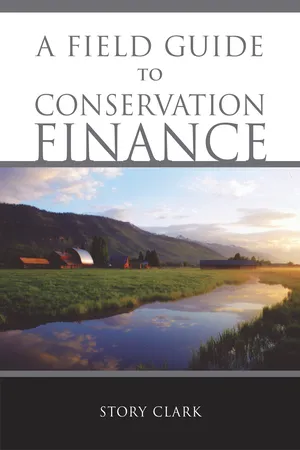
Finally, a comprehensive book on land conservation financing for community and regional conservation leaders. A Field Guide to Conservation Finance provides essential advice on how to tackle the universal obstacle to protecting private land in America: lack of money.
Story Clark dispels the myths that conservationists can access only private funds controlled by individuals or that only large conservation organizations have clout with big capital markets. She shows how small land conservation organizations can achieve conservation goals using both traditional and cutting-edge financial strategies. Clark outlines essential tools for raising money, borrowing money, and reducing the cost of transactions. She covers a range of subjects including transfer fees, voluntary surcharges, seller financing, revolving funds, and Project Related Investment programs (PRIs). A clear, well-written overview of the basics of conservation finance with useful insights and real stories combine to create a book that is an invaluable and accessible guide for land trusts seeking to protect more land.
- English
- ePUB (mobile friendly)
- Available on iOS & Android
eBook - ePub
A Field Guide to Conservation Finance
About this book
Information
Part 1
Positioning Your Organization
Chapter 1
Organizational Readiness
Ready or Not: The Hardeman Meadows
It was a “must buy” ranch. Three quarters of a mile of highway corridor defining the edge of one town and the gateway to another, and half a mile deep, dotted with grazing cattle. The pasture and elegant barn preserved the area’s rural character. The ranch offered a tranquil foreground to the dramatic backdrop of the mountains. A beloved, local agricultural family owned it, but they were forced to sell due to family reasons. The father was a popular local auctioneer. The children were star ropers and basketball players. They were kind community people pushed to make a tough decision.
The family had approached the local land trust a year earlier. At the time, this young land trust was accepting donated easements and was not in a position to purchase expensive land. Because of the perceived risk, the land trust responded with a modest offer to purchase the ranch. In this conservative community, the land trust had been working quietly with landowners at their kitchen tables, soliciting conservation easement gifts. It was not interested in controversy or high-profile issues, fearing that they would jeopardize these essential relationships. While the land trust very much wanted to protect the ranch, it could not imagine risking money it didn’t have.
The family turned to a developer who planned to blanket the pastures with townhouses. Once the negotiations were public, the community reacted; everyone was in an uproar. Newspaper headlines tracked the developer’s every move and the public’s angry responses. Eyes turned toward the land trust to find a solution.
The land trust could hide no more. Saving or losing the ranch was quickly becoming its defining moment. Although the community was activated to help the land trust succeed, it was an untested volunteer force—affluent but untapped to do more than support the land trust’s $70,000 annual budget. The land trust’s two-and-a-half-person staff was eager to take on the project, but its board of ranchers and donors was understandably hesitant. A crucial factor, though, was the land trust’s board chair, who had run a major corporation.

Figure 1.1 The Hardeman Ranch epitomizes the agricultural heritage of Jackson Hole, Wyoming. Once threatened by development, the southern part of the ranch became the Jackson Hole Land Trust’s first major conservation purchase. (Jackson Hole News & Guide)
In the eleventh hour, the land trust bit the bullet and risked its entire savings ($100,000) to buy a nonrefundable option. Then it set out to raise almost $2 million dollars in three months to buy the property. Before it signed the option, the land trust considered where it would find the money. It talked to a few donors. But in all honesty, it had little idea how it was going to pay for the land and had no commitments from donors for funds. The whole project was dangerous. It placed the fledgling land trust’s existence at risk and threatened to dash the hopes of many in this new land conservation movement.
Over the next three months, the land trust threw its first big community fundraiser outdoors in a park in Wilson, Wyoming. It snowed the night before and into the morning. The county committed $500,000 to the project, only to withdraw its commitment when sued for authorizing the expenditure. Never having worked with a bank before, the land trust hastily arranged for a loan to cover the county’s share. After the three months, with the county lawsuit still pending, the land trust had not raised all the money needed. It exercised its option anyway and squeezed out the last $100,000 in the final days. Less than six hours before closing, it completed a complex resale agreement with a conservation buyer for part of the ranch and a ten-year lease with another local nonprofit for the barn.
So why so much struggle and all the surprises? The land trust was not ready. When a land trust faces its first big acquisition, it can let the situation get desperate and risk everything—stressing its board and panicking its donors—or it can get ready in advance. Pushed by seemingly uncontrollable circumstances, many land trusts take the panic route. The impending threat of development has catalyzed the creation of many land trusts. Those that survive grow from the experience. But it is an unnecessarily difficult and perilous way to grow. Some readers may choose to skip this first section of the book because they are too busy saving land to get ready. But they will be back if they survive that first big deal, because no one wants to do it that way again.
How do I know? Because the “Campaign to Save the Hardeman Meadows,” described above, was my first exposure to big money and time-pressured purchases by my small land trust. I wanted to do this deal more than anyone, but I had no idea what I was getting into. When the heat was on, a group of us had cornered our board chair, and against his better judgment, he agreed to recommend the project to our board. That decision cost him and others four months of sleepless nights, for only one reason: we were not ready. We had cultivated landowner contacts, but we hadn’t cultivated other key community members, donors, and leaders who would have stood ready to help us in important ways.
Hard work by many, the business acumen of our chair, and lots of luck got us through. We made the contacts, but in a big rush. The project defined us and made us a stronger, more active land trust. It built up our donor base, and it makes me proud every time I pass by the beautiful Hardeman Ranch. But we could have gone under. There are easier and safer ways to mature.
I have done it both ways—the unprepared way and the prepared way—and I highly recommend the latter. Even when you are fully prepared, deals can be scary and unpredictable, so there is no reason to be unprepared as well. It is really not so difficult to begin getting ready now for that crucial moment when that most important place is threatened and the land trust must step in.
What does it mean to be prepared? It means being organizationally and financially ready and having the right project. I have made plenty of mistakes in all these categories. For the Hardeman Meadows project, our land trust didn’t have an optimal board for purchasing land; we didn’t have a large established donor base or prospects ready to write checks. We had not done a thorough feasibility study and didn’t have a clear idea of our sources of funding or a plan for the land. These are organizational and financial issues. Fortunately, the ranch gave us a good place to start because it was an important conservation project and so many people wanted to save it.
Since then, again through trial and error, I have learned many strategies that will help any land trust move into the land or conservation easement purchase business. What follows in this section is not an exhaustive list of the dos and don’ts but a brief primer on organizational, financial, and project-related strategies that should make acquisitions easier.
Organizational Readiness
Some of the basic principles of getting ready to buy conservation interests (land or conservation easements) are the same as those relevant to preparing a fundraising campaign.1 You cannot jump into a fundraising campaign without preparatory work. Land or easement purchase is no different. Just as any company will reorganize with structural and even personnel changes if it moves into a new business, a land trust must do the same. An organizational assessment is a good way to sort out internal needs, prioritize them, and develop timelines for change.2 An assessment does not have to be an elaborate process. It can be gratifying to assess a land trust’s strengths—there are always many. But for this new line of work, some degree of organizational change is usually needed. It should begin at the top with the board of directors and move through every aspect of the organization.
Board of Directors
The board of directors is the most crucial element of a successful organization. It should be the policy- and direction-setting body of any conservation organization. It has the fiduciary responsibility for the organization—a serious role. Most important, the board offers leadership. A land trust can have all the best plans and best staff, but without board leadership, nothing will change. When a land trust is small, the board should also supply valuable manpower. The board of directors is the perfect place for a land trust to get the skills, experience, and wisdom it needs but for which it can’t afford to pay. A founding board should be passionate and generous with time and money. As the organization evolves, especially if it becomes staffed, the board must develop a bigger view with larger goals. It can then take on substantial fundraising roles and oversee management. But leadership always remains a key element to success.3

Figure 1.2 Alan Hirschfield at the closing for the Hardeman Meadows. (Courtesy of Jackson Hole Land Trust)
Building and maintaining a strong board is not a matter of luck. It takes careful consideration of what skills and expertise the organization needs and who will make its mission a high priority and be compatible for working intensely together. Small organizations rarely take a critical look at their boards. Often, they are so appreciative of anyone willing to serve that they don’t think about the overall composition. An effective board will attract other talented people more easily. People like to be part of an effective, well-functioning operation. An ideal board is composed of people who are committed to the organization and offer a variety of skills. The traditional three W’s for nonprofit board composition—wealth, wisdom, and work—still hold true. Don’t forget that leadership ability, often overlooked as an essential board skill, is part of that wisdom.
Nonprofit board size varies. I serve on the board of one large, sophisticated conservation organization with thirty-four members and on another board with eight members. All boards must have an effective decision-making structure. For a large board, an active executive committee is essential. A small board may put less emphasis on an executive committee. A big board takes more management but brings more skills in-house. Without good management, members of a large board can lose interest. A small board can be more nimble.
As part of an organizational assessment, a board and staff (if there is staff) should ask what skill sets are currently on the board and what skills are needed for the new course charted for the organization. Professionals with skills that may benefit a land trust include bankers, landscape architects, surveyors, engineers, title company personnel, and real estate lawyers (who do not represent the land trust while serving on the board), appraisers, and investors.
What about real estate agents or brokers and developers? There are pros and cons to adding them to a land trust board. The obvious benefits are their working knowledge of land transactions and pricing, their negotiating skills, and their purchase and sale expertise. On the negative side is the potential for conflict of interest, or at least the appearance of a conflict of interest. Real estate agents and developers who work with the same type of real estate as the land trust in the same service area may, or maybe perceived to, gain a professional advantage from connections with buyers and sellers involved with the land trust. The image of developers—and, to a lesser degree, realtors—work—ing in conflict with conservation can also taint a land trust’s image.
In a cutthroat real estate environment, the choice of one realtor or developer over another can hurt a land trust’s reputation among the rest of the real estate community. On the other hand, the wealth of information that comes with the right person can be worth the trouble. If, after weighing the pros and cons, a board decides to invite a realtor or developer to join, then extra care is needed to avoid these ethical and public relations issues. (In the Hardeman Meadows project, the fact that a successful realtor was on our board, and in the spotlight for being there, while also serving on the county commission led to the lawsuit against the county and the subsequent withdrawal of the county’s $500,000 share from the project.)
Not all of the necessary land acquisition experts will fit on the board or are right for it. The board should have a comfortable balance of landowners, donors, citizens, scientists, and land-related professionals. Nonetheless, people with all of the skills essential to acquisition should be encouraged to join the land trust team, whether on the board or in some other capacity.
In addition to their own expertise, board members’ connections are invaluable. For instance, if a land trust is considering borrowing money (and many acquisition strategies require it), then board members should ask, “Have I taken my local banker to lunch to talk to him [or her] about the land trust?” When we needed a bank loan for the purchase of the Hardeman Meadows, I had no real contacts with bankers. Fortunately, our board chair had frequent dealings with the local bank. (For more information on bank loans, see chapter 11.)
Paid Staff
Having a paid staff for a land trust helps immensely. Because running a land trust can be exhausting, a volunteer-run organization tends to be more reactive. It simply has less time to plan a proactive course. A land trust with staff has more time to develop and carry out a long-term conservation plan. It can focus on its highest-priority projects and use its resources for highest return. A volunteer land trust faces so many tasks just to stay afloat that it must focus on immediate threats.4 In its early years, a land trust usually has plenty of important reactive conservation work. Eventually, though, it must take the time, whether staffed or unstaffed, to set that work in the context of a land trust’s vision for the future.
Generally, the more staff, the more proactive a land trust can be. For example, having in-house real estate knowledge opens deal-making doors. If the land trust is small, it must rely on its board and others closely associated with the organization who have time and real estate skills to invest. Chris DeForest, of the Inland Northwest Land Trust, which operates in Washington State and northern Idaho, explains the situation when his land trust suddenly had to negotiate a purchase option and raise the $50,000 to pay for it: “If we hadn’t had Asha on staff we would have been in real trouble. She had worked in real estate and knew how to negotiate and write up the agreements. It was my rapport with the landowner and her expertise that got us through that first acquisition.” Of course real estate skills can be learned. As Chris says: “Now that we know how to write up an option, we could do it again much more easily.” But it is best not to learn at the negotiating table with critical land on the line. If a board member has good experience in this area, be sure to team up staff with that person so that these skills can begin to be transferred for the next transaction.
Staff and volunteer roles and responsibilities should be clear before heading into a big project, because life can get pretty chaotic during any project. Everyone wants to be part of the excitement of protecting a critical piece of land—and everyone can be. But staff, board, and volunteers should understand their responsibilities. One person must be the project leader and direct the negotiations. Other individuals should take charge of fundraising, communications, and managing documents. Remembering that negotiations are handled in confidence, there are still ways to involve members of the land trust community so that no one feels left out. For most ...
Table of contents
- About Island Press
- Title Page
- Dedication
- Copyright Page
- Table of Contents
- Acknowledgments
- Foreword
- Introduction: A Field Guide
- Part 1 - Positioning Your Organization
- Part 2 - Raising Money
- Part 3 - Borrowing Money
- Part 4 - Looking Ahead
- Conclusion: How It Could Come Together in the Future
- Appendix
- Glossary
- Notes
- Bibliography
- About the Author
- Index
- Island Press Board of Directors
Trusted by 375,005 students
Access to over 1.5 million titles for a fair monthly price.
Study more efficiently using our study tools.
Frequently asked questions
Yes, you can cancel anytime from the Subscription tab in your account settings on the Perlego website. Your subscription will stay active until the end of your current billing period. Learn how to cancel your subscription
No, books cannot be downloaded as external files, such as PDFs, for use outside of Perlego. However, you can download books within the Perlego app for offline reading on mobile or tablet. Learn how to download books offline
Perlego offers two plans: Essential and Complete
- Essential is ideal for learners and professionals who enjoy exploring a wide range of subjects. Access the Essential Library with 800,000+ trusted titles and best-sellers across business, personal growth, and the humanities. Includes unlimited reading time and Standard Read Aloud voice.
- Complete: Perfect for advanced learners and researchers needing full, unrestricted access. Unlock 1.5M+ books across hundreds of subjects, including academic and specialized titles. The Complete Plan also includes advanced features like Premium Read Aloud and Research Assistant.
We are an online textbook subscription service, where you can get access to an entire online library for less than the price of a single book per month. With over 1.5 million books across 990+ topics, we’ve got you covered! Learn about our mission
Look out for the read-aloud symbol on your next book to see if you can listen to it. The read-aloud tool reads text aloud for you, highlighting the text as it is being read. You can pause it, speed it up and slow it down. Learn more about Read Aloud
Yes! You can use the Perlego app on both iOS and Android devices to read anytime, anywhere — even offline. Perfect for commutes or when you’re on the go.
Please note we cannot support devices running on iOS 13 and Android 7 or earlier. Learn more about using the app
Please note we cannot support devices running on iOS 13 and Android 7 or earlier. Learn more about using the app
Yes, you can access A Field Guide to Conservation Finance by Story Clark in PDF and/or ePUB format, as well as other popular books in Economics & Urban Planning & Landscaping. We have over 1.5 million books available in our catalogue for you to explore.