This E-ssential is a three-part series that covers John Davis's epic journey from Florida to Maine. In 2011, with support from the Wildlands Network, Davis traveled 7,600 miles in 10 months from Florida to Maine by foot, bicycle, skis, and canoe/kayak. His extensive traveles were motivated by wanting to answer the question “Is it possible in the twenty-first century to identify and protect a continental-long wildlife corridor that could help to protect eastern nature into the future?”
John paints a vivid picture of the physical challenges of the trek, such as climbing the highest point in South Carolina with a heavily loaded bike and trying to consume the 8,000 calories per day he needed to fuel himself for the journey. As readers adventure with Davis, they will also share his evolving understanding of what it would take to implement an Eastern Wildway.
Eastern wildlife, both seen and unseen, from Florida panthers to North Carolina’s red wolves to the ghosts of cougars farther north, are the real focus of this adventure as John explores how such wildness can coexist with human development in the most populated regions of the United States. The science and conservation of large-scale connectivity are brought to life by his travels—offering unique insights into the challenges and opportunities for creating an Eastern Wildway. This is a must-read for enthusiasts of hiking narratives, as well as professionals and students interested in issues related to large-scale connectivity. Compelling photographs and other graphics complement John’s fascinating story.
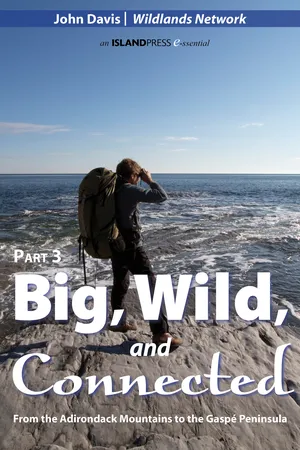
eBook - ePub
Big, Wild, and Connected
Part 3: From the Adirondack Mountains to the Gaspé Peninsula
- 90 pages
- English
- ePUB (mobile friendly)
- Available on iOS & Android
eBook - ePub
Big, Wild, and Connected
Part 3: From the Adirondack Mountains to the Gaspé Peninsula
About this book
Information
CHAPTER ELEVEN

Where Salmon Still Spawn
Near-Boreal New Brunswick and Quebec
Late October and November in forests and along rivers and coasts of New Brunswick and Quebec; weather mostly cool and gray, with chilling rains, snow squalls, freezing nights, but also occasional crisp clear days. I paddle Restigouche River, hike part of the International Appalachian Trail, slog up snowy mountains in Chic-Chocs, cycle South Shore of St. Lawrence River, and walk to the end …
For meanness, our kind’s elimination of Atlantic salmon, American eel, shads, brook and lake trout, and other migratory fish from countless of our continent’s once-rich waterways ranks up there with our extermination of American bison, eastern elk, wolves, cougar, and passenger pigeon as low points in American history. None of these fish has been driven to extinction like the passenger pigeon was (and the Carolina parakeet, great auk, sea mink, and others), but all have been severely reduced in numbers and distribution due to habitat fragmentation and degradation through dam building, logging, pollution, and other human insults to North America’s rich freshwater realm. Thankfully, Canada has been kinder to its rivers than the United States has to its, and Atlantic salmon in the east and Pacific salmon in the west still ascend many of its coastal rivers. I would see my first truly wild Atlantic salmon on New Brunswick’s Restigouche River.

Brook trout, a native fish needing cold, clean waters. (Photo courtesy of Larry Master)
Water was reasserting its primacy as I strode and rode toward winter and the northern end of the Appalachians. Rain and snow increasingly controlled my movement, but beckoning me onward were aquatic concentrations of wildlife such as I hadn’t seen since Florida’s River of Grass.
I was mostly alone on this final stretch of TrekEast. Various American friends had hoped to join me in southeastern Canada, but their busy lives far away prevented them. In their place, though, New Brunswick and Quebec conservationists went out of their way to help call attention to the need to restore an Eastern Wildway, and I ended up feeling that eastern Canada’s conservation community is as strong as that of the eastern United States.
Plea for an International Peace Park
I nearly missed one of the most important pieces of a future Eastern Wildway. Pedaling down the frontage road on the US side of the St. John River, which separates the United States and Canada, I was growing pessimistic about habitat connections from Maine north into New Brunswick. Below the confluence with the Allagash, the St. John River seemed too hemmed in by roads and houses. (Upriver, south of the border, the Nature Conservancy has conserved tens of thousands of acres along the St. John.)
As I was about to ride north and east from another of Maine’s struggling old mill towns, Madawaska, Conrad Reining caught me by phone, reminded me I must not miss the Three Borders Area, and gave me a phone number for one of its chief proponents. Fortuitously, Dr. Yves Carrier happened to have a day free. He and his friend Guy Landry picked me up on the road paralleling the St. John on the Canadian side, deftly tossed my overloaded mountain bike in the back of Yves’s pick-up truck, and drove me upriver.
Even below its confluence with the Allagash, Yves persuaded me, the St. John has stretches only lightly settled, and we must not give up on cross-border connectivity, for moose and other creatures are commonly crossing the two-lane roads (busy at intervals during day, but lightly trafficked at night) and swimming the river. Before they were extirpated from the area by guns and saws, caribou apparently moved through the St. John Valley, as well. The stronger remaining ecological connection, however, Yves and Guy showed me, is a bit farther north and west, along a tributary of the St. John, the St. Francis River.
Looking at a map of northern New England and southeastern Canada, you might assume that from Maine’s northernmost point, the international border is going straight south and east along mere survey lines. Actually, it’s going in amazingly (glacially?) straight south and southeast lines along the St. Francis River and its various lakes. One of the more intact second-order river systems in the eastern United States is actually half Canadian—the US-Canada line runs down the middle of the St. Francis waterway from Lac Pohénégamook to the confluence with the St. John—and its entire watershed deserves to be a transboundary peace park.
For years, Dr. Carrier, his wife Juliet, and Guy have been advocating for a transboundary wildland that is like an unrecognized mirror image of the Allagash Wilderness Waterway—a place they hope will one day be a Three Borders Transboundary Peace Park. They have organized “eco-challenges,” with teams of outdoor athletes taking a big wild loop including remote mountain biking, bushwhacking the New Brunswick-Quebec border, and canoeing more than fifty wild miles down the St. Francis River. Opportunities abound for outdoor adventure, and the area could attract numerous paddlers, hikers, mountain bikers, and other outdoorspeople if it were publically protected as a park instead of privately held by timber companies.
Yves and Guy took me up the St. Francis River in their big canoe (with a small outboard motor) from Glazier Lake to Beau Lake. During four hours on the water, we saw no other people and only two cottages. This quietude could be lost, however, if a park or other reserve is not created, since private lands in the area are protected only by lack of road access. As we boated along the international boundary, we periodically landed on the Canadian side but never the US side, in case Homeland Security has hidden spy cameras in the Maine woods. Meanwhile, an osprey overhead wove back and forth from the United States to Canada, rightfully heedless of US customs. Guy said people on both sides of the international boundary commonly and innocently crossed and intermingled and thought little of the border until American Homeland Security paranoia set in after the terrorist attacks of September 11, 2001. Since then, border tensions have been a sad or mad part of life for people in these parts, especially on the Canadian side—US customs officials being the less tolerant. Part of Guy’s desire for a transboundary park stems from his family’s and friends’ ways of life being truncated by border tensions.
Yves and Guy explained their challenges in promoting the area for protection, which sound much like hurdles faced by Maine Woods National Park proponents. Many rural people in New Brunswick assume their livelihoods depend on corporate forestry and factory farms. Pulp and poultry are the two main products of western New Brunswick, neither providing enough jobs and both vulnerable to global markets and corporate profits. As a family-practice doctor, though, Yves can speak with authority and has won over some listeners to the cause of a transboundary park, which could encompass hundreds of thousands of still mostly intact forested acres and a waterway that would attract paddlers as the Allagash does. He and Guy argue that the jobs created by such recreational tourism would match or surpass the uncertain employment of the pulp and poultry industries, would secure a better future for wildlife and outdoorspeople of the area, and would strengthen trust between peoples on different sides of the borders.
A profitable new outdoor pursuit that is likely to continue on the St. John and St. Francis Rivers is “musky” fishing, including an annual fishing derby in Fort Kent, Maine, that draws thousands of sportsmen and women. Sadly, the muskellunge is an exotic and invasive species in these waters, introduced years ago by a well-meaning but misinformed angler; it has displaced or devoured many of the brook and lake trout and landlocked Atlantic salmon that used to swim these river systems in generous numbers and sizes. Were it feasible, encouraging anglers to fish out the muskies and allow recovery of native trout and salmon populations would be the best way to return the rivers (and the native fish) to health. Then, a Three Borders Transboundary Peace Park could also be a world-class destination for traditional anglers.
Moreover, a peace park in the Three Borders Area could be linked to a larger Maine Woods National Park to the south and Quebec’s great Laurentides Wildlife Reserve (Réserve faunique des Laurentides) to the west, perhaps all to be honored with Biosphere Reserve or World Heritage Site designation to encourage preservation of the rich natural and cultural heritage of the North Woods. Indeed, the sparsely populated landscape stretching from Greenville, Maine, north across the St. John watershed and New Brunswick panhandle, and west over the Boundary Mountains and across the St. Lawrence River and through Laurentides Wildlife Reserve—the Greater Laurentian and Acadian landscape—has arguably the greatest wildlands recovery potential in the East. Here, lynx still pounce on snowshoe hares, caribou await the chance to roam outward from Laurentides, trout and salmon spawn in undammed streams, moose and eagles have rebounded, and only a few paved roads—which could be retrofitted with wildlife crossings—stand between wolves and America!
Of course, talking of reconnecting habitats across the St. Lawrence River begs the question of how much this great seaway serves as a barrier to wildlife movement and if there are realistic ways to remedy that problem. More study on this is needed, and the answers probably vary up and down the river. Nearing the ocean, the St. Lawrence becomes immense—virtually an inland sea. East of Laurentides, just downstream of Quebec City, it is wide but perhaps not too wide for an eager young wolf to trot across ice in winter. The trouble with that idea is that the St. Lawrence Seaway is a major shipping channel, so icebreakers keep the ice from forming a safe wildlife passage in winter. Restoring ecological connections between the northeastern United States and southeastern Canada, then, may require modifying management of the St. Lawrence Seaway. Roads running parallel to the river on both sides are big barriers, but these could be softened with wildlife crossing structures. Anyway, the St. Lawrence River is itself a crucial wildlife habitat—for several species of whales, among other noble creatures—and a defining feature of this region, and it needs to be better protected and understood as we strive to restore an Eastern Wildway.
Back in the St. John watershed, over a delectable dinner of vegetables and meats they’d procured with their own gardens and arrows, Yves, Juliet, and Guy told me stories of their Acadian ancestors and native Madawaskan societies, with the unifying theme that the St. John River and its tributaries comprise a watershed of inestimable worth to people of several intermingled cultures as well as to wildlife of many species. A sure way to pass on the vivid natural and cultural histories is to get the peoples of New Brunswick, Quebec, and Maine working together to establish a Three Borders Area Transboundary Peace Park with wild connections far beyond, where osprey and salmon, wolf and caribou, lynx and hare, moose and archer can wander one great wild forest, free of artificial customs.
Refuge in an Industrial Forest
Pedaling northeast from the St. John River back into the Appalachians in New Brunswick was like riding back in northern Maine again. Cold rain made the ride dreary and chilling; industrial management of the forest made the scenery monotonous and wildlife scarce. What New Brunswick and Maine both need, I wearily thought, are big wild parks and transitions toward cutting many fewer trees but getting much more out of them. Pulp, poultry, and potato monocultures are unstable and resource-depleting ways to support human communities and are death for natural communities. The mindset that is keeping this region economically dependent on unsustainable exploitation was exemplified by a sign on Route 180 east toward Mount Carleton Provincial Park, which read “Belle Vue” and pointed to a vista of industrial plantations and clear-cuts. A little farther east, an even scarier view opened up: a big hillside had been scalped—a 500-acre clear-cut, I’d estimate—amid a managed timberland not much more diverse than a cornfield.
I arrived at Mount Carleton Provincial Park after it closed to summer activities and before it opened for winter pursuits. I camped (at a departing warden’s kind suggestion) in a closed campground north of Big Nictau Lake, being apparently the only visitor in the whole park. The next day, I donned rain gear yet again, rode to the Sagamook trailhead, and hiked up that mountain and to its south Mounts Head and Carleton. The three summits are remnants of an extinct volcano now not much more than 2,500 feet high after glacial leveling during the ice ages and subsequent erosion.
From atop Mount Carleton, highest point in Canada’s Maritime Provinces (820 meters, or nearly 2,700 feet, although Quebec’s Gaspé Peninsula has many mountains over 3,000 feet), I looked through parting clouds over a haphazard mix of beautiful lakes and ugly clear-cuts. The forest in much of Mount Carleton Provincial Park looks healthy and mature—though provincial parks are sometimes opened to logging, unfortunately—but beyond the too-small park, spindly trees dominate.
This little range of mountains is far enough north that hikers must prepare for serious weather and naturalists can look forward to seeing boreal plants. During much of my hike over Sagamook, Head, and Carleton, a cold rain and thick fog obscured views but lent a properly northern Appalachian feel to the place. Stunted spruce-fir forests with heath shrubs grow at low elevations at this latitude, beginning below
2,500 feet; in the Adirondacks, I’d not look for such Lilliputian charm below 4,000 feet.
More of New Brunswick should be appreciated and protected like Mount Carleton is. The provincial park should be greatly expanded and connected to protected buffers along the Tobique, Nepisiguit, Restigouche, and Kedgwick Rivers and other major streams. Biological connections north into Quebec and west into Maine need to be restored.
Paddling Past Salmon and Eagles
If New Brunswick’s environmental problems could be reduced to one name, it would be Irvine. This extractive company has dominated provincial politics here for decades and now stands in the way of secure habitat connections for the province and its wildlife.
Bravely striving to counter corporate rule, the Canadian Parks and Wilderness Society, Canoe Restigouche, and other conservation groups and businesses have been pressing for wide protection of the Restigouche and other New Brunswick rivers. In the near term, the most promising approach to reconnecting nature through this timber-industry-dominated maritime province is to expand existing parks and widely buffer—with no-cut zones—rivers and brooks. Complementing that work to reform public lands and waters policy are the private lands conservation efforts of the Nature Conservancy of Canada and smaller land trusts.
Conservationists in the United States often rightly decry the mismanagement of our national forests by the US Forest Service, which has too often done the bidding of the timber industry; but the situation is even worse on Crown Lands in New Brunswick, where timber companies get favorable leases and then cut as heavily as they want. The New Brunswick government is on record as endorsing, but delinquent in implementing, the national goal of 12 percent protection of landscapes—a sadly small and insufficient fraction but well above current levels. At present, only about 4 percent of New Brunswick is protected, and even some of this meager amount is less than permanent or certain.
Salmon and trout need clean gravels under well-oxygenated water for successful spawning. Thus, Atlantic salmon and brook and lake trout are all good indicators of stream health. Big dams, busy roads, industrial agriculture, and heavy logging are fatal for salmonids (salmonidae being the family of fish that includes salmon, trout, and whitefish). In various wildland reserve designs for the northern Appalachians, such as one drafted by Robert Long and Paula Mackay fifteen years ago for the Greater Laurentian Wildlands Project, the Atlantic salmon was chosen as a focal species, meaning a small group of species chosen to represent the habitat needs of much of the region’s wildlife. To borrow from several decades of conservation planning documents for the northern Appalachians, the reasoning is that if we protect enough habitat in interconnected reserves for salmon, brook trout, American eel, otter, wolves, marten, ...
Table of contents
- Cover
- Title Page
- Copyright
- Contents
- Acknowledgments and Dedication
- Introduction. Why Protect Wildways: Lessons Confirmed by TrekEast on the Importance of Wildlife Corridors
- Chapter 9. Our Wildest Lands Are Not Wild Enough: Adirondack Park and Surrounds
- Chapter 10. For Whom the Forest Works: Northern Appalachians and Maine Woods
- Chapter 11. Where Salmon Still Spawn: Near-Boreal New Brunswick and Quebec
- Chapter 12. Can We Get There From Here? Is an Eastern Wildway Still Possible?
- About the Author
- About Wildlands Network
- About Island Press
Trusted by 375,005 students
Access to over 1.5 million titles for a fair monthly price.
Study more efficiently using our study tools.
Frequently asked questions
Yes, you can cancel anytime from the Subscription tab in your account settings on the Perlego website. Your subscription will stay active until the end of your current billing period. Learn how to cancel your subscription
No, books cannot be downloaded as external files, such as PDFs, for use outside of Perlego. However, you can download books within the Perlego app for offline reading on mobile or tablet. Learn how to download books offline
Perlego offers two plans: Essential and Complete
- Essential is ideal for learners and professionals who enjoy exploring a wide range of subjects. Access the Essential Library with 800,000+ trusted titles and best-sellers across business, personal growth, and the humanities. Includes unlimited reading time and Standard Read Aloud voice.
- Complete: Perfect for advanced learners and researchers needing full, unrestricted access. Unlock 1.5M+ books across hundreds of subjects, including academic and specialized titles. The Complete Plan also includes advanced features like Premium Read Aloud and Research Assistant.
We are an online textbook subscription service, where you can get access to an entire online library for less than the price of a single book per month. With over 1.5 million books across 990+ topics, we’ve got you covered! Learn about our mission
Look out for the read-aloud symbol on your next book to see if you can listen to it. The read-aloud tool reads text aloud for you, highlighting the text as it is being read. You can pause it, speed it up and slow it down. Learn more about Read Aloud
Yes! You can use the Perlego app on both iOS and Android devices to read anytime, anywhere — even offline. Perfect for commutes or when you’re on the go.
Please note we cannot support devices running on iOS 13 and Android 7 or earlier. Learn more about using the app
Please note we cannot support devices running on iOS 13 and Android 7 or earlier. Learn more about using the app
Yes, you can access Big, Wild, and Connected by John Davis,Wildlands Wildlands Network,Wildlands Network in PDF and/or ePUB format, as well as other popular books in Biological Sciences & Environmental Conservation & Protection. We have over 1.5 million books available in our catalogue for you to explore.