The last fifteen years have been a period of dramatic change, both in the world at large and within the fields of ecology and conservation. The end of the Cold War, the dot-com boom and bust, the globalizing economy, and the attacks of September 11, among other events and trends, have reshaped our worldview and the political environment in which we find ourselves. At the same time, emerging knowledge, needs, and opportunities have led to a rapid evolution in our understanding of the scientific foundations and social context of conservation.
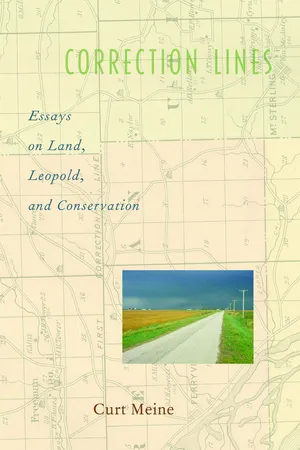
Correction Lines is a new collection of essays from one of our most thoughtful and eloquent writers on conservation, putting these recent changes into perspective and exploring the questions they raise about the past, present, and future of the conservation movement. The essays explore interrelated themes: the relationship between biological and social dimensions; the historic tension between utilitarian and preservationist approaches; the integration of varied cultural perspectives; the enduring legacy of Aldo Leopold; the contrasts and continuities between conservation and environmentalism; the importance of political reform; and the need to "retool" conservation to address twentyfirst-century realities.
Collectively the essays assert that we have reached a critical juncture in conservation—a "correction line" of sorts. Correction Lines argues that we need a more coherent and comprehensive account of the past if we are to understand our present circumstances and move forward under unprecedented conditions.
Meine brings together a deep sense of history with powerful language and compelling imagery, yielding new insights into the origins and development of contemporary conservation. Correction Lines will help us think more clearly about the forces that have changed, and are changing, conservation, and inspire us to address current realities and future needs.
- English
- ePUB (mobile friendly)
- Available on iOS & Android
eBook - ePub
About this book
Information
PART ONE
Conservation’s Usable Past

1
The Oldest Task in Human History
The whole world is coming,
A nation is coming, a nation is coming.
The Eagle has brought the message to the tribe.
The father says so, the father says so.
Over the whole earth they are coming.
The buffalo are coming, the buffalo are coming,
The Crow has brought the message to the tribe,
The father says so, the father says so.
—LAKOTA GHOST DANCE SONG (1890)
We end, I think, at what might be called the standard paradox of the twentieth century: our tools are better than we are, and grow better faster than we do. They suffice to crack the atom, to command the tides. But they do not suffice for the oldest task in human history: to live on a piece of land without spoiling it.
—ALDO LEOPOLD (1938)
ONE WAY to understand the roots of conservation in the United States is to examine documents from official meetings, policy decisions, and legislative actions that occurred as the movement coalesced in the late 1800s and early 1900s. Another way is to examine the evidence outdoors, in situ, in the landscapes we inhabit, in the places we are.
Most of the tangible links to conservation’s origins have disappeared. The hooves, horns, and bones of the myriad bison were long ago hauled off the Great Plains to meet their end in glue pots and gardens. The remains of the last passenger pigeons roost beneath bell jars, growing fustier with each passing decade. The hats that sported snow-white plumes from Florida’s egrets have gone the way of all fashion. Topsoils from the Midwest’s prairies rest in downstream mucks; the plants that made them—and that they made—have lost their claim on the horizon, and do well to hold on in their graveyard, railway, and roadside refugia.
Some objects, however, remain to bear witness. Walk among the aspen, balsam fir, birch, and bracken fern forests of the upper Great Lakes and you will find them: the moldering stumps of fallen white pines. They hunker down in the shade of the second-growth forest (to become, with a minor leap of imagination, bears). Others stand out, weathered gray, in dry openings. Their insides have rotted away, rain, lichen, moss, and insects doing the work of the ages. Only the outermost annual rings of punky wood remain, disintegrating easily in the human hand. Many of the stumps are charred, reminders upon reminders, signs of the fire last time.
The epoch of white pine logging reached its climax in Michigan, Wisconsin, Minnesota, and Ontario in the 1880s and 1890s. The seeds from which those old-growth trees grew had sifted to earth two, three, even four centuries before. Who knows how far and deep their roots went. Sometimes white pine followed white pine on the same site, the roots following tried-and-true pathways carved by patient ancestors through glacial soil, boulder fields, and bedrock.
An early forester, writing in 1898, described the effects of one brief generation of lumbering on northern Wisconsin:
Nearly the entire territory has been logged over. The pine has disappeared from most of the mixed forests and the greater portion of pineries proper has been cut. . . . Nearly half of this territory has been burned over at least once, about three million acres are without any forest cover whatever, and several million more are but partly covered by the dead and dying remnants of the former forest. . . . Here are large tracts of bare wastes, “stump prairies,” where the ground is sparsely covered with weeds and grass, sweet fern, and a few scattering runty bushes of scrub oak, aspen, and white birch.1
By the time those words were written, the smart lumbermen of the upper Great Lakes and Mississippi River basins had already shifted their attention, equipment, and capital to the piney woods of the South and the astonishing conifer forests of the Pacific Northwest.
From the viewpoint of the culture whose three centuries of expansion brought them down, the extensive stands of Pinus strobus, from Newfoundland to Minnesota, were in exactly the right place at exactly the right time, providing a raw material it desired most ardently, insatiably, and finally. From the white pine ’s perspective—if we may grant a perspective to another species—its distribution placed it in the worst possible place at the worst possible time, directly in the path of a gathering force with little inclination to pause, even to consider the conditions conducive to its self-perpetuation. As the “inexhaustible” pineries were, in due course, exhausted, pause came of necessity, at least for some people and some forests.2
The decaying stumps will not endure much longer. In a few more years, they will have melted back into the soil, reabsorbed by the medium, returned fully to the flow of time and nutrients. For a little while yet, they will record the extreme to which a narrow concept of social and economic development was taken, and the moment when a new commitment to “the oldest task in human history” took root.

The delirious climax of white pine logging coincided with other indicators of changing times, landscapes, and social conditions across the continent. In 1889, weary remnants of Indian nations throughout the West undertook the Ghost Dance in a desperate effort to revive their lost world. The dance and the dream ended on December 19, 1890, at the Battle of Wounded Knee.3 The report of the 1890 census, noting that the “unsettled” area of the United States had dwindled to isolated fragments, declared the “frontier of settlement” closed. Three years later, at the Columbian Exposition in Chicago, historian Frederick Jackson Turner built on this finding in his seminal discussion of “The Significance of the Frontier in American History.” 4 In the fall of 1890, Congress acted to protect lands now included within Yosemite, Sequoia, and Kings Canyon National Parks.5 And on March 3, 1891, Congress passed the Forest Reserve Act; later that month, President Benjamin Harrison proclaimed the Yellowstone Park Timber Land Reserve, the nation’s first forest reserve and the germ of the national forest system.6
At the time, some of these “current events” were widely reported; others passed with little notice. Now they appear as transition points in a broad pattern of cultural and environmental change. The pattern is still emerging, and ever-evolving. There is no definitive agreement on its past development or its implications for the future, and there is much room for debate, varied emphases, and alternative visions. But the changes initiated in the 1890s were fundamental. The basic and tacit assumptions of the post–Civil War boom years would no longer go unchallenged. Few citizens of that era saw the lumber barons’ “large tracts of bare waste” as anything but evidence of the latest welcome advance of civilization. Deforestation continued (and continues still) to be visited upon other lands. The rationale, attitudes, and incentives behind deforestation persist. By the turn of the twentieth century, however, stumpfields were no longer what they had been just a few short years before: a universal emblem of human progress.
The changes of the 1890s did not arrive unanticipated. Although belief in the creed the stump symbolized had long dominated American society, undercurrents of reaction against it welled up intermittently, emerging through various cultural, legal, and professional channels. Explorers and naturalists, including John and William Bartram, Meriwether Lewis and William Clark, and John James Audubon, described and documented the astounding diversity of the continent. Early and mid-nineteenth century thinkers, writers, and poets—from Thomas Jefferson and Ralph Waldo Emerson to Henry David Thoreau and William Cullen Bryant—articulated an alternative view of the natural world, as a source not merely of material goods, but of intellectual enlightenment, aesthetic satisfaction, philosophical insight, and spiritual solace. Landscape artists of the 1800s, including Thomas Cole, Asher Durand, Frederic Edwin Church, Albert Bierstadt, and Thomas Moran, conveyed a similar view in their light-suffused canvasses. Other adventuring artists—Karl Bodmer and George Catlin prominent among them—gave real faces and lives to the generic “savages” that existed beyond the ken of “civilization.”
In the latter half of the century, proto-conservationists, including George Perkins Marsh, Frederick Law Olmsted, John Wesley Powell, C. Hart Merriam, Carl Schurz, and George Bird Grinnell, insisted that the attitudes and policies that had until then dominated the settlement and development of the American landscape required adjustment. Since the colonial era, local communities and the states had sporadically adopted ordinances and regulations to protect water, forests, game and fish populations, and other resources. At the national level, the post–Civil War years saw the establishment of Yellowstone National Park (1872) and the Adirondack Forest Preserve (1885); organization of the American Fish Culturists’ Association (1870) and the American Forestry Association (1875); and the founding of the original Audubon Society and the Boone and Crockett Club (1886 and 1887, respectively).
As of 1890, however, there was no coherent body of beliefs, philosophy, literature, history, science, economics, policy, and law through which the American people could understand and better guide their long-term relationship with the natural world, and scant evidence that such was regarded as an important societal or national goal. There was no U.S. Forest Service; there was, for that matter, no effective profession of forestry as yet in the United States. Nor were there professions tending to the stewardship of soils or waters, rangelands or wildlife. There was little public discussion of the responsibility of private citizens and private industry for the natural objects, processes, and conditions upon which their livelihoods and communities depended. By 1890, however, the doctrine of conquest and the undercurrents of opposition to it had begun to precipitate out the social and political movement that would come to be called conservation.7
No one person can be said to have ushered in the new movement. Three figures, however, have come to exemplify the impulses that drove it and the tensions that divided it in its early years: John Muir, Gifford Pinchot, and Theodore Roosevelt.
In 1890, fifty-two-year-old John Muir was focused on gaining federal protection for the lands surrounding his beloved Yosemite Valley. His success in this led to the creation of the Sierra Club in 1892 and established Muir as the country’s leading voice for the protection and preservation of wild nature, a role he occupied until his death in 1914. Building on foundations provided by Emerson, Thoreau, and Marsh, but bringing to his arguments a lifetime of experience in wild country, Muir made the public case for preservation on several grounds. Like many who agitated on behalf of forests, Muir (building especially on the work of Marsh) could cite the benefits of forest cover in regulating water flows and protecting soils. But the protection of forests, and wildlands in general, involved a broader spectrum of values. Muir strongly emphasized the restorative powers of “long-drawn breaths of pure wilderness.” Exposure to wild country provided aesthetic, psychological, and spiritual benefits that could not be gained in urban or even pastoral landscapes. There was in Muir’s outlook, too, an abiding sense of the intrinsic beauty and worth of all things within the “one great unit of creation.” The plunder and waste that had gone by the name of progress, and that Muir had witnessed in America’s eastern forests, constituted nothing less than acts of desecration, attributable ultimately to the hubris of “Lord Man.”8
As the embodiment of the “romantic-transcendental preservation ethic,” Muir defined one wing of the nascent conservation movement.9 What guidance did this ethic offer in the effort to “live on a piece of land without spoiling it”? It said, in effect, that for those remnants of yet “unspoiled” land, one succeeds in the task by not living on them at all but by setting them aside as places where, in the words of the 1964 Wilderness Act, “man . . . is a visitor who does not remain.”
At the end of 1890, Gifford Pinchot was twenty-five years old and returning to the United States, having spent the previous year studying forest management in France, Switzerland, and Germany. Although interest in forestry had been growing (primarily among scientists) in the United States through the 1870s and 1880s, Pinchot was the first American to receive formal training in the field. He returned determined to bring professional forestry to a country where, as he later put it, “the most rapid and extensive forest destruction ever known was in full swing.”10 Within fifteen years Pinchot, riding the wave of the Progressive movement alongside his friend and political patron Roosevelt, would succeed. With the creation of the Forest Service in the U.S. Department of Agriculture in 1905, Pinchot established forestry as the locus of conservation within the government and in the public mind.
And what was forestry? Forestry aimed “to make the forest produce the largest possible amount of whatever crop or service will be most useful, and keep on producing it for generation after generation of men and trees.”11 This utilitarian mission lay at the heart of the “resource conservation ethic” that defined the other wing of the conservation movement, and that Pinchot more than any other individual promulgated. “The forest,” Pinchot stated, “rightly handled—given the chance—is, next to the earth itself, the most useful servant of man.”12 The utilitarian ethic stood in contrast to the epic wastefulness that had marked the era of rampant forest exploitation. It stood in contrast, as well, to the preservationist ethic. Where Muir saw “one great unit of creation,” Pinchot found “just two things on this material earth—people and natural resources.”13 Taken to its extreme, this view led to a particular conception of forests and of forestry. “Forestry,” Pinchot maintained until the end of his life, “is Tree Farming.”14
The guiding principle of Progressive Era utilitarian conservation was to manage natural resources so as to produce commodities and services “for the greatest good to the greatest numbe...
Table of contents
- ABOUT ISLAND PRESS
- Title Page
- Copyright Page
- Dedication
- Epigraph
- Table of Contents
- ACKNOWLEDGMENTS
- Introduction: Turning the Corner
- PART ONE - Conservation’s Usable Past
- PART TWO - Leopold’s Legacy
- PART THREE - Facing Forward
- NOTES
- ACKNOWLEDGMENT OF SOURCES
- ABOUT THE AUTHOR
- INDEX
- ISLAND PRESS BOARD OF DIRECTORS
Trusted by 375,005 students
Access to over 1.5 million titles for a fair monthly price.
Study more efficiently using our study tools.
Frequently asked questions
Yes, you can cancel anytime from the Subscription tab in your account settings on the Perlego website. Your subscription will stay active until the end of your current billing period. Learn how to cancel your subscription
No, books cannot be downloaded as external files, such as PDFs, for use outside of Perlego. However, you can download books within the Perlego app for offline reading on mobile or tablet. Learn how to download books offline
Perlego offers two plans: Essential and Complete
- Essential is ideal for learners and professionals who enjoy exploring a wide range of subjects. Access the Essential Library with 800,000+ trusted titles and best-sellers across business, personal growth, and the humanities. Includes unlimited reading time and Standard Read Aloud voice.
- Complete: Perfect for advanced learners and researchers needing full, unrestricted access. Unlock 1.5M+ books across hundreds of subjects, including academic and specialized titles. The Complete Plan also includes advanced features like Premium Read Aloud and Research Assistant.
We are an online textbook subscription service, where you can get access to an entire online library for less than the price of a single book per month. With over 1.5 million books across 990+ topics, we’ve got you covered! Learn about our mission
Look out for the read-aloud symbol on your next book to see if you can listen to it. The read-aloud tool reads text aloud for you, highlighting the text as it is being read. You can pause it, speed it up and slow it down. Learn more about Read Aloud
Yes! You can use the Perlego app on both iOS and Android devices to read anytime, anywhere — even offline. Perfect for commutes or when you’re on the go.
Please note we cannot support devices running on iOS 13 and Android 7 or earlier. Learn more about using the app
Please note we cannot support devices running on iOS 13 and Android 7 or earlier. Learn more about using the app
Yes, you can access Correction Lines by Curt Meine in PDF and/or ePUB format, as well as other popular books in Biological Sciences & Essays on Nature. We have over 1.5 million books available in our catalogue for you to explore.