The landscapes of North America, including eastern forests, have been shaped by humans for millennia, through fire, agriculture, hunting, and other means. But the arrival of Europeans on America’s eastern shores several centuries ago ushered in the rapid conversion of forests and woodlands to other land uses. By the twentieth century, it appeared that old-growth forests in the eastern United States were gone, replaced by cities, farms, transportation networks, and second-growth forests. Since that time, however, numerous remnants of eastern old growth have been discovered, meticulously mapped, and studied. Many of these ancient stands retain surprisingly robust complexity and vigor, and forest ecologists are eager to develop strategies for their restoration and for nurturing additional stands of old growth that will foster biological diversity, reduce impacts of climate change, and serve as benchmarks for how natural systems operate.
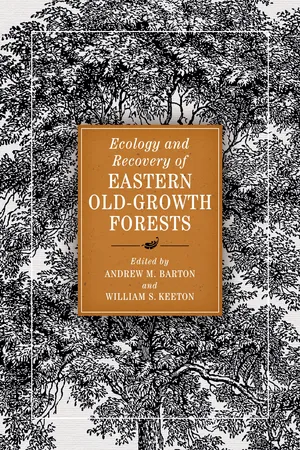
Forest ecologists William Keeton and Andrew Barton bring together a volume that breaks new ground in our understanding of ecological systems and their importance for forest resilience in an age of rapid environmental change. This edited volume covers a broad geographic canvas, from eastern Canada and the Upper Great Lakes states to the deep South. It looks at a wide diversity of ecosystems, including spruce-fir, northern deciduous, southern Appalachian deciduous, southern swamp hardwoods, and longleaf pine. Chapters authored by leading old-growth experts examine topics of contemporary forest ecology including forest structure and dynamics, below-ground soil processes, biological diversity, differences between historical and modern forests, carbon and climate change mitigation, management of old growth, and more.
This thoughtful treatise broadly communicates important new discoveries to scientists, land managers, and students and breathes fresh life into the hope for sensible, effective management of old-growth stands in eastern forests.
- 340 pages
- English
- ePUB (mobile friendly)
- Available on iOS & Android
eBook - ePub
Ecology and Recovery of Eastern Old-Growth Forests
About this book
Chapter 1
Introduction: Ecological and Historical Context
Andrew M. Barton
The science of old growth is multifarious, reflecting the complexity of these ecosystems and their considerable variation across the landscape and time. It is also tied to human agency, both the centuries of exploitation of forests and the evolution of the emotive ideas surrounding old growth. The goal of this introduction is to provide context for old-growth science and the diverse set of 14 chapters that follow.
We will start by addressing the perennial question What is old growth? Writing about old-growth ecosystems demands the penance of wrestling with the definition. It is a wickedly difficult but important exercise. We will then remind readers why people care about old-growth forests in the first place, in other words, why this book exists at all. Once we have established the what and why of this book, we will provide some ecological context, first geographically, and then temporally, by examining in detail how the sites supporting two extant eastern old-growth forests have changed over the past 20,000 years. In other words, we will address the questions of how old-growth ecosystems have reached their current state and how this should shape our expectations for the future in a rapidly changing world. Those two paleoecological narratives lead us directly to human history, first to the early North Americans, and then to modern times, in which old growth became an idea, a conservation goal, and a controversy. Although social and political aspects of old growth are not the focus of this book, they provide important background for the science, which affects and is affected by those currents. We will end by exploring different frameworks for making sense of and synthesizing the diversity of chapters to follow.
What Is Old Growth?
Some readers might expect a sharp, clear definition that demarcates old growth from “not old growth.” If so, what follows might prove to be a disappointment. Defining old growth has produced a cottage industry for scientists and forest managers striving for clarity and pragmatism. In a recent analysis of old-growth definitions and concepts, Pesklevits et al. (2011) cite more than 15 papers whose purpose is to define and circumscribe the subject. The US Forest Service toiled over definitions for a decade before publishing a guide to old-growth stands on national forests in the eastern United States (Tyrrell et al. 1998). The diversity of definitions, criteria, classifications, and confusions has been characterized vividly, as has the lack of consensus (Spies 2004; Wirth et al. 2009). Pesklevits et al. (2011) argue that defining old growth is a “wicked problem” (Rittel and Webber 1973) in the sense that it is “irreconcilably tricky or perpetually vexing.” Wicked has also been used to describe the social problem of solving climate change (Grundmann 2016).
More recently, ecologists have embraced the idea that, “a consensus on the wording of an ecological definition of old growth will never be reached and may not be desirable, given the diversity of forests.” (Spies 2004; see also Wirth et al. 2009). In fact, the discipline of ecology is full of terms, such as community, ecosystem, and complexity that are left vague but are operationalized for particular research, sites, or applications. Granted some of the confusion about what constitutes old growth emerges from the reality that “old growth is simultaneously an ecological state, a value-laden social concept, and a polarizing political phenomenon.” (Pesklevits et al. 2011). Underlying the diversity of old-growth criteria, however, are real differences in these ecosystems across the local landscape and the continent. The challenge of any definition, therefore, is the tradeoff between generality and acknowledgement of complexity. We propose that the very act of grappling with old-growth forest definitions, as cumbersome as it might be, promotes an understanding of the variation in ecological patterns and processes (see chapter 4, for example).
Despite the variety of definitions, we can identify two intertwined attributes of old growth that are common to many conceptions and are particularly relevant for this book: forests with old trees that have been largely undisturbed by people since their origin. Hunter and White (1997) showed that these two axes should be thought of as continuous, that is, there is no objective threshold of either age or “naturalness” that separates old growth from somewhat old and natural forests. As forests age since their rebirth after the last disturbance, whether natural or anthropogenic, they slowly develop characteristics of old growth, and, by definition, the less intervention by humans, the more an ecosystem can be said to be under the control of nonhuman forces. As will become apparent in this book, the imprint of humans on nature, even old growth, increases apace regardless of remoteness and history, injecting new “wickedness” into defining and characterizing old growth.
Like all humans, scientists classify continuous phenomena into categories to better understand them. So, developing specific criteria that helps identify or characterize old-growth forests can be seen as an attempt to gain an understanding of the function, variability, and dynamics of forests that have developed over long periods with little human impact. Moreover, at least for some regions or specific forest types, old-growth criteria “may be useful for … inventorying stands … prioritizing sites for protection … determining whether or when forests … acquire an old-growth condition …” (Tyrrell et al. 1998).
Many criteria have been proposed, including the following:
- trees more than 50 percent of the maximum age of the dominant tree species;
- a variety of ages of dominant tree species;
- establishment of new individuals by gap-phase dynamics (i.e., the formation of small canopy gaps);
- the death of all members of the original cohort that established directly after the last major natural disturbance;
- and the presence of large snags and coarse woody debris (e.g., dead trunks and branches) on the forest floor.
Certainly, these criteria effectively describe the stereotypical old-growth forests of the Pacific Northwest, the cove forests of the southern Appalachians (chapter 4), and many of the mixed old-growth forests of the northeastern United States and southeastern Canada (chapter 6) and the northern Lake States region (chapter 7). As helpful as these detailed criteria might be, however, they would eliminate some forest types that are clearly very old and largely undisturbed by humans: centuries-old cedars perched on the cliff-face of the Niagara escarpment (Kelly and Larson 2007), for example, as well as some ecosystems described in this book (e.g., chapter 3). Therein lies the rub: The more specific the definition, the less it applies to the tremendous range of variation in forests and woodlands that meet a commonsense and ecologically important conception of “old growth.”
Given that a goal of this book is to better understand the natural patterns and processes of old-growth forests and how these vary across the landscape, we embrace a permissive definition of what constitutes old-growth forest. In other words, we will let our contributors decide what old growth is for the systems in which they work, even if that stretches the boundaries of the most common conceptions. We are convinced that the diversity of ecological phenomena and ecosystems encompassed by this approach justifies its slackness.
Why is Old Growth Important?
Why do individuals and societies care about old-growth forests? Clearly, the science, conservation, and controversy surrounding old growth arose and persist because these ecosystems are valued (Whitney 1987; Davis 1996; Spies and Duncan 2009; Wirth et al. 2009; Maloof 2011). Our goal is to provide a brief summary of the importance of old growth, divided into three categories of values: biodiversity (see Glossary), direct benefits to people, and moral standing. These are interrelated, but we separate them for convenience.
Old-growth forests harbor biodiversity at multiple levels. They provide a storehouse of genetic diversity that has evolved through eons and developed ecologically over centuries. A wide range of species thrive or even depend on the structures, resources, and long-term undisturbed nature of old-growth forests (chapter 11), and destruction would lead to a loss of biodiversity at the forest, regional, and planetary scales, the degree of such harm uncertain (Davis 1996; Spies and Duncan 2009; Wirth et al. 2009). The dependence of the Northern Spotted Owl on old-growth forests in the Pacific Northwest was, of course, the pivotal issue that launched old growth into international consciousness (Spies and Duncan 2009). Finally, old growth is a key stage in the successional processes of forests, and as such is a linchpin in the conservation goal of sustaining a diversity of habitats and ecosystem types (Spies 2004). Our knowledge of the importance of older forests for biodiversity and the complex species interactions therein continues to grow, especially regarding less charismatic, but still important, organisms (chapters 3, 9, 11,...
Table of contents
- Cover
- Title Page
- Copyright
- Contents
- Foreword—Thomas A. Spies
- Preface—Andrew M. Barton and William S. Keeton
- Chapter 1. Introduction: Ecological and Historical Context—Andrew M. Barton
- Chapter 2. Old-Growth and Mature Remnant Floodplain—Forests of the Southeastern United States Loretta L. Battaglia and William H. Conner
- Chapter 3. Fire-Maintained Pine Savannas and Woodlands of the Southeastern United States Coastal Plain—Robert K. Peet, William J. Platt, and Jennifer K. Costanza
- Chapter 4. Old-Growth Forests in the Southern Appalachians: Dynamics and Conservation Frameworks—Peter S. White, Julie P. Tuttle, and Beverly S. Collins
- Chapter 5. Topography and Vegetation Patterns in an Old-Growth Appalachian Forest: Lucy Braun, You Were Right!—Julia I. Chapman and Ryan W. McEwan
- Chapter 6. Old-Growth Disturbance Dynamics and Associated Ecological Silviculture for Forests in Northeastern North America—Anthony W. D’Amato, Patricia Raymond, and Shawn Fraver
- Chapter 7. Historical Patterns and Contemporary Processes in Northern Lake States Old-Growth Landscapes—David J. Mladenoff and Jodi A. Forrester
- Chapter 8. Is Management or Conservation of Old Growth Possible in North American Boreal Forests?—Daniel Kneeshaw, Philip J. Burton, Louis De Grandpré, Sylvie Gauthier, and Yan Boulanger
- Chapter 9. Forest-Stream Interactions in Eastern Old-Growth Forests—Dana R. Warren, William S. Keeton, Heather A. Bechtold, and Clifford E. Kraft
- Chapter 10. Belowground Ecology and Dynamics in Eastern Old-Growth Forests—Timothy J. Fahey
- Chapter 11. Biological Diversity in Eastern Old Growth—Gregory G. McGee
- Chapter 12. Eastern Old-Growth Forests under Threat: Changing Dynamics due to Invasive Organisms—John S. Gunn and David A. Orwig
- Chapter 13. Silviculture for Eastern Old Growth in the Context of Global Change—William S. Keeton, Craig G. Lorimer, Brian J. Palik, and Frédérik Doyon
- Chapter 14. Source or Sink? Carbon Dynamics in Eastern Old-Growth Forests and Their Role in Climate Change Mitigation—William S. Keeton
- Chapter 15. Conclusion: Past, Present, and Future of Old-Growth Forests in the East—William S. Keeton and Andrew M. Barton
- Glossary
- Contributors
- About the Editors
- Index
Trusted by 375,005 students
Access to over 1.5 million titles for a fair monthly price.
Study more efficiently using our study tools.
Information
Publisher
Island PressYear
2018Topic
Biological SciencesPrint ISBN
9781610918909
9781610918893
Subtopic
Environmental ScienceeBook ISBN
9781610918916
Index
Biological SciencesFrequently asked questions
Yes, you can cancel anytime from the Subscription tab in your account settings on the Perlego website. Your subscription will stay active until the end of your current billing period. Learn how to cancel your subscription
No, books cannot be downloaded as external files, such as PDFs, for use outside of Perlego. However, you can download books within the Perlego app for offline reading on mobile or tablet. Learn how to download books offline
Perlego offers two plans: Essential and Complete
- Essential is ideal for learners and professionals who enjoy exploring a wide range of subjects. Access the Essential Library with 800,000+ trusted titles and best-sellers across business, personal growth, and the humanities. Includes unlimited reading time and Standard Read Aloud voice.
- Complete: Perfect for advanced learners and researchers needing full, unrestricted access. Unlock 1.5M+ books across hundreds of subjects, including academic and specialized titles. The Complete Plan also includes advanced features like Premium Read Aloud and Research Assistant.
We are an online textbook subscription service, where you can get access to an entire online library for less than the price of a single book per month. With over 1.5 million books across 990+ topics, we’ve got you covered! Learn about our mission
Look out for the read-aloud symbol on your next book to see if you can listen to it. The read-aloud tool reads text aloud for you, highlighting the text as it is being read. You can pause it, speed it up and slow it down. Learn more about Read Aloud
Yes! You can use the Perlego app on both iOS and Android devices to read anytime, anywhere — even offline. Perfect for commutes or when you’re on the go.
Please note we cannot support devices running on iOS 13 and Android 7 or earlier. Learn more about using the app
Please note we cannot support devices running on iOS 13 and Android 7 or earlier. Learn more about using the app
Yes, you can access Ecology and Recovery of Eastern Old-Growth Forests by Andrew M. Barton,William S. Keeton in PDF and/or ePUB format, as well as other popular books in Biological Sciences & Environmental Science. We have over 1.5 million books available in our catalogue for you to explore.