Over the next several decades, as human populations grow and developing countries become more affluent, the demand for energy will soar. Parts of the energy sector are preparing to meet this demand by increasing renewable energy production, which is necessary to combat climate change. But many renewable energy sources have a large energy sprawl—the amount of land needed to produce energy—which can threaten biodiversity and conservation. Is it possible to meet this rise in energy demand, while still conserving natural places and species?
In Energy Sprawl Solutions, scientists Joseph M. Kiesecker and David Naugle provide a roadmap for preserving biodiversity despite the threats of energy sprawl. Their strategy—development by design—brings together companies, communities, and governments to craft blueprints for sustainable land development. This commonsense approach identifies and preemptively sets aside land where biodiversity can thrive while consolidating development in areas with lower biodiversity value. This approach makes sense for energy industries and governments, which can confidently build sustainability into their energy futures.
This contributed volume brings together experts in diverse fields such as biodiversity conservation, ecology, ecosystem services, wildlife, fisheries, planning, energy, economics, and finance. Early chapters set the context for global patterns of biodiversity risk from energy extraction and the challenges of achieving a green future while maintaining energy security. Middle chapters are devoted to case studies from countries around the world, each describing a different energy sector and the collaborative process involved in planning complex energy projects in a way that maximizes biodiversity protection. Detailed maps and charts help orient readers to countries and energy sectors, providing proof for what is possible.
With biodiversity declining rapidly because of an energy-hungry world, this book provides a needed guide for elected officials, industry representatives, NGOs and community groups who have a stake in sustainable energy-development planning.
eBook - ePub
Energy Sprawl Solutions
Balancing Global Development and Conservation
- 172 pages
- English
- ePUB (mobile friendly)
- Available on iOS & Android
eBook - ePub
Energy Sprawl Solutions
Balancing Global Development and Conservation
About this book
Information
Topic
Sciences biologiquesSubtopic
ÉcologiePART 1

A Glimpse into Future Sprawl
By 2050, global energy consumption is expected to grow by over 65 percent and global electricity demand is projected to nearly double (fig. p1-1). This development will help fuel economic growth, improve quality of life, and lift people out of poverty–-1.2 billion more people will gain access to electricity by 2030. This growth has clear benefits and seems destined to happen. What we don’t know is how much, where, and what it will cost natural systems.
At the same time, climate change remains a serious concern—many people characterize it as the defining environmental challenge of the twenty-first century. Climate is central: glimpsing into our energy future, we see that we are going to use more of every type of energy to fuel a growing and more affluent world population. Efforts to reduce greenhouse gas emissions, the bulk of which are from energy-related activities, will strongly shape the future of energy development.
If the world wants to hit the carbon emission reduction targets we agreed to in the 2015 Paris Agreement, we’ll have to shift from traditional carbon energy sources to a mix of renewables. We’ll also then experience firsthand the trade-offs caused by this shift to renewables—namely, the heavier human footprint associated with renewable energies. Without careful planning we could trade one crisis—climate change—for another: land-use change and conflict (fig. p1-2).
To understand how and where future energy development might happen, we have to first understand more deeply our inventory of potential energy resources. No one is certain what energy mix will best serve both increasing demands and attempts to reduce CO2 emissions, so we have to consider potential development scenarios or alternative development pathways. Part I of this book provides an industry perspective into long-term trends in energy supply and demand, and into the resulting geopolitical shifts and social change that underlie our potential energy future. As part of the first-ever global analysis across all energy sectors, part I also looks at which continents and countries are likely to be most impacted by our energy decision making.
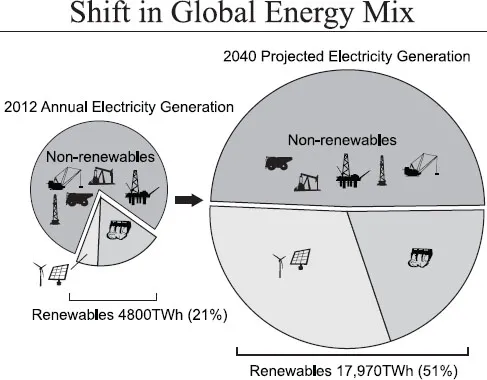
Figure p1-1. Shift in global energy mix; data adapted from IEA, World Energy Outlook 2015 (see ch. 1, n. 3).
Readers of chapter 1 will uncover this key message about our ever-increasing energy footprint on earth: it’s a lot! Our new estimates of the relative potential for energy expansion show that globally, 20 percent of remaining natural lands—about 20 million square kilometers, or an area larger than the size of Russia—are considered to be under high threat of future development. More than half the world’s regions will face the risk of up to 50 percent conversion of their land surface to some sort of development. Africa and South America will likely undergo a doubling and tripling of natural lands impacted. Already-developed regions will not be immune to further development—people living in Europe, Central America, and Southeast Asia will live with a land-use intensity they have never before experienced. These impacts are likely to arise not from a single driver, but as a multitude of sectors acting in concert. Legal land protections are poorly equipped to counter this threat, with less than 5 percent of at-risk natural lands currently protected.
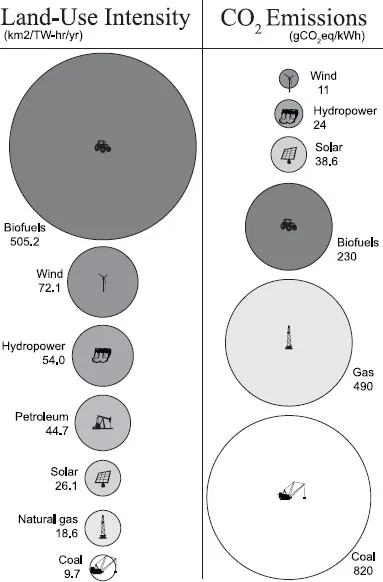
Figure p1-2. Comparison of the energy footprints in terms of land required (km2/TW-hr/yr) and CO2 emissions (gCO2eq/kWh). Land footprint adapted from McDonald et al., “Energy Sprawl or Energy Efficiency” (see ch. 1, n. 4); CO2 emissions data adapted from Steffen Schlömer, Thomas Bruckner, Lew Fulton, Edgar Hertwich, Alan McKinnon, Daniel Perczyk, Joyashree Roy, Roberto Schaeffer, Ralph Sims, Pete Smith, and Ryan Wiser, “Annex III: Technology-Specific Cost and Performance Parameters,” in Climate Change 2014: Mitigation of Climate Change, Working Group III Contribution to the Fifth Assessment Report of the Intergovernmental Panel on Climate Change, 2014.
In chapter 2 we highlight two main alternative development scenarios: the first, in which proactive policy drivers dominate, forcing society to address energy issues in ways that will reduce impacts to nature; and the second, in which market drivers dominate, resulting in significant impacts to nature. If government plays a strong role and firm, far-reaching policy measures are introduced, we’ll see more-compact cities and a transformed global transport network in the future. These new policies can help promote more renewable energy and lower-carbon energy sources (e.g., natural gas).
Alternatively, we could see a more volatile energy future. If energy demand surges, owing to strong economic growth, influence might be more widely distributed and government will take longer to agree on major decisions. Market forces rather than policies will shape this energy system; oil and coal remain a significant part of the energy mix and renewable energy grows more slowly. Without a conscious effort to alter the business-as-usual approach through regulations on energy use and production, we won’t be able to avoid the impacts of continued energy development.

CHAPTER 1
Geography of Risk
James Oakleaf, Christina M. Kennedy,
Sharon Baruch-Mordo, and Joseph M. Kiesecker
Human populations have a tendency to sprawl. Just look out the plane window as you leave any airport and you will likely see a city blending with agricultural fields for miles. With the aid of satellite imagery, this pattern can be witnessed on a global scale, revealing that urban and agricultural areas now make up over 40 percent of the Earth’s land surface.1 Sprawl is also a critical issue for the energy sector. Energy sprawl is the product of the amount of energy produced and the land-use intensity of production. Production is the terawatt hours per year of energy and intensity is the square kilometers of habitat given over to that production.
Different types of energy vary widely in their footprint. Many of the renewable energy sectors that are desperately needed to combat climate change have very large spatial footprints. As human populations grow—expected to hit 9 billion by 20502—and demand for energy soars in developing countries, something will have to give.3 The larger energy footprint of renewables will inevitably lead to trade-offs with land-use conversion.4 We will need to manage energy development in a way that can meet demands but also reduces the impacts on natural systems that support both human and wildlife populations.
Assessing Cumulative Risk
Proactively identifying lands at risk of conversion and strategically planning to mitigate future impacts is critical to achieve a sustainable balance between development and conservation.5 But striking this balance is only possible if we first understand where and how future development may occur. To do this we combined nine potential development threats to identify where current natural lands are at future risk of conversion or modification.6 We aggregated spatial patterns of expected energy threats from conventional and unconventional oil and gas, coal, solar, wind, hydropower, and biofuels, and merged these with nonenergy threats from mining, urbanization, and agricultural expansion to produce a global cumulative development threat map (fig. 1-1a). Next, we determined where high cumulative development threat overlapped with current natural lands to identify habitats at future risk (fig. 1-1b). We summarized the threat patterns by terrestrial biomes (the world’s major ecological communities—e.g., grasslands or forests) and geopolitical regions to show where proactive conservation planning and subsequent actions might be beneficial. We combined energy and nonenergy footprints because natural areas without risk from one source of development may still be impacted by another, and proactively planning to mitigate for all potential sources of habitat loss or fragmentation is the only way to maintain large, intact landscapes for conservation and human well-being.
Natural Lands at Risk
New developments are likely to be dispersed across the globe, potentially affecting 20 percent of the Earth’s remaining natural lands (fig. 1-1b).7 Currently, 21 percent of all biomes have half their natural habitats converted, and 57 percent have more than a quarter converted. Based on our study, future development could push half the world’s biomes to more than 50 percent converted, and all biomes could lose over 25 percent of their natural lands (with the exception of boreal forests and tundra).
Although development risk is globally dispersed, we found that three biomes could be disproportionally affected. These contain 66 percent of delineated at-risk natural lands: tropical and subtropical grasslands, savannas, and shrublands (total area of 5.84 million square kilometers); deserts and xeric shrublands (total area of 3.7 million square kilometers); tropical and subtropical moist broadleaf forests (total area of 3.4 million square kilometers). Accounting for current and potential future development, three biomes could become predominantly human modified: tropical and subtropical dry broadleaf forests (83 percent); temperate broadleaf and mixed forests (72 percent); and mangroves (71 percent).
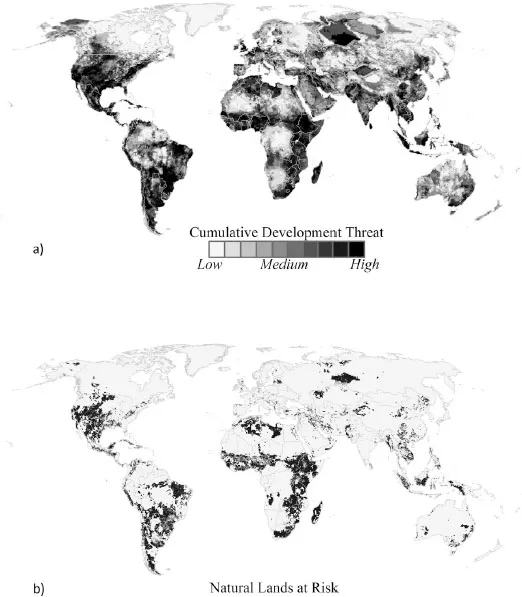
Figure 1-1. Future cumulative development threat and natural lands at risk. (a) Global development threat map produced by equally weighting and combining individual future sector development threat maps. (b) Natural lands at-risk map produced by selecting natural lands that fell within the top 25 percent of the cumulative threat scores. Adapted from “A World at Risk: Aggregating Development Trends to Forecast Global Habitat Conversion.”
The geopolitical regions of Central America, Europe, and Southeast Asia face the most land conversi...
Table of contents
- Cover
- Title Page
- Copyright
- Contents
- Foreword
- Preface
- Part I A Glimpse into Future Sprawl
- Part II Solutions for Reducing Energy Sprawl
- Part III Making Best Practice Common Practice
- About the Editors
- Contributors
- Acknowledgments
- Index
Trusted by 375,005 students
Access to over 1.5 million titles for a fair monthly price.
Study more efficiently using our study tools.
Frequently asked questions
Yes, you can cancel anytime from the Subscription tab in your account settings on the Perlego website. Your subscription will stay active until the end of your current billing period. Learn how to cancel your subscription
No, books cannot be downloaded as external files, such as PDFs, for use outside of Perlego. However, you can download books within the Perlego app for offline reading on mobile or tablet. Learn how to download books offline
Perlego offers two plans: Essential and Complete
- Essential is ideal for learners and professionals who enjoy exploring a wide range of subjects. Access the Essential Library with 800,000+ trusted titles and best-sellers across business, personal growth, and the humanities. Includes unlimited reading time and Standard Read Aloud voice.
- Complete: Perfect for advanced learners and researchers needing full, unrestricted access. Unlock 1.5M+ books across hundreds of subjects, including academic and specialized titles. The Complete Plan also includes advanced features like Premium Read Aloud and Research Assistant.
We are an online textbook subscription service, where you can get access to an entire online library for less than the price of a single book per month. With over 1.5 million books across 990+ topics, we’ve got you covered! Learn about our mission
Look out for the read-aloud symbol on your next book to see if you can listen to it. The read-aloud tool reads text aloud for you, highlighting the text as it is being read. You can pause it, speed it up and slow it down. Learn more about Read Aloud
Yes! You can use the Perlego app on both iOS and Android devices to read anytime, anywhere — even offline. Perfect for commutes or when you’re on the go.
Please note we cannot support devices running on iOS 13 and Android 7 or earlier. Learn more about using the app
Please note we cannot support devices running on iOS 13 and Android 7 or earlier. Learn more about using the app
Yes, you can access Energy Sprawl Solutions by Joseph M. Kiesecker, David E. Naugle, Joseph M. Kiesecker,David E. Naugle in PDF and/or ePUB format, as well as other popular books in Sciences biologiques & Écologie. We have over 1.5 million books available in our catalogue for you to explore.