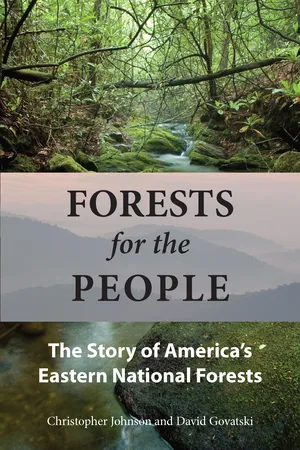
Forests for the People tells one of the most extraordinary stories of environmental protection in our nation’s history: how a diverse coalition of citizens, organizations, and business and political leaders worked to create a system of national forests in the Eastern United States. It offers an insightful and wide-ranging look at the actions leading to the passage of the Weeks Act in 1911—landmark legislation that established a system of well-managed forests in the East, the South, and the Great Lakes region—along with case studies that consider some of the key challenges facing eastern forests today.
The book begins by looking at destructive practices widely used by the timber industry in the late 1800s and early 1900s, including extensive clearcutting followed by forest fire that devastated entire landscapes. The authors explain how this led to the birth of a new conservation movement that began simultaneously in the Southern Appalachians and New England, and describe the subsequent protection of forests in New England (New Hampshire and the White Mountains); the Great Lakes region (Michigan, Wisconsin, and Minnesota), and the Southern Appalachians.
Following this historical background, the authors offer eight case studies that examine critical issues facing the eastern national forests today, including timber harvesting, the use of fire, wilderness protection, endangered wildlife, oil shale drilling, invasive species, and development surrounding national park borders.
Forests for the People is the only book to fully describe the history of the Weeks Act and the creation of the eastern national forests and to use case studies to illustrate current management issues facing these treasured landscapes. It is an important new work for anyone interested in the past or future of forests and forestry in the United States.
eBook - ePub
Forests for the People
The Story of America's Eastern National Forests
- 394 pages
- English
- ePUB (mobile friendly)
- Available on iOS & Android
eBook - ePub
Forests for the People
The Story of America's Eastern National Forests
About this book
Information
PART I
HOW THE EASTERN NATIONAL FORESTS WERE SAVED
Part I tells the story of one of the most remarkable environmental reclamation projects in world history: the restoration of the eastern forests of the United States. It has been said that in 1500, a squirrel could have scrambled across treetops from Maine to Minnesota without ever touching the ground. As European Americans settled the continent, however, they cut down millions of trees for a variety of forest products, including lumber to build a growing nation’s homes and businesses and to print increasing numbers of newspapers and books.
By 1900, the forests of New England’s White Mountains, the southern Appalachians, and the Lake states of Michigan, Wisconsin, and Minnesota were heavily depleted. Corporate executives and political leaders alike feared that the country faced a timber famine that would inhibit economic growth. At the same time, thousands of hikers, campers, hunters, and anglers despaired over the disappearance of beautiful vistas of forest-covered mountains.
During this key period, outdoor lovers, progressive political leaders, and forward-looking business leaders joined together to form a movement dedicated to the rescue and the restoration of the forests of the East, South, and Lake states, culminating in the passage of the Weeks Act in 1911. Here is the story of how that pivotal conservation law was passed and how it created a robust network of eastern national forests.
CHAPTER 1
The Disappearing Forests of the White Mountains
It was 1890 in the Pemigewasset valley of New Hampshire’s White Mountains, and the loggers attacked the stand of trees with grim determination. Two men downed the trees with five-foot-long crosscut saws—known affectionately as “misery whips”—and then laid the hardwoods on the ground. They rolled the precious spruce and pines over them and down the side of the mountain to waiting sleds, where a tender carefully loaded them. A teamster snapped the reins and drove the horse-powered sleds through the woods to a river or railroad siding (figure 1.1). There the logs were sent on their way to waiting sawmills, to be turned into lumber for a growing nation with a voracious appetite for wood.
The men were clear-cutting, or taking all the trees no matter how small or immature they were. New chemical processes allowed paper manufacturers to transform even the smallest spruce into paper, and as a result, the loggers cut every single tree and delivered the entire harvest to paper mills. The manufacturers ground the spruce into pulp and produced enormous rolls of paper that fed the needs of newspaper and magazine publishers. Meanwhile, back in the forest, miles of slash—debris formed from branches, leaves, twigs, and stumps—lay strewn over the ground. The slash dried into kindling, waiting for a lightning strike, a spark from a passing steam locomotive, or a carelessly thrown match to ignite it. If the slash caught fire on a dry and windy day, the entire mountainside could blaze into a holocaust within minutes.

Figure 1.1 Logging road in Lincoln, New Hampshire. During the nineteenth and early twentieth centuries in the White Mountains, loggers used horses to haul logs along dirt roads, causing considerable erosion. USDA Forest Service, Eastern Region Photo Archives.
The forest in which the crew of loggers were performing their labors was nestled in the Pemigewasset valley, bordered on the west by the gorgeous Franconia Range with its Old Man of the Mountain and on the east by equally picturesque Crawford Notch. The sparkling waters of the East Branch of the Pemigewasset River meandered gracefully through the valley. An emerald forest of spruce, pine, and hardwoods had once carpeted the entire valley, but now the sea of green was interrupted by large tracts of land stripped of nearly all vegetation.
Over the next several years, the heavy logging in the White Mountains and in other parts of New England would result in massive deforestation and devastating fires. The timber harvesting was a direct outgrowth of the rapid industrialization of the United States during the second half of the nineteenth century, when the country had an unquenchable thirst for natural resources—for coal, iron ore, oil—and for wood. In many ways, wood was the oil of the nineteenth century. In addition to supplying lumber to build the feverishly expanding cities of the United States, wood powered locomotives, warmed factories and homes, and built a thousand necessities of daily life, from clothespins to shoe lasts.
The rapid disappearance of millions of trees, however, was inspiring something new, something important: the birth of a movement to conserve, protect, and restore forests. Conservationists challenged conventional wisdom about natural resources with provocative questions. Were America’s forests valuable only as cornucopias of timber and other resources, and were those resources truly inexhaustible? Were the forests equally important for their beauty, their opportunities for recreation, and the habitat they provided to wildlife? Were public needs, especially in the East, being served by private ownership of the country’s timberlands? These questions would soon stir passionate debates in southern Appalachia and the Lake states, as chapters 2 and 3 will examine, but it was in New England that these issues first surfaced.
New Hampshire’s Forest Heritage
Timber harvesting had a long and honorable tradition in the White Mountains, which rise and fall like granite-laden waves over one million acres in northern New Hampshire and western Maine. The industry had its origins in the earliest days of European-American settlement of New England, and it reflected the attitudes that Europeans brought with them that nature was to be subjugated and used for the service of humanity. When the colonists arrived, they found boundless forests of majestic white pines, which they downed to build log cabins and then houses with beams made from the tree’s strong, knot-free lumber. A single tree could produce an astonishing amount of wood. Old-timers recalled tabletops that were 33 inches wide and beams 7 inches wide, all carved from the wood of a single white pine.
After the American Revolution, the pace of settlement in New Hampshire accelerated, as did the amount of logging. Human economic activities and technology transformed the New England landscape into what environmental historian William Cronon has called “a patchwork quilt on the landscape.”1 Settlers cleared fields, divided land into parcels, and constructed roads, fences, houses, and barns. The parcelization of the land made it economically productive and made room for the infrastructure for population growth, reflecting assumptions about land use that European-Americans brought with them. Another assumption was the virtual inexhaustibility of the northern forests. Frederick Kilbourne, a historian who wrote a classic history of the White Mountains, Chronicles of the White Mountains, observed, “So vast were formerly the forests in the valleys and on the lower slopes of the Mountains themselves that the supply of timber seemed inexhaustible. . . . No thought of a possible future scarcity ever entered the minds of the early lumbermen.”2 Infinitude was a driving article of faith of the nineteenth century.
After the Civil War, two developments spurred New Hampshire’s timber industry even more. In 1867, Governor Walter Harriman decided that the state would sell the last 172,000 acres of prime acreage in the northern forests—land that was estimated to be worth hundreds of thousands of dollars—for a mere $26,000.3 Speculators snapped up the cheap land and immediately started harvesting the mature trees. It is true that Harriman greatly undervalued the land, but government policy at that time was to sell lands in the public domain to spur economic development by private enterprise.
The other stimulus for the logging industry was the coming of the railroads to northern New Hampshire. Before the 1860s, most loggers had to limit their operations to tracts near rivers and streams, on which they floated logs downstream to the burgeoning sawmills in Portsmouth and other cities. The forest interiors remained relatively untouched, as loggers found it difficult to haul long and cumbersome logs over rough mountain terrain. After the Civil War, though, entrepreneurs laid railroad tracks farther north into New Hampshire, primarily to bring tourists into the northern reaches of the mountains but also to ship freight, including logs.
J. E. Henry: “The Heartless Lumber King”
As a result, New Hampshire offered ample opportunities for resourceful entrepreneurs, and one who grabbed his chance with a vengeance was James Everell Henry, or J. E. Henry for short. Henry was destined to become the most famous logging baron of New England and would be widely disparaged as “the Heartless Lumber King,” “the Wood Butcher,” and “the Mutilator of Nature.”4 He burned with the same relentless drive for success as Andrew Carnegie, John D. Rockefeller, Jay Gould, and other tycoons of the Gilded Age who had made their fortunes by supplying a growing nation with raw materials and industrial products. The nation craved wood and other forest products, and J. E. Henry was more than happy to oblige.
He was a native of the northern forest, born on April 21, 1831, in Lyman, New Hampshire, where his father struggled to eke out a living as a farmer in New Hampshire’s rocky soil and mountainous terrain. When the father died from tuberculosis in 1845, the son had to scramble to support his mother and six siblings, so at the age of 15, he tackled one of the toughest jobs in the northern woods: hauling freight over treacherous mountain roads from Portland, Maine, to Montpelier, Vermont, and other points in northern New England.
Along the rocky path to manhood, Henry experienced setbacks that would have defeated anyone less determined. At one point, he bought a supply of popcorn to sell at a local fair and thought he had made a handsome profit when he realized with a shock that he had been paid with counterfeit money. Such incidents steeled his cynicism and tough-mindedness. He tried his hand at a variety of other enterprises, including growing wheat in Minnesota, but that venture turned out badly because of a run of bad weather. Before long, Henry realized that his greatest opportunities for wealth were in his native New Hampshire, and he returned home in the mid-1870s. The nation’s demand for forest products was exploding, and there seemed no end to the uses for high-quality wood, including rifle stocks, railroad ties, bridges, roads, houses, and public buildings. Wood for houses was in peak demand, as the great cities of the East absorbed immigrants spilling onto America’s shores and rural young migrating to urban factories.
Henry recognized the huge opportunity that railroads were opening up in the northern woods, and he began to apply the methods of industry to timber harvesting. In 1876, he allied himself with Charles Joy and A. T. Baldwin to form the company Henry, Joy and Baldwin. They organized their operation vertically, controlling forestlands, harvesting the timber, owning rail stock, and milling the logs into lumber. Later they added paper manufacturing to their ever-growing empire. The company snapped up properties with virgin timber in Carroll and Bethlehem, townships northwest of the Presidential Range.5
Fires in the Zealand Valley
One of Henry’s earliest targets was the virgin timber of the Zealand valley, a splendid bowl of forestland west of Crawford Notch. The firm purchased property in the valley, and then Henry bought out Joy and Baldwin, gaining control of the company. Now he was the sole decision maker, and he pushed hard. He took trees that were more than ten inches in diameter, yet he also left the younger trees to mature. According to forest historian Bill Gove, “At Zealand, he apparently wasn’t applying the clearcutting that later was to become so obvious and so criticized when he logged the Pemigewasset Valley.”6 In 1884, Henry reached an agreement with the Boston and Lowell Railroad (later part of the Boston and Maine Railroad) to build a ten-mile logging line into the valley. Two years later, the Zealand Valley Railroad was successfully carrying logs from the heart of the valley, which featured up-and-down terrain that necessitated locomotives to pull their loads up a grade of 5.4 percent. The railroad operated for only thirteen years, 1884 to 1897, but in that short span of time it hauled millions of board feet.7
Perched on the northern apron of the valley, near the confluence of the Zealand and Ammonoosuc Rivers, was Zealand Village, which was itself a product of Henry’s drive to control all phases of his operations. The town boasted a high-capacity sawmill powered by steam, but it also contained small houses for dozens of Henry’s laborers, a boardinghouse, shops for repairing locomotives and their parts, and a post office. A school master even taught the children of Henry’s workers in one of the houses in the village.8
Scattered throughout the Zealand valley were also numerous logging camps, which one writer described as little more than a “primitive log cabin for wood choppers and a log stable nearby for the horses.”9 Operations peaked during the winter, when the loggers, who numbered as many as 250, felled trees and transported them on sleds over the thick blanket of New Hampshire snow to waiting railroad cars. The men worked eleven hours a day, but they earned a fair wage of $6 a week plus room and board. And they were productive. In 1886 and 1887, they cut an astonishing thirteen million board feet of timber.10 (One board foot is one foot long, one foot wide, and one inch thick.) Henry insisted that his crew make productive use of everything, even the manure. He ordered his men to scoop up the odiferous by-product and load it onto railroad cars, which carried it to the southern reaches of the state to be sold as fertilizer. The company built charcoal kilns and turned hardwoods into charcoal, which was in growing demand as a cooking fuel and for manufacturing steel. Workers cut hardwoods, placed them clos...
Table of contents
- Cover Page
- Title Page
- Copyright
- Dedication
- Contents
- Acknowledgments
- Introduction
- Part I How the Eastern National Forests Were Saved
- Part II Issues Facing the Eastern National Forests Today
- Conclusion
- Notes
- Selected Bibliography
- About the Authors
- Index
Trusted by 375,005 students
Access to over 1.5 million titles for a fair monthly price.
Study more efficiently using our study tools.
Frequently asked questions
Yes, you can cancel anytime from the Subscription tab in your account settings on the Perlego website. Your subscription will stay active until the end of your current billing period. Learn how to cancel your subscription
No, books cannot be downloaded as external files, such as PDFs, for use outside of Perlego. However, you can download books within the Perlego app for offline reading on mobile or tablet. Learn how to download books offline
Perlego offers two plans: Essential and Complete
- Essential is ideal for learners and professionals who enjoy exploring a wide range of subjects. Access the Essential Library with 800,000+ trusted titles and best-sellers across business, personal growth, and the humanities. Includes unlimited reading time and Standard Read Aloud voice.
- Complete: Perfect for advanced learners and researchers needing full, unrestricted access. Unlock 1.5M+ books across hundreds of subjects, including academic and specialized titles. The Complete Plan also includes advanced features like Premium Read Aloud and Research Assistant.
We are an online textbook subscription service, where you can get access to an entire online library for less than the price of a single book per month. With over 1.5 million books across 990+ topics, we’ve got you covered! Learn about our mission
Look out for the read-aloud symbol on your next book to see if you can listen to it. The read-aloud tool reads text aloud for you, highlighting the text as it is being read. You can pause it, speed it up and slow it down. Learn more about Read Aloud
Yes! You can use the Perlego app on both iOS and Android devices to read anytime, anywhere — even offline. Perfect for commutes or when you’re on the go.
Please note we cannot support devices running on iOS 13 and Android 7 or earlier. Learn more about using the app
Please note we cannot support devices running on iOS 13 and Android 7 or earlier. Learn more about using the app
Yes, you can access Forests for the People by Christopher Johnson,David Govatski in PDF and/or ePUB format, as well as other popular books in Biological Sciences & Environmental Conservation & Protection. We have over 1.5 million books available in our catalogue for you to explore.