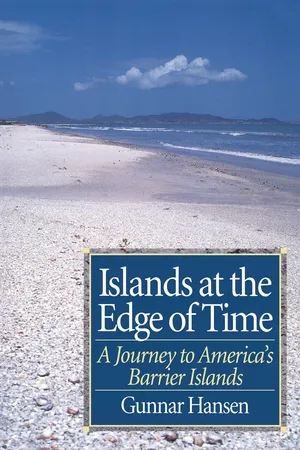
Islands at the Edge of Time is the story of one man's captivating journey along America's barrier islands from Boca Chica, Texas, to the Outer Banks of North Carolina. Weaving in and out along the coastlines of Texas, Louisiana, Mississippi, Alabama, South Carolina, and North Carolina, poet and naturalist Gunnar Hansen perceives barrier islands not as sand but as expressions in time of the processes that make them. Along the way he treats the reader to absorbing accounts of those who call these islands home -- their lives often lived in isolation and at the extreme edges of existence -- and examines how the culture and history of these people are shaped by the physical character of their surroundings.
- English
- ePUB (mobile friendly)
- Available on iOS & Android
eBook - ePub
About this book
Information
Chapter 1

Boca Chica
Boca Chica, Texas, in March. The sun near the horizon, the air filtered through a petroleum-blue haze. Three days earlier, the biggest solar flare ever seen had erupted from the surface of the sun. Though the x-rays and ultraviolet light had reached the earth in eight minutes, the second stream of radiation—the solar wind of electrons, protons, and other atomic particles stripped from their atoms—was only now entering the earth’s magnetic field. This evening, as the sun settled onto the horizon, I could see the cool spot on its northeast quadrant where the flare had blown off, a black mote three times the diameter of the earth. The air was thick and cloudless, and I looked directly at the un-distorted solar disk as it approached the horizon.
The new moon floated directly above. It had come between the sun and the earth the day after the flare, and in much of western North America people had watched it eclipse part of the sun. Now two days old, it hung suspended, a thin silver scythe blade almost touching the sun, its horns pointing upward. The moon’s dark side faced the earth, clearly visible.
I had come to the barrier beach at Boca Chica to begin an erratic journey along America’s barrier islands. These islands run almost continuously from south Texas along the Gulf of Mexico to Florida, then up the Atlantic coast past the Sea Islands, past the Outer Banks, past the famed and hideous Jersey shore, past Fire Island to the small barriers of southern Maine—a twenty-seven-hundred-mile beach, the longest stretch of barrier islands in the world.
Even though we often think of the mainland shore as the coastline, these fragile offshore barrier islands are America’s true coast. They serve as buffer to the mainland, protecting it against the direct attack of the sea. When the ocean hits it, a barrier island deflects the blow with its low angle to the water. And if that is not enough, if the water still slams too hard, then the island moves; it gives in a bit and accommodates the onrush. Barrier islands retreat when the sea rises; narrow when its energy increases or the sand supply diminishes; even spread out again when there is more sand.
These islands are small—most only a few feet above sea level, many only a mile, or even a few hundred yards, wide—and ephemeral—moving constantly, grain of sand by grain of sand, with the motion of the sea against them. From the air a barrier island appears to be a fine white band snaking along the mainland. From any distance at sea, it is nothing more than a thin dark line on the horizon.
I was taking this trip because I wanted to know about the geology and environment of these islands. But I had other, less concrete reasons for going. I was born on an island, and live on one now. I count myself blessed to have spent more than half my life surrounded by water. Since I became aware of islands as places in themselves, I have seen life on them as somehow different from life on the mainland. Now I wanted to know what made an island, particularly a barrier island, so different. What was the spirit of such a place?
I knew in a general sense: islands are separate from other places, with clear boundaries, not like the mainland, where one spot blends into the next. And so an island has a sense of definition and limits about it. It is here, and nothing else is here. I can travel only so far before I simply run out of island. On many an island, from some high spot I can see its entire world with a sweep of the eye. And with a sweep of my mind’s eye, I can encompass any island.
Perhaps because of these physical characteristics, we islanders tend to have a deep sense of belonging to a community. We see ourselves, like our islands, as self-contained, free from the outside world. Yet there is an irony—in seeing ourselves and making ourselves separate from the rest of humanity, we are all the closer to those who share the island with us. We tend to think of our fellow islanders as family, and of those who do not live on the island as not. Often there is also a kind of contradiction among us (at least on those islands I have lived on or haunted); for all our wanting to stick together, islanders distinguish between natives and those who are newly arrived, between those who belong and those who wish to belong, between those whose island this is and those whose it is not.
I was setting off in search of something, a deeper understanding of the essence of barrier islands, something that would show me what they shared with each other and how these islands were unlike other places. That was the best way I could describe to myself what I was looking for—I hoped that “something” would become more clear as I looked. I wanted to know why I was so drawn. Maybe I was searching for the distinction between those who belonged to an island and those who did not.
I could not hope to visit all, or even most, of the three hundred or so barrier islands along the coast. I would go to certain islands because of their geology and because of their people. Serendipity too would lead me; I would go where my travels took me.
I would see much of the Texas coast. In addition to its geology, I was interested in its history. My grandfather was born in Galveston, a barrier island along eastern Texas, and had lived through a hurricane there. I would spend time in Louisiana. As one geologist told me, if I was going to write about barrier islands, I had better write about Louisiana; its sinking shoreline was a model for the disaster that would soon enough engulf the rest of the U.S. coast. I wanted to visit the Sea Islands of Georgia and South Carolina, special kinds of hybrid barrier islands. And I wanted to go to the Outer Banks, particularly the islands of Ocracoke and Portsmouth—one the last surviving community of Bankers (as inhabitants of the Outer Banks were known), the other abandoned.
I would go in search of people as well. I once read about a man who had survived a hurricane on a small Mississippi barrier island by lashing himself to a tree; when friends in Beaufort, North Carolina, spoke of him, I knew I must learn what I could about him. As I traveled, others would make suggestions. A stranger in Columbia, South Carolina, said I should meet a man on Saint Helena who knitted casting nets (a skill brought here from Africa) and who could multiply and divide Roman numerals. That was enough for me; I remembered an elementary school teacher claiming that act was impossible—a reason, she contended, why the Roman Empire had collapsed.
I had prepared for this journey by spending time with the coastal geologist Orrin Pilkey, Jr. Already well respected internationally by his peers, he was becoming visible to the public as a strong voice among those who felt great concern about the development and use of the barrier islands. As such, he was also becoming a target for criticism; those involved with coastal issues seemed to either love him or hate him.
He has been described alternately as a giant elf and as a dwarf from a Wagnerian opera, descriptions based on his short stature, silvered beard, barrel chest, and, as one writer said, “whimsical disposition.” I doubt that he cares much for these characterizations. He has also been called (in print) “the single most influential voice warning of the inevitably changing face of America’s seacoast” and (not in print) “that pain in the ass.” He probably likes these descriptions better.
Pilkey seems to conceive of barrier islands as living, conscious beings, and at times he even grants them will and thought. The only proper human approach to these islands, he says, is to leave them alone. That is an interesting idea to me. I like the notion of thinking of them as alive; it helps one see how to live with a place. Yet I find myself glad that people have lived on them.
Pilkey and I had walked the beaches of the Outer Banks as he talked geology and gave me a vision of Pilkey’s True Faith. We would meet again when I returned to the Carolinas.
A friend’s father, a sometime vacationer at Nags Head on the Outer Banks, had told me that the islands were all the same. Just sand and dunes and mosquitoes, he said. Sand and dunes and mosquitoes. He had chuckled to himself when he repeated it, as if he had come upon a new idea. Then he started to tell me a joke about two Outer Banks mosquitoes fighting over a tourist.
Even some Texans are not especially excited about their islands. One writer has said that none of the 624 miles of Texas tidewater coastline offers “anything spectacular in the way of scenery.” What, I wonder, is she looking for?
The barrier islands are spectacular—moving, restless sand with life clinging onto it. There are plants: from the sea oats anchoring the dunes to the Spartina grasses of the back marshes, from small white morning glories in the beach sand to great maritime forests. And there is wildlife: pale ghost crabs picking their way out of their holes at night, countless gulls and terns drifting overhead or prowling the surf zone, delicate and rich protein life in the brackish bays between the islands and the mainland.
Some of these islands stand as much as twenty-five miles offshore, frighteningly thin, exposed sand ribbons. I have found myself on barrier islands so narrow and so far out to sea that standing atop a dune ten feet tall I could see both sides of the island and no other land. To the east the open North Atlantic beat against the beach, and to the west it might as well have been open ocean, for the mainland was too far away to see. It was a discomforting view, one that reminded me just how vulnerable these islands and their inhabitants are.
It is this vulnerability that has influenced the islanders most—both those who have held on for generations, living in careful harmony with the islands or in ignorance of their special nature, and those who have just arrived, tempted by the sea’s lulling monotony to build their houses on the dunes or in front of them, forgetting that these islands move and that the sea is not always kindly. Almost three-quarters of America now lives within fifty miles of the shore. Those who do not live directly on the water seem to want to; many of them flock to the beaches in their free time.
Barrier islands are also places where lives have passed in isolation, tied to the sea and the weather, often in extreme circumstances. Life there is often marginal. These islands are less separate now with encroaching development, and the isolation will continue to diminish in coming years. But some of the lonely places survive. People had lived and died on these islands, and I wondered what that living and dying had meant to them.
In the eighth century the Venerable Bede wrote that our life on earth was like a sparrow that for a moment left the winter’s storm, flashing in one door of the king’s hall during his dinner and out another door at the opposite end. That life was seen for only a moment before it slipped away. Our life appears to be more or less like this, Bede wrote, and we are absolutely ignorant of what may follow or precede it.
For me barrier islands speak of our existence. Each island is small, specific, here, often at the edge, sometimes clearly seen, sometimes not. Whatever the island is, it is all we islanders have. And it is surrounded by the sea, the unknown and unknowable. Sometimes the sea is benign, sometimes it is dangerous; always it is indifferent. It is a notion that has always in some way been with me, maybe even as a child, when I would explore the shore and look out at the water, or when, visiting friends on other islands, I would stand in the boat and watch the approaching shoreline of a new place anchored in this blue uncertainty. Maybe the idea has not been articulated, but it has always been with me: these islands represent life.
I was starting my search for the definable and the undefinable at the mouth of the Rio Grande. And though Boca Chica is not an island, it is almost one—a narrow barrier spit connected to the mainland along a tenuous, shallow saltpan that threatens to flood at the slightest rising of the sea. The same processes that form barrier islands formed Boca Chica.
In preparation I had bolted a plywood box to the bed of my jeep to give me a secure place to store my gear. Unsure of what I would find, I took too many things. I filled the box with tent, sleeping bag, hot-weather and cold-weather clothes, small white-gas burner, cameras, field glasses, notebooks, and portable computer. Before I slammed it shut, I somehow managed to stuff in, too, a canvas bag of maps and books—ecology and geology guides, as well as local histories. I tied an ice-filled cooler on top and laced four five-gallon water jugs around the cooler.
Then I jammed a well-worn canvas hat on my head and started south through the poverty of south Texas, past the fabled and endless King Ranch, past the citrus groves and palms, toward Brownsville and the fertile Rio Grande Valley, and out onto Boca Chica. The warm air had the perfume of flowers; then, as I approached Boca Chica, it smelled of salt.
I drove out along the road on the saltpan and onto the barrier spit. The road came out through a small cluster of young foredunes and onto the beach, which rose barely a foot or two above sea level for a hundred yards. From there extended a low dune line maybe three feet high, with no vegetation—then a larger, grassy, more stable dune line farther back. The island was narrow, in places lacking any dunes between the beach and the back saltpan, and showing evidence of several overwashes, where storm waves had carried completely over the dune line and into the back marsh. The beach itself was eroding about ten feet per year, close to twenty feet near the mouth of the river.
Looking north, I could see the big condominiums and hotels built on the sands of South Padre Island a few miles away, across Brazos Santiago Pass. As high as ten or fifteen stories, they loomed up as if from the water. Just surf, some sand, and these buildings jutting out of nothingness.
Boca Chica, though, held no such development. There was only the sound of the sea’s steady hiss from the lines of low breakers advancing on the shore. And the sound of cars and trucks as they cruised the hard sand of the forebeach. A light breeze blew in from the Gulf of Mexico. The temperature was in the midsixties. It was seventy-seven degrees in nearby Harlingen, on the mainland, and would be warmer tomorrow—late winter in south Texas.
Along the water, sanderlings ran ahead of the incoming swash, then followed the receding water back out, like children at play. The laughing gulls and herring gulls, though, stared like dreamy adults trying to remember something. Some waded into the water up to their bird-ankles. Several turned their heads toward me. A great blue heron flew off with slow strokes as I approached.
South toward the river, the foreshore narrowed to about fifty yards. Matted straw lay tossed up onto it. The beach was full of debris. Plastic milk jugs, shampoo bottles, six-pack rings, beer cans, pizza and sandwich boxes, oil cans, glass bottles, antifreeze jugs, chlorine bottles, Styrofoam cups, rusty cans were everywhere. Masses of color from water jugs, detergent bottles, plastic excelsior punctuated the sand—white, yellow, blue, turquoise, green, pink. A broken chair sat forlornly next to a yellow plastic hawser and an ancient oil drum. Even some logs had been thrown up on the shore. Much of this assortment had been dropped here. But much the sea had carried in. Throw trash into the Gulf of Mexico, and the currents will dump it on a Texas barrier island.
Alone in the midst of the wreckage stood a sandcastle, five feet from the water’s edge. A wall six inches high connected two nine-inch turrets molded from foam cups. Shells decorated the sides; a foot-long stick served as a flagpole on one tower. It would not last.
At the southern tip of Boca Chica, the Rio Grande was some thirty yards across, with slow-moving and grayish brown-green water, not broad and brown as. I had expected. On this shore stood two white Fords, each approaching twenty years old, each with a single fisherman working out of an open trunk, a couple of poles stuck into the sand. On the Mexican shore two dozen people fished or leaned against their trucks in conversation; upstream, five men loaded tackle aboard a powerboat.
Behind the foredunes at the river, the island flattened out into a confusion of dunes. The backdune area looked as if it had been flooded a lot—from the front with ocean overwash, and from the rear by the river. Foot-deep gullies marked where water had run back into the marsh and the bay behind it. Bird tracks crisscrossed the wind-rippled surfaces. Back here the sand was clean—no debris, no castoffs, no shells—fine and golden and warm from the sun. I sifted it through my fingers, fistfuls sliding easily from my grip.
Two pickups stopped near me by the river’s edge. Five men set up a single fishing pole, then stacked a large quantity of wood. When they lit it, it quickly came to a smoky roar. They stood there quietly chatting in Spanish, eating grapefruit.
The men in the boat came down the river. Instead of crossing the bar at its mouth, they ran parallel to the beach, testing the engine. They picked their way out along the surf and in a few minutes they were gone. I watched as they headed out. I imagined I could see the great lens of sand that lay below the water’s surface, stretching far out into the Gulf. That sand had made this island. This was where it all came from, carried down on the Rio Grande when the river really was grande before the rainfall decrease of several thousand years ago. The river then had dumped its billions of tons of sand from the southwestern watershed into the Gulf and formed the Rio Grande headland. Now that sand lay out there somewhere, invisible under the featureless ocean. And the river was so small that I could have waded across.
I was disappointed. Boca Chica was not what I had expected. It was not pure and magical. It was used and dirty with human dirt.
I had to leave. With far to go, I started to make my way north along the beach.
The jeep’s radio was describing a low-pressure area that had been tracking across the country for a week and now lingered on the East Coast. The storm threatened homes as far north as New Jersey. Tides were high on the Outer Banks. Beaches were eroding from Kill Devil Hills, North Carolina, to Vero Beach, Florida; twenty-eight houses had been damaged and three had fallen into the sea. Waves threatened to undermine sixty-one others. Much of the coast seemed to be melting away.
The sun fell toward the horizon and bloodied into a deeper red. The dunes began to glow, and the angular light showed off their forms—the long expanses of smooth surface with a knife-edge where the sand had slumped, unable to maintain its angle of repose; the ripples along the swollen dune lobe casting small shadows; mounds of sand that had become only lines against the dark blue water and the paler blue sky. The island became pure shape in these last moments before the sun slipped from view, leaving the horned moon to hang alone.
The solar flares continued throughout the following days, generating great magnetic storms. Trapped in earth’s magnetic field, the ionized particles lit the sky and clouded radio transmissions with their static. Emergency phone lines filled with calls from those who wondered what was happening overhead. Red, blue, and gray lights streamed from the north, shaped like towering windblown cur...
Table of contents
- Cover Page
- Title Page
- Copyright
- Dedication
- Table of Contents
- Foreword
- Preface
- Chapter 1: Boca Chica
- Chapter 2: Sand
- Chapter 3: Padre Island
- Chapter 4: Treasure
- Chapter 5: Big Wind
- Chapter 6: Galveston
- Chapter 7: Delta
- Chapter 8: Fingers in the Dike
- Chapter 9: Odd Men Out
- Chapter 10: Sea Islands
- Chapter 11: The Land
- Chapter 12: Hugo
- Chapter 13: King of North Carolina
- Chapter 14: Bankers
- Acknowledgments
- Suggested Readings
Trusted by 375,005 students
Access to over 1.5 million titles for a fair monthly price.
Study more efficiently using our study tools.
Frequently asked questions
Yes, you can cancel anytime from the Subscription tab in your account settings on the Perlego website. Your subscription will stay active until the end of your current billing period. Learn how to cancel your subscription
No, books cannot be downloaded as external files, such as PDFs, for use outside of Perlego. However, you can download books within the Perlego app for offline reading on mobile or tablet. Learn how to download books offline
Perlego offers two plans: Essential and Complete
- Essential is ideal for learners and professionals who enjoy exploring a wide range of subjects. Access the Essential Library with 800,000+ trusted titles and best-sellers across business, personal growth, and the humanities. Includes unlimited reading time and Standard Read Aloud voice.
- Complete: Perfect for advanced learners and researchers needing full, unrestricted access. Unlock 1.5M+ books across hundreds of subjects, including academic and specialized titles. The Complete Plan also includes advanced features like Premium Read Aloud and Research Assistant.
We are an online textbook subscription service, where you can get access to an entire online library for less than the price of a single book per month. With over 1.5 million books across 990+ topics, we’ve got you covered! Learn about our mission
Look out for the read-aloud symbol on your next book to see if you can listen to it. The read-aloud tool reads text aloud for you, highlighting the text as it is being read. You can pause it, speed it up and slow it down. Learn more about Read Aloud
Yes! You can use the Perlego app on both iOS and Android devices to read anytime, anywhere — even offline. Perfect for commutes or when you’re on the go.
Please note we cannot support devices running on iOS 13 and Android 7 or earlier. Learn more about using the app
Please note we cannot support devices running on iOS 13 and Android 7 or earlier. Learn more about using the app
Yes, you can access Islands at the Edge of Time by Gunnar Hansen in PDF and/or ePUB format, as well as other popular books in Biological Sciences & Travel. We have over 1.5 million books available in our catalogue for you to explore.