What makes strolling down a particular street enjoyable? The authors of Measuring Urban Design argue it's not an idle question. Inviting streets are the centerpiece of thriving, sustainable communities, but it can be difficult to pinpoint the precise design elements that make an area appealing. This accessible guide removes the mystery, providing clear methods to measure urban design.
In recent years, many "walking audit instruments" have been developed to measure qualities like building height, block length, and sidewalk width. But while easily quantifiable, these physical features do not fully capture the experience of walking down a street. In contrast, this book addresses broad perceptions of street environments. It provides operational definitions and measurement protocols of five intangible qualities of urban design, specifically imageability, visual enclosure, human scale, transparency, and complexity.
The result is a reliable field survey instrument grounded in constructs from architecture, urban design, and planning. Readers will also find a case study applying the instrument to 588 streets in New York City, which shows that it can be used effectively to measure the built environment's impact on social, psychological, and physical well-being. Finally, readers will find illustrated, step-by-step instructions to use the instrument and a scoring sheet for easy calculation of urban design quality scores.
For the first time, researchers, designers, planners, and lay people have an empirically tested tool to measure those elusive qualities that make us want to take a stroll. Urban policymakers and planners as well as students in urban policy, design, and environmental health will find the tools and methods in Measuring Urban Design especially useful.
- 243 pages
- English
- ePUB (mobile friendly)
- Available on iOS & Android
eBook - ePub
About this book
Information
Topic
ArchitectureSubtopic
Architecture GeneralCHAPTER ONE
Introduction1
In terms of the public realm, no element is more important than streets. This is where active travel to work, shop, eat out, and engage in other daily activities takes place, and where walking for exercise mostly occurs. Parks, plazas, trails, and other public places also have an important role in physical activity, but given the critical role and ubiquity of streets, this book focuses on the qualities that make one street more inviting and walkable than another. Think of your last trip to a great European city and what, other than the historic structures and the food, was memorable. You walked its streets for hours and did not tire. It is the magic of a great street environment.
Until recently, the measures used to characterize the built environment have been mostly gross qualities such as neighborhood density and street connectivity (see reviews by Ewing and Cervero 2010; Handy 2005; and Ewing 2005). The urban design literature points to subtler qualities that may influence choices about active travel and active leisure time. Referred to as perceptual qualities of the urban environment, or urban design qualities, such qualities are presumed to intervene between physical features and behavior, encouraging people to walk (see figure 1.1). Testing this presumption requires reliable methods of measuring urban design qualities, allowing comparison of these qualities to walking behavior.
Many tools for measuring the quality of the walking environment have emerged in the past few years. Generically called walking audit instruments, these are now used across the United States by researchers, local governments, and community groups. Robert Wood Johnson’s Active Living Research (ALR) website alone hosts sixteen walking audit instruments. They involve the measurement of such physical features as building height, block length, and street and sidewalk width.
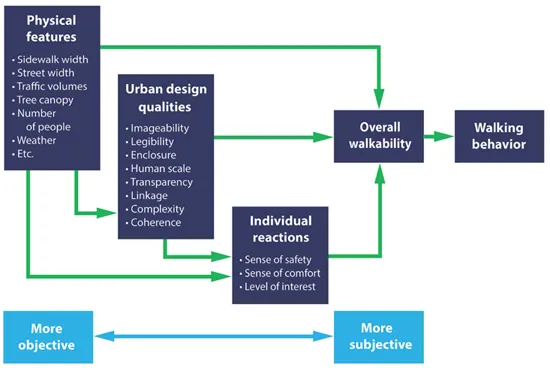
Figure 1.1.
Urban design qualities are more than the individual physical features that they comprise, as they have a cumulative effect that is greater than the sum of the parts. Physical features individually may not tell us much about the experience of walking down a particular street. Specifically, they do not capture people’s overall perceptions of the street environment, perceptions that may have complex or subtle relationships to physical features.
Perceptual qualities are also different from such qualities as sense of comfort, sense of safety, and level of interest, which reflect how an individual reacts to a place—how a person assesses the conditions there, given his or her own attitudes and preferences. Perceptions are just that—perceptions. They may elicit different reactions in different people. They can be assessed objectively by outside observers; individual reactions cannot.
Our challenge in creating a tool to measure urban design qualities was to move from highly subjective definitions to operational definitions that capture the essence of each quality and can be measured reliably across raters, including those without training in urban design.
Why You Should Read This Book
Measuring Urban Design provides operational definitions and measurement protocols for five intangible qualities of urban design: imageability, visual enclosure, human scale, transparency, and complexity. To help disseminate these measures, this book also provides a field survey instrument that has been tested and refined for use by lay observers.
This instrument has several strengths. First, it is grounded conceptually in constructs from architecture, urban design, and planning. Second, it has been carefully tested and validated. Third, it comes with detailed instructions for assessing the five urban design qualities. For these reasons, the instrument offers researchers a “gold standard” for the systematic measurement of urban design. A test in New York City showed that the instrument can be implemented in large-scale studies relating the built environment to social, psychological, and health outcomes.
Initial Screening of Qualities
Key perceptual qualities of the urban environment were identified based on a review of the classic urban design literature. Without much empirical evidence, these qualities are presumed to influence people’s decisions to walk rather than drive to a destination, stroll in their leisure time, or just hang out and socialize on a street. Perceptual qualities figure prominently in such classics as those listed in box 1.1.
The research team also reviewed the visual preference and assessment literatures, which attempt to measure how individuals perceive their environments and to better understand what individuals value in their environments. Partial listing of this voluminous empirical literature is provided in Ewing (2000) and updated in Ewing et al. (2005). These literature reviews go beyond the boundaries of urban design to the fields of architecture, landscape architecture, park planning, and environmental psychology, as perceptual qualities of the environment figure prominently in these fields as well.
Our review yielded a list of fifty-one perceptual qualities of the urban environment (box 1.2). Of these fifty-one qualities, eight were selected for further study based on the importance assigned to them in the literature: imageability, enclosure, human scale, transparency, complexity, coherence, legibility, and linkage. Of the eight, the first five were successfully measured in a manner that passed tests of validity and reliability.
Box 1.1.
Classic Works in Urban Design That Address Perceptual Qualities
City Planning according to Artistic Principles, Camillo Sitte, 1889 (complete English translation 1986)
The Image of the City, Kevin Lynch, 1960
The Concise Townscape, Gordon Cullen, 1961
The Death and Life of Great American Cities, Jane Jacobs, 1961
A Pattern Language: Towns, Buildings, Construction, Christopher Alexander, Sara Ishikawa, and Murray Silverstein, 1977
Fundamentals of Urban Design, Richard Hedman, 1984
Finding Lost Space: Theories of Urban Design, Roger Trancik, 1986
Life between Buildings: Using Public Space, Jan Gehl, 1987
City: Rediscovering the Center, William Whyte, 1988
Town Planning in Practice, Raymond Unwin, 1909
History and Precedent in Environmental Design, Amos Rapoport, 1990
Great Streets, Allan Jacobs, 1993
Trees in Urban Design, Henry Arnold, 1993
Box 1.2.
Fifty-One Perceptual Qualities of the Built Environment
adaptability
distinctiveness
intricacy
richness
ambiguity
diversity
legibility
sensuousness
centrality
dominance
linkage
singularity
clarity
enclosure
meaning
spaciousness
coherence
expectancy
mystery
territoriality
comfort
focality
naturalness
texture
compatibility
formality
novelty
transparency
complementarity
human scale
openness
unity
complexity
identifiability
ornateness
upkeep
continuity
imageability
prospect
variety
contrast
intelligibility
refuge
visibility
deflection
interest
regularity
vividness
depth
intimacy
rhythm
Imageability
Imageability is the quality of a place that makes it distinct, recognizable, and memorable. A place has high imageability when specific physical elements and their arrangement capture attention, evoke feelings, and create a lasting impression. It is probably not one element by itself that makes a street imageable but rather the combination of many.
According to Kevin Lynch (1960), a highly imageable city is well formed, contains distinct parts, and is instantly recognizable to anyone who has visited or lived there. It plays to the innate human ability to see and remember patterns. It is a city whose elements are easily identifiable and grouped into an overall pattern.
Landmarks are a component of imageability. The term landmark does not necessarily denote a grandiose civic structure or even a large object. In the words of Lynch, it can be “a doorknob or a dome.” What is essential is its singularity and location, in relationship to its context and the city at large. Landmarks are a principle of urban design because they act as visual termination points, orientation points, and points of contrast in an urban setting. Tunnard and Pushkarev (1963, p. 140) attribute even greater importance to landmarks, saying, “A landmark lifts a considerable area around itself out of anonymity, giving it identity and visual structure.”
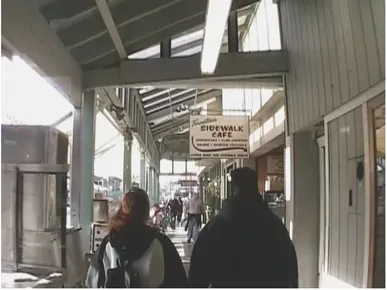
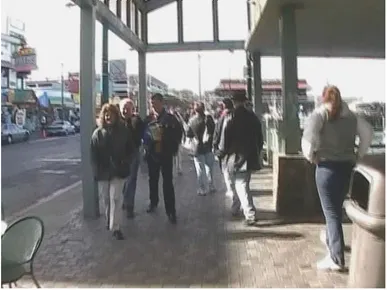

Figures 1.2a, b, c. Video clips shot at Fisherman’s Wharf, San Francisco, CA, rating high in Imageability.
Imageability is related to “sense of place.” Gorden Cullen (1961, p. 152) asserts that a characteristic visual theme will contribute to a cohesive sense of place and will inspire people to enter and rest in the space. Jan Gehl (1987, p. 183) explains this phenomena using the example of famous Italian city squares, where “life in the space, the climate, and the architectural quality support and complement each other to create an unforgettable total impression.” When all factors manage to work together to such pleasing ends, a feeling of physical and psychological well-being results: the feeling that a space is a thoroughly pleasant place in which to be.
Imageability is influenced by many other urban design qualities—enclosure, human scale, transparency, complexity, coherence, legibility, and linkage—and is in some sense the net effect of these qualities. Places that rate high on these qualities are likely to rate high on imageability as well—the neighborhoods of Paris or San Francisco, for example. However, places that rate low on these qualities may also evoke strong images, though ones that people may prefer to forget. Urban designers focus on the strength of positive images in discussing imageability and sense of place.
A panel of experts we assembled most often mentioned vernacular architecture as a contributor to imageability (Ewing and Handy 2009). Other influences mentioned were landmarks, striking views, unusual topography, and marquee signage. Beyond Kevin Lynch’s (1960) detailed qualitative characterizations, and two quantitative studies of building recall, we could find no attempts to operationalize imageability in either visual assessment studies or design guidelines.
Enclosure
Enclosure refers to the degree to which streets and other public spaces a...
Table of contents
- Cover
- Title Page
- Copyright
- Contents
- Acknowledgments
- Chapter one: Introduction
- Chapter two: Data Collection
- Chapter three: Analysis and Final Steps
- Chapter four: Urban Design Qualities for New York City
- Chapter five: Validation of Measures
- Chapter six: Field Manual
- Appendix 1: Biosketches of Expert Panel Members
- Appendix 2: Operational Definitions of Physical Features
- Appendix 3: Urban Design Qualities and Physical Features
- Appendix 4: Scoring Sheet Measuring Urban Design Qualities
- References
Trusted by 375,005 students
Access to over 1.5 million titles for a fair monthly price.
Study more efficiently using our study tools.
Frequently asked questions
Yes, you can cancel anytime from the Subscription tab in your account settings on the Perlego website. Your subscription will stay active until the end of your current billing period. Learn how to cancel your subscription
No, books cannot be downloaded as external files, such as PDFs, for use outside of Perlego. However, you can download books within the Perlego app for offline reading on mobile or tablet. Learn how to download books offline
Perlego offers two plans: Essential and Complete
- Essential is ideal for learners and professionals who enjoy exploring a wide range of subjects. Access the Essential Library with 800,000+ trusted titles and best-sellers across business, personal growth, and the humanities. Includes unlimited reading time and Standard Read Aloud voice.
- Complete: Perfect for advanced learners and researchers needing full, unrestricted access. Unlock 1.5M+ books across hundreds of subjects, including academic and specialized titles. The Complete Plan also includes advanced features like Premium Read Aloud and Research Assistant.
We are an online textbook subscription service, where you can get access to an entire online library for less than the price of a single book per month. With over 1.5 million books across 990+ topics, we’ve got you covered! Learn about our mission
Look out for the read-aloud symbol on your next book to see if you can listen to it. The read-aloud tool reads text aloud for you, highlighting the text as it is being read. You can pause it, speed it up and slow it down. Learn more about Read Aloud
Yes! You can use the Perlego app on both iOS and Android devices to read anytime, anywhere — even offline. Perfect for commutes or when you’re on the go.
Please note we cannot support devices running on iOS 13 and Android 7 or earlier. Learn more about using the app
Please note we cannot support devices running on iOS 13 and Android 7 or earlier. Learn more about using the app
Yes, you can access Measuring Urban Design by Reid Ewing,Otto Clemente in PDF and/or ePUB format, as well as other popular books in Architecture & Architecture General. We have over 1.5 million books available in our catalogue for you to explore.