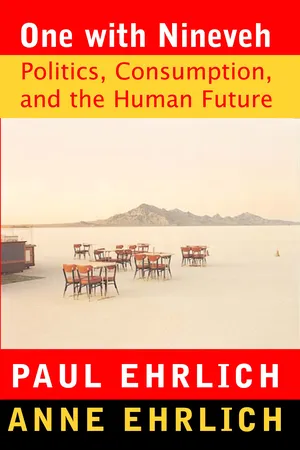
Named a Notable Book for 2005 by the American Library Association, One with Nineveh is a fresh synthesis of the major issues of our time, now brought up to date with an afterword for the paperback edition. Through lucid explanations, telling anecdotes, and incisive analysis, the book spotlights the three elephants in our global living room-rising consumption, still-growing world population, and unchecked political and economic inequity-that together are increasingly shaping today's politics and humankind's future. One with Nineveh brilliantly puts today's political and environmental debates in a larger context and offers some bold proposals for improving our future prospect.
eBook - ePub
One With Nineveh
Politics, Consumption, and the Human Future
- English
- ePUB (mobile friendly)
- Available on iOS & Android
eBook - ePub
One With Nineveh
Politics, Consumption, and the Human Future
About this book
Information
Print ISBN
9781597260312
9781559638791
Subtopic
Public Affairs & AdministrationChapter 1
THE HUMAN PREDICAMENT
“We hold dominion over palm and pine”
RUDYARD KIPLING, “Recessional,” 18971
IS HUMANITY REALLY on a collision course with the natural world, which supports us all? Are we really in a predicament? It seems hard to believe. Most readers of this book, including us, lead quite nice lives; we are not poor. We are well housed and well clothed and have access to an incredibly rich variety of food and material things to make life comfortable and convenient, even luxurious. Our kids and grandchildren are well educated, and many electronic diversions are piped directly into our homes. Predicament? Most people in the world would give anything to share our predicament—and more than a few would like to see us not enjoy so much luxury (and that’s part of the human predicament).
We suspect that you share our natural ambivalence here. By the world’s standards, you’re probably leading a rather comfortable life, with no obvious, immediate threats in sight—and yet you know that humanity is in trouble. In coming to grips with this evident paradox, with our troubled thoughts for future well-being, we’ve found it helpful to deliberately expand our perspective. By adopting an ecologist’s view of time and space, one can consider stretches of time hundreds of generations long and view all of Earth as a neighborhood. Doing so reveals a picture of great triumph in the rise of our species to planetary dominance—but also of the increasingly troubling side effects of that triumph.
An Ecological View
Most of the universe is lonely, harsh, and often violent—inhospitable beyond anything humanity has ever experienced. The other planets in our solar system offer none of the comforts of Earth—not even such essentials as breathable air, abundant water, or a level of gravity suitable for human beings. Planets associated with distant star systems have been observed, but with no assurance that they can or do support any life—still less life that we might find recognizable. Earth is humanity’s only home and the only one we are ever likely to have. It is uniquely suited to life, including human life, and we are utterly dependent on its characteristics and capacities, especially its sumptuous panoply of life, which evolved over more than 4.5 billion years.
Just suppose, through a quirk of space-time, we could look through a telescope at Earth as it was some 16,000 years ago, when there were perhaps two or three million people. Would we recognize it? Some aspects would seem essentially unchanged: the arrangement of the continents, the oceans, and many major rivers and lakes would look very much as it does today. But other aspects might seem quite strange: a much greater extent of ice on northern continents and polar seas, for instance, and coastlines somewhat different, thanks to a lower sea level then. We might notice much broader expanses of forest both in ice-free temperate regions, such as North America, Europe, Asia, and southern South America, and in tropical regions of Central and South America, Asia, and Africa. But, most remarkable, there would be no obvious signs of human activity—no large cities or towns, no Great Wall of China, no farm fields, pastures, or clear-cut swaths in forests, no big dams or reservoirs, no open-pit mines or quarries, no highways or railways traced across continents.
At higher magnification, we would see a very different array of large animals inhabiting the continents: huge woolly mammoths, giant ground sloths and beavers, saber-toothed cats, and numerous other unfamiliar creatures, as well as more familiar ones such as deer, antelopes, horses, and bears. And, if we looked very carefully, we might notice a few small groups of human beings living in temporary camps scattered across Africa, Europe, Asia, and Australia and subsisting by hunting large and small herbivorous animals and gathering edible plants from their surroundings. At night, we might be able to spot a few campfires and an occasional wildfire in grassland or forest—a great contrast to the brilliant clusters of artificial lights visible over much of the land in contemporary satellite photos.
Suppose now our space-time shift fast-forwarded to 200 years ago—just after 1800, as the industrial revolution was gaining momentum in Europe and a billion or so people inhabited Earth. How much change would we notice from nearly 16,000 years earlier? Perhaps not as much as you might expect. Of course, the glaciers would have retreated, and continental outlines and sea levels would be virtually identical with those of today. Most tropical regions would still be heavily forested, as would most of eastern North America and northern Eurasia. The Mediterranean basin and the Middle East, however, would appear to be semi-desert, and many of the large animals of the Pleistocene would have disappeared entirely, while others, such as lions and elephants, would have had their ice-age distributions greatly restricted.
Signs of human occupation would be considerably more obvious and widespread; villages, towns, and some quite large cities, such as London, Paris, and Shanghai, would be visible, as would many areas of farmland, mainly centered in European and Asian areas of high production today. Development in North and South America would be largely confined to coastal areas; Africa would appear rather spottily settled and cultivated, but with no large cities south of the Sahara. In Europe and North America, where industry was gaining a foothold, there would be as yet no electric power or motorized transport. Fuel for heat and metalworking would be wood or coal (making cities quite smoky); power would come from water mills or windmills, lighting from candles or oil lamps. A nighttime view from space would reveal only a little more light than that produced by the campfires of ice-age hunter-gatherers. Thus, even as recently as 200 years ago, the adverse environmental effects of the human population of roughly a billion people were significant but still very small by comparison with today’s.
Building the Human Enterprise
A nighttime view from space today, however, brings home just how massively and rapidly humanity has transformed its earthly home in the process of becoming the dominant animal on the planet. Most of Earth’s land areas are now ablaze with light from cities, towns, highways, oil-well flares, and agricultural burning. In 16,000 years (an eye-blink in geologic time), the human population has expanded more than a thousandfold in number, from a few million to more than 6 billion by the turn of the twenty-first century. By comparing tonight’s view with one from two centuries in the past, one begins to grasp how much of that transformation has occurred in just 1 or 2 percent of the time since glaciers stood a mile thick over the present site of New York City. In daylight, it also would be strikingly evident that the sixfold increase in population size and some thirtyfold increase in industrial activity since 1800 have resulted in the nearly complete occupation and transformation of Earth’s land surface for human habitation.
During the sixteen millennia since the height of the ice age, human beings have domesticated animals and learned to plant and harvest crops; they have found ways to extract raw materials, process them, and manufacture products on a massive scale. People have devised means that allow them to travel a thousand times more rapidly and have created enormous cities and astonishingly complex social systems. When we look at Earth’s surface from a jet airplane today, obvious signs of that activity are almost everywhere except in polar regions, deserts, the tops of mountain ranges, tropical forests, and the oceans. Some 28 percent of the world’s ice-free land area is now dedicated (as cropland or pasture) to producing food for human beings, and much of the rest is used for less intensive grazing or for extraction of forest products and other resources.2
Homo sapiens has now become a truly global geological force. Among other things, it has changed the amount and patterns of light reflected back into space from Earth’s surface, altered vast biogeochemical cycles that circulate the elements upon which our lives depend, freed many minerals from Earth’s crust at rates comparable to or even exceeding those of natural processes such as wind and water erosion, and withdrawn so much water from large rivers that they sometimes no longer reach the sea.3 The scale of the human enterprise4 is now so gigantic that people are significantly altering even the gaseous composition of the atmosphere and changing the climate.5
The principal driving forces of those environmental impacts, which multiply together to batter the global systems that provide us with food, fresh water, and an equitable climate, are population growth, overconsumption, and the use of wasteful and often damaging technologies, combined with the particular social, political, and economic arrangements that facilitate or even promote high levels of consumption. 6 Everyone contributes to the collision course, but some far more than others. The most damaging and far-reaching assaults on the natural world are caused by the wealthy few, with their enormous affluence and collective power, rather than by the much more numerous poor. Those in the rich and powerful minority draw resources and goods from the entire planet, and they have been responsible for most of the environmental degradation over the past half-century because their average consumption per person is so high. These inequalities have great implications not only for the differing effects on the environment but also for the different strategies that will be needed in building a sustainable future.
Unequal Dominators
The newly industrialized nations of Europe and North America led a surge of population growth in the nineteenth and early twentieth centuries. All the advances and accomplishments entrained by the industrial revolution enabled humanity to support an ever larger population by channeling Earth’s natural productivity more and more into systems modified for human use7 and by exploiting new mineral and energy sources, especially stored energy from long-vanished life: fossil fuels. It also stimulated trade between continents and nations, and it dramatically changed power relationships among them in ways that persist today. Some regions prospered and gained power, and others did not—for reasons that are not entirely understood. Important factors historically, as explained by Jared Diamond, have been regional differences in the quality and quantity of productive land and in the availability of environmental resources (e.g., the lack of animals suitable for domestication in Africa).8
Other key factors may include such historical accidents as locations where market economies first thrived; cultural traits that allowed industrialization to take hold and the sorts of institutions that developed to support it;9 who carried what disease where; which nations managed to build empires; whether colonized nations were originally rich or poor; and how colonizers behaved.10 Whatever the details of causation, human domination of the world in the twentieth century had the unfortunate side effect of creating a division between prospering industrialized nations and poor traditional societies (or “developed” and “developing” nations).
The divergence is seen as well in the different demographic paths the two groups have followed: the industrialized nations eventually lowered their birthrates, while the non-industrial regions of Latin America, Asia, and Africa did not. When modern medical technology was introduced in industrially less developed countries after World War II, the result was a dramatic drop in mortality rates and a population explosion.
The best news today is that populations in most industrialized countries (notably excepting the United States) are no longer expanding, and some have even begun to shrink slightly. Rapid population growth still prevails in many developing countries, however.11 More than 95 percent of the population growth in the next half-century is projected to be in developing regions, which unfortunately are the least able to cope with billions more people.
The divergence between population growth rates in industrialized and developing regions has been more than matched by the still widening disparity in wealth and power,12 even as the extent of affluence and the amount of resource consumption on average worldwide have both multiplied. While building their industrial systems throughout much of the nineteenth and twentieth centuries, western Europe, North America, and, later, Japan grew ever richer. By the end of the twentieth century, these nations had achieved economic dominance over most of the world. People in industrialized nations have secured the lion’s share of the gains, while those in the poorest regions have gained little or nothing.13 Human dominance of the planet, in effect, has been a function more of temperate-zone “pine” than of tropical “palm.”
In the process, life for millions of human beings has been made safer, more secure, culturally richer and more comfortable, and relatively free of diseases and environmental risks. Yet these remarkable accomplishments have mostly benefited only the inhabitants of wealthy industrialized countries and the affluent classes of the developing world. Along with the colossal expansion of the human enterprise and unprecedented affluence achieved by some hundreds of millions of people, perhaps 2 to 3 billion others have attained modest levels of comfort and security. While this is truly a major achievement, it too has an underside: more and more people are increasingly (and mostly unknowingly) joining in the escalating assault on the global environment, complicating the prospects for escaping the human predicament. Billions more are still struggling...
Table of contents
- Title Page
- Copyright Page
- Dedication
- Table of Contents
- Introduction - HOSTAGES TO HUBRIS
- Chapter 1 - THE HUMAN PREDICAMENT
- Chapter 2 - THE COSTS OF SUCCESS
- Chapter 3 - THE TIDE OF POPULATION
- Chapter 4 - THE CONSUMPTION FACTOR
- Chapter 5 - TECHNOLOGY MATTERS
- Chapter 6 - BILLIONS, BIRTHRATES, AND POLICIES
- Chapter 7 - CONSUMING LESS
- Chapter 8 - A CULTURE OUT OF STEP
- Chapter 9 - HUMAN BEHAVIOR AT THE MILLENNIUM
- Chapter 10 - SUSTAINABLE GOVERNANCE IN AMERICA
- Chapter 11 - HEALING A WORLD OF WOUNDS
- Notes
- References
- ACKNOWLEDGMENTS
- ABOUT THE AUTHORS
- ABOUT THE CENTER FOR CONSERVATION BIOLOGY
- Index
Trusted by 375,005 students
Access to over 1.5 million titles for a fair monthly price.
Study more efficiently using our study tools.
Frequently asked questions
Yes, you can cancel anytime from the Subscription tab in your account settings on the Perlego website. Your subscription will stay active until the end of your current billing period. Learn how to cancel your subscription
No, books cannot be downloaded as external files, such as PDFs, for use outside of Perlego. However, you can download books within the Perlego app for offline reading on mobile or tablet. Learn how to download books offline
Perlego offers two plans: Essential and Complete
- Essential is ideal for learners and professionals who enjoy exploring a wide range of subjects. Access the Essential Library with 800,000+ trusted titles and best-sellers across business, personal growth, and the humanities. Includes unlimited reading time and Standard Read Aloud voice.
- Complete: Perfect for advanced learners and researchers needing full, unrestricted access. Unlock 1.5M+ books across hundreds of subjects, including academic and specialized titles. The Complete Plan also includes advanced features like Premium Read Aloud and Research Assistant.
We are an online textbook subscription service, where you can get access to an entire online library for less than the price of a single book per month. With over 1.5 million books across 990+ topics, we’ve got you covered! Learn about our mission
Look out for the read-aloud symbol on your next book to see if you can listen to it. The read-aloud tool reads text aloud for you, highlighting the text as it is being read. You can pause it, speed it up and slow it down. Learn more about Read Aloud
Yes! You can use the Perlego app on both iOS and Android devices to read anytime, anywhere — even offline. Perfect for commutes or when you’re on the go.
Please note we cannot support devices running on iOS 13 and Android 7 or earlier. Learn more about using the app
Please note we cannot support devices running on iOS 13 and Android 7 or earlier. Learn more about using the app
Yes, you can access One With Nineveh by Paul R. Ehrlich,Anne H. Ehrlich,Paul R. Ehrlich in PDF and/or ePUB format. We have over 1.5 million books available in our catalogue for you to explore.