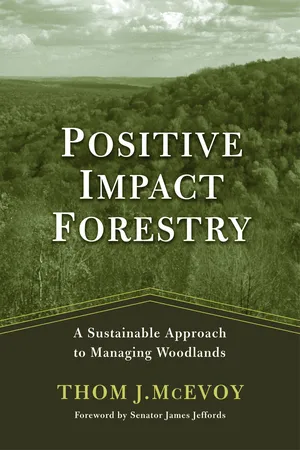
Positive Impact Forestry is a primer for private woodland owners and their managers on managing their land and forests to protect both ecological and economic vitality. Moving beyond the concept of "low impact forestry," Thom McEvoy brings together the latest scientific understanding and insights to describe an approach to managing forests that meets the needs of landowners while at the same time maintaining the integrity of forest ecosystems. "Positive impact forestry" emphasizes forestry's potential to achieve sustainable benefits both now and into the future, with long-term investment superseding short-term gain, and the needs of families—especially future generations—exceeding those of individuals.
Thom McEvoy offers a thorough discussion of silvicultural basics, synthesizing and explaining the current state of forestry science on topics such as forest soils, tree roots, form and function in trees, and the effects of different harvesting methods on trees, soil organisms, and sites. He also offers invaluable advice on financial, legal, and management issues, ranging from finding the right forestry professionals to managing for products other than timber to passing forest lands and management legacies on to future generations.
Positive Impact Forestry helps readers understand the impacts of deliberate human activities on forests and offers viable strategies that provide benefits without damaging ecosystems. It speaks directly to private forest owners and their advisers and represents an innovative guide for anyone concerned with protecting forest ecosystems, timber production, land management, and the long-term health of forests.
Named the "Best Forestry Book for 2004" by the National Woodlands Owners Association.
- English
- ePUB (mobile friendly)
- Available on iOS & Android
eBook - ePub
About this book
Information
CHAPTER 1
Forestry’s Past Is Prologue
I had the good fortune years ago while studying forestry to meet a farmer during a road-trip over spring break. Still a year shy of graduation, I felt as though I had already mastered the major concepts of my studies. Upon learning I was a student of forestry the farmer insisted I visit his land nearby, to “look at his timber.” Since I had no pressing plans and it sounded interesting, I decided to accept his offer. I felt slightly awkward in doing so, but it occurred to me that I might be bound by some forester’s equivalent of the Hippocratic Oath to help this man and his forests.
I followed him a few miles up the road, in the same direction I was going, to a beautifully tended farm. We parked our vehicles in front of the barn and jumped into a beat-up old Ford pickup that had seen better days. The tour started almost as fast as the truck, and I learned that the family owned a section of land (640 acres), about a third of which was dedicated to fresh vegetables, corn silage, pasture, and beef cattle. The rest was woodlands that had been in his family since the area was settled, and his great-grandfather was mostly responsible for clearing the lands dedicated to crops (which seemed plausible since this fellow was old enough at the time to be my grandfather). I could see the woodlot beyond the fields.
No more than five minutes after leaving the barn and proceeding on a well-tended trail, we entered the forest, and I was immediately stunned by the stature of trees; these were mostly hardwoods with diameters ranging from two to three feet, but there were also widely scattered stems that were significantly larger. Tree heights were well over 100 feet, except in patches where overstory trees had been carefully harvested over the years. I asked if we could stop and walk around a bit and we did.
The chapter title, “Forestry’s Past Is Prologue” is from The Tempest, act 2, scene 1, lines 261–263. Antonio to Sebastian: “We all were sea-swallow’d, though some cast again, / And by that destiny to perform an act / Whereof what’s past is prologue, what to come, / In yours and my discharge.” Wm. Shakespeare, 1564–1616, first published in the First Folio, the collected works of Shakespeare, in 1623.
The forest floor was covered with a litter layer so deep it was like walking on sponge. With my friend’s permission, I carefully pulled back the leaf litter and dug down through humus and a mat of roots, more than 12 inches before reaching mineral soil. After realizing I had never seen anything like this, I carefully backfilled the small hole. A few minutes later (or possibly seconds later, because I had lost track of time) while looking straight up through the canopy high overhead, I felt a strong sense of inadequacy. The farmer had been talking all along and I had not heard a word. I realized that this man who had shared his forest would eventually ask what I thought about it. There was nothing I could say except that it was perfect, and I told him so.
Later, he told me that the only tree cutting on the land was done by family members, using a farm tractor and an arch on wheels that lifted the front end of logs. There were only a few rules that originated with his great-grandfather, passed down from one generation to the next. He alluded to an income- and access-sharing arrangement with brothers and sisters, but the specific formula was never made clear and I thought it inappropriate to ask. A general guideline they followed, however, was to harvest only single trees that likely would not survive another cutting cycle, which I understood to be no more frequent than once every ten years and then only during winter months. An extensive and well-maintained trail system was developed by the family, and in one recent cutting cycle they had harvested more than planned due to mortality following a few years of insect defoliations. Nevertheless, a single tree from his forest, the farmer pointed out, usually sold for more money than an entire acre’s worth of wood from his neighbor’s land. And the only foresters that had ever been on the land came as visitors, just like me.
From a forestry standpoint, the farmer was harvesting only a small fraction of growth potential, but in large, valuable trees, so I could not argue with the result. It was—and still is—one of the most beautiful forests I have ever seen. It was also only the second time I had seen a relatively undisturbed forest soil, one that had never been tilled or burned or seriously disturbed except for the very light harvesting regime the family used. I wondered about the patriarch who had set this plan in motion more than 150 years earlier, what power held sway over his spawn to ensure the forest was never cut any harder than he thought appropriate. As I think back, there are hundreds of questions that come to mind.
Considering that the family had never employed the services of a forester, it was a significant lesson for a young student of forestry full of hubris—a lesson that has stayed with me for many years and is now fundamental to the concept of positive impact forestry: Knowledge about forests is principally a function of care and respect for land. Good practices are second nature to those who learn respect, especially when lessons come from a parent. For those whose families lack these traditions, respect evolves from learning about forests in other ways, which is the purpose of this book.
On the way back to the barn, the farmer seemed to glow with my compliments until I had exhausted all the superlatives that came to mind. After a few moments of quiet, he praised his great-grandfather who laid down the rules, and then he said that good soils and patience probably had more to do with a healthy forest than anything his family had done. Although I did not doubt his word at the time, having witnessed the product of that philosophy, it was years before I could accept this simple wisdom as a fundamental truth about forests; and I have since witnessed the same phenomenon on forest lands of others that have passed down both the land and a legacy from generation to generation, usually without help from professionals. Undisturbed soils and good practices are fundamental to healthy forest ecosystems, and patience is a virtue of forest owners who manage their lands for timber. Knowledge of forests and respect of the land, good practices, healthy soils, and patience are the essence of positive impact forestry, as described in the chapters that follow.
Evolution of Forest Use and Management
Archeological records from areas known to support forests since the time humans arrived on the scene prove that people have always used forests. But there is a significant difference between using resources and managing them. By definition, management is a process of exerting control for the purposes of allocating benefits. Sophistication in methods, in tools, or in the reasoning of those who endeavor to manage is irrelevant. Management implies control, and control means use and allocation.
No one knows when or where forest use shifted from simply accepting what forests are capable of providing to managing them, but one of the earliest indirect records of management is found in North America. Cores extracted from lake bottoms in Florida reveal pollen layers that would indicate a fairly regular, prehistoric pattern of pine ecosystems gradually replaced by oak forests as climatic conditions changed. Following the last glacial period, nearly ten thousand years ago, much of Florida was covered with hardwood forests of oak interspersed with small patches of prairie (Watts 1971). Beginning about seven thousand years ago, a new pattern emerged: well-established oak/prairie communities were abruptly replaced by pine to a much greater extent and faster than earlier transitions, and more so than could be explained by climate changes alone (Myers 1985).
The onset of this new pattern is believed coincidental with the arrival of humans on the Florida Peninsula. Paleo-Indians of that era were well known for using fire to drive game, a forest management practice initiated seven thousand years ago that hastened the conversion of a fire-prone ecosystem into one that is fire dependent.
Despite the fact that burning probably converted relatively game-rich forest habitat into pine communities that supported less game, the people who used these practices were managing forests. And herein lies an important message about management: long-term consequences are not always positive. In fact, the more a management practice focuses on immediate gain—especially when “gain” is solely the product of one value—the more prone management is to fail in time with respect to that value. The practice of using fire to drive game was not exclusive to people of the Florida Peninsula or even North America. Nevertheless, it is one of the only areas where paleobotanical records coincide with human activities that endeavored to “manage” forests for benefits.
It is purely speculative to assume that at some time during the many generations it took to convert oak forests into pine, at least one person—probably many—recognized a pattern; the practice of burning forests to drive game created a different forest that supported less game. But those who were responsible for ensuring people had plenty to eat, seeing no other way to provide food as efficiently as the “old” ways, refused to change. So long as there were plenty of opportunities to manage forests using fire to obtain game, and people were well-fed, there was no reason to change. Herein is another important message about management: When the past is used as sole justification for current practices, it is easy to ignore reasons to change even though failure to change may one day prove fatal. Management practices are a means of achieving desirable futures, but only for those who see the future as far more important than the past.
The failings of prehistoric cultures are forgivable because it is almost impossible to contemplate long-range impacts when immediate needs are so pressing. Unfortunately, there are parallels between the motivations of hungry Paleo-Indians and cash-strapped woodland owners of today who, in times of need, turn to forests. For both, decisions are driven by short-term gain, regardless of long-term impacts on the health and functioning of the ecosystem providing benefits.
In more recent times, but still predating the emergence of forest science, there is evidence of long-range, strategic thinking about forests and management practices capable of providing future benefits. By designating forests and managing them to achieve specific future benefits, decision making transcends generations. One of the most famous true stories of managing forests for future generations comes from the anthropologist and philosopher Gregory Bateson (Brand 1994):
New College, Oxford, is of rather late foundation, hence the name. It was founded around the late 14th century. It has, like other colleges, a great dining hall with oak beams across the top. These might be two feet square, forty-five feet long.
A century ago, so I am told, some busy entomologist went up into the roof of the dining hall with a penknife and poked at the beams and found that they were full of beetles. This was reported to the College Council, who met in some dismay, because where would they get beams of that caliber nowadays?
One of the Junior Fellows stuck his neck out and suggested that there might be on College lands some oak. These colleges are endowed with pieces of land scattered across the country. So they called in the College Forester, who of course had not been near the college itself for some years, and asked him about oaks.
And he pulled his forelock and said, ‘Well sirs, we was wonderin’ when you’d be askin.’
Upon further inquiry it was discovered that when the College was founded, a grove of oaks had been planted to replace the beams in the dining hall when they became beetly, because oak beams always become beetly in the end. This plan had been passed down from one Forester to the next for five hundred years. ‘You don’t cut them oaks. Them’s for the College Hall.’
Providing for the future is an important theme of forestry. The impetus to plant and manage oaks was based on knowledge that the original beams would eventually need to be replaced. It is nothing short of miraculous that the purpose of a planting predating Shakespeare was passed from generation to generation of foresters. The New College, Oxford, story is one of the first examples of people cultivating trees for a specific future use, which is “management” in a context much closer to modern-day interpretations than the game-driving practices of Paleo-Indians.
In the late eighteenth and early nineteenth century, forests of northern Europe were cut hard to support industrial development. A prominent nobleman of that era, Heinrich Cotta, educated in the natural sciences, detected a pattern of forest use that would soon lead to wood shortages. In 1816, Cotta published the first textbook on forestry, Advice on Silviculture. In the preface of his book, Cotta postulates an important message about forestry, that it is a science borne of scarcity. This prescient sentiment and other timeless observations about the effects of humans on forests are as true today as they were then. His is one of the few books remembered more for the preface than for the body of the text. “Cotta’s preface,” as the piece is popularly known today, is a short, but haunting, cautionary note aimed at students of forestry, with a message that will ring true for as long as people depend on forest ecosystems for wood fiber.
I first came across Professor Cotta’s words in the epilogue to Principles of Silviculture (Daniels et. al. 1979); my choice of textbook for a silviculture course I taught in the late 1970s at the University of Connecticut. The authors obtained a translation by Professor B. E. Fernow—born and educated in Germany, but still a prominent name in American forestry—that was first published in volume 1 of the Forest Quarterly in 1902. Most U.S. students of forestry during Fernow’s time spent at least a portion of their undergraduate education in Germany, which is arguably the birthplace of forestry as we know it today. When forestry was in its infancy here, German was the second language of many students.
Cotta’s grandson, Heinrich von Cotta, is said to have translated the preface in 1865. But this earlier version translates the book title as Instruction or Course in Afforestation. Despite a discrepancy in titles (which probably has to do with the emergence of the word silviculture, a term Cotta may not have used), the text translations of Fernow and von Cotta agree word for word. A copy of “Cotta’s Preface” is available on-line from the Forest History Society’s Web site: http://www.lib.duke.edu/forest/Publications/fhtfall00.html.
People who have made careers of forestry, or those who think they know all there is to know about forests but have never seen a translation of Cotta’s preface, should prepare to have the foundations of their beliefs challenged like never before. That Cotta made these observations almost two hundred years ago is nothing less than prescient. His message is so important that much of it is discussed below.
“If the inhabitants of Germany should leave their country it would be all grown up with woods within a century,” Cotta begins. “Since there would be no one to use them, the soil would be enriched and the woods would not only increase in size, but in productive power. If, however, the people returned again and made just as large drafts as before for wood, litter and pasturage, the woodlands—even with the best forest management—would again not only be reduced in size, but also become less fertile.”
In a few sentences, Henrich Cotta has exposed an essential fallacy of forestry; that human intervention improves forests, and that nature is inherently wasteful if humans are not there to monitor and manage things. Yes, management can improve a forest’s ability to supply human benefits, but not without costs; and we must be mindful of these costs, says Cotta, lest we make the same mistakes again.
“We have now a forestry science because we have a dearth of wood,” says Cotta, yet “forestry does not offer any nostrums and can do nothing against the course of nature.” Quoting a celebrated physician of his time, Cotta goes on to say, “The good physician lets people die; the poor one kills them. With the same right one can say the good forester allows the most perfect forest to become less so; the poor one spoils them.” Professor Cotta explains his analogy to medicine—which had more than its share of quackery at the time—this way: “just as a good physician cannot hinder that men die because that is the course of nature, so the best forester cannot hinder that the forests, which came to us from past times, become less now they are being utilized. The good forester then [allows] the forest to become less, but only where it cannot be helped; the poor forester, on the other hand, spoils them everywhere.”
The condition of forest soils figures prominently in Professor Cotta’s commentary about exploitive uses: “Without utilization, the forest soil improves constantly; if used in orderly manner it remains in a natural equilibrium; if used faultily it becomes poorer. The good forester takes the highest yield from the forest without deteriorating the soil, the poor one neither obtains this yield nor preserves the fertility of the soil.”
That Heinrich Cotta made these statements about forest soils before much was known about root physiology, mycorrhizal fungi, and the essential complements of soil flora and fauna is remarkable. Given the labor necessary to harvest timber in the early nineteenth century, one can only imagine how Cotta would react to the soil disturbances wrought by some of the harvesting systems we employ today.
As a further caution, Cotta tells readers to avoid the hubris that is peculiar to college graduates. The true student of forestry is rewarded with more questions than answers, and eventually one is “cured of [their] conceit!”
“Forestry,” according to Cotta, “is based on the knowledge of nature, the deeper we penetrate its secrets, the deeper the depths before us. What the light of an oil lamp makes visible is easily overlooked; many more things we can see by torch light, but infinitely more in the sunlight. The lighter it grows around us, the more unknown things become apparent, and it is a sure sign of shallowness, if anybody believes he knows it all.”
Many of the problems of forestry, according to Professor Cotta, are rooted in the fact that the world of foresters is inevitably divided into two groups: “empiricists” and “scientists.” “Rarely are both united,” he chides. Empiricists...
Table of contents
- About Island Press
- Title Page
- Copyright Page
- Epigraph
- Table of Contents
- Foreword
- Preface
- CHAPTER 1 - Forestry’s Past Is Prologue
- CHAPTER 2 - Understanding Forest Ecosystems
- CHAPTER 3 - Creating Disturbances in Forests through Silviculture
- CHAPTER 4 - Harvesting and Selling Timber
- CHAPTER 5 - Positive Impact Harvesting Practices
- CHAPTER 6 - Managing Forests for Wildlife and Nontimber Products
- CHAPTER 7 - The Future of Forests and Forest Products
- CHAPTER 8 - Intergenerational Planning Methods for Forests
- Epilogue
- APPENDIX A - Online Resources
- APPENDIX B - Forestry-Related Internet Sites of Interest
- APPENDIX C - Public Sources of Forestry Assistance
- Glossary
- Literature Cited
- Index
- Island Press Board of Directors
Trusted by 375,005 students
Access to over 1.5 million titles for a fair monthly price.
Study more efficiently using our study tools.
Frequently asked questions
Yes, you can cancel anytime from the Subscription tab in your account settings on the Perlego website. Your subscription will stay active until the end of your current billing period. Learn how to cancel your subscription
No, books cannot be downloaded as external files, such as PDFs, for use outside of Perlego. However, you can download books within the Perlego app for offline reading on mobile or tablet. Learn how to download books offline
Perlego offers two plans: Essential and Complete
- Essential is ideal for learners and professionals who enjoy exploring a wide range of subjects. Access the Essential Library with 800,000+ trusted titles and best-sellers across business, personal growth, and the humanities. Includes unlimited reading time and Standard Read Aloud voice.
- Complete: Perfect for advanced learners and researchers needing full, unrestricted access. Unlock 1.5M+ books across hundreds of subjects, including academic and specialized titles. The Complete Plan also includes advanced features like Premium Read Aloud and Research Assistant.
We are an online textbook subscription service, where you can get access to an entire online library for less than the price of a single book per month. With over 1.5 million books across 990+ topics, we’ve got you covered! Learn about our mission
Look out for the read-aloud symbol on your next book to see if you can listen to it. The read-aloud tool reads text aloud for you, highlighting the text as it is being read. You can pause it, speed it up and slow it down. Learn more about Read Aloud
Yes! You can use the Perlego app on both iOS and Android devices to read anytime, anywhere — even offline. Perfect for commutes or when you’re on the go.
Please note we cannot support devices running on iOS 13 and Android 7 or earlier. Learn more about using the app
Please note we cannot support devices running on iOS 13 and Android 7 or earlier. Learn more about using the app
Yes, you can access Positive Impact Forestry by Thomas J. McEvoy in PDF and/or ePUB format, as well as other popular books in Biological Sciences & Ecology. We have over 1.5 million books available in our catalogue for you to explore.