Protected natural areas have historically been the primary tool of conservationists to conserve land and wildlife. These parks and reserves are set apart to forever remain in contrast to those places where human activities, technologies, and developments prevail. But even as the biodiversity crisis accelerates, a growing number of voices are suggesting that protected areas are passé. Conservation, they argue, should instead focus on lands managed for human use—working landscapes—and abandon the goal of preventing human-caused extinctions in favor of maintaining ecosystem services to support people. If such arguments take hold, we risk losing support for the unique qualities and values of wild, undeveloped nature.
Protecting the Wild offers a spirited argument for the robust protection of the natural world. In it, experts from five continents reaffirm that parks, wilderness areas, and other reserves are an indispensable—albeit insufficient—means to sustain species, subspecies, key habitats, ecological processes, and evolutionary potential. Using case studies from around the globe, they present evidence that terrestrial and marine protected areas are crucial for biodiversity and human well-being alike, vital to countering anthropogenic extinctions and climate change.
A companion volume to Keeping the Wild: Against the Domestication of Earth, Protecting the Wild provides a necessary addition to the conversation about the future of conservation in the so-called Anthropocene, one that will be useful for academics, policymakers, and conservation practitioners at all levels, from local land trusts to international NGOs.
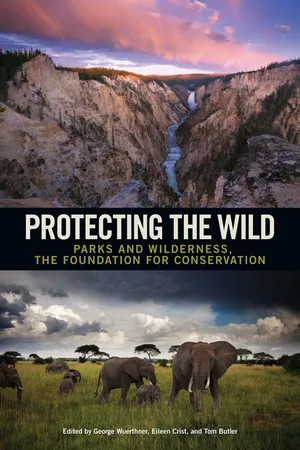
eBook - ePub
Protecting the Wild
Parks and Wilderness, the Foundation for Conservation
- 364 pages
- English
- ePUB (mobile friendly)
- Available on iOS & Android
eBook - ePub
Protecting the Wild
Parks and Wilderness, the Foundation for Conservation
About this book
[ONE]
BOLD THINKING ABOUT PROTECTING THE WILD
Nature Needs (at least) Half: A Necessary New Agenda for Protected Areas
HARVEY LOCKE
I ARGUE THAT CONSERVATION TARGETS should be based on what is necessary to protect nature in all its expressions. When in 1987 the Brundtland Report called for tripling the world’s protected area estate (which was then at 3–4 percent of the land area) there was a strong belief that sustainable development would ensure the proper care for nature on the rest of the unprotected Earth. This has proven wrong. We therefore must materially shift our protected areas target to protect at least half of the world—land and seas—in an interconnected way to conform with what conservation biologists have learned about the needs of nature. Instead, we have set goals that are politically determined, with arbitrary percentages that rest on an unarticulated hope that such nonscientific goals are a good first step toward some undefined, better, future outcome. This has been a destructive form of self-censorship. It is time for conservationists to reset the debate based on scientific findings and assert nature’s needs fearlessly.
It is well-settled scientifically that humanity’s relationship with the natural world is in trouble. The Intergovernmental Panel on Climate Change stated bluntly: “The resilience of many ecosystems is likely to be exceeded this century by an unprecedented combination of climate change, associated disturbances (e.g., flooding, drought, wildfire, insects, ocean acidification), and other global change drivers (e.g., land use change, pollution, overexploitation of resources).”1 The human species has become so dominant that some argue we have entered a new geological age dominated not by the chemical and physical workings of the Earth as they exist under their own motion from time to time but by us humans and they propose we call this new period “the Anthropocene.”2
This is not new. Our species’ troubled relationship with nature has been widely understood for twenty-five years. In 1987 the United Nations published Our Common Future, known widely as the Brundtland Report. It stated: “As the century closes, not only do vastly increased human numbers and their activities have that power [to alter planetary systems], but major unintended changes are occurring in the atmosphere, in soils, in waters, among plants and animals and in the relationships among all these.”3 A few years later the “World Scientists’ Warning to Humanity,” which was signed by the majority of the living Nobel Prize winners in science at the time, said starkly: “Human beings and the natural world are on a collision course. Human activities inflict harsh and often irreversible damage on the environment and on critical resources. If not checked, many of our current practices put at serious risk the future that we wish for human society and the plant and animal kingdoms, and may so alter the living world that it will be unable to sustain life in the manner that we know. Fundamental changes are urgent if we are to avoid the collision our present course will bring about.”4
The concerned scientists identified the need to bring environmentally damaging activities under control in order “to restore and protect the integrity of the earth’s systems we depend on” and stated that “we must halt deforestation, injury to and loss of agricultural land, and the loss of terrestrial and marine plant and animal species.”5
The first global conservation targets for protected areas: 10 or 12 percent
Protected areas were identified by the authors of the Brundtland Report as a critical response to the troubled relationship between humanity and the rest of nature. They called them “areas managed explicitly to conserve species and ecosystems” and stated: “Conservation of living natural resources—plants, animals, and micro-organisms, and the non-living elements of the environment on which they depend—is crucial for development. Today the conservation of wild living resources is on the agenda of governments: Nearly 4 percent of the Earth’s land area is managed explicitly to conserve species and ecosystems, and all but a small handful of countries have national parks.” The chapter concluded, “a consensus of professional opinion suggests that the total expanse of protected areas needs to be at least tripled if it is to constitute a representative sample of Earth’s ecosystems.”6 This led to the first widely accepted goals for protected areas. Depending on who did the math it became the 10 percent goal or the 12 percent goal for global protected areas. Note that the goal spoke to representation of ecosystems.
A global target emerges from the Convention on Biological Diversity
The urgency of the scientific declarations in the late 1980s and early 1990s about humanity’s failing relationship with nature led to the Earth Summit in Rio di Janeiro in 1992. Many of the world’s political leaders attended. They signed two conventions intended to confront the integrated problems: the Framework Convention on Climate Change and the Convention on Biological Diversity.7 The objective of the Convention on Biological Diversity (CBD) is “the conservation of biological diversity, the sustainable use of its components and the fair and equitable sharing of the benefits arising out of the utilization of genetic resources.” Biological diversity was defined as “the variability among living organisms from all sources including, inter alia, terrestrial, marine and other aquatic ecosystems and the ecological complexes of which they are part; this includes diversity within species, between species and of ecosystems.”8
The CBD’s provisions institutionalized protected areas as a key strategy to protect biodiversity. The CBD defines a protected area as “a geographically defined area which is designated or regulated and managed to achieve specific conservation objectives.” It provides at Article 8 for “In-situ Conservation,” and the first five items speak directly to protected areas:
Each Contracting Party shall, as far as possible and as appropriate:
a)Establish a system of protected areas or areas where special measures need to be taken to conserve biological diversity;
b)Develop, where necessary, guidelines for the selection, establishment and management of protected areas or areas where special measures need to be taken to conserve biological diversity;
c)Regulate or manage biological resources important for the conservation of biological diversity whether within or outside protected areas, with a view to ensuring their conservation and sustainable use;
d)Promote the protection of ecosystems, natural habitats and the maintenance of viable populations of species in natural surroundings;
e)Promote environmentally sound and sustainable development in areas adjacent to protected areas with a view to furthering protection of these areas.9
In 2002 the parties to the CBD did a strange thing. They set a nonnumerical goal that was designed to slow down the bleeding of life from the Earth but did not seek expressly to conserve biodiversity. The goal was “to achieve by 2010 a significant reduction of the current rate of biodiversity loss at the global, regional and national level as a contribution to poverty alleviation and to the benefit of all life on Earth.”10
In the Foreword to the 2010 Global Biodiversity Outlook 3, an assessment of the state and trends of biodiversity in the world, UN Secretary General Ban-Ki Moon summarizes how ineffective this “slow-the-bleeding” approach was: “In 2002, the world’s leaders agreed to achieve a significant reduction in the rate of biodiversity loss by 2010. Having reviewed all available evidence, including national reports submitted by Parties, this third edition of the Global Biodiversity Outlook concludes that the target has not been met.”11
In 2012, at Nagoya, Japan, the failure of this approach was recognized by the parties to the CBD and a more specific Target 11 for protected areas was set: “By 2020, at least 17 percent of terrestrial and inland water, and 10 per cent of coastal and marine areas, especially areas of particular importance for biodiversity and ecosystem services, are conserved through effectively and equitably managed, ecologically representative and well connected [sic] systems of protected areas and other effective area-based conservation measures, and integrated into the wider landscapes and seascapes.”12
While these references to protected areas in the broader landscape and connectivity are important new developments, no scientific rationale is given for the protected area targets of 17 percent land and 10 percent marine. Nor was a longer-term target set against which these might be considered mileposts. In 1998, one of the fathers of conservation biology, Michael Soulé, and his then student, M. A. Sanjayan, published a provocative article “Conservation Targets: Do They Help?,” in which they demonstrated that protecting only 10 percent of the Earth would not protect biodiversity.13 No other publication has scientifically defended such low numerical targets.
What scientific analysis suggests protected area targets ought to be
In a world where humans were just one species interacting among many we would not need protected areas. This was the case for most of human history. Now we need them.
It is clear from a plain reading of its text that the goal of the CBD (and by extension of the 193 state parties to it) is to preserve nature, defined as biodiversity, with protected areas as an essential tool. It should follow that all the work done in furtherance of that Convention should be based on the best scientific answer to the question: “What does nature need in order to conserve biodiversity and how do we get there given the desires of humans?” Strangely that is not what has happened. Instead, the focus has been: “What are humans willing to spare?” This is, of course, political, not scientific, and suffers from the basic flaw that it does not seek an effective solution to the problem the CBD was created to address. So what is the best scientific information on how much we should protect?
Reed Noss and Allen Cooperrider concluded that in most regions 25–75 percent (or on average 50 percent) of an area will need protection to maintain biodiversity and ecological processes.14 A poetic suggestion for the amount of protected areas needed came from biologist and author E. O. Wilson who called for “half the world for humanity, half for the rest of life, to make a planet both self-sustaining and pleasant.”15 Tropical ecologist John Terborgh noted that half the world was degraded and called for the protection of the other half.16 Robert Pressey and colleagues noted that “recent comprehensive conservation plans have delineated around 50% or more of regions for nature conservation.”17 Leona Svancara and coauthors reviewed 159 articles reporting or proposing 222 conservation targets and assessed differences between policy-driven and evidence-based approaches.18 By “evidence-based approaches” they meant an adequate understanding and mapping of the distribution and viability of the conservation requirements of individual biodiversity features, such as species and vegetation types, and found that the average percentages of area recommended for evidence-based targets were nearly three times as high as those recommended in policy-driven approaches.
Coordinated by the Canadian Boreal Initiative, 1500 scientists, from more than 50 countries around the world, came together to write to Canadian governments to urge protection of “in the range of half” of that country’s vast boreal forests. Their letter included the following succinct summary of the widely known conservation science:
The relatively intact state of Canada’s northern Boreal region provides an opportunity to implement conservation strategies to protect the region’s ecological integrity. The field of conservation biology identifies four objectives that must be achieved to ensure the long-term viability of an ecosystem: 1) all native ecosystem types must be represented in protected areas; 2) populations of all native species must be maintained in natural patterns of abundance and distribution; 3) ecological processes such as hydrological processes must be maintained; and 4) the resilience to short-term and long-term environmental change must be maintained. Achieving these objectives requires an extensive interconnected network of protected areas and sustainable management of the surrounding areas. Reviews of previous conservation planning initiatives provide further direction by indicating that protected areas should cover in the range of half of the landscape to achieve the objectives listed above.19
Note that representation, the basis of the 10 percent or 12 percent goal that began with the Brundtland Report, remains fundamentally important but is only one of four elements needed to sustain ecosystems over time.
Ana Rodrigues and Kevin Gaston considered the needs of species and found the minimum percentage of area needed to represent all species within a region increases with the number of targeted species, the size of selection units, and the level of species’ endemism and stated that “the 10% target proposed by the International Union for Conservation of Nature (IUCN) is likely to be wholly insufficient, and that much larger fractions of area are estimated to be needed, especially in tropical regions.”20 In 2004 The Nature Conservancy, The Nature Conservancy of Canada and other partners concluded their multi-expert-driven assessment of an area of mountains and valleys that straddles the Canada-U.S. border. The goal of the conservation assessment was to identify the suite of conservation sites and strategies that ensure the long-term survival of all native plant and animal species and natural communities in the region. They assessed with a coarse filter 40 terrestrial systems and 77 aquatic systems, and with a fine filter 75 rare plant communities, 95 rare plants, and 56 animals. They combined target plant and mammal species (both terrestrial and aquatic) in a SITES optimization model. They concluded that 49.7 percent of the r...
Table of contents
- Cover
- Title Page
- Copyright
- Dedication
- Contents
- Foreword
- Introduction: Protected Areas and the Long Arc Toward Justice
- Part One: Bold Thinking About Protecting the Wild
- Part Two: Rewilding Earth, Rewilding Ourselves
- Part Three: Protected Areas: The Foundation for Conservation
- Afterword
- Acknowledgments
- Contributors
- Notes
- Index
Trusted by 375,005 students
Access to over 1.5 million titles for a fair monthly price.
Study more efficiently using our study tools.
Information
Publisher
Island PressYear
2015Topic
Biological SciencesPrint ISBN
9781610915489
eBook ISBN
9781610915519
Index
Biological SciencesFrequently asked questions
Yes, you can cancel anytime from the Subscription tab in your account settings on the Perlego website. Your subscription will stay active until the end of your current billing period. Learn how to cancel your subscription
No, books cannot be downloaded as external files, such as PDFs, for use outside of Perlego. However, you can download books within the Perlego app for offline reading on mobile or tablet. Learn how to download books offline
Perlego offers two plans: Essential and Complete
- Essential is ideal for learners and professionals who enjoy exploring a wide range of subjects. Access the Essential Library with 800,000+ trusted titles and best-sellers across business, personal growth, and the humanities. Includes unlimited reading time and Standard Read Aloud voice.
- Complete: Perfect for advanced learners and researchers needing full, unrestricted access. Unlock 1.5M+ books across hundreds of subjects, including academic and specialized titles. The Complete Plan also includes advanced features like Premium Read Aloud and Research Assistant.
We are an online textbook subscription service, where you can get access to an entire online library for less than the price of a single book per month. With over 1.5 million books across 990+ topics, we’ve got you covered! Learn about our mission
Look out for the read-aloud symbol on your next book to see if you can listen to it. The read-aloud tool reads text aloud for you, highlighting the text as it is being read. You can pause it, speed it up and slow it down. Learn more about Read Aloud
Yes! You can use the Perlego app on both iOS and Android devices to read anytime, anywhere — even offline. Perfect for commutes or when you’re on the go.
Please note we cannot support devices running on iOS 13 and Android 7 or earlier. Learn more about using the app
Yes, you can access Protecting the Wild by George Wuerthner, Eileen Crist, Tom Butler, George Wuerthner,Eileen Crist,Tom Butler in PDF and/or ePUB format, as well as other popular books in Biological Sciences & Environmental Conservation & Protection. We have over 1.5 million books available in our catalogue for you to explore.