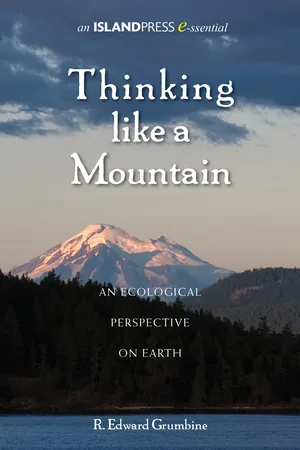
In Thinking Like a Mountain, we have excerpted a clear and inviting introduction to the science of conservation biology from Ed Grumbine's previous book, Ghost Bears. Grumbine offers a succinct and evocative description of why we should all care about biodiversity, protected lands, connectivity, and extinction rates, and the advantages to be gained by attempting to 'think like a mountain', as so eloquently phrased by Aldo Leopold.
- English
- ePUB (mobile friendly)
- Available on iOS & Android
eBook - ePub
About this book
Information
Subtopic
EcologyIndex
Biological SciencesIntroduction
In July 2011, a photograph of a mature grizzly bear was published in the Seattle Times, proving that the animal still wanders the Greater North Cascades Ecosystem in Washington state and southern British Columbia. The last picture of a grizzly in the region had been snapped in 1996, though indirect evidence (tracks, scat) showed grizzlies to be in the greater ecosystem since about the time Ghost Bears was first published in 1992. Biologists believe that there are some 20 animals roaming the North Cascades backcountry, but people almost never encounter them; this is one reason why I chose the book’s title.
But there were other reasons to consider grizzly bears as ghosts in the greater North Cascades. I wrote Ghost Bears to help readers to understand the just-evolving science of conservation biology with its emphasis on protecting biological diversity, to explain how species like grizzlies may remain present in ecosystems even as they fade away to become less-functional members of natures’ uncertain order, and to track how U.S. environmental laws, policies, and values were set to accommodate these new scientific insights—or not. With a new photograph of the ghost bear to rekindle a sense of both fear and respect in the fate of this iconic predator, along with 20 years of insights about conservation science and policy implementation in the US, here is a brief update of ghost bears, greater ecosystems, and the biology of thinking like a mountain.
Twenty years in time is nothing to a mountain, maybe more important to a bear. But the last two decades have been critical for the development of our scientific understanding of what makes nature tick. We have also deepened our comprehension of the reasons why we need to do more to protect the ecosystems that we call home. The trouble is, while we increasingly grasp the biology of thinking like a mountain, we still cannot manage to act, in Aldo Leopold’s famous phrase, as “plain members and citizens” of Earth.
When I wrote chapter two of Ghost Bears, I wanted to explore “how humans, with their view of nature limited by a short-term, seventy-odd- year stay, might learn about the long run from Koma Kulshan”, Mount Baker, the icy totem presiding over the greater North Cascades. I personified Koma Kulshan, rock and ice, giving the mountain eyes and a voice. What the mountain saw in 1992—the biodiversity crisis born of “inadequate nature reserves, human overpopulation, nonsustainable resource consumption, . . . impending rapid climate change, and imperfect laws”—is considerably more advanced today. Protected areas are increasingly segregated from their surroundings, the latest U.N. population data projects more people on the planet by 2050 than the numbers I used in Ghost Bears, and globalization in general and the rise of China’s consumer masses in particular have ratcheted all of us closer to resource limits. The only major change in my earlier narrative is that climate change is no longer “impending”, it is here.
To encourage general knowledge about biodiversity and to guide readers toward the realization that biodiversity is about much more than numbers of species, I portrayed Koma Kulshans’ key message as “think big, think connected, think whole”. And while we have gotten better at such thinking, we have yet to link our scientific knowledge with decisive conservation action on the ground. Our failures are manifest. Grizzlies in the North Cascades remain unlisted as a separate subpopulation under the Endangered Species Act. The law has never been updated since Ghost Bears was published, despite ample scientific evidence to do so. Climate change impacts, conservation linkages, insights from landscape and disturbance ecology—none of these are reflected in current law. In fact, every President since I wrote the book has attempted to weaken the Act; the most recent incursion came in March 2012 when the Obama Administration tried to narrow the definition of “significant” when defining range requirements for listed species.
Beyond species-level concerns, there has been particular scientific interest in how to design and manage protected areas in the face of ever-increasing habitat fragmentation across US landscapes. Conservation biologist David Theobald and coauthors recently located lands with high importance for connectivity and found that while about 15 percent of these places were already protected, 57 percent had no protection at all. Every conservation biologist recognizes the importance of linking protected areas into larger landscapes. Every course in every university now teaches the importance of connectivity and that is progress, but little of this science has found its way into federal or state policy. In U.S. biodiversity policy making, there appears to be an inverse relation between biological knowledge and the political will to act.
There have been some positive trends. The Clinton Administration’s 1994 Northwest Forest Plan dramatically lowered cut levels across federal timber lands in an effort to protect the Northern Spotted Owl. The cut has shrunk by billions of board feet reducing pressure on primary forests, the owl and a host of other old growth-dependent species. The economy in the Pacific Northwest has adjusted, though not without economic pain and frustration for some during the transition. But populations of the Northern Spotted Owl continue to decline at the alarming rate of about 4 percent a year due to a complex ecological combination of habitat fragmentation, reproductive stress, and the spread of the Barred Owl, a non-native predator. Despite great efforts, one of conservation biology’s policy implementation success stories may still not be enough to provide long-term viability to a creature that grabbed the headlines throughout the 1990s.
Mountains don’t ask questions, but many people want to know: Why take all the trouble to save a bird that few people have ever seen, or a bear that can attack and kill humans? One answer to these questions since Ghost Bears appeared has been to attempt to place monetary value on nature’s services. If we can’t care enough to act on biodiversity’s behalf simply because we share the same planet with the rest of the host of life, maybe better behavior could be fostered if a majority came to realize the unfathomable economic cost of paying for all the clean air, clean water, and nutrient recycling that nature provides for free. Science is supportive of this approach. In early June 2012, a paper published in Nature confirmed that the general value of biodiversity is especially high since reducing it causes ecosystems to become less efficient at producing biomass, recycling processes lag, and food chains across food webs tend toward instability. I summed this up in “The Biology of Thinking Like a Mountain” by writing that, from an ecosystem services perspective, “people are utterly dependent on biodiversity.” But, so far, biological or economic meta-analyses of the consequences of reducing biodiversity have not done much to alter peoples’ everyday behavior.
After another 20 years of losing more biodiversity than anyone can afford, people still have not learned to think like mountains. As a society, Americans cannot even define the parameters of an acceptable health care system, or to decide what degree of climate impacts we are willing to bequeath to our children. So, of course, we remain unable to act to protect species and ecosystems.
People thinking like mountains? Maybe this sets the bar too high, but I don’t believe so. As an intelligent species, we are dependent on our vision and our voice to communicate and thrive. And despite the best efforts of an author’s imagination, mountains cannot use language nor do they have eyes with which to see. Even species with the gift of sight cannot see ghosts; they are limited by the confines of their cultural vision.
But the grizzly bear persists, the fact of greater ecosystems will not fade away. Mountains may be silent, but they also lift the human spirit; they are role models for the longrun and the far-reaching view.
The Biology
of Thinking
Like a Mountain
of Thinking
Like a Mountain
On any clear day from the summit crater of Mount Baker, the North Cascades range is transformed magically. The spectacular climax of old-growth forests, wild, glacier-gouged valleys, and endless unpeopled mountains that most humans know as North Cascades National Park expands into a larger world of oceanic clouds and geologic strata thrust skyward by the force of drifting continents. In fertile lowlands below, between the mountains and the sea, people cluster in cities and suburbs and spread up broad river valleys in towns and on farms. This sweeping view of a mountain range of inspiring size and wildness is experienced as but a small part of the planet—it can be teased from a map, almost touched from an airplane—but you still feel, standing on the peak, as if you are at a still point of the turning world.
The Lummi Indians knew Mount Baker as Koma Kulshan, the “Great White Watcher.” What does the mountain see? Is there hidden meaning in the cloud masses that roll eastward off the Pacific and drench the western slopes of the Cascades with life-giving snow and rain? What is it like to participate in the creation of weather, to be a working part of the North Cascades? What wisdom may be gained from standing in one place for 700,000 years, experiencing time at the pace of millennia? Aldo Leopold, in A Sand County Almanac, believed that “only the mountain has lived long enough to listen objectively to the howl of a wolf.” If this is true, humans, with their view of nature limited by a short-term, seventy-odd-year stay, could learn about the long run from Koma Kulshan. If we could somehow query the mountain about the health of the Greater North Cascades neighborhood, what would the nature of its reply be?
I imagine Koma Kulshan would provide several answers, and at different scales of space and time. To a smoking volcano, a 600-year-old Douglas-fir lives for a month and a 40,000-acre forest fire is an itch on an elbow. To facilitate communication, the mountain would have to telescope its vast experience into terms and a time frame meaningful to humans, say, the last few hundred years.
To begin, the mountain might note that only 3.2 percent of the Earth’s surface has been protected in parks, reserves, and wildlife sanctuaries.[1] A little over 4 percent of the United States is protected as wilderness, leaving about 95 percent open to development. At the scale of Washington State, about 12 percent of all lands are set aside. Throughout the world, the country, and the Pacific Northwest, mountain ranges are relatively well protected. A glance at any map shows that parks and reserves are clustered in the scenic high country. Koma Kulshan is part of the Mount Baker Wilderness and the North Cascades are chock-full of parks, wildlands, and roadless areas. What does this mean for ecosystems outside of the highlands? Because of their relatively harsh climate, mountains, in general, do not harbor the diversity of life that is found in river valleys, foothills, marshes, and plains. In California, for example, 95 percent of alpine ecosystems are protected while less than 1 percent of riparian communities, which have the greatest species diversity, are in reserves.[2] This pattern, found throughout the world, has evolved because humans proclaim preserves based on how they look aesthetically, not on how they work ecologically.
Adopting a mountain’s perspective might help us to consider the long-term implications of this practice. Turning from the high country to human cities in the lowlands, Koma Kulshan would ponder the population growth of Homo sapiens.
Seattle and the cities of Puget Sound are booming. The growth rate of the United States as a whole is beginning to edge upward again. On a planetary scale, the United Nations predicts that thirty-five years from now humans may number 8.5 billion, with the increase since 1950 equaling the total increase over the millions of years since the species first emerged.[3] Demographers suggest that if present trends continue, the world’s population will probably level off in about a hundred years at around 10 to 12 billion people, double what it is today. Some biologists have already calculated that it will take five hundred to one thousand years before human numbers drop back down to an “optimum” level, barring famines, epidemics, and wars.[4] What havoc would these numbers wreak on the rest of Earth’s life forms?
Though the link between population growth and resource consumption is sometimes difficult for people to discern, it would seem clear as unsullied air to a mountain. The old-growth forests at the foot of Koma Kulshan in the western North Cascades are falling faster than they can grow back. On all the westside national forests in Oregon and Washington the cut level mandated for 1991 was 3.45 billion board feet (bbf), yet studies taking ancient-forest ecosystem protection and the northern spotted owl into account suggest that less than half that amount could be cut on a sustained-yield basis.[5] At the global level, resource consumption faces obvious limits. As biologists Paul Ehrlich and E. O. Wilson make abundantly clear, if growth in human population is multiplied by per capita aspiration for material goods, the future for undeveloped lands is grim.[6] Topsoils worldwide are being eroded at many times the rate at which they are formed. The United States is losing excessive amounts of soil on 44 percent of its cropland.[7] On another front, if the people of India owned automobiles on the same per capita basis as Americans, the subcontinent would be clogged with 440 million vehicles, almost four times the number that exist in the United States today.[8] Global oil and gas consumption and atmospheric pollution would be radically increased.
Koma Kulshan’s eye sweeps south of the Columbia River and north to the dry ranges of interior British Columbia, where the Cascades settle into foothill forests of ponderosa pine. It notes that the North Cascades grizzly bear population is down to maybe ten, that salmon runs are greatly diminished, that scores of Northwest species are at risk, and that thro...
Table of contents
- Cover
- TitlePage
- CopyrightInformation
- AboutIslandPressEssentials
- Introduction
- Introduction-1
- Chapter
- Chapter-1
- AboutTheAuthor
- FurtherReading
- AboutIslandPress
- AboutIslandPress-1
- AboutIslandPress-2
Trusted by 375,005 students
Access to over 1.5 million titles for a fair monthly price.
Study more efficiently using our study tools.
Frequently asked questions
Yes, you can cancel anytime from the Subscription tab in your account settings on the Perlego website. Your subscription will stay active until the end of your current billing period. Learn how to cancel your subscription
No, books cannot be downloaded as external files, such as PDFs, for use outside of Perlego. However, you can download books within the Perlego app for offline reading on mobile or tablet. Learn how to download books offline
Perlego offers two plans: Essential and Complete
- Essential is ideal for learners and professionals who enjoy exploring a wide range of subjects. Access the Essential Library with 800,000+ trusted titles and best-sellers across business, personal growth, and the humanities. Includes unlimited reading time and Standard Read Aloud voice.
- Complete: Perfect for advanced learners and researchers needing full, unrestricted access. Unlock 1.5M+ books across hundreds of subjects, including academic and specialized titles. The Complete Plan also includes advanced features like Premium Read Aloud and Research Assistant.
We are an online textbook subscription service, where you can get access to an entire online library for less than the price of a single book per month. With over 1.5 million books across 990+ topics, we’ve got you covered! Learn about our mission
Look out for the read-aloud symbol on your next book to see if you can listen to it. The read-aloud tool reads text aloud for you, highlighting the text as it is being read. You can pause it, speed it up and slow it down. Learn more about Read Aloud
Yes! You can use the Perlego app on both iOS and Android devices to read anytime, anywhere — even offline. Perfect for commutes or when you’re on the go.
Please note we cannot support devices running on iOS 13 and Android 7 or earlier. Learn more about using the app
Please note we cannot support devices running on iOS 13 and Android 7 or earlier. Learn more about using the app
Yes, you can access Thinking Like a Mountain by R. Edward Grumbine in PDF and/or ePUB format, as well as other popular books in Biological Sciences & Ecology. We have over 1.5 million books available in our catalogue for you to explore.