"Illuminating." —New York Times
WIRED's Required Science Reading 2016
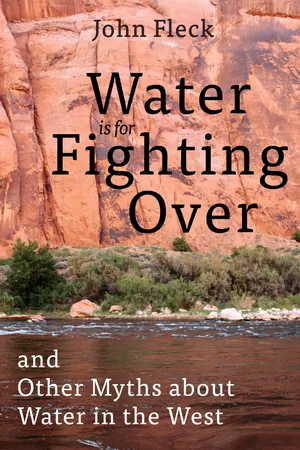
When we think of water in the West, we think of conflict and crisis. In recent years, newspaper headlines have screamed, “Scarce water and the death of California farms,” “The Dust Bowl returns,” “A ‘megadrought’ will grip U.S. in the coming decades.” Yet similar stories have been appearing for decades and the taps continue to flow. John Fleck argues that the talk of impending doom is not only untrue, but dangerous. When people get scared, they fight for the last drop of water; but when they actually have less, they use less.
Having covered environmental issues in the West for a quarter century, Fleck would be the last writer to discount the serious problems posed by a dwindling Colorado River. But in that time, Fleck has also seen people in the Colorado River Basin come together, conserve, and share the water that is available. Western communities, whether farmers and city-dwellers or US environmentalists and Mexican water managers, have a promising record of cooperation, a record often obscured by the crisis narrative.
In this fresh take on western water, Fleck brings to light the true history of collaboration and examines the bonds currently being forged to solve the Basin’s most dire threats. Rather than perpetuate the myth “Whiskey's for drinkin', water's for fightin' over," Fleck urges readers to embrace a new, more optimistic narrative—a future where the Colorado continues to flow.
- 248 pages
- English
- ePUB (mobile friendly)
- Available on iOS & Android
eBook - ePub
About this book
CHAPTER 1
Rejoining the Sea
STANDING IN THE DRY BED of the Colorado River at San Luis in the Mexican state of Sonora, just south of the Arizona border, Manuel Campa was insistent. The Mexican border city, perched on a low mesa to the east, is not just “San Luis.” It is “San Luis Río Colorado.” “It’s the only city that has the name ‘Río Colorado,’” Campa, technical director of the city’s water utility, told me as we strolled the river’s sandy bottom on a warm spring morning. It took imagination to grasp what Campa was getting at. Nineteenth-century steamboats once passed this spot. The Colorado was once a river here.
No more. The only thing capable of navigating the Río Colorado’s bed that day was a four-wheeler with fat tires. Tamarisk, a scrappy invasive shrub, had long ago replaced native cottonwoods and willows along the river channel.1 Water-loving beavers, once common, seemed a comic impossibility.2
Over the last century, we have taken the river’s water, moving it through dams and canals to grow a hydraulic empire of farms and cities across the semi-arid Colorado River Basin. By the time the Colorado River approaches its feeble desert end, most of its water has been diverted to Denver, Albuquerque, Phoenix, Las Vegas, Los Angeles, Mexicali, and vast farmlands in between. Morelos Dam, twenty-two miles upstream from San Luis, diverts Mexico’s share of the water—the last of the river—to the rich, productive farmland of the Mexicali Valley and cities to the west.

Colorado River Basin.
The first time I saw this, I was stunned. Driving the Yuma County levee past Morelos Dam in 2010, I saw the last trickles of water from leaks in the dam and a shallow water table disappear within a few miles into a sandy, dry channel. This great river, the Colorado, around which I have spent much of my life, whose water I have showered with and drunk, which has grown the food I eat and floated my boats for hundreds of miles, simply disappears into the desert sand.
But that spring day in 2014, Campa and I were awaiting something remarkable. In the midst of fourteen years of drought, with reservoirs dropping upstream and fears of water shortage gripping the Colorado River Basin, water managers were creating a modest “pulse flow,” meant to mimic a natural spring flood through the desiccated delta.
It was a test of how much water would be needed for native plants to come back to life and repopulate the area. But as the water arrived at San Luis, and for the weeks after, it became something more. The usually dry riverbed past the town turned into a fiesta as children who had never seen water here frolicked in a briefly flowing Río Colorado. And at another, deeper level, it demonstrated unprecedented international cooperation to achieve a goal once thought impossible.
Chinatown
As California burned through the summer of 2015, its fourth year of drought, geographer Daniel Grant described the myriad photos of cracked reservoir mud and dried irrigation ditches and their accompanying headlines as part of a “genre of apocalyptic prophecy” that functions, according to Grant, “by diagnosing a human misalignment with nature, and foresees a future in which nature—as a kind of secular deity—punishes our errant behavior.”3
For much of my professional life as a writer, chronicling our uneasy existence in this arid place, I embraced this narrative. When I wrote stories about drought for the Albuquerque Journal, we had an office joke about “the obligatory cracked mud photo.” The paper’s photographers and I would hover over stream-gauge data to find the driest stretch of New Mexico’s rivers, and it was always a bonus if they came back with an image that included a dead fish to punctuate the message.
These stories resonate, dominating our understanding of life in the arid West. Thus it is that the classic movie Chinatown has come to stand in for the history of Los Angeles water. It is a tale of villains bent on profit, messing with nature, and ultimately punished for their sins. To many, Chinatown represents water management in LA, despite historians’ best efforts to remind us that it was just a movie, that things didn’t really happen that way.4 The apocalyptic vision isn’t limited to fiction. James Lawrence Powell, in his 2011 Colorado River history Dead Pool, predicts a Grapes of Wrath–like exodus from Phoenix.5
Perhaps no work is more important to the West’s narrative of crisis than journalist Marc Reisner’s epic Cadillac Desert, ominously subtitled The American West and Its Disappearing Water. Its core message, one commentator wrote later, was that the overbuilding of dams and overuse of water in the western United States would “catalyze an apocalyptic collapse of western US society.”6 Whether that is a fair characterization of Reisner’s work is an open question. Cadillac Desert has become shorthand for the water crisis, with all varieties of doom attributed to Reisner.
In fact, Reisner concentrated his fierce critique on what he saw as a corrupt process that overbuilt the West’s great plumbing system. The subtitle notwithstanding, Cadillac Desert spends little time on the “disappearing water,” or the actual human consequences of water shortages. But neither did Reisner shy away from apocalyptic rhetoric. In the 1993 afterword to the book’s second edition, Reisner was explicit. California had just experienced what was at the time its worst drought on record, which, Reisner said, “qualifies best as punishment meted out to an impudent culture by an indignant God.”7
Like many who manage, engineer, utilize, plan for, and write about western water today, I grew up with the expectation of catastrophe. I first wrote about water shortage in California during that same late-1980s–early-’90s drought Reisner bemoans. But as drought set in again across the Colorado River Basin in the first decade of the twenty-first century, I was forced to grapple with a contradiction: despite what Reisner had taught me, people’s faucets were still running. Their farms were not drying up. No city was left abandoned.
I began asking the same question, again and again: when the water runs short, who actually runs out? What does that look like? Far from the punishment of an indignant God, I found instead a remarkable adaptability. In Doña Ana County on the Rio Grande in southern New Mexico, I saw farmers idle alfalfa and cotton fields, crops that bring low returns for each gallon of water, shifting scarce supplies to keep high-dollar pecan orchards healthy and productive. As water supplies dropped to record lows, farmers continued to prosper. New Mexico’s cities fared just as well. In the midst of the drought, Albuquerque cut its per capita water use nearly in half, and the great aquifer beneath the city actually began rising as a result of a shift in supply and reduced demands. Across the Colorado River Basin, I found the same story over and over, from the fountains of Las Vegas and Phoenix to the farms of Imperial and Yuma counties, to the sprawling coastal metropolis of LA.
When people have less water, I realized, they use less water.
In spite of the doomsday scenarios, westerners were coping, getting along with their business in the face of less water. Things might have been easier had we not made the mistakes Reisner so ably documented, but we did what we did and, as scarcity sets in, we are adjusting to the new realities. I have witnessed this resilience time and again as I travel the hydraulic landscape of the western United States. This book chronicles my attempt to understand and explain where that ability to adapt comes from, how it works, and how we can call on it to get us through the hard times ahead.
The Myths
The catastrophe narrative isn’t just inaccurate—it promotes myths that actually stand in the way of solving our problems. Most obvious is the myth that “water’s for fighting over.” The quote is wrongly attributed to Mark Twain, but it’s also just plain wrong. Fighting rarely solves water problems, and scholars have found that collaborative agreements are far more common than winner-take-all fights, whether in the courts or with guns.
A corollary myth is that “water flows uphill toward money,” as if the rich will inevitably run roughshod over their neighbors in the coming water wars. But a century of water allocation law and policy shows this is simply false for the vast majority of the water in the United States. One need simply look at farming’s share of Colorado River water (some 70 to 80 percent) compared with its share of the economies of the US basin states (2 percent) to see the fallacy in that truism. The far-richer cities have far less water than their farming cousins.8
The most pervasive of the myths is that we are “about to run out of water.” I’ve heard it countless times, and it usually follows a predictable pattern. Today, we need this much water to support this many people and this much farming. As either grows, we’ll need more water, the narrative would suggest. When the “need” line crosses the supply line, we will “run out.” This ignores history, where again and again we have seen both city and farm communities adapt and continue to grow and prosper without using more water, often, in fact, using less. But that deeply held fear of “running out” of water feeds back into the first myths, triggering a limbic response to protect “our share” against others.
And therein lies the risk. If everyone ignores their own adaptive capacity and simply fights for more, or even fights for the share they’ve got now in a shrinking system, we are led headlong into conflict, with dangerous results. If instead we recognize our ability to make do with less, and invest in institutions that facilitate water sharing, we can create systems for robust, flexible, and equitable water allocation. Only then can we preserve the West that we all have come to inhabit, know, and love.
Stories of Success
There are success stories in the recent history of the Colorado River’s management.
The first type of success story involves communities that have found a way to use less water. It happens at many different scales and among many different types of water users.
Big cities, like Albuquerque and Las Vegas, have shown remarkable conservation success, with populations continuing to grow in recent decades even as water use goes down. Regional water managers at agencies like the Metropolitan Water District of Southern California and the Central Arizona Water Conservation District have developed innovative, flexible new approaches to managing supplies; storm-water capture, sewage reuse, aquifer storage, and other similar innovations have diversified sources of water and provided a buffer against drought.
Farm communities also have demonstrated the ability to do more with less, with agriculture thriving in California’s Imperial Valley and Yuma, Arizona, even as they face pressure from outsiders charging that their water use is wasteful.
These stories are crucial in part because they show communities working with the cards they were dealt. When fighting over water, it is easy to say, “We can no longer afford to grow alfalfa in the desert,” or “We can no longer afford a Phoenix or Las Vegas.” Simply cutting off a few limbs would eliminate the deficit that causes the reservoirs to keep dropping. I reject that approach for two reasons. First, there are questions of justice and equity in deciding which communities stay and continue to use water and which communities must go. Second, though, and more important, we have no omniscient power giving us the ability to decide which water uses will continue. When we decide our future, the Imperial Valley and Las Vegas are at the table, defending their right to exist. As a result, the only tractable plans are ones that work with current water users.
That reality points toward the second type of success story. At the scale of the entire Colorado River Basin, in the messy complex of governance that manages decisions about who gets how much of the big river’s water, we have made tremendous progress. Governments have banded together to come up with a plan to reduce California’s overuse of the river, and they’ve developed a deal with Mexico to share surpluses and shortages, and even to spare some precious water to return flows to the Colorado’s parched channel through its old Mexican delta. This was rarely easy, but it resulted in deals that benefited a spectrum of water users and community values.
Underlying both of these models of success is a willingness to recognize water problems and collaborate in solving them, often across geographic, political, and organizational boundaries. Conflict is sometimes a part of these processes, but ultimately success comes by avoiding fights over water.
But these successes have not been enough, something that can be seen most clearly in Lake Mead itself, the first great reservoir that stores the Colorado River’s water for millions of people downstream. Despite the hope offered by the success stories described above, we have not done enough. Lake Mead continues to shrink. Water users continue to take more out of the Colorado River system than nature puts in, keeping us on an unsustainable path.
Just as importantly, westerners have failed to notice their own successes. Seeing Lake Mead drop should encourage water users to redouble their efforts, to build on the extraordinary conservation programs they have created. But too often, it instead triggers fear, fueling the myths in a dangerous feedback loop. If I think I need more water, I am more likely to be willing to fight for it.

Egret on the Lower Colorado River (© Lissa Heineman).
San Luis Río Colorado
Beyond the water banking agreements and lawn buyback programs and agriculture-to-urban transfers that will be needed to succeed is a fuzzy, at times difficult to grasp, often imperfect but nevertheless critical element to solving the Colorado River’s problems. Participants have come to call it “the network.”
The network is a sometimes formal but often informal group of lawyers, engineers, hydrologists, farmers, water managers, diplomats, and environmentalists who have been working together on these issues, often for decades. Meeting in conferences, on river trips, and in hotel bars, they must hold the seemingly contradictory goals of zealously guarding their own communities’ water supplies while at the same time figuring out how we all can share as shortage looms.
This disparate group keeps what one participant has described as a “laser-like focus” on the big problems posed by the dropping reservoirs. They are the ones who have to figure out how our society can live with less water. This is where our adaptive capacity must come from.
Social scientists who study big, complex, sprawling problems like this call such collective problem solving “network governance.” The web of relationships among the people who carry it out is more expansively ...
Table of contents
- Cover
- About Island Press
- Title Page
- Copyright
- Dedication
- Contents
- Acknowledgments
- Chapter 1. Rejoining the Sea
- Chapter 2. Water Squandered on a Cow
- Chapter 3. Fountains in the Desert
- Chapter 4. Negotiating the Rapids
- Chapter 5. Arizona’s Worst Enemy
- Chapter 6. Averting Tragedy
- Chapter 7. Turning Off LA’s Tap
- Chapter 8. So Cal Cuts Back
- Chapter 9. The Great Fallowing
- Chapter 10. Emptying Lake Mead
- Chapter 11. Who’s Left Out?
- Chapter 12. A Beaver Returns to the Delta
- Chapter 13. Conclusion
- Notes
- Bibliography
- Island Press | Board of Directors
Trusted by 375,005 students
Access to over 1.5 million titles for a fair monthly price.
Study more efficiently using our study tools.
Information
Publisher
Island PressYear
2016Topic
Biological SciencesPrint ISBN
9781642830118
9781610916790
Subtopic
Environment & Energy PolicyeBook ISBN
9781610916806
Index
Biological SciencesFrequently asked questions
Yes, you can cancel anytime from the Subscription tab in your account settings on the Perlego website. Your subscription will stay active until the end of your current billing period. Learn how to cancel your subscription
No, books cannot be downloaded as external files, such as PDFs, for use outside of Perlego. However, you can download books within the Perlego app for offline reading on mobile or tablet. Learn how to download books offline
Perlego offers two plans: Essential and Complete
- Essential is ideal for learners and professionals who enjoy exploring a wide range of subjects. Access the Essential Library with 800,000+ trusted titles and best-sellers across business, personal growth, and the humanities. Includes unlimited reading time and Standard Read Aloud voice.
- Complete: Perfect for advanced learners and researchers needing full, unrestricted access. Unlock 1.5M+ books across hundreds of subjects, including academic and specialized titles. The Complete Plan also includes advanced features like Premium Read Aloud and Research Assistant.
We are an online textbook subscription service, where you can get access to an entire online library for less than the price of a single book per month. With over 1.5 million books across 990+ topics, we’ve got you covered! Learn about our mission
Look out for the read-aloud symbol on your next book to see if you can listen to it. The read-aloud tool reads text aloud for you, highlighting the text as it is being read. You can pause it, speed it up and slow it down. Learn more about Read Aloud
Yes! You can use the Perlego app on both iOS and Android devices to read anytime, anywhere — even offline. Perfect for commutes or when you’re on the go.
Please note we cannot support devices running on iOS 13 and Android 7 or earlier. Learn more about using the app
Please note we cannot support devices running on iOS 13 and Android 7 or earlier. Learn more about using the app
Yes, you can access Water is for Fighting Over by John Fleck in PDF and/or ePUB format, as well as other popular books in Biological Sciences & Environment & Energy Policy. We have over 1.5 million books available in our catalogue for you to explore.