A household icon of the environmental movement, Aldo Leopold (1887-1948) may be the most quoted conservationist in history. A Sand County Almanac has sold millions of copies and Leopold's writings are venerated for their perceptions about land and how people might live in concert with the whole community of life.
But who is the man behind the words? How did he arrive at his profound and poetic insights, inspiring generations of environmentalists? Building on past scholarship and a fresh study of Leopold's unpublished archival materials, Julianne Lutz Newton retraces the intellectual journey generated by such passion and intelligence.
Aldo Leopold's Odyssey illuminates his lifelong quest for answers to a fundamental issue: how can people live prosperously on the land and keep it healthy, too? Leopold's journey took him from Iowa to Yale to the Southwest to Wisconsin, with fascinating stops along the way to probe the causes of early land settlement failures, contribute to the emerging science of ecology, and craft a new vision for land use.
More than a biography, this articulate volume is a guide to one man's intellectual growth, and an inspirational resource for anyone pondering the relationships between people and the land.
eBook - ePub
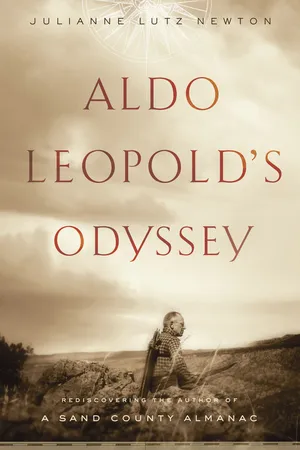
Aldo Leopold's Odyssey
Rediscovering the Author of A Sand County Almanac
- English
- ePUB (mobile friendly)
- Available on iOS & Android
eBook - ePub
About this book
Information
Print ISBN
9781597264426
9781597260459
Chapter 1
Seed Plots

The conservation of our natural resources and their proper use constitute the fundamental problem which underlies almost every other problem of our national life.
President Theodore Roosevelt, June 10, 1907
By 1909—the start of Aldo Leopold’s professional career—the United States had traveled far on a journey toward material prosperity within its continent of natural bounty. The New World was a cornucopia of land products. Already it had fed industrial revolutions in western Europe and in America, helping to transform the world. Its natural wealth also had stimulated the emergence of a new, multi-ethnic civilization—a capitalist industrial one characterized by individualism, faith in science and technology, democracy, and economic growth. Most Americans were engaged in a hopeful quest for progress, 1 and they were working hard at it, in a pulsing combination of people, land, and dreams. Fresh out of forestry school and assigned to America’s southwestern frontier, Leopold was caught up in the exciting bustle of the times, though doubts would soon arise in his mind about where the country was heading.
Progress in America was calculated largely in expanding ciphers. If emerging costs of growing prosperity were beginning to cast a shadow, for more than a hundred years the general trend on the development side of the national ledger had been upward. The geographic expansion of the nation itself, for example, had been extraordinary. The thirteen original states covered 210 million acres of land and water; by the early twentieth century the territory of the United States had swelled to nearly 2 billion acres with the addition of the Louisiana Purchase and the annexing of new states and territories. 2 From the beginning of the nineteenth century the U.S. population rose from 5 million people, with an average density of 7 people per square mile, to 88 million people, averaging 30 people per square mile by 1909.3 Homestead entries, too, continued to rise as more new settlers spread westward across the continent—1909 saw more than 12 million acres claimed, double the amount registered just a decade earlier.4
Many Americans evidently believed that decent lives might still be built by farming the land, and one-third of the 1909 laboring population, more than 12 million workers (including 6 million farmers), was engaged in agricultural pursuits, including dairying, lumbering, forestry, stock raising, and crop growing. Stocks of cattle, horses, sheep, mules, and swine had risen within a half century from 53 million to 206 million animals by 1909.5 The two largest cereal crops—corn and wheat—alone covered 57.5 million acres in 1870, and within forty years the acreage had nearly tripled.6 By then irrigation had allowed 10 million additional acres of dry, agriculturally unproductive land to grow grains, fruits, and vegetables.7
Just as agriculture was expanding and transforming the landscape, so, too, were industry and commerce. By the time Leopold began his career there were almost as many manufacturing workers in the nation as there were agricultural workers,8 and between 1850 and 1909 the combined value of manufactured products had risen from $1 billion to more than $20 billion, more than twice the value generated by the nation’s farms at the time.9 To distribute foods and manufactured goods—grains, cotton, livestock, coal, railroad ties, groceries, fabrics, ladies’ hats, linseed oil, and axle grease—and to boost overseas trade, an elaborate network of transportation and communication also was developing. In 1909 trains carried close to 1 billion passengers and more than 1.5 billion short tons of freight over 240,000 miles of rail lines.10 More than 2 million miles of public roads crossed the nation11 and millions of short tons of commodities were floated on the country’s inland rivers.12 By 1909, too, more than 8 million miles of telephone and telegraph wires knitted the countryside.13
The materials to develop America’s landscapes largely came from the land itself. If conventional indicators of national progress were showing steep upward trends, on the other side of the ledger the supplies of nature’s raw materials needed for such growth—minerals, timber, fish, soils—were noticeably declining. The nation’s forests, for example, had been heavily used to build America’s homes, farms, industries, and expanding networks. By the first decade of the twentieth century the forest products industry was the nation’s fourth largest (behind food products, textiles, and iron and steel industries), valued at more than $1 billion annually.14 In 1909 alone, for example, the steam and electric railroad industries purchased nearly 124 million hewed and sawed railroad ties—of oak, southern pine, cedar, chestnut, Douglas fir, tamarack, cypress, hemlock, and western yellow pine.15 The same year, railroads and other utilities together purchased 4 million wooden poles, mostly of cedar, chestnut, oak, pine, and cypress. 16 Fifteen billion roofing shingles were cut,17 and private mills produced 44 million M ft. of lumber18 that year for a multitude of building projects.19 Pine trees in southern states yielded 29 million gallons of turpentine for use in paint thinners, cleaners, electrical insulation, soaps, and sizing.20 Before European arrival, forests covered nearly half the country—around 1 billion acres.21 In the 250 years between 1600 and 1850 new settlers had deforested 173 million acres of the country. In the following half century almost twice that amount—an additional 323 million acres of forest—fell to the axe and saw. Barely 500 million acres of forest remained by 1909, when Leopold began his career as a forest ranger, and the cutting continued.22
By the late nineteenth century pressures on the forests had prompted efforts to promote their more efficient use. In 1905 the nation’s 60 forest reserves regulated activities on 56 million acres.23 Four years later, as Leopold began his career, these numbers, thanks largely to presidential proclamations made by Theodore Roosevelt,24 had risen sharply, to 150 national forests covering 172 million acres—all the responsibility of the USDA Forest Service, by then four years old.25
The national forests were created to protect the natural resources within them. They were to do this, however, not by preventing all uses but by managing forest resources better so that America’s progress could be ongoing. In fact, some of these forestlands remained open for homesteading and private settlement. The national forests also offered free timber to individual home owners for firewood and home-building projects. In 1909, under the program 33,431 citizens cut 105,205 M ft. of timber for private use.26 Commercial timber sales took an additional 352,000 M ft. that year,27 while leased grazing lands within national forests added up to 130 million acres and supported more than 9 million cattle, goats, hogs, horses, and sheep.28 Forest-use pressures were intense, and juggling all the demands on forest’s while keeping their productive capacities operative for present and future generations was the challenging task presented to the mostly young, all-male troupe of professional foresters.29

A photograph in Leopold’s collection. By 1909, when Leopold began his Forest Service career, the forest products industry was the country’s fourth largest, and about half of the nation’s 1 billion acres of forest had already been cut to help meet the growing demands of development.
OF MEN AND TREES
Aldo Leopold of Burlington, Iowa, at age twenty-two, received his Master of Forestry degree from the Yale Forest School in 1909 and immediately began work with the USDA Forest Service in Arizona. He was proud to be counted among the first of the nation’s scientifically trained foresters, and he dreamed of one day being supervisor of a public forest covering thousands, even millions, of acres. Just before graduation, a classmate had remarked, “I’d rather be a Supervisor than be the King of England.” Leopold heartily agreed.30 Forestry was heady work, given what forests had meant—and still meant—in the nation’s history. It was also sobering work, given the alarms raised about the decline in the nation’s available timber.
Among those showing the greatest concern about shrinking forests was Gifford Pinchot, founder of the Yale school and first chief of the Forest Service.31 By Pinchot’s estimate, with at least half of the nation’s timber already gone, the nation’s forests retained only a twenty-year supply of timber at the annual rate of use as the twentieth century began.32 Every year Americans were cutting at a rate up to two-thirds faster than the forests could grow. A timber famine was looming, Pinchot asserted, and it would “touch every man, woman, and child in all the land.”33 Pinchot’s warning echoed widely across the country, casting a shadow on the nation’s future and giving force to the conservation impulse.34 It added urgency to the labors of his young, developing Service, which was challenged to apply scientific management to keep timber flowing.
Worries about the nation’s declining forests extended to the cultural and political values that forests were said to promote. Writing in 1896, the influential historian Frederick Jackson Turner proclaimed forest clearings “the seed plots of American character.”35 Forests challenged pioneers one by one, family by family, to turn dense vegetation into gardens and groves for human habitation, in the process gaining self-reliance and fortitude—“a forest-change,”36 Turner called it. Forest clearing, that is, forged a new national type, the self-made man, free and equal—bearing the hope of a better future for himself and his community. This typical settler, Turner contended, displayed “faith in man, hope for democracy, belief in America’s destiny, [and] unbounded confidence in his ability to make his dreams come true.”37 The forest-forged man of action was quick to call on the national government “to break down the mountain barrier by internal improvements”38 so that no obstacle might frustrate his or his neighbors’ opportunities for economic prosperity. America’s aggressive forces of democracy and nationalism, Turner concluded, came “stark and strong and full of life.”39 And they emerged out of America’s forests.
These links between forests and America’s pioneering, self-reliant culture were later echoed in a 1940 novel, The Trees, by Conrad Richter. In Richter’s story a late eighteenth-century family, the Lucketts, headed west to Ohio from their home in Pennsylvania, which suffered from a “woods famine” and lack of reliable game. Arriving in Ohio’s unbroken forest, the Lucketts felt both the allure of natural abundance and the dark foreboding of land not yet refashioned by human hands:
They rounded a high ridge . . . for a moment Sayward reckoned that her father had fetched them unbeknownst to the Western ocean and what lay beneath was the late sun glittering on green-black water. Then she saw that what they looked down on was a dark, illimitable expanse of wilderness. It was a sea of solid treetops broken only by some gash where deep beneath the foliage an unknown stream made its way. . . . Though they waited here till night, the girl knew that no light of human habitation would appear except the solitary spark of some Delaware or Shawanee campfire. . . . This is the way it was, she would say to herself. Nowhere else but in the American wilderness could it have been. . . . “You can smell the game!” [Father said]. . . . “We mought even get rich and have shoes!” Sulie [the youngest] spoke out.40
The fictional Lucketts would face a host of struggles and griefs as their lives unfolded. Yet, because they and real settlers like them managed to endure, the generations that followed had not only shoes but a great deal more. Somehow the first crudely equipped settlers cleared a vast land, giving rise to a striving, energetic culture—first carving out simple and lonely dwellings, then creating forest neighborhoods with dirt paths and cartways. In time small settlements grew into towns linked by carriage roads and then railways. And at each step of development, forest products played a role. Timber formed and warmed houses, stores, churches, and courthouses. Shaped into logs and boards, it provided foundations for rail ties and supplied structure for iron and coal mines. Forest trees, forest clearings: from the beginning they played leading roles in America’s civilization-building story.

A photograph taken by Leopold near Plainfield, Wisconsin, around 1939. Tree stumps remained for years after a settler carved out a farm from the wilderness; the process, repeated by millions of people, transformed the country’s landscape.
SETTLING IN
Aldo Leopold’s first post with the Forest Service was as an assistant forester in a district containing some of the wildest landscapes remaining in the United States. Nothing could have pleased him more. Arriving in Springerville, Arizona, in July 1909, Leopold found grama grass underfoot and an endless sky overhead. Giving character to Forest District 3 were hollows fragrant with junipers and filled with the chatter of piñon jays. To the southwest were the alpine-tipped White Mountains and the Mogollon Rim; to the south-east, the tangled canyons of Blue River, full of wild cattle, wild turkeys, white-tailed deer, and mallards on the river flats. Looming large on the southern horizo...
Table of contents
- Title Page
- Copyright Page
- Dedication
- Table of Contents
- Preface
- Introduction - Launching Out
- Chapter 1 - Seed Plots
- Chapter 2 - Written on the Hills
- Chapter 3 - The Middle Border
- Chapter 4 - Interpreting Pharaoh’s Dream
- Chapter 5 - An American System
- Chapter 6 - A Common Concept of Land
- Chapter 7 - Ecological Poetry
- Chapter 8 - The Germ and the Juggernaut
- Chapter 9 - Wildlife and the New Man
- Chapter 10 - Knowin g Nature
- Chapter 11 - A New Kind of Conservation
- Notes
- Bibliography
- Sources of Illustrations and Excerpts
- Index
Trusted by 375,005 students
Access to over 1.5 million titles for a fair monthly price.
Study more efficiently using our study tools.
Frequently asked questions
Yes, you can cancel anytime from the Subscription tab in your account settings on the Perlego website. Your subscription will stay active until the end of your current billing period. Learn how to cancel your subscription
No, books cannot be downloaded as external files, such as PDFs, for use outside of Perlego. However, you can download books within the Perlego app for offline reading on mobile or tablet. Learn how to download books offline
Perlego offers two plans: Essential and Complete
- Essential is ideal for learners and professionals who enjoy exploring a wide range of subjects. Access the Essential Library with 800,000+ trusted titles and best-sellers across business, personal growth, and the humanities. Includes unlimited reading time and Standard Read Aloud voice.
- Complete: Perfect for advanced learners and researchers needing full, unrestricted access. Unlock 1.5M+ books across hundreds of subjects, including academic and specialized titles. The Complete Plan also includes advanced features like Premium Read Aloud and Research Assistant.
We are an online textbook subscription service, where you can get access to an entire online library for less than the price of a single book per month. With over 1.5 million books across 990+ topics, we’ve got you covered! Learn about our mission
Look out for the read-aloud symbol on your next book to see if you can listen to it. The read-aloud tool reads text aloud for you, highlighting the text as it is being read. You can pause it, speed it up and slow it down. Learn more about Read Aloud
Yes! You can use the Perlego app on both iOS and Android devices to read anytime, anywhere — even offline. Perfect for commutes or when you’re on the go.
Please note we cannot support devices running on iOS 13 and Android 7 or earlier. Learn more about using the app
Please note we cannot support devices running on iOS 13 and Android 7 or earlier. Learn more about using the app
Yes, you can access Aldo Leopold's Odyssey by Julianne Lutz Warren in PDF and/or ePUB format. We have over 1.5 million books available in our catalogue for you to explore.