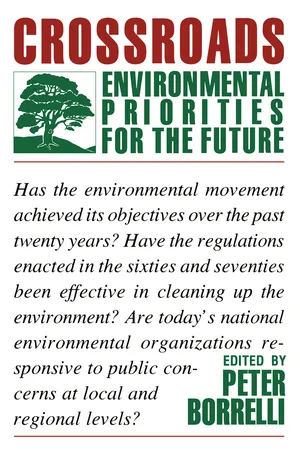
The environmental movement today is at a critical crossroads. Crossroads: Environmental Priorities for the Future is an in-depth assessment of the movement's successes and failures, and also offers prescriptions for the future. It includes contributions from some of the country's top environmental leaders and activists, including Barry Commoner, Stewart Udall, William K. Reilly, Gus Speth, Jay Hair, Lois Gibbs, Michael Frome, Chuck Little, and William Futrell.
- English
- ePUB (mobile friendly)
- Available on iOS & Android
eBook - ePub
About this book
Information
Part I
Trends
1
Environmentalism at a Crossroads
ONE OF THE BY-PRODUCTS of the Reagan era has been a rare degree of introspection among environmentalists. Obstacles placed in the way of aggressive environmental action—federal budget cuts, legislative stonewalling, and appointments committed to undoing the progressive gains of the sixties and seventies—have forced environmental advocates not only to try harder but to reexamine priorities and strategies.
For those who enlisted in the movement on Earth Day, and especially for those who already were active during the preceding decade, the Reagan era has been doubly difficult to cope with. During this period, some environmentalists have begun to feel that the idealism of the movement is mysteriously expiring. And the belief that environmental programs had been woven into the fabric of American society has been shaken, even shattered.
Reflection is proving to be both stabilizing and divisive. On the one hand, there is a growing consensus about priorities. On the other, the debate over tactics and management has torn apart some organizations and led to the proliferation of smaller, local organizations. Recently, The Amicus Journal asked nearly one hundred environmentalists around the country to reflect on the past, present, and future directions of the movement.
Every April, Gaylord Nelson, chairman of the Wilderness Society, is asked whatever happened to Earth Day. Where’s the razzmatazz, the crowd, the sense of purpose that attended the birth of the modern environmental movement?
The former U.S. senator from Wisconsin, who authored the legislation that proclaimed April 22,1970, Earth Day, usually returns an understanding smile and patiently explains that the media hype that occasioned the nationwide event was the means, not the end, of environmentalism. “Earth Day did not create the interest; all it gave was an opportunity to express itself. My sole purpose was to force the issue on the politicians and to make it a part of the national dialogue.”
During a fourteen-year career in state government, he had witnessed a deep-seated interest in the outdoors. Hunting, fishing, and camping were central to Wisconsin’s good life, and those who enjoyed it had begun to realize that the landscape of their youth was changing for the worse, that their love of country was growing in direct proportion to their hatred for the city, which often was the source of the countryside’s decline. Nationally, writers such as Rachel Carson, Aldo Leopold, and Paul Sears were alerting a growing army of citizens to the ravages and dangers of postwar growth and technology.
Despite this nascent concern, the conservation movement was still largely a movement of nature lovers who joined in the National Audubon Society’s Christmas bird count, hiked with the Sierra Club, or fished with the Izaak Walton League. Earth Day had a metamorphic and democratizing effect. Both strains of the American conservation movement—the pragmatic reform tradition established by Teddy Roosevelt and Gifford Pinchot, and the preservationist tradition established by Henry David Thoreau and John Muir—expanded their agendas and took on new members by the thousands. The common denominator was pollution, and for a short time there was a merger of the political left and right, radicals and reformers, professionals and volunteers. The outcome was one of the major social movements of the twentieth century.
Recalling his arrival in Washington, D.C., in 1963, Nelson says, “There were not more than five broad-gauged environmentalists in the Senate: Lee Metcalf, Ed Muskie, Frank Church, Clinton Anderson, Hubert Humphrey.” When he introduced a ban on DDT during his freshman year, John Dingell (D-Michigan) was the only representative willing to sponsor a companion bill in the House. By comparison, today he believes that “all one hundred senators would claim to be environmentalists, and at least fifty to sixty are very knowledgeable about one or two issues. I knew we had arrived last year when during a floor debate in the Senate over the administration’s proposal to sell off some public lands, Jesse Helms (R-North Carolina) stood up and said, ‘This goofy administration is not going to get away with selling national forest lands.’
“If you had told me [in 1970] that Congress would authorize $18 billion for waste water treatment in 1986, I would not have believed it. The last Johnson budget only had $250 million in it.”
From Nelson’s perspective, the movement is growing exponentially. “The reason groups like the Wilderness Society, National Wildlife Federation, and NRDC have clout today is that the base [of environmentalism] is broadening. Senator Proxmire calls the environmental lobby the most effective one in Washington.” Not, he adds, because groups like the Wilderness Society have grown (from 37,000 members and a budget of $1.5 million in 1981 to 165,000 members and a budget of $8 million today), but because the movement has expanded at all levels. “The movement is as vital as ever,” says Nelson. “The trends are all positive. It’s all part of a big mosaic.”
If Nelson is one of the graybeards of the modern environmental movement, Denis Hayes must be considered one of its middle-aged veterans. The founder and organizer of Earth Day, Hayes later became head of the short-lived Solar Energy Research Institute, established during the height of the energy crisis and abolished early on by the Reagan administration. Today, he practices law in Palo Alto, California, and chairs the Washington, D.C.-based Fund for Renewable Energy and the Environment (successor to the once vital, now defunct Solar Lobby).
“In terms of sustainability, the movement has exceeded our expectations,” says Hayes. “It’s managed to avoid the American tendency to come and go like hula hoops, Davy Crockett hats, and punk rock haircuts.” He contrasts it with the nuclear freeze movement, which recently merged with SANE: white hot in ‘80, torpid in ’87. “There was a conscious decision in organizing Earth Day that [environmentalism] would not be posited in a fashion that was ideologically exclusive; there was room for middle-class housewives, business executives, radical college kids. Its capacity to reach out to an enormously broad set of constituents, and to give people a way to assimilate the values in things that they can consciously do and affect—and see consequences, have given it staying power.”
Doug Scott was the student organizer of Earth Day at the University of Michigan at Ann Arbor. A wilderness advocate, he was a point man in the new old brigade made up of young people primarily interested in carrying on the work of Robert Marshall, Howard Zahniser, and Horace Albright. (The label “environmentalist” never quite wore as well on them as it did on the Columbia students protesting Con Ed emissions in New York—the vanguard of a talented and ambitious new new movement that carried on its advocacy with such groups as Nader’s Raiders, Environmental Action, the Environmental Defense Fund, Natural Resources Defense Council, and Friends of the Earth.) Today, he is the conservation director of the Sierra Club, which claims a membership of about 400,000 and a budget of $23 million.
“Our ambitions, plans, and visions about what was the art of the possible for preserving wilderness were feeble compared to today’s reality. Eighty million of the 91 million acres in the wilderness system have been added since the Wilderness Act was passed (1964). This is an enormous achievement, and most of that land was never on anybody’s agenda.”
Scott recalls that in the late sixties, Michael McCloskey, then conservation director (now chairman) of the Sierra Club, wrote a letter to the Forest Service and made the mistake of enclosing a map of the club’s “ultimate” plan for the Siskiyou wilderness area in northern California. “Now it’s three times as large and the Forest Service keeps hauling out this yellowed letter and saying, ‘but you guys said.’ Our fondest ambitions have underestimated the growth of our political clout.”
Earth Day did much more than attract hot new blood to the established conservation movement of the fifties and sixties. A whole new agenda, focused on “the quality of life” (a phrase worn thin during the seventies and seldom heard today), poured out of Washington. The new environmentalists were highly legalistic and advocated clean air and water as matters of right. Indeed, some of the new movement’s leaders such as William Futrell, a former law professor in Georgia (now president of the Environmental Law Institute in Washington, D.C.), had cut their activist teeth in the civil rights movement. A few others like John Adams, NRDC’s first and only executive director, were crime fighters at the U.S. Attorney’s office in Manhattan. In the context of the times, pollution was viewed as an injustice; a logical extension of the disdain so powerfully expressed by Teddy Roosevelt for those who robbed and wasted the country’s natural resources.
With the passage of the Clean Air Act of 1963, Congress set in motion a nationwide program to achieve acceptable air quality. But it was not until 1970—at the height of public attention—that Congress further required achievement of national air quality standards to protect human health by 1975. (Amendments in 1977 extended the deadline for the attainment of ambient air quality standards in most areas to 1982.)
Under the Clear Water Act (1972), the government was directed “to restore and maintain the chemical, physical, and biological integrity of the nation’s waters,” especially to eliminate the discharge of pollutants by 1985. And so it was with a panoply of environmental concerns, as legislation was passed to protect drinking water, control hazardous wastes, regulate toxic chemicals, prevent ocean dumping, and reclaim strip mines.
The rush of legislative reforms spawned a whole new field of law, which in turn led to landmark litigation the names of which—Storm King, Calvert Cliffs, Overton Park, Vermont Yankee—roll off the tongues of early environmental attorneys such as David Sive of New York (a board member at one time or another of virtually every major conservation or environmental group) like the names of famous military campaigns.
Russell Train, the dean of Washington environmentalists, chaired the first Council on Environmental Quality (CEQ) under Nixon and now presides over the recently merged World Wildlife Fund-U.S. and Conservation Foundation. He recalls with a mixture of bemusement and pride that the movement of the sixties grew “without any apparent divine guidance or highly visible leadership. We just started identifying problems and fussing around with them and coming up with a program, which typically was a regulatory program. By and large, given the agenda of the time, we did pretty damn well.”
Train was astonished by a recent scathing attack by Edith Efron, author of The Apocalyptics: Cancer and the Big Lie, accusing him and other Earth Day adventists of manipulating public opinion on toxic substances. Referring to his speech before the National Press Club in 1976, Efron claimed that “even [Samuel] Epstein and [Ralph] Nader were made to look diffident and uncertain by Russell E. Train who told his audience that ‘because of toxic chemicals in use in industry, all Americans’ lives were in peril.’ He said the nation must stress ‘the prevention, rather than the treatment of disease’ and that such industrial dangers must be dealt with before, not after they entered the environment.” Efron added that Train’s “historically significant remarks” were incorporated in the Toxic Substances Control Act and contributed to its passage.
Train laughs at the thought that such a statement could have been considered “extremist rhetoric” then or now. “Philosophically, temperamentally,” says Train, “I’m sort of flopping around in the middle. Dave Brower once joked, in retaliation for a remark I had made about his making others appear reasonable, ‘Thank God for Russell Train for he makes it possible for almost everyone else to sound outrageous.’ ”
The story illustrates Hayes’s observation on the ideological inclusiveness of the movement in the late sixties and early seventies. Today, however, there is evidence of increasing diversity as ideological lines are being drawn, partly to set new directions, partly to reassess the past.
Although the Reagan administration set the stage, several incidents within the movement focused attention on strategic, ideological, and organizational differences. The first was the open and bitter breakup in 1985 of Friends of the Earth (FOE) over managerial and tactical issues. It resulted in the forced resignation of its charismatic founder and chairman, David Brower, perhaps the one person in the country who came closest to embodying the values of the national movement (Sive often has likened Brower to Martin Luther King, Jr.).
At about the same time, a number of other national organizations— including the Sierra Club, National Audubon Society, Environmental Defense Fund (EDF), and the Wilderness Society—underwent major reorganization in their front offices.
The movement, which had been expanding its international activities, also was stunned by the French government’s sinking of the Greenpeace flagship, Rainbow Warrior, and the killing of a crew member. Never before had the movement come up against such violent opposition.
And finally, the publication of an innocuous sounding report by the heads of ten major environmental groups, entitled An Environmental Agenda for the Future, prompted regional environmentalists to voice ideological independence from the nationals.
In Washington, San Francisco, and New York, the corporate homes of most of the national organizations, there is a great deal of talk these days about the grass roots. For older groups like the National Audubon Society and the Sierra Club, citizen action is where it all began. For groups like NRDC and EDF, which are supported by growing memberships but do not have local affiliations, the grass roots, nevertheless, are where much of the action is. The reason: toxic substances in the air we breathe, water we drink, food we eat.
Major segments of the movement have experienced both a definitional and substantive shift from the earlier, generic quality-of-life agenda to a human health and well-being agenda. While the two are not mutually exclusive, the latter is more personal and touches the lives of more Americans than virtually any other social issue, save the economy and nuclear war. The New Republic calls today’s (the new new) environmentalism “America’s issue.”
The administration’s policies, according to the magazine’s editors, “are based on one of Reaganism’s pet conceits: that environmentalists are a fringe group of anti-growth elitists. What Middle America really wants are jobs and industrial growth, however many poisonous byproducts that growth may generate. . . . In fact, Reagan’s ideology indisputably places him on the fringe.” His appointments of James Watt as interior secretary and Anne Gorsuch Burford as administrator of EPA demonstrated how totally out of touch he is with the American people on environmental issues. And his pocket veto of the Clean Water Act last fall showed how much out of step he is with Congress. (The water bill was Congress’s first order of business in 1987, and again it passed by a sufficiently wide margin to override a second veto.)
Ironically, the antienvironmental policies of the Reagan administration, most hard felt by labor and minorities, have strengthened the alliance between these groups and the environmental movement. Today, pollution is treated more as a people problem. Generic concerns about industrial policy and standards of emission and discharge have yielded to concerns about the health and safety of migrant farmhands, industrial workers, and inner-city children.
The most striking characteristic of the new new movement is that most of its followers are not card-carrying environmentalists. The national groups have benefited handsomely during the past five or six years; their ranks have swelled from about 4 million in 1980 to about 7 million in 1987. Some critics argue that these figures are misleading, because there is some overlap of membership among the groups (perhaps as much as 30 percent). On the other hand, if each group were to include lapsed members and put a number on what it believes to be its numerical base of support, it is conceivable that the nationals have a following of 10—15 million.
If the growth among the nationals has been robust, the growth at the local level has been explosive. Estimates are crude and varied, but there may be as many as 25 million people involved in one way or another in local and regional issues ranging from the hot new concerns about groundwater contamination, nuclear waste disposal, and municipal landfills, to traditional conservation and preservation issues involving wildlife and public lands.
Lois Gibbs, who first organized her neighbors to protest conditions at Love Canal in Buffalo and now heads the Citizen’...
Table of contents
- Title Page
- Copyright Page
- Table of Contents
- Introduction
- Part I - Trends
- Part II - Perspectives
- List of Contributors
- Index
- ISLAND PRESS - BOARD OF DIRECTORS
Trusted by 375,005 students
Access to over 1.5 million titles for a fair monthly price.
Study more efficiently using our study tools.
Frequently asked questions
Yes, you can cancel anytime from the Subscription tab in your account settings on the Perlego website. Your subscription will stay active until the end of your current billing period. Learn how to cancel your subscription
No, books cannot be downloaded as external files, such as PDFs, for use outside of Perlego. However, you can download books within the Perlego app for offline reading on mobile or tablet. Learn how to download books offline
Perlego offers two plans: Essential and Complete
- Essential is ideal for learners and professionals who enjoy exploring a wide range of subjects. Access the Essential Library with 800,000+ trusted titles and best-sellers across business, personal growth, and the humanities. Includes unlimited reading time and Standard Read Aloud voice.
- Complete: Perfect for advanced learners and researchers needing full, unrestricted access. Unlock 1.5M+ books across hundreds of subjects, including academic and specialized titles. The Complete Plan also includes advanced features like Premium Read Aloud and Research Assistant.
We are an online textbook subscription service, where you can get access to an entire online library for less than the price of a single book per month. With over 1.5 million books across 990+ topics, we’ve got you covered! Learn about our mission
Look out for the read-aloud symbol on your next book to see if you can listen to it. The read-aloud tool reads text aloud for you, highlighting the text as it is being read. You can pause it, speed it up and slow it down. Learn more about Read Aloud
Yes! You can use the Perlego app on both iOS and Android devices to read anytime, anywhere — even offline. Perfect for commutes or when you’re on the go.
Please note we cannot support devices running on iOS 13 and Android 7 or earlier. Learn more about using the app
Please note we cannot support devices running on iOS 13 and Android 7 or earlier. Learn more about using the app
Yes, you can access Crossroads by Peter Borrelli in PDF and/or ePUB format, as well as other popular books in Biological Sciences & Environmental Science. We have over 1.5 million books available in our catalogue for you to explore.