How are greenways designed? What situations lead to their genesis, and what examples best illustrate their potential for enhancing communities and the environment? Designing greenways is a key to protecting landscapes, allowing wildlife to move freely, and finding appropriate ways to bring people into nature. This book brings together examples from ecology, conservation biology, aquatic ecology, and recreation design to illustrate how greenways function and add value to ecosystems and human communities alike.
Encompassing everything from urban trail corridors to river floodplains to wilderness-like linkages, greenways preserve or improve the integrity of the landscape, not only by stemming the loss of natural features, but also by engendering new natural and social functions. From 19th-century parks and parkways to projects still on the drawing boards, Designing Greenways is a fascinating introduction to the possibilities-and pitfalls-involved in these ambitious projects. As towns and cities look to greenways as a new way of reconciling man and nature, designers and planners will look to Designing Greenways as an invaluable compendium of best practices.
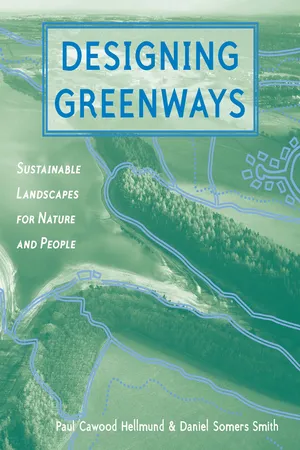
eBook - ePub
Designing Greenways
Sustainable Landscapes for Nature and People, Second Edition
- English
- ePUB (mobile friendly)
- Available on iOS & Android
eBook - ePub
Designing Greenways
Sustainable Landscapes for Nature and People, Second Edition
About this book
Trusted by 375,005 students
Access to over 1.5 million titles for a fair monthly price.
Study more efficiently using our study tools.
Information
Topic
ArchitectureSubtopic
Architecture GeneralCHAPTER 1
INTRODUCTION: GREENWAY FUNCTIONS, DESIGN, AND HISTORY
Greenways and Landscape Integrity: An Overview
Greenways are being designated in cities and countrysides throughout North America and elsewhere. Sometimes these conservation areas are a response to environmental problems, such as flooding or degrading water quality. Other times their creation is an act of pure vision—people imagining a better community—one where people and natural processes coexist more closely. Often, despite this recent popularity, people fail to recognize the full range of contributions greenways can make to society and the environment. It is as if open spaces, especially in metropolitan areas, have been thought of as just so much generic greenery, mere backdrops for people’s activities.1
In this chapter we suggest why greenways are deserving of their newfound popularity and how their functions can be enhanced, but also consider their limitations. We discuss how the greenway concept came to be, how it has been defined, and how its spatial form and content have varied. We also highlight the significant social and ecological functions of greenways, in advance of a fuller discussion of greenway ecology and design in subsequent chapters.
Greenways Vary Widely in Type and Name
Greenways are bands on the landscape, designated for their natural or recreational resources or other special qualities. Greenways—known by a variety of monikers (table 1.1)—straddle waterways, traverse ridgelines, and sometimes cut across the landscape independent of topographic features. They range from narrow urban trail corridors to winding river floodplains to very wide, wildernesslike landscape linkages. Although they exist in varied landscapes, from cities to farmland to commercial forests, historically they have most frequently been created in suburban areas. All greenways have in common their linearity and official designation, or at least popular identification, as distinct areas of the landscape with recognized qualities.
TABLE 1.1. Greenway and greenwaylike designations.
Greenways vary widely in function, situation, and name. What they all have in common is that they are primarily linear or networks of linear lands designated or recognized for their special qualities.
| TERM | OBJECTIVE OR CONDITION | EXAMPLES |
|---|---|---|
| Biological corridor (biocorridor) | Protect wildlife movement and accomplish other aspects of nature conservation. | Mesoamerican Biological Corridor through Central America; Chichinautzin Biological Corridor, State of Morelos, Mexico |
| Bioswale | Filter pollutants from storm runoff (usually at the scale of a site). | Numerous examples in various localities. See, for instance, the bioswales that are part of the City of Seattle Public Utilities’ Street Edge Alternative (SEA) project in northwest Seattle. |
| Conservation corridor | Conserve biological resources, protect water quality, and/or mitigate the impacts of flooding. | Southeast Wisconsin environmental corridors |
| Desokota | Blend rural and urban areas in a dense web of transactions, tying large urban cores to their surrounding regions in the same landscape. (From the Indonesian words “desa,” for village, and “kota,” for town. Also known as the McGee–Ginsburg model.1) | Indonesia and China |
| Dispersal corridor | Facilitate migration and other movement of wildlife. Can also be a road corridor that unintentionally facilitates movement of weeds. | Owl dispersal corridor in the Juncrook area of the Mt. Hood National Forest in Oregon; Marine dispersal corridors for blue crab in the Chesapeake Bay |
| Ecological corridors (eco-corridors) | Facilitate movement of animals, plants, or other ecological processes. | North Andean Patagonian Regional Eco-Corridor Project |
| Ecological networks | Facilitate movement or other ecological processes. | Pan-European Ecological Network for Central and Eastern Europe |
| Environmental corridor | Conserve environmental quality. | Southeastern Wisconsin environmental corridors |
| Greenbelts | Protect natural or agricultural lands to restrict or direct metropolitan growth. | City of Boulder, Colorado, greenbelt; London, England, greenbelt |
| Green extensions | Put residents in contact with nature in their day-to-day lives through a system of residential public greenspace, shaded sidewalks, and riparian strips. | Nanjing, China2 |
| Green frame | Provide a network of greenspace for a metropolis or larger area. | San Mateo County, California, Shared Vision 2010 for the county’s future development green frame; Addis Ababa, Ethiopia, green frame |
| Green heart | Protect a large area of greenspace that is surrounded by development. Originally referred to a specific area in the Netherlands, but now more widely used. | The agricultural open space surrounded by the Randstad, Holland’s urban ring, consisting of the cities of Amsterdam, The Hague, Rotterdam, and Utrecht |
| Green infrastructure | Protect greenspace for multiple objectives on equal grounds with gray infrastructure (i.e., roads, utility lines, etc.). | Maryland Greenprint Program; Chatfield Basin Conservation Network—Denver, Colorado, metropolitan area |
| Green fingers | Purify stormwater through bioswales. | Buffalo Bayou and Beyond for the 21st Century Plan, Houston, Texas, area |
| Green links | Connect separated greenspace. | Green Links initiative to connect isolated patches of habitat throughout the lower mainland of British Columbia |
| Greenspace or green space | Protect lands from development. | Countless systems (usually called “open space”) across North America |
| Green structure or reenstructure | Connect separated areas of greenspace and provide a structure around which development may occur. Term is commonly used in Europe. | Greater Copenhagen Green Structure Plan |
| Green veins | Help protect biodiversity in agricultural landscapes through networks of small, mostly linear landscape elements. | Term has been used by scientists in the Netherlands, France, and other European countries |
| Green wedges | Keep developed areas apart while bringing greenspace closer to the heart of a settlement. Almost the reverse of the greenbelt concept. 3 | Melbourne, Australia; 1971 General plan for Moscow, Russia |
| Landscape linkages | Connect large ecosystems across broad linear bands, including undisturbed rivers. | Pima County, Arizona, Critical Landscape Linkages |
| Natural backbone | Facilitate ecological processes. | Central and Eastern Europe |
| Nature frames | Provide recreation, protect water quality, serve urban design, and mitigate for environmental impacts. | Lithuanian’s Nature Frame |
| Open space | Protect lands from development. | Countless systems in cities and counties across North America |
| Recreational corridors | Provide recreation. | Hillsborough County, Florida, Greenway System; Alberta Recreational Corridors |
| River or other linear parks | Protect or at least follow river or other corridors, sometimes with scenic drives and trails. | Rock Creek Park, Washington, D.C. |
| Scenic corridors | Protect scenery. | Scottsdale, Arizona, Scenic Corridors; Clayoquot Sound, British Columbia, Scenic Corridors |
| Trail corridors | Provide recreation. | Applachian Trail, eastern United States |
| Utilitarian corridors | Serve utilitarian functions, such as routes for canals or power lines, but also may protect nature and provide recreation. | Metro Phoenix, Arizona, Grand Canal |
| Vegetative or riparian buffers | Buffer a stream or body of water and protect water quality by planting or maintaining a riparian strip. | Numerous examples in various localities, especially in agricultural landscapes in the midwestern United States and Canada |
| Wildlife corridors | Protect wildlife movement between areas of habitat. | Yellowstone to Yukon Conservation Initiative (Canada and U.S.); Mountains to Mangroves South East Queensland Wildlife Corridor (Brisbane, Queensland, Australia) |
| 1 Sui, D. Z., and H. Zeng. (2000). “Modeling the dynamics of landscape structure in Asia’s emerging desokota regions: A case study in Shenzhen.” Landscape and Urban Planning 758: 1-16. | ||
| 2 Shuang, C., and C. Y. Jim. (2003). Green space planning strategies compatible with high-density development in the urban area. Internet Conference on Ecocity Development, http://www.ias.unu.edu/proceedings/icibs/ecocity03/papers.html. | ||
| 3 Lynch, K. (1981). A Theory of Good City Form. Cambridge, MA, MIT Press. p. 441. | ||
People have been setting aside greenways of various sorts for more than one hundred years. In North America in the late 19th and early 20th centuries, parkways—early prototypes for greenways—were created to connect urban parks. During the same period, broad greenbelts were designed to encircle some cities and limit urban sprawl. In the 1960s, citizens, ecological planners, and landscape architects recognized the need to protect waterways and other corridors that included a high concentration of important natural features. More recently, natural scientists and conservationists have considered the significance of corridors for wildlife management and biodiversity protection. Social scientists have explored how greenways affect things such as economics, community and civic life, and social interaction among diverse users. At the same time, citizens, alarmed by the rapid loss of open space to development, have expressed strong desires for opportunities for outdoor recreation near where they live.
Ideally, greenways are corridors of land and water (and networks of such corridors) designed and managed for multiple purposes, such as nature conservation, recreation, stormwater management, community enhancement, social equity, and scenery protection, with an overall aim of sustaining the integrity of the landscape, including both its natural (biophysical) and social components.2 The term greenway has gained wide acceptance among landscape architects, greenspace planners, conservationists, and citizen groups.3 But the terms used to identify greenways and other greenspaces are used imprecisely. This confusion is apparent in the range of terms shown in table 1.1.
Networks of greenways are sometimes known as green infrastructure—“interconnected networks of green space that conserve natural ecosystem values and functions and provide associated benefits to human populations.”4 In Europe greenway networks, along with the nature reserves they connect, are likely to be known as ecological networks, even if their purpose is more than just nature conservation.5 In this book we primarily use the terms greenway, the more encompassing greenspace (rather than the vague open space6), green infrastructure, and ecological networks.
Greenways Help Retain...
Table of contents
- About Island Press
- Title Page
- Copyright Page
- Dedication
- Table of Contents
- PREFACE
- CHAPTER 1 - INTRODUCTION: GREENWAY FUNCTIONS, DESIGN, AND HISTORY
- CHAPTER 2 - GREENWAY ECOLOGY AND THE INTEGRITY OF LANDSCAPES: AN ILLUSTRATED PRIMER
- CHAPTER 3 - GREENWAYS AS WILDLIFE CORRIDORS
- CHAPTER 4 - RIPARIAN GREENWAYS AND WATER RESOURCES
- CHAPTER 5 - THE SOCIAL ECOLOGY OF LANDSCAPE DESIGN: APPLICATIONS FOR GREENWAYS
- CHAPTER 6 - ECOLOGICAL GREENWAY DESIGN
- EPILOGUE - LANDSCAPE LINES TO HOLD
- INDEX
- ISLAND PRESS BOARD OF DIRECTORS
Frequently asked questions
Yes, you can cancel anytime from the Subscription tab in your account settings on the Perlego website. Your subscription will stay active until the end of your current billing period. Learn how to cancel your subscription
No, books cannot be downloaded as external files, such as PDFs, for use outside of Perlego. However, you can download books within the Perlego app for offline reading on mobile or tablet. Learn how to download books offline
Perlego offers two plans: Essential and Complete
- Essential is ideal for learners and professionals who enjoy exploring a wide range of subjects. Access the Essential Library with 800,000+ trusted titles and best-sellers across business, personal growth, and the humanities. Includes unlimited reading time and Standard Read Aloud voice.
- Complete: Perfect for advanced learners and researchers needing full, unrestricted access. Unlock 1.5M+ books across hundreds of subjects, including academic and specialized titles. The Complete Plan also includes advanced features like Premium Read Aloud and Research Assistant.
We are an online textbook subscription service, where you can get access to an entire online library for less than the price of a single book per month. With over 1.5 million books across 990+ topics, we’ve got you covered! Learn about our mission
Look out for the read-aloud symbol on your next book to see if you can listen to it. The read-aloud tool reads text aloud for you, highlighting the text as it is being read. You can pause it, speed it up and slow it down. Learn more about Read Aloud
Yes! You can use the Perlego app on both iOS and Android devices to read anytime, anywhere — even offline. Perfect for commutes or when you’re on the go.
Please note we cannot support devices running on iOS 13 and Android 7 or earlier. Learn more about using the app
Please note we cannot support devices running on iOS 13 and Android 7 or earlier. Learn more about using the app
Yes, you can access Designing Greenways by Paul Cawood Hellmund,Daniel Smith in PDF and/or ePUB format, as well as other popular books in Architecture & Architecture General. We have over 1.5 million books available in our catalogue for you to explore.