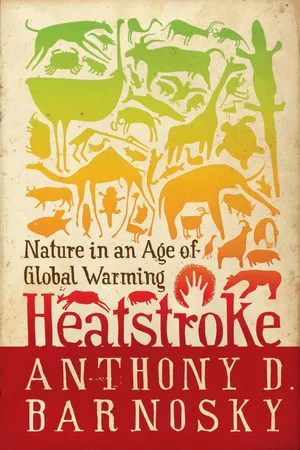
In 2006, one of the hottest years on record, a “pizzly” was discovered near the top of the world. Half polar bear, half grizzly, this never-before-seen animal might be dismissed as a fluke of nature. Anthony Barnosky instead sees it as a harbinger of things to come.
In Heatstroke, the renowned paleoecologist shows how global warming is fundamentally changing the natural world and its creatures. While melting ice may have helped produce the pizzly, climate change is more likely to wipe out species than to create them. Plants and animals that have followed the same rhythms for millennia are suddenly being confronted with a world they’re unprepared for—and adaptation usually isn’t an option.
This is not the first time climate change has dramatically transformed Earth. Barnosky draws connections between the coming centuries and the end of the last ice age, when mass extinctions swept the planet. The differences now are that climate change is faster and hotter than past changes, and for the first time humanity is driving it. Which means this time we can work to stop it.
No one knows exactly what nature will come to look like in this new age of global warming. But Heatstroke gives us a haunting portrait of what we stand to lose and the vitality of what can be saved.
- 270 pages
- English
- ePUB (mobile friendly)
- Available on iOS & Android
eBook - ePub
About this book
Information
PART ONE
Recipe for Disaster?
Chapter 1
The Heat Is On
It's a different Earth; we might as well hold a contest to pick a new name.
AS RAIN was spattering my tent high in the Colorado mountains, it didn't really seem like a different Earth to me, even though much of the world was reeling from one of the hottest summers yet recorded. This was the summer of 1988, the second year in a row of unusual heat. In fact, the average global temperatures in both 1987 and 1988 were the hottest on record up to then, fueling speculation in the news about whether global warming, a trend that climatologists had been talking about over the previous three decades or so, was to blame.
I had perhaps more reason than most to be thinking about global warming because at the time I was in the midst of digging fossil rats, mice, and other animals out of a cave in order to learn how mountain wildlife had been affected by climate changes that took place hundreds of thousands of years ago. For three summers I had been returning to the mountains, donning a headlamp and coveralls with the rest of my crew, and descending deep underground with shovels, trowels, screens, compasses, cameras, and assorted other gear. We were traveling back in time, peeling away the dirt floor of the cave—sedimentary layers of dust, clay, and rock—that encased hundreds of thousands of fossil bones. Determining the kinds of sediments in each layer—whether flowstone was present, for example, or compacted clay—told us something of the climate that had prevailed outside the cave in times past, and the bones told us what kinds of animals had lived in that climate. Each layer we peeled away essentially exposed a new snapshot of a long-gone ecosystem, and by analyzing all those snapshots and reassembling them in sequence, we would be able to track the ecological effects of past global warming events. We had dug deep enough to take us back nearly a million years, long before humans had any impact on climate, back to both past glacial ages much cooler than today and warmer periods resembling today's climate. The idea was to understand how ecosystems had responded to the extreme global warming events indicated by the glacial to interglacial shifts, so that we could better gauge what to expect with warming in the future.
But truth be told, for me, as for most of us in 1988, immediate problems felt more pressing than the effects of global warming, which only become evident over decades and centuries. I had sixty people to keep productively busy, and although we were spending mornings deep in a cave where the weather outside didn't matter, the afternoon rains were slowing us down. Each day after lunch, the morning's diggings were hauled out in canvas money bags and trucked to a nearby stream, where we used hoses and gasoline-powered pumps to wash the dirt through screens, leaving the fossils and gravel behind. Before the fossils could be separated from the gravelly matrix for identification, they had to dry. And that was where the rain was a problem. We were falling behind schedule.
In the soggy matrix clogging the screens, though, we did notice lots of fossil teeth and jawbones of marmots. They were so big they were hard to miss. Marmots are a kind of groundhog of the genus Marmota. The ones that live in the Colorado Rockies today are Marmota flaviventris, or yellow-bellied marmots. They are chubby, squirrel-like rodents (in fact marmots are members of the squirrel family) that we occasionally watched scampering around the boulders above the cave. They have puffy cheeks and buck teeth, like cartoon characters. They alternately hunch up their backs and then stretch out when they run, like a slinky whose ends you push together until it bends in the middle and the front end extends outward. They look at you first with surprise, then with a little bit of disgust, before they take off. The fossils we were picking off the screens were from long-dead Marmota, and showed us that marmots, in some form or fashion, had been a part of that Colorado mountain ecosystem for close to a million years. They were there during ice ages,2 when most of the surrounding 3,000- to 4,300-meter (10,000- to 14,000-foot) mountains hosted vast glaciers. When the glaciers receded marmot populations persisted, even when the local climate became hotter and drier than it is today. What we were finding seemed to say that if any kind of animal should be able to persevere through dramatic climate changes, marmots should.
That ability to survive makes sense when you take into account what marmots do for a living. Like people, they hide from the weather. Unlike people (at least, most people), they hide in burrows. That means that a marmot's-eye view of climate is much like the view my crew and I had while we were crawling around inside the cave. Marmots construct elaborate burrow systems into which, in the Colorado Rockies, they disappear anytime the outside temperature gets colder than about 1˚C (34˚F) or hotter than 26˚C (79˚F). In the burrows, the temperature stays between 8–10˚C (46–50˚F), even though the outside temperature might be far colder or hotter. Marmots thus spend only about 20 percent of their lives outside their climate-controlled dwellings (If you have an office or factory job, the time you spend outdoors is probably a little less, maybe 10 percent of your year.). From the marmot's perspective, a problem with their climate-control system is that it forces them to spend all winter in their burrows without food (something we could never do)—and that's about 60 percent of their life.
To stay alive, yellow-bellied marmots in the Colorado mountains generally go into their burrows in early September to hibernate, reducing their metabolism to the bare minimum in order to conserve energy. They finally emerge sometime in the spring, April or May, when the fat reserves they accumulated during the previous summer begin to get low. As you might imagine, they're hungry. The cue that tells them to stay out of their burrows is warmer air, which in ideal circumstances has been melting the snow outside for some days prior to the marmots' emergence. When all that goes as it should, the sleepy, hungry marmots stagger out of their burrows and blink their eyes at what must be a welcome sight: fresh new shoots of nutritious vegetation poking up where only a few days before snowfields blanketed the ground. The salad bar's open. The delicate balance of each element in a marmot's life—a climate-controlled burrow, hibernation, a warm-air wakeup call, melting snow, and vegetation growth—seems to have served marmots well. This balancing act hadn't failed in nearly a million years in that mountain locale, and marmots seemed as much a part of the landscape as the rocks they trundled over.
Knowing this made me think that where I was camping and digging then was not a “different Earth” at all. Ecologically at least, things seemed to be chugging along pretty much as usual. What neither the marmots nor I knew at the time, though, was that their days there may be numbered.
Not far away, about 100 kilometers to the west as the crow flies, in the mountains above Gunnison, a team of researchers at the Rocky Mountain Biological Laboratory had for decades been painstakingly measuring temperatures inside marmot burrows and the air temperature outside, gauging snowfall and the timing of snowmelt, and recording when the first marmots emerged from each long winter of hibernation.3 What the data made clear when the team published it in 2000 would have been disturbing to any marmot, had they only known, even as far back as twelve years earlier. In the spring of '88, the average marmot popped out of its burrow to look for something to eat around May 8, a week earlier than they were emerging in 1976. By 1999 marmots would be sticking their heads above ground near April 21, some 23 days—nearly a full month—earlier than they had in the mid-1970s. Meanwhile, more winter snow was falling each year and even the increasing spring temperatures were not melting the snow fast enough, as a marmot would see it—which meant that, year by year, more marmots were seeing snow instead of salad when they awakened, emaciated from hibernation. A higher percentage of the population, in other words, was spending too much energy awake when they should have been conserving energy asleep. Which means death. Something strange was happening to the climate, something that upset the natural balance that had been genetically coded into those climate-controlled marmots through their evolutionary history. For the marmots, it was beginning to look like a different Earth after all.
The summer of that same year, 1988, many of the eastern states were experiencing a heat wave, in the midst of which, coincidentally, the Senate Committee on Energy and Natural Resources was holding hearings about global warming. The scientists who testified there were facing a different kind of heat than people were suffering outside. They were trying to explain, in ways easy to understand, the long-term crises that could arise from global warming—no easy feat when you consider that the nature of climate science is computer models and probability calculations, just the stuff to make eyes glaze and heads nod, and the nature of people is to worry about what's happening today, not what might happen twenty or fifty or a hundred years from now. The task was complicated, too, because the easy way out—blaming the roasting temperatures outside the Capitol on global warming—was not scientifically sound: there was simply no way of knowing whether any particular weather event, like the hot summer of '88 or the gradual shift in the timing of snowfall versus warm spring temperatures in the Colorado Rockies over ten years, was the result of long-term global warming, or just a fluke.
But, specific weather events aside, some disturbing overall trends were becoming clear to the scientists, which led James Hansen, one of the pioneers in pushing for action to mitigate climate change, to state the case in no uncertain terms: “It's time to stop waffling so much and say that the greenhouse effect is here and is affecting our climate now.”4 Other respected scientists and climate policy advocates were offering future scenarios that seemed overly dramatic at the time, such as:
[A] major hurricane . . . coming out of the Caribbean . . . of near-record intensity . . . [would] . . . hit . . . with storm tides as high as 4 meters (12 feet), bringing devastation. . . . Advance warning and prompt evacuation [would] keep loss of life to less than a hundred, but property damage [would be] in excess of $1 billion.5
That was a scenario offered by climatologist Stephen Schneider in a book he published in 1989 to raise awareness on the climate change issue. Think of Schneider as the Bob Dylan of climate science. Just as Dylan was writing songs and rousing the civil rights crowds in the 1970s, Schneider was studying how to calculate the probabilities of specific kinds of climate events, and reaching out to policy makers with his conclusion: namely, that global warming was a threat whose effects would become increasingly evident in the next couple of generations. And, just as Dylan worked his crowds in the ensuing decades, so did Schneider in congressional halls and meeting rooms where national climate policy was discussed at the highest levels, such as at that Senate committee hearing in 1988.
Seventeen years later, in fact, Schneider's scenario proved overly optimistic. The prediction was pretty close on the storm tides (4.3 meters versus 4), but when Hurricane Katrina destroyed New Orleans (not to mention entire communities in Mississippi), there was no prompt evacuation, nearly 2,000 people were killed, and property damage was in excess of $81 billion—all from that one storm. Debate ensued in the scientific literature as to whether or not the record number of hurricanes that year—28—was attributable to global warming, but a couple of facts were indisputable: warmer ocean waters fuel more-extreme storms, and the ocean, as well as the rest of the earth, had been getting on average warmer and warmer for five decades, and especially the preceding decade. The ten warmest years that thermometers had ever measured occurred from 1990 to 2005. While there were some year-to-year ups and downs, on average each year was successively warmer than the last, with 1998 claiming the dubious honor of the hottest year ever known, and 2002, 2003, and 2001 taking second, third, and fourth place, respectively. In short, by 2005 global warming had not only arrived, it had literally taken the world by storm and had given us a dramatic sneak preview of what to expect from a different Earth.
What makes the Earth different now compared to centuries past is that humans, primarily through burning oil, gas, and coal, have changed the very air we breathe. While that may have been a point of debate in 1988, today it is as close as we get to fact in science6—meaning that atmospheric composition can be measured fairly precisely, that those measurements have been tracked with some precision over the past five and a half decades, and that a half century of measurements can be compared to what scientists have been able to discover about what the atmosphere was like hundreds, thousands, and even millions of years ago.
Details aside for now, the comparisons converge on disturbing conclusions that go beyond the immediate temperature rises themselves. First, today the air we breathe has more carbon dioxide, methane, nitrous oxide, sulfur dioxide, and other “greenhouse gases” than it has had for at least four hundred thousand years—longer than humans have been a species. They are called “greenhouse gases” because, as their concentration in the atmosphere increases, they prevent some of the heat that would normally radiate back into space—heat ultimately derived from the sun's rays striking the earth—from leaving the atmosphere. Just like a greenhouse, the Earth heats up as a result.
Second, the concentrations of those gases have risen—and are rising—so fast that it is staggering. By the time babies born today are in their fifties, even the best-case scenario predicts that more greenhouse gases will be in the air than has been the case in three million years—if we go on our merry way without any mitigation efforts. In just the years since 1950, we have approximately doubled the amount of greenhouse gases in our atmosphere. That was on top of the doubling that had already taken place between the start of the industrial revolution, say around 1700, and 1950. And that may have been on top of increased levels of at least two gases, carbon dioxide and methane, that prehistoric humans, through agricultural burning, land clearing, and coal burning, had begun dumping into the atmosphere as long ago as 8,000 years.7
Not only are we living at a time already warmer than Earth has experienced in at least four hundred thousand years, we are also living at a time when the climate is changing much faster than normal. Earth has not experienced a similarly fast rate of climate change within at least the last 60 million years. The reason we tend not to notice is that the increase in greenhouse gases is incremental year to year, decade to decade, century to century, without a lot of discern-able change within a human lifetime, until all hell breaks loose—which is now. Those ever-increasing levels of greenhouse gases are beginning to give us an Earth that not only is hotter, but one that also promises many other climatic changes: exceptionally violent storms more often, shortened growing seasons in some places and lengthened ones in others, droughts in some places, too much rain in others, and transformation of what used to be coastline (or even inland) into ocean.
Seen in that light, the scientific wakeup call about marmots in the Colorado Rockies, already evident by 1988 and getting louder by 2000, fit all too well into a bigger picture. Not only was our species' unwitting tinkering with the atmosphere inflicting collateral damage on this Colorado ecosystem where, for all practical purposes, the actual footprints of people were few and far between, but this atmospheric tinkering was actually beginning to disturb what we regard as “natural” ecosystems even in places where there are virtually no human footprints.
Places such as high in the Canadian Arctic. In April of 2006 a hunter from Idaho, Jim Martell, paid $50,000 for one of the many versions of a wilderness experience, the chance to shoot a polar bear near the top of the world on Banks Island, Canada. There's not much on Banks Island in the way of people. It's a big island—in land area around 67,000 square kilometers (26,000 square miles), a little bigger than West Virginia—but it has only one small settlement of around 114 native Inuit people. The rest of the place is ice, snow, tundra, shin-high willows, musk oxen, caribou, and, of course, polar bears. But that's not what Martell shot. Instead he bagged a pizzly, or a grolar bear, depending on what you want to call it. The bear looked enough like a polar bear to draw Martell's bead, but when he checked out his kill, he saw not only the cream-colored fur typical of polar bears, but also a hump on its back, long claws, a shallow face, and brown patches around its eyes, nose, and back. Those made it look more like a grizzly bear than a polar bear. Later DNA tests showed why it seemed like a little of both: Martell's trophy had a polar bear mother and a grizzly bear father.
Something out of the ordinary had happened, something that raised a host of questions. For starters, what were a polar bear and grizzly bear doing in the same place? Polar bears are pagophilic, which means they live almost exclusively on sea ice, especially the annual ice that forms over the polar continental shelves and around island archipelagos. Polar bears come onto land when sea ice melts completely in the summer, or in the case of pregnant females, when it's time to den and birth cubs in the winter. Even when on land, they tend to stay within a few kilometers of the coast. Polar bears prefer icy marine habitats because evolution has prepared them to specialize almost exclusively on a food source that is unavailable to other terrestrial animals: seals (with an occasional narwhal or walrus for variety). Most of their fat reserves are put on during the spring breakup of pack ice, when holes and open-water corridors in the ice provide a place for seals to come up for gulps of air and to bask. The bears sniff out such breathing holes and employ a technique called still-hunting: quietly waiting by the hole until dinner appears, at which time they attack and, if they are lucky, pull out a desperately wriggling seal.
Grizzlies, on the other hand, are today denizens of the terrestrial arctic (and a few alpine or forested regions where people have allowed them to remain). They amble across the hills, hunting and scavenging prey like caribou, moose, ground squirrels, spawning salmon and trout, as well as a wide variety of vegetation. Like you and me, they are omnivores, cosmopolitan in their tastes, but firmly rooted on shore. Grizzly range stops where the sea begins, which is to say some 100 kilometers (62 miles) south of Banks Island. When sea ice is at its greatest extent in the winter, polar bear range butts right up against grizzly range, but there is little chance of interaction then because grizzlies are hibernating and pregnant female polar bears are denning (male polar bears stay active year-round). The ranges of the two species near Banks Island are completely separated in summer by 100 kilometers of open water. That leaves only spring as a time, potentially, for individuals of the two species to run across each other, during what is typically the mating season for both grizzlies and polar bears. The pizzly bear shot in 2006 suggests that a couple of years earlier, when pack ice was breaking up, an errant male grizzly awoke from hibernation and ventured out onto the ice, where he encountered a female polar bear. Or else the ice melted so fast that both were stranded on land by June, which is the latest month when the breeding sea...
Table of contents
- Title Page
- Copyright
- Contents
- Dedication
- Preface
- PART ONE. RECIPE FOR DISASTER?
- Chapter 1. The Heat Is On
- Chapter 2. Behind Nature's Heartbeat
- Chapter 3. On Our Watch
- Chapter 4. Witnessing Extinction
- Chapter 5. No Place to Run To
- PART TWO. NORMAL FOR NATURE
- Chapter 6. California Dreaming
- Chapter 7. Disturbance in Yellowstone
- Chapter 8. Mountain Time in Colorado
- Chapter 9. Africa on the Edge
- PART THREE. UNCHARTED TERRAIN
- Chapter 10. Disappearing Act
- Chapter 11. Losing the Parts
- Chapter 12. Skeleton Crew
- Chapter 13. Bad Company
- Chapter 14. Geography of Hope
- Appendix. Slowing Down Global Warming
- Notes
- Index
Trusted by 375,005 students
Access to over 1.5 million titles for a fair monthly price.
Study more efficiently using our study tools.
Frequently asked questions
Yes, you can cancel anytime from the Subscription tab in your account settings on the Perlego website. Your subscription will stay active until the end of your current billing period. Learn how to cancel your subscription
No, books cannot be downloaded as external files, such as PDFs, for use outside of Perlego. However, you can download books within the Perlego app for offline reading on mobile or tablet. Learn how to download books offline
Perlego offers two plans: Essential and Complete
- Essential is ideal for learners and professionals who enjoy exploring a wide range of subjects. Access the Essential Library with 800,000+ trusted titles and best-sellers across business, personal growth, and the humanities. Includes unlimited reading time and Standard Read Aloud voice.
- Complete: Perfect for advanced learners and researchers needing full, unrestricted access. Unlock 1.5M+ books across hundreds of subjects, including academic and specialized titles. The Complete Plan also includes advanced features like Premium Read Aloud and Research Assistant.
We are an online textbook subscription service, where you can get access to an entire online library for less than the price of a single book per month. With over 1.5 million books across 990+ topics, we’ve got you covered! Learn about our mission
Look out for the read-aloud symbol on your next book to see if you can listen to it. The read-aloud tool reads text aloud for you, highlighting the text as it is being read. You can pause it, speed it up and slow it down. Learn more about Read Aloud
Yes! You can use the Perlego app on both iOS and Android devices to read anytime, anywhere — even offline. Perfect for commutes or when you’re on the go.
Please note we cannot support devices running on iOS 13 and Android 7 or earlier. Learn more about using the app
Please note we cannot support devices running on iOS 13 and Android 7 or earlier. Learn more about using the app
Yes, you can access Heatstroke by Anthony D. Barnosky in PDF and/or ePUB format, as well as other popular books in Biological Sciences & Environmental Conservation & Protection. We have over 1.5 million books available in our catalogue for you to explore.