The conventional approach to river protection has focused on water quality and maintaining some "minimum" flow that was thought necessary to ensure the viability of a river. In recent years, however, scientific research has underscored the idea that the ecological health of a river system depends not on a minimum amount of water at any one time but on the naturally variable quantity and timing of flows throughout the year.
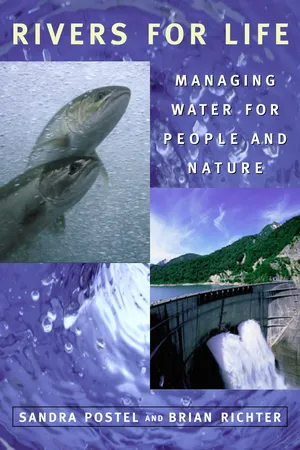
In Rivers for Life, leading water experts Sandra Postel and Brian Richter explain why restoring and preserving more natural river flows are key to sustaining freshwater biodiversity and healthy river systems, and describe innovative policies, scientific approaches, and management reforms for achieving those goals. Sandra Postel and Brian Richter: explain the value of healthy rivers to human and ecosystem health; describe the ecological processes that support river ecosystems and how they have been disrupted by dams, diversions, and other alterations; consider the scientific basis for determining how much water a river needs; examine new management paradigms focused on restoring flow patterns and sustaining ecological health; assess the policy options available for managing rivers and other freshwater systems; explore building blocks for better river governance.
Sandra Postel and Brian Richter offer case studies of river management from the United States (the San Pedro, Green, and Missouri), Australia (the Brisbane), and South Africa (the Sabie), along with numerous examples of new and innovative policy approaches that are being implemented in those and other countries.
Rivers for Life presents a global perspective on the challenges of managing water for people and nature, with a concise yet comprehensive overview of the relevant science, policy, and management issues. It presents exciting and inspirational information for anyone concerned with water policy, planning and management, river conservation, freshwater biodiversity, or related topics.
- English
- ePUB (mobile friendly)
- Available on iOS & Android
eBook - ePub
About this book
Information
CHAPTER ONE
Where Have All the Rivers Gone?
In his 1901 inaugural address, U.S. President Theodore Roosevelt set the tone for what would become a century of unprecedented and profound transformation of the earth’s rivers. “[G] reat storage works are necessary,” he said, “to equalize the flow of streams and to save the flood waters.”1 After passage of the National Reclamation Act the following year, the United States opened a new chapter in humanity’s long history with water, one that viewed human control of rivers as fundamental to economic and social advancement. Government engineers built dams and reservoirs for irrigation, flood control, hydropower generation, and water supply. They dredged river channels for shipping and diked river banks to contain unruly floodwaters. River after river was transformed for human purposes as the U.S. economy’s demand for water, electricity, and flood protection grew. Much of the world embarked on a similar path, often aided by U.S. engineers eager to share their experience and expertise.
Just shy of a century after Roosevelt’s course-setting pronouncement, another U.S. political leader made a surprising and prescient statement of a different kind. During an interview for a 1997 documentary, Barry Goldwater, the 1964 Republican presidential candidate and former U.S. senator from Arizona, was asked how he would vote today if he could decide again on whether to support or oppose the construction of Glen Canyon Dam on the Colorado River. Completed in 1963, this super dam flooded a remarkable canyon and allowed for such complete control of the Colorado’s flow that little of the river’s water reaches the sea. “I’d vote against it,” said Goldwater, who had advocated strongly for the dam several decades earlier. “When you dam a river you always lose something.” For him, the price of progress had been too great.2
The words of Roosevelt and Goldwater serve as poignant markers to the beginning and ending of the twentieth-century approach to rivers. Society’s needs and values have changed. Equally important, scientists have begun to uncover the severity of the ecological harm done by the large-scale alteration of rivers to suit human purposes. Many rivers around the world, large and small, are drying up before they reach their natural destinations. In addition to the Colorado River, five of the largest rivers in Asia—the Ganges, the Indus, the Yellow, and the Amu Dar’ya and Syr Dar’ya—no longer reach the sea for large portions of the year.3 Channelized rivers, such as the Rhine in Europe and a large stretch of the Missouri in the U.S. Midwest, no longer meander but rather flow artificially straight and deep to allow for the shipping and barging of goods. Levees have disconnected the mighty Mississippi River from 90 percent of its floodplain.4
Dams and diversions now alter the timing and volume of river flows on a wide geographic scale. Worldwide, some 60 percent of the 227 largest rivers have been fragmented by dams, diversions, or other infrastructure.5 Most of the rivers of Europe, Japan, the United States, and other industrialized regions are now controlled more by humanity’s hand than by nature’s. Rather than flowing to the natural rhythms of the hydrologic cycle, they are turned on and off like elaborate plumbing works.
Societies have reaped substantial economic rewards from these modifications to rivers—from the generation of hydroelectric power to the expansion of irrigated agriculture to the growth of trade along shipping routes. However, serious losses have mounted on the ecological side of the ledger. In their natural state, healthy rivers perform myriad functions—such as purifying water, moderating floods and droughts, and maintaining habitat for fisheries, birds, and wildlife. They connect the continental interiors with the coasts, bringing sediment to deltas, delivering nutrients to coastal fisheries, and maintaining salinity balances that sustain productive estuaries. From source to sea and from channel to floodplain, river ecosystems gather, store, and move snowmelt and rainwater in synchrony with nature’s cycles. The diversity and abundance of life in running waters reflect millions of years of evolution and adaptation to these natural rhythms.
From a strictly human perspective, healthy rivers perform numerous “ecosystem services”—the processes carried out by natural ecosystems that benefit human societies and economies. Rivers, wetlands, and other freshwater ecosystems constitute part of the natural infrastructure that keeps our economies humming. Like workers in a factory, wetland plants and animals are an organized and productive team—absorbing pollutants, decomposing waste, and churning out fresh, clean water. With great efficiency, periodic floods shape river channels and redistribute sediment, creating habitat essential to fish and other riverine life. Moreover, river systems do this work for free. Even if we knew how to replicate all the valuable functions that rivers perform, it would cost an enormous sum to replace them. The services performed by wetlands alone can be worth on the order of $20,000 per hectare per year.6
In little more than a century—a geologic twinkling of an eye—human societies have so altered rivers that they are no longer adequately performing many of their evolutionary roles or delivering many of the ecological services that human economies have come to depend upon. A significant portion of freshwater species worldwide—including at least 20 percent of freshwater fish species—are at risk of extinction or are already extinct. Because floodwaters are no longer getting cleansed by floodplain wetlands, more pollution is reaching inland and coastal seas, causing damage such as the low-oxygen “dead zone” in the Gulf of Mexico and the deterioration of Europe’s Black Sea. In short, in many parts of the world, the harnessing of rivers for economic gain is now causing more harm than good. But because most of the harm goes unrecognized or unvalued, it gets left out of the cost-benefit equations that often determine how rivers get managed. As a result, far too little has been done to stop, much less reverse, the decline in river health.
To date, efforts to restore and protect rivers have focused primarily on two goals—improving water quality, and establishing minimum flow requirements so that rivers and streams do not run completely dry. These actions have improved river conditions in many locations. The Cuyahoga River in northern Ohio is no longer in danger of catching fire again, for instance, and many fish populations are benefiting from less-polluted waters. But the focus on minimum flows and water quality has done too little to restore the functions and processes that sustain the integrity of river systems overall.
During the last decade, scientists have amassed considerable evidence that a river’s natural flow regime—its variable pattern of high and low flows throughout the year as well as across many years—exerts great influence on river health.7 Each natural flow component performs valuable work for the system as a whole. Flood flows cue fish to spawn and trigger certain insects to begin a new phase of their life cycle, for example, while very low flows may be critical to the recruitment of riverside (or riparian) vegetation. Consequently, restoring rivers now under heavy human control requires much more than simply ensuring that water is in the channel: it requires re-creating to some degree the natural flow pattern that drives so many important ecological processes. Flow restoration may involve operating dams and reservoirs so as to mimic a river’s pre-dam highs and lows. In rivers not yet heavily dammed or controlled, including many in developing countries, the challenge is to preserve enough of the natural flow pattern to maintain ecological functions even while the river is managed for other economic purposes.
In a nutshell, the challenge of twenty-first-century river management is to better balance human water demands with the water needs of rivers themselves. Meeting this challenge will require a fundamentally new approach to valuing and managing rivers. Fortunately, river scientists and policymakers in a number of countries—especially in Australia, South Africa, and the United States—have developed and tested some new ideas for achieving this more optimal balance. As described in Chapters 2 and 3, the most promising approaches incorporate new scientific knowledge, new management practices, and new policy tools. Bringing these promising initiatives to scale, however, will require new approaches to river governance—the process of establishing and administering the rules that dictate how rivers get managed and who benefits from them—which is explored in Chapter 5.
Although rivers around the world and the life they support are now in great peril, there is cause for optimism about the possibility of their return to health. As noted in Chapter 4, more than 230 rivers around the world are already undergoing some degree of flow restoration. Dams are being taken down, levees are being set back to reconnect rivers with their floodplains, conservation practices are enabling some water to return to nature, and reservoir releases are being modified to better replicate natural flow patterns. Viewed collectively, these actions constitute the vanguard of a movement to realign the health of our human water economy with that of nature’s water economy. They also underscore the importance of preserving ecosystem-sustaining flows in rivers not yet harnessed by human infrastructure, so that the costly downsides of twentieth-century-style water management can be prevented in the first place.
Every once in a while the social and political stars align on an issue in a way that enables a quantum shift to occur in the way that issue is perceived and handled by human societies. For the health and conservation of rivers, that alignment is beginning to form. It consists of three key elements: (1) the growing recognition of the importance of biological diversity and the value of natural ecosystem services, (2) the scientific consensus that restoring some degree of a river’s natural flow pattern is the best way to protect and restore river health and functioning, and (3) the emergence of new models of decision-making about river management that offer the promise of more inclusive, equitable, and ecologically sustainable outcomes.
This alignment opens new windows of opportunity, but the challenge ahead is large. It calls on scientists, onservationists, river managers, policymakers, and citizens to work together, across disciplines and professional boundaries. And it calls on society to adopt rules of water governance that recognize our interdependence with rivers—the blue arteries of the earth that course through and sustain the planet’s life-support system.
WHY WE NEED HEALTHY RIVERS
Through the ages, rivers have played a central role in the evolution of human societies. Many great early civilizations sprung up alongside rivers—including the ancient Mesopotamians in the fertile plains of the Tigris and Euphrates rivers, the ancient Egyptians in the valley of the Nile, and the early Chinese societies in the valley of the Yellow, affectionately known in China as its “mother” river. As symbols of purity, renewal, timelessness, and healing, rivers have shaped human spirituality like few other features of the natural world. To this day, millions of Hindus in India immerse themselves in the waters of the Ganges in rituals of cleansing that are central to their spiritual life. Similarly, rivers have shaped the landscape in fundamental ways, carving remarkable canyons with their erosive power and creating huge deltas through their deposition of sediment. Evoking magic, mystery, and beauty, rivers have inspired painters, poets, musicians, and artists of all kinds throughout history, adding immeasurably to the human experience.
From a hydrologic perspective, rivers play a central role in the global cycling of water between the sea, air, and land. Along with underground aquifers, they gather precipitation and carry it as runoff to the sea, which then cycles moisture back to the land via the atmosphere. This cycle constantly renews the finite supply of water on the continents and thus sustains all life on land. From a human standpoint, rivers are principal sources of water for drinking, cooking, and bathing, for growing crops where rainfall is not su...
Table of contents
- ABOUT ISLAND PRESS
- Title Page
- Copyright Page
- Dedication
- Table of Contents
- ACKNOWLEDGMENTS
- CHAPTER ONE - Where Have All the Rivers Gone?
- CHAPTER TWO - How Much Water Does a River Need?
- CHAPTER THREE - The Policy Toolbox
- CHAPTER FOUR - Down to the River
- CHAPTER FIVE - Building Blocks for Better River Governance
- CHAPTER SIX - Epilogue: Can We Save Earth’s Rivers?
- NOTES
- BIBLIOGRAPHY
- ABOUT THE AUTHORS
- INDEX
- ISLAND PRESS BOARD OF DIRECTORS
Trusted by 375,005 students
Access to over 1.5 million titles for a fair monthly price.
Study more efficiently using our study tools.
Frequently asked questions
Yes, you can cancel anytime from the Subscription tab in your account settings on the Perlego website. Your subscription will stay active until the end of your current billing period. Learn how to cancel your subscription
No, books cannot be downloaded as external files, such as PDFs, for use outside of Perlego. However, you can download books within the Perlego app for offline reading on mobile or tablet. Learn how to download books offline
Perlego offers two plans: Essential and Complete
- Essential is ideal for learners and professionals who enjoy exploring a wide range of subjects. Access the Essential Library with 800,000+ trusted titles and best-sellers across business, personal growth, and the humanities. Includes unlimited reading time and Standard Read Aloud voice.
- Complete: Perfect for advanced learners and researchers needing full, unrestricted access. Unlock 1.5M+ books across hundreds of subjects, including academic and specialized titles. The Complete Plan also includes advanced features like Premium Read Aloud and Research Assistant.
We are an online textbook subscription service, where you can get access to an entire online library for less than the price of a single book per month. With over 1.5 million books across 990+ topics, we’ve got you covered! Learn about our mission
Look out for the read-aloud symbol on your next book to see if you can listen to it. The read-aloud tool reads text aloud for you, highlighting the text as it is being read. You can pause it, speed it up and slow it down. Learn more about Read Aloud
Yes! You can use the Perlego app on both iOS and Android devices to read anytime, anywhere — even offline. Perfect for commutes or when you’re on the go.
Please note we cannot support devices running on iOS 13 and Android 7 or earlier. Learn more about using the app
Please note we cannot support devices running on iOS 13 and Android 7 or earlier. Learn more about using the app
Yes, you can access Rivers for Life by Sandra Postel,Brian Richter in PDF and/or ePUB format, as well as other popular books in Biological Sciences & Public Policy. We have over 1.5 million books available in our catalogue for you to explore.