Between 1996 and 2007, voters approved almost $24 billion for local government park, open space, and other conservation purposes. Despite this substantial sum for land protection, there was at that time no book available to guide officials as they implemented voters’ mandates. The Conservation Program Handbook was written in response to numerous requests to The Trust for Public Land for exactly this type of guidance from community leaders who wanted to know how to effectively conserve their iconic landscapes.
In addition, in November 2008, despite massive doses of terrible financial news, voters across the U.S. approved land conservation funding measures. It was a record-breaking year for land protection financing, with voters demonstrating substantial support for open space ballot measures despite the economic and fiscal crisis of the time.
The Conservation Program Handbook is a manual that provides all of the information—on a broad spectrum of topics—that conservation professionals are likely to encounter. It compiles and distills advice from professionals based on successful conservation efforts across the country, including a list of “best practices” for the most critical issues conservationists can expect to face. By providing information on how to do conservation work in the best possible manner, The Conservation Program Handbook has the goal of increasing the amount, quality, and pace of conservation being achieved by local governments throughout the nation.
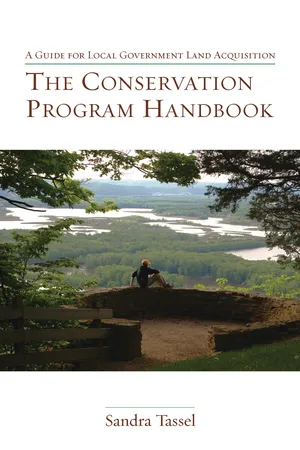
eBook - ePub
The Conservation Program Handbook
A Guide for Local Government Land Acquisition
- English
- ePUB (mobile friendly)
- Available on iOS & Android
eBook - ePub
About this book
Information
CHAPTER I
INTRODUCTION

ON ELECTION DAY, a community passes a measure that will fund a new land conservation program. The supporters of this measure celebrate, go to sleep, and wake up happy the next day. However, as they pick up the champagne bottles and recycle the campaign posters, they start to realize that a new challenge lies ahead. Now that the voters have approved the funding to protect cherished land, a program must be created to spend the allocated monies in the most efficient and productive way possible. These conservationists have pressing and important work to do.
In some communities, of course, the people who work to pass the measure understand before the vote that getting money is only the beginning. The people who design a program most often start their work by looking to established programs for advice. They collect sample documents, legislation, and policy manuals and use these as a basis for their new program. However, this approach has its pitfalls. For one thing, it is time-consuming, and, as any conservationist can tell you, time lost equals land lost, especially in areas where the pressure for development is intense.
A more serious drawback of this approach is that the programs used as models may not be the best ones to emulate. People who are launching a new program may not know all the results produced by the agency whose procedures are being used as a model. Thus they may reproduce expensive mistakes, unnecessary bureaucracy, or unproductive policies, and they risk perpetuating ineffective practices. A program can be large or well established without being a good model to follow. For these reasons, it might be wiser, especially for a small, new entity, not to use other agencies as models.
A similar dilemma confronts people who manage existing programs and want to assess their past performance or evaluate ways to improve their future efforts. Community leaders and program staff search for appropriate measurement techniques and methods. Until now, it appeared that the only valid approach was to compare procedures and progress with those of other agencies. But, in a similar way, you cannot really know whether the comparison is valid.
Programs used as
models by new programs
may not be the best ones
to emulate.
models by new programs
may not be the best ones
to emulate.
THE PURPOSE OF THIS PUBLICATION
This handbook, produced by The Trust for Public Land (TPL), seeks to eliminate the need for original research by local government programs that will be creating or upgrading policies to guide public investments in land for a range of natural, cultural, and recreational purposes. It presents the results of extensive investigations into local land acquisition agencies around the United States. To create this publication, we studied communities of various sizes with programs that protect many kinds of natural resources. However, this book is not merely a compilation of sample documents and a list of the techniques currently in use. Instead, experienced land conservation experts from around the country, led by a team of TPL staff, with experience in local government, land trusts, planning, law, and real estate, have provided their wisdom and advice to advance land protection work at the local government level. Their input and the information from the communities that were studied have been distilled into the recommendations you will find throughout this publication. (See Appendix I for the names of the interviewees.)
Both common and unusual strategies for conservation success were studied in order to create the practices we recommend here for local government land conservation programs. These strategies have been proven to yield good results and can therefore be trusted as cornerstones for new programs. Each key chapter provides a list of best practices, which present essential recommendations and show how at least one successful program has approached the chapter’s topic.
The Trust for Public Land, the funders, the author, and all the contributors want to help citizens, elected officials, agency staff, and nonprofits involved in land protection to establish as many good acquisition programs as they can, as quickly as possible. Doing so will protect more of this country’s special places by saving public dollars and making those dollars available more rapidly.

After passing a financing measure communities ask “We have money, now what?”
Securing the passage of a funding referendum is a huge challenge for most communities. It is the subject of a useful reference work, The Conservation Finance Handbook, also published by TPL.1 This new publication begins where that handbook leaves off: it discusses the practices that follow the success of the funding measure and serves as a useful guide for reviewing or assessing established programs.
Much of the work described here can be done before the election. Efforts to shape the program beforehand may actually strengthen the cause and create greater momentum for voter approval. Elected officials, citizens, and local government staff frequently draft language to guide the implementation of a program before the measure. You can use this handbook to guide the creation of the implementation steps in advance. If you do, it may give the voting public confidence that the planned program will be effective, accountable, and consistent with the goals described during the campaign.
USE AND ADAPT WHAT YOU NEED FROM EACH CHAPTER
In an attempt to cover all common elements, this handbook includes some information that applies only to certain parts of the country. This is a diverse nation, governed by diverse state and local governments that follow their own laws. Not all topics are relevant to all communities or programs, nor is the order in which they are presented always right for a given community or program, so use what you can. Also, although this handbook was written for local governments, many of its recommendations are applicable to state programs as well.
Depending on the capacities of government where you live or work, you may find that this handbook addresses topics that seem unnecessary or irrelevant. However, if you are starting, expanding, restructuring, or making significant changes in a program—such as adding staff for the first time—we suggest that you examine each chapter with an open mind. You may find techniques or approaches that will improve your operations. Improved functioning means more conservation per dollar and programs that better meet conservation objectives.
WHAT IS A GOOD PROGRAM?
To develop the best practices that are recommended in this publication, we had to define the overarching program characteristics we hoped to reproduce and encourage. Broadly speaking, the objective was to find and analyze agencies that are successfully protecting resources, regardless of their particular local goals and objectives. More specifically, we focused on the three qualities listed below as the fundamental definition of a good acquisition program. Our best-practices recommendations are based on programs that exhibited the following characteristics:
Effectiveness. Effective programs are achieving the purposes for which they were created and funded. Often these purposes are set forth in a park or open-space master plan, or in another document that was the foundation of the finance measure. Effective programs spend their acquisition funds strategically on the best possible projects, protected properties are properly managed, and the public benefits as promised. The protection tools these programs use are the ones most appropriate for the resource type, the real estate market, and the regional political realities.
Efficiency. The efficiency of a program is determined by the proportion of public funding actually invested in conservation and stewardship, as opposed to many other possible and necessary expenses, such as salaries, equipment, and other overhead. Efficient programs leverage their funding through locally appropriate mechanisms such as matching funds, bargain sales, purchases of less-than-fee interests in real estate (such as conservation easements), and partnerships. Each taxpayer dollar achieves its maximum conservation effect through careful management of the program’s limited monies.
Respect. Respect for a program reflects both the program’s conservation successes and the relationship it has built with the community it serves. The long-term survival of the program and its ability to secure ongoing funding depend on public perception. Respected programs feature policies that are responsive, respectful, and realistic. These gain support from voters, elected officials, funders, partners, and landowners.
The author sought out programs around the country that exhibited these three attributes so that their policies and procedures could be analyzed. Conservation leaders provided the names of local agencies they perceived as fitting this profile. Twenty-two of these agencies plus several nonprofit conservation organizations are featured as case studies to provide true stories from programs that have successfully gone through their startup phases and appear to match the definition of good programs, or have especially useful approaches to specific issues. In many chapters, points are clarified by case studies, by advice from an expert on a particular challenge, or by examples showing how one community implemented a specific best practice.
GATHERING THE DATA
Best practices were developed from information gathered in one-on-one interviews with community leaders, public employees, elected officials, land trust staff, and transaction consultants around the country. In addition, insights into the most effective methods of acquiring land were gathered from staff at several conservation nonprofits that were involved directly in land protection transactions, from experts who have advised new programs during their startup phases and by examining documents from dozens of other programs. (A complete list of interviewees and programs studied can be found in Appendices I and II.)
Thus, these interviews with agency staff and experts provided the basis for the recommendations that follow. These recommendations allow the post-election-day celebration to continue without concern. If they are incorporated into policy and action, they will produce the first transaction closing—and, in its wake, a new celebration party—more quickly. They can also serve as reliable yardsticks to measure the effectiveness, efficiency, and responsiveness of existing programs.
We decided not to write about failures, missed opportunities, or errors—no matter how sad or illustrative they were—even though we did study such situations. Rather, this publication focuses on the lessons that can be learned from their possibly disappointing results. To help your program avoid the pitfalls that have made other programs less successful than they might have been, this publication presents advice in a generally positive form, without detailing the mishaps from which the lessons have been derived.

Dane County WI was one of the programs studied because of its award-winning program.
Numerical and statistical data were collected with the assistance of Yoko Matsumoto, a graduate student at the University of Washington’s Evans School of Public Administration, who conducted a mail survey of 140 counties with park and open space programs and subsequent phone conversations. The results of her research were summarized in an unpublished report titled “Local Land Conservation Efforts: A Study of Selected County Programs in the United States.”2 Excerpts from this report are part of se...
Table of contents
- About Island Press
- Title Page
- Copyright Page
- Table of Contents
- Table of Contents
- FOREWORD
- PREFACE
- ACKNOWLEDGMENTS
- CHAPTER I - INTRODUCTION
- CHAPTER II - LAYING THE GROUNDWORK FOR PROTECTING LAND
- CHAPTER III - ADVISORY COMMITTEES
- CHAPTER IV - STAFFING
- CHAPTER V - PROJECT SELECTION
- CHAPTER VI - CRITERIA
- CHAPTER VII - IDENTIFICATION AND APPLICATION POLICIES AND PROCESS
- CHAPTER VIII - DUE DILIGENCE AND DOCUMENTATION
- CHAPTER IX - LEVERAGE AND PARTNERSHIPS
- CHAPTER X - TRANSACTION DESIGN
- CHAPTER XI - LAND MANAGEMENT AND STEWARDSHIP
- CHAPTER XII - COMMUNICATIONS
- CHAPTER XIII - CONCLUSION
- ENDNOTES
- APPENDIX 1
- APPENDIX II
- RESOURCES
- INDEX
- Island Press Board of Directors
Trusted by 375,005 students
Access to over 1.5 million titles for a fair monthly price.
Study more efficiently using our study tools.
Frequently asked questions
Yes, you can cancel anytime from the Subscription tab in your account settings on the Perlego website. Your subscription will stay active until the end of your current billing period. Learn how to cancel your subscription
No, books cannot be downloaded as external files, such as PDFs, for use outside of Perlego. However, you can download books within the Perlego app for offline reading on mobile or tablet. Learn how to download books offline
Perlego offers two plans: Essential and Complete
- Essential is ideal for learners and professionals who enjoy exploring a wide range of subjects. Access the Essential Library with 800,000+ trusted titles and best-sellers across business, personal growth, and the humanities. Includes unlimited reading time and Standard Read Aloud voice.
- Complete: Perfect for advanced learners and researchers needing full, unrestricted access. Unlock 1.5M+ books across hundreds of subjects, including academic and specialized titles. The Complete Plan also includes advanced features like Premium Read Aloud and Research Assistant.
We are an online textbook subscription service, where you can get access to an entire online library for less than the price of a single book per month. With over 1.5 million books across 990+ topics, we’ve got you covered! Learn about our mission
Look out for the read-aloud symbol on your next book to see if you can listen to it. The read-aloud tool reads text aloud for you, highlighting the text as it is being read. You can pause it, speed it up and slow it down. Learn more about Read Aloud
Yes! You can use the Perlego app on both iOS and Android devices to read anytime, anywhere — even offline. Perfect for commutes or when you’re on the go.
Please note we cannot support devices running on iOS 13 and Android 7 or earlier. Learn more about using the app
Please note we cannot support devices running on iOS 13 and Android 7 or earlier. Learn more about using the app
Yes, you can access The Conservation Program Handbook by Sandra Tassel in PDF and/or ePUB format, as well as other popular books in Biological Sciences & Environmental Conservation & Protection. We have over 1.5 million books available in our catalogue for you to explore.