eBook - ePub
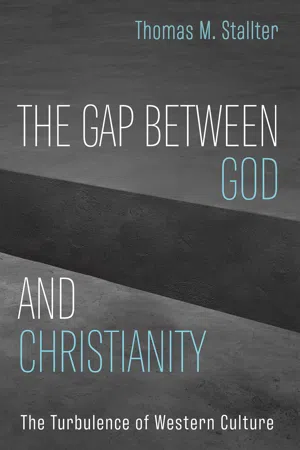
The Gap Between God and Christianity
The Turbulence of Western Culture
- 310 pages
- English
- ePUB (mobile friendly)
- Available on iOS & Android
eBook - ePub
About this book
What we fear most has ironically come upon us as Western individualists. We are being controlled by the invisible forces of culture and they have come between God and us. Silent but in the background of all we do and think, its influence cannot be overlooked. We condone and even encourage and champion the very things that create distance between our needs and God's goodness, between our plans and his destiny for us, between our weakness and his strength. We have been deceived. Not only have we created distance between us, but we seldom free God from these cultural and personal expectations and let him speak for himself. We have locked God into our system and, in the end, distracted by our needs for social and personal survival. We must turn our eyes toward him, open our ears to his voice, and let him speak.
Information
Topic
Theology & ReligionSubtopic
Christian MinistryChapter 1
Discovering the Power of Culture
Since we will be talking a great deal about culture, and most of my audience does not actually know what that is, we need to start with a basic framework for the concept. I will define culture and unpackage it in detail in chapter 4, but here let me give a simple definition that should suit our purposes at this point. Culture is a human system for survival full of values, beliefs, information, and intuitive understandings through which we view and interpret our experience in the world. It causes the resulting behavior in each particular social context to seem normal. What people do not realize is that most of the culture for any group of people is invisible. We see the behavior it causes and only occasionally interact, somewhat superficially, with the unseen levels though they are always at work to shape that behavior. This frame of reference is far more critical than we realize for life to make sense.
Let me illustrate culture at work in producing behavior. Everything begins with foundational understandings, or assumptions, about reality. These result in beliefs about what is true in light of this assumed reality. These beliefs generate values about what is good or bad to do, and these values result in choices of behavior that become normal in each culture but differ from culture to culture. We’ll use a generalization from Japanese culture. Many traditional Japanese understand and assume everyone else understands that the world is full of nature spirits called kami. This is the basis of Shinto. This understanding leads to a belief that these spirits must inhabit natural forms such as mountains or old trees, especially old ginkgo trees. When a kami lives in an old tree, that tree spirit is called a kodama. This belief generates a value on the importance of showing respect and even reverence for the kodama in old trees. This prevalent value results in behaviors considered normal for traditional Japanese, such as showing respect or bowing to old trees or avoiding them if one is in a hurry and cannot stop to pay homage.15
We usually list some twenty-five to thirty potential areas of difference between cultures. But when you consider the implications of these for many areas in life, some of them covering broad ranges of activity, we can easily count hundreds of such differences at work in a culture. Think of your own Western culture as different in nearly all of these areas of assumptions, beliefs, and values compared with non-Western cultures, including biblical cultures.16 And then, we must remember that similar behavior between two cultures does not mean similar values behind it, and similar values may not result in the same behavior. When we see some similarity between cultures, we generally assume too much. People crossing cultures need to be aware of the influence of these systems on the people of the host culture and their endeavors with them. But the most significant barrier is not the influence of their culture on the people we encounter; it is that of our own on us. It prevents us from gaining a valuable understanding of the host people in their situation.
In addition to this difficulty, many of us do not see a deviation from the expected values of our culture as necessary but try to keep them and what God gives us in the same system. We shall see that this is called syncretism, and it can influence all we do. So, for example, if Western Christians have syncretized their individualism or values on achievement with biblical truth, their message to the world is compromised whether they are working in their own culture or another. There is also the issue of local applications. These are legitimate applications in a specific culture and are necessary for all Christians. God’s revelation is absolute in every way, but within each culture, its application is relative to the meanings of behavior in that culture. To take the message from God to a second culture, we have to go back to what it meant to the original audience and take that message to our modern audience without adding to it the applications it has in our own culture. The host culture must then make their own applications of a verse like “husbands love your wives.”17 So, in effect, people of every culture have their own expression of Christianity. But, if we syncretize the Gospel with our own cultural values, letting them have free reign in our expression of Christianity, it is no longer the actual message God gave us. We have some serious work, some contextualization, to do in our own culture before we can offer the true message to another culture.
We can see the enormous obstacles we are up against if we do not consider the hidden influence of culture. But that may be just our problem. The difficulty we face as Americans is understanding that we have a culture and are under its subtle but persistent control. It is nearly inconceivable for us to think that there is an invisible force influencing our lives. We believe that we are in control of our own lives. That is the meaning of the word, individualist. We are each independent and make our own decisions. But it is not so. We do not notice our culture at work even though we see the world and understand our experiences through it. It is an interpretive grid that makes life make sense, a frame of reference for navigating our social, mental, and physical survival. As with a computer, this operating system in the background makes all the programs of our lives function “normally.” It gives us the expectations we need in day-to-day life. In chapter 4, we will go into detail concerning this influence of culture.
We are products of God’s providence. He has provided the way of salvation through Christ for us and the peace it gives us. But my own early experience and later observations of the church in the US, Europe, Central Africa, and South Korea reveal less of that peace than we would expect. The struggles of the early Corinthian church with cultural values and personal survival continue to invade the church. My study of this influence of culture over the years gives me a perspective that brings alarm to my nervous system. How often have we thwarted God’s purposes in our lives and ministries by allowing cultural values to trump his purposes? Though he provides contentment when we trust him, we continue to seek emotional and social survival through cultural channels. After all this time, after all the excellent teachers we have had in our lives, all the impressive books in our libraries, all the experiences of God’s grace, we still are not much farther along than we were at the beginning of the journey in this matter of understanding the powerful and insidious influence of our culture on our lives and faith. It is time we made progress. His providence controls our circumstances; we must allow loyalty to control our choices for him.
As I share my observations in this discussion with those in ministry, the struggle may begin with our theological attitudes. There are approaches to theology that overlook fundamental limitations brought to the task by insensitivity to the influence of self and culture on us and, therefore, our theology. In addition, care must be taken to avoid loyalty to one theologian without having an open mind to see what may be on the other side. Caution must be employed that loyalties to our theological group are not disguised as an attachment to the truth. Lastly, we need some theological modesty. C.S. Lewis reminds us, “One is sometimes (not often) glad not to be a great theologian; one might so easily mistake it for being a good Christian.”18 In addition to this danger, there is much we don’t know.
We need openness to consider some hidden but powerful and undesirable cultural influences in our approach to God’s Word, sensitivity in our approach to God himself, and some attention to the need for proper contextualization. Only with this humility at heart can we allow that God is beyond what our culture-driven, individualist, and informational efforts can establish on their own. We must begin by recognizing the one behind, and above, and in our human experience, at work in often imperceptible ways, yet often bounded in our perception by our limited, human, culture-shaped minds.
We cannot ignore this central issue. To misunderstand the role of culture in our task is to be off course. Our own cultural frame of reference cannot become a filter leaving out essential applications in the receptor culture. Nor can Western cultural absolutes be allowed to contaminate the message. It is time to loosen the grip of our culture on our perspectives of truth and help those in our ministries understand its powerful influence on us.
If we ignore the cultural frameworks of the biblical world, we will default to our own with little question as to their relevancy to the tasks of hermeneutics and theology. We ignore the acute relevance of the original culture in applying that biblical truth to everyday life, theirs and ours. From our modern cultural perspective, we end up trying to explain what God has and, even worse, what he has not given us to know. Our cultural predisposition is to resolve ambiguity. Being from an objective, low-context, informational, logic-bound culture, it bothers us deeply. Problems demand solutions; questions require answers. We must have a social context for these answers and solutions to work. Not knowing another, we use our own. In the passages where culture matters, this approach inevitably shapes our theological conclusions. Can we change our course?
Information about God can too commonly be an end in itself. We are often in love with our theology the way it is, and we can be very defensive of our system. But if we give no heed, we may lock God in the prison of human, cultural, and theological preferences that do not let him speak for himself. Our love affair may be spiritual adultery. In addition to overlooking culture in our theology, should not our pastoral ministries experts realize the effect of this influence on ministry to the culture-bound people of our day?
If we were fish, I would be asking that we take time to consider the water we are in and its effects on our outlook and projections of reality on the world outside the little ponds we have made for ourselves. The authors and actors of the biblical text were surrounded by a cultural atmosphere in the same way but in an entirely different body of water. To keep our analogy, it is as dissimilar as saltwater is from fresh. Only a few fish can swim in both. Our own culture is as ordinary to us as the water is to the fish. This sense of normality makes us feel like there are no real differences in other ponds, or at least none worth our attention to their details. Water is water. The word for this attitude is ethnocentrism. We allow the norms and values of our own pond to become our expectations of those in any other pond. If we extend these understandings, and we do, to the social situations of the biblical text, we cause distortion. Nothing could be more foreign to that context than twenty-first-century Western cultural expectations.
If information about God becomes an end in itself, the result is a church founded on information and local culture instead of on the true nature of God and the realities of his lordship in our lives within our cultures. A church based on the realities of who he is and his purposes in the world that speaks to today’s cultural values can transfor...
Table of contents
- Title Page
- Preface
- Acknowledgments
- List of Abbreviations
- Introduction
- Chapter 1: Discovering the Power of Culture
- Chapter 2: Western Values and Middle Eastern Texts
- Chapter 3: An Example of Our Culture at Work in Interpretation
- Chapter 4: Western Culture as a System for Survival
- Chapter 5: The Cultural Context of Language
- Chapter 6: The Intrusion of Culture in Knowing and Serving God
- Chapter 7: The Filter of Cultural Expectations
- Chapter 8: The Filter of Theological Systems
- Chapter 9: The Filter of Personal Needs
- Chapter 10: Culture and the Self
- Chapter 11: Culture and the Church
- Chapter 12: Enculturation and Conversion
- Chapter 13: The Battle with Syncretism, Legalism, and Mysticism
- Chapter 14: The Unchanging Need for Human Survival
- Chapter 15: The Words We Use
- Chapter 16: God’s Will and Culture’s Control in Our Lives
- Chapter 17: Wisdom from Above Is within Reach
- Chapter 18: Goodness, Providence, and Suffering
- Chapter 19: Closing the Gap, Letting God be God
- Glossary
- Appendix 1
- Appendix 2
- Bibliography
Trusted by 375,005 students
Access to over 1.5 million titles for a fair monthly price.
Study more efficiently using our study tools.
Frequently asked questions
Yes, you can cancel anytime from the Subscription tab in your account settings on the Perlego website. Your subscription will stay active until the end of your current billing period. Learn how to cancel your subscription
No, books cannot be downloaded as external files, such as PDFs, for use outside of Perlego. However, you can download books within the Perlego app for offline reading on mobile or tablet. Learn how to download books offline
Perlego offers two plans: Essential and Complete
- Essential is ideal for learners and professionals who enjoy exploring a wide range of subjects. Access the Essential Library with 800,000+ trusted titles and best-sellers across business, personal growth, and the humanities. Includes unlimited reading time and Standard Read Aloud voice.
- Complete: Perfect for advanced learners and researchers needing full, unrestricted access. Unlock 1.5M+ books across hundreds of subjects, including academic and specialized titles. The Complete Plan also includes advanced features like Premium Read Aloud and Research Assistant.
We are an online textbook subscription service, where you can get access to an entire online library for less than the price of a single book per month. With over 1.5 million books across 990+ topics, we’ve got you covered! Learn about our mission
Look out for the read-aloud symbol on your next book to see if you can listen to it. The read-aloud tool reads text aloud for you, highlighting the text as it is being read. You can pause it, speed it up and slow it down. Learn more about Read Aloud
Yes! You can use the Perlego app on both iOS and Android devices to read anytime, anywhere — even offline. Perfect for commutes or when you’re on the go.
Please note we cannot support devices running on iOS 13 and Android 7 or earlier. Learn more about using the app
Please note we cannot support devices running on iOS 13 and Android 7 or earlier. Learn more about using the app
Yes, you can access The Gap Between God and Christianity by Thomas M. Stallter in PDF and/or ePUB format, as well as other popular books in Theology & Religion & Christian Ministry. We have over 1.5 million books available in our catalogue for you to explore.