eBook - ePub
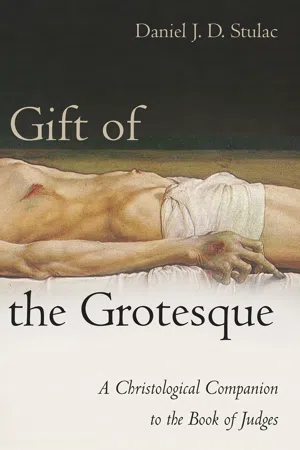
Gift of the Grotesque
A Christological Companion to the Book of Judges
- 140 pages
- English
- ePUB (mobile friendly)
- Available on iOS & Android
eBook - ePub
About this book
"No other book of the Bible is quite so R-rated. No other book is quite so ugly or grotesque. Judges offers its reader not a roster of angelic saints, but an astonishing tempest of brutality, feces, slaughter, assassinations, conspiracy, genocide, child sacrifice, rage, betrayal, mass graves, gang-rape, corpse mutilation, kidnapping, and civil war." Gift of the Grotesque offers readers a series of seven theological essays focused on one of the most confusing and challenging books in the biblical canon. Stulac's captivating style combines sensitive exegesis with broadly accessible meditations on culture, art, music, literature, memoir, theology, and spirituality. Better understood as a companion rather than a biblical commentary, this unusual resource will kickstart the theological imagination of anyone who struggles to understand how the book of Judges points forward to the life and work of Jesus Christ. Dare to follow an experienced biblical scholar into the heart of Israel's theological Dark Age, and you will encounter there the transformative Word of God in ways you do not expect. The prophetic book of Judges, writes Stulac, "wants to gut you like a fish, because on the far side of that unenviable prospect, it wants you alive like you've never lived before."
Information
Topic
Theology & ReligionSubtopic
Biblical Commentary1
House of Horrors
(Judges 1–2)
How does idolatry maintain its appeal? Generation after biblical generation seems to be taken in by those ubiquitous blocks of gilded wood, by stone statutes and clay figurines, by images, amulets, and ephods. Why are the people of God so chronically beguiled by a transparent farce? Can’t they see that when a person cuts down a tree, making an idol from one half while using the other half for fuel, the whole proposal on which idolatry rests devolves into sheer nonsense (Isa 44:9–20)? From a perspective anchored in the assumptions and prejudices of the modern West, it is easy—too easy (and too convenient, I think)—to imagine that ancient Israel was, for this reason, a culture of superstitious ingénues, a population of primitives little more enlightened than the cavemen caricatured in a Gary Larson cartoon.
The attraction to idolatry is not an intellectual one. It never was, it never is. After all, if pressed to apologize, the idolator can always invoke dissociation, claiming that the idol functions more like a religious icon, inhabited in some sense or merely inspired by the deity who stands behind it. No, it was never an intellectual attraction, and indeed Isaiah’s rhetoric on the subject should not be confused with modern skepticism, for its lyric poetry has more to do with an aesthetic celebration of God’s re-creational power than with experimentation and proof. In all their multitudinous forms, idols’ enduring attraction was and remains visceral, not intellectual. Idols appeal to the gut, to the appetites, to the affections. They satisfy the human longing for control, for safety, and for predictability in a bleeding world. They promise to alleviate our natural anxieties by making us masters of our own creativity. They put divinity into a person’s physical hands, right there in his or her grasp, just as an Apple’s ergonomic shape and pleasant heft suit the curve of one’s fingers. An idol fits in your pocket; you can wrap it up for lunch. You can manage an idol, trade an idol, engineer an idol, fashion an idol into the likeness of the thing that excites or troubles you most—and so reduce your creatureliness to a commodity bought and sold. One nibble wouldn’t hurt, would it? “For then you shall be like gods . . . .”1

In the Bible’s premodern imagination, Israel’s resurgent taste for idols does not amount to an isolated series of infractions against a list of arbitrary rules. Nor does idolatry constitute a matter of libertine defiance in response to God’s uptight and austere “no.” Rather, idolatry is always connected to the problem of place. It manifests Israel’s failure to receive and thus to inhabit the Land. Into the thick of this problem—the lived tension between dependence versus autonomy, receptivity versus selectivity, gift versus gargoyle—the reader of the book of Judges is thrown.
Idolatry is always connected to the problem of place. It manifests Israel’s failure to receive and thus to inhabit the Land.
That reader cannot be criticized too harshly if, upon concluding the book of Joshua, he or she assumes that the Israelites’ conquest of Canaan had been fit with a tidy bow, so that their possession of the Land was assured (Josh 11:23) if not quite an accomplished fact (Josh 13:1–6). True, indications to the contrary had popped up along the way—subtle, offhand comments suggesting that Israel always had and always would struggle in its divine commission: lo horishu “they did not dispossess . . .” (Josh 13:13); lo yakhelu lehorishu “they were not able to dispossess . . .” (Josh 17:12); mitrappim labo lareshet “lax in coming to dispossess . . .” (Josh 18:3). But such language always played second fiddle to the more robust theme of victory and that victory’s corresponding division of the spoils. The casual reader of Joshua may therefore imagine that, at book’s end, Israel has finally reached a position to actualize its destiny as Abram’s Promised Children in Abram’s Promised Land. The book of Judges, however, presents a less sanguine alternative. In three crucial ways, it picks up on the discordant note already present in Joshua—that lingering, background dissonance—and draws it forward onto center stage.
Judges’ first move disrupts the reader’s sense of time. As its point of orientation, the book asserts that Joshua son of Nun is already dead (“And it was, after the death of Joshua . . .”; Judg 1:1). It seems appropriate, therefore, that the biblical storyline should move on to catalogue the Israelites’ efforts to wrap up whatever loose ends their former leader may have left behind. But at the same moment that the text advances the biblical chronology, it also tosses its reader backwards into reruns. Just a few verses later, Joshua’s still-living partner in espionage, Caleb, offers his daughter Aksah to anyone who can capture the town of Kiriath Sepher, and so Caleb’s youngest brother, Othniel, takes up the challenge (Judg 1:12–13). Aksah then petitions her father for an additional water resource in the arid country that she and Othniel have apparently come to possess as a result of Othniel’s feat (Judg 1:14–15). Haven’t we seen this movie before? Indeed we have, in Josh 15:16–19, a text that matches Judg 1:12–15 almost to the letter. Why does the Bible retell such an odd vignette, and more to the point, why does the Bible suggest that the events it relates happened both before and after Joshua’s death? The modern mind, trained to submit itself to the strict authority of materialist cosmology, believes wholeheartedly in the inviolability of time’s arrow. What’s done is done. If Judges were a history/fiction of some kind, offering its reader a slice of the “real past,” then either it or the book of Joshua must contain an error on this point. The two books cannot both be true. But the premodern book of Judges is not a history/fiction; it is better conceptualized as liturgical scripture. Through free play with such literary impossibilities, it opens the reader’s imagination to paradox and to mystery, and in this case specifically, it makes a crucial, lateral move away from the book of Joshua even while proposing to follow Joshua in chronological sequence. In other words, Judges simultaneously embeds itself in the world of Joshua—the immanent and ongoing conquest of Canaan—and yet also begins again, after the death of Joshua, when a new generation had arisen who did not know God or the wonderful acts of power God had performed on Israel’s behalf (Judg 2:6–10). As a result, the first two chapters of Judges insist that their reader accept the following premise, grossly illogical though it may seem to rational historians: the problems that beset Israel in the book of Judges are problems that obtain in Joshua’s day, and yet should be blamed entirely on a later generation (Judg 2:11–23)!
But why? Why foist such a mind-splitting paradox on the hapless reader who merely wants to find out what happened next? The answer to this question lies in the narrative theology of the greater book. Judges concerns itself far less with accurate historical sequence (Israel’s “real past” in the modern sense) than it attempts to paint an iconographical portrait of a nation lost in the grip of idolatry. One may go kicking and screaming or one may adopt a martyr’s poise, but either way the book plunges its reader into a theological Dark Age, a world where calendars fail and civil wars flourish. “After the death of Joshua” (Judg 1:1)—and equally, before the death of Joshua—Israel wanders into a spiral maze, where left turn after left turn after left turn always takes God’s people back to the place where they began: the chronic despoliation of Promised Land. The book of Joshua, conversely, is marked by accomplishment and order. Israel arrives. It settles. It comes home at long last after suffering centuries of exilic slavery followed by an arduous journey through the desert. All that remains true. But the Bible also demands that Joshua’s truth cannot be understood apart from a second, more discomfiting memory that parallels what has come before: in the midst of triumph, Israel staggers into a cyclical void. Here the Israelites are home but never at peace, landed but somehow always landless, simultaneously the engineers and the victims of a world where nothing is learned and nothing is gained. That is, after all, the deep irony of forbidden fruit. It produces every outcome for which it is designed, not simply those that first attract the eater’s eye.
Judges concerns itself far less with accurate historical sequence . . . than it attempts to paint an iconographical portrait of a nation lost in the grip of idolatry.
Thus, in a second move closely related to the first, Judges’ opening chapters also destabilize the reader’s sense of success. Whereas in the book of Joshua Israel scores repeated victories, dispossessing the Canaanites and then distributing the Promised Land among the twelve tribes, the alternative plot preserved in Judges remembers much of the Land as having been retained under Canaanite control, still requiring the dispossession and distribution that the book of Joshua narrates. Judah and Simeon arrive first on the scene. They form an alliance, but the pair go to war in a manner disturbingly isolated from greater Israel. Where are the Ephraimites, the Asherites, the Zebulunites, and the Danites? Where are the Reubenites and Gadites, who had promised to finish the conquest of Canaan alongside their siblings before returning to their families on the far side of the Jordan? Striking out on their own, Judah and Simeon pursue a more provincial conquest, one of limited scope and smaller ambition, apart from the collective strength of God’s people. Initially, outcomes are positive. Numerous Canaanite towns capitulate—even Gaza, Ashkelon, and Ekron of the Philistines (Judg 1:18). But then resounds a familiar dissonance, like a C-sharp played on top of a C, discord picked up from Josh 13:13 and thrust once more into the listener’s ears: lo horishu. As it turns out, Judah does not possess the whole of its territory (Judg 1:19). From this point forward, the language of failure, not victory, will define the Israelite experience in the book of Judges. Occasional high notes resurface, of course—glorious victories under Deborah, Gideon, and Samson (among others), those larger-than-life “heroes” of the Old Testament in the days before the kings. But always these triumphs will become subject to the unraveling and dismemberment of the Israelite ideal. Lo horishu, lo horishu, lo horishu. Like an ironic military drum, Judges begins to beat its refrain: lo horishu, lo horishu, lo horishu. They did not possess, they did not possess, they did not possess . . . Judah fails, Benjamin fails, Manasseh fails, Ephraim fails, Zebulun fails, Asher fails, Naphtali fails, Dan fails (Judg 1:21–36). God’s promise to Abram winds up a dead end, a half-paved cul-de-s...
Table of contents
- Title Page
- Author’s Note
- Prelude
- Chapter 1: House of Horrors
- Chapter 2: A Double-Mouthed Sword
- Chapter 3: Victory
- Chapter 4: Strange Math
- Chapter 5: Beyond Calculation
- Chapter 6: Broken Light
- Chapter 7: On the Stable Floor
- Postlude
- Further Reading
Trusted by 375,005 students
Access to over 1.5 million titles for a fair monthly price.
Study more efficiently using our study tools.
Frequently asked questions
Yes, you can cancel anytime from the Subscription tab in your account settings on the Perlego website. Your subscription will stay active until the end of your current billing period. Learn how to cancel your subscription
No, books cannot be downloaded as external files, such as PDFs, for use outside of Perlego. However, you can download books within the Perlego app for offline reading on mobile or tablet. Learn how to download books offline
Perlego offers two plans: Essential and Complete
- Essential is ideal for learners and professionals who enjoy exploring a wide range of subjects. Access the Essential Library with 800,000+ trusted titles and best-sellers across business, personal growth, and the humanities. Includes unlimited reading time and Standard Read Aloud voice.
- Complete: Perfect for advanced learners and researchers needing full, unrestricted access. Unlock 1.5M+ books across hundreds of subjects, including academic and specialized titles. The Complete Plan also includes advanced features like Premium Read Aloud and Research Assistant.
We are an online textbook subscription service, where you can get access to an entire online library for less than the price of a single book per month. With over 1.5 million books across 990+ topics, we’ve got you covered! Learn about our mission
Look out for the read-aloud symbol on your next book to see if you can listen to it. The read-aloud tool reads text aloud for you, highlighting the text as it is being read. You can pause it, speed it up and slow it down. Learn more about Read Aloud
Yes! You can use the Perlego app on both iOS and Android devices to read anytime, anywhere — even offline. Perfect for commutes or when you’re on the go.
Please note we cannot support devices running on iOS 13 and Android 7 or earlier. Learn more about using the app
Please note we cannot support devices running on iOS 13 and Android 7 or earlier. Learn more about using the app
Yes, you can access Gift of the Grotesque by Daniel J. D. Stulac in PDF and/or ePUB format, as well as other popular books in Theology & Religion & Biblical Commentary. We have over 1.5 million books available in our catalogue for you to explore.